In summer 2026, Idecaf’s children’s musical “Ngày xửa ngày xưa” (“Once Upon a Time”) was performed 40 times, and every show sold more than 900 tickets — about 37,000 in all. Families came three generations at a time: parents who had watched these shows as children some twenty years earlier brought their own kids, and audiences from distant provinces chartered buses to come into the city for the show. “Đây là kết quả vượt ngoài sự mong đợi của chúng tôi” — “This result went beyond our expectations,” the theater’s manager, Trầm Thanh Thảo, told the newspaper Tuổi Trẻ (Tuổi Trẻ, August 1, 2026; SGGP, May 29, 2026).
The theater’s name isn’t Vietnamese at all. IDECAF is a French acronym — the Institut d’Échanges Culturels avec la France, the Institute for Cultural Exchange with France — and since 1997 producer Huỳnh Anh Tuấn’s private drama company has played in its hall. The sign out front carries a French name; on stage you get Vietnamese fairy tales, the scholar-statesman Nguyễn Trãi, the general Lê Văn Duyệt and “The Tale of Kiều.” And under the hall lie a century and a half of Saigon history. According to research by the historian Tim Doling, in 1859 French forces threw up a makeshift earthen fortification near today’s junction of Thái Văn Lung and Lê Thánh Tôn streets; later the site housed the navy’s health service, and after that the modernist building of a French cultural center.
At a glance
A private theater in a French institute’s hall
Nhà hát kịch Idecaf is a private drama theater. It is owned by Công ty TNHH Sân khấu – Nghệ thuật Thái Dương (Thái Dương Stage and Art Co., Ltd.; thái dương means “sun”), which director Huỳnh Anh Tuấn and actor Thành Lộc founded in April 2000 (Vietnamese Wikipedia). In 2012 Vietnam News reported that Idecaf received no financial assistance from the State and ran on private investment, under the “socialisation model” (xã hội hóa) that the State had introduced to bring non-state money into the theater. The same paper calls Idecaf one of the leading private troupes in southern Vietnam; in 2022 the company had 30 professional artists, not counting its backstage crews (Vietnam News, 2012, 2022, 2025).
The theater took its name from the building. In 1997 Huỳnh Anh Tuấn rented the hall of IDECAF — Viện Trao đổi Văn hóa với Pháp, the Institute for Cultural Exchange with France — and gave his drama stage the same name (VnExpress, 2022). The hall still belongs to the institute; the theater rents it. Until September 2023 the company was called Sân khấu kịch Idecaf (“Idecaf Drama Stage”); after that it became Nhà hát kịch Idecaf (“Idecaf Drama Theatre”), and the new name was announced on September 25 (Tuổi Trẻ, September 25, 2023).
The company plays comedies, dramas, historical plays and musicals, and its children’s program also takes in cải lương (the musical drama of southern Vietnam) and hát bội (classical Vietnamese drama) (Vietnam News, 2022, 2025). The sheer volume of work shows in an overview on the theater’s website, written as of the end of 2016: over twenty years, more than 100 productions for adults, 30 puppet shows for children, 29 editions of the children’s musical “Ngày xửa ngày xưa” and the TV program “Chuyện ngày xưa” (“Tales of Long Ago”), made with the city television station HTV — and, all told, “Hơn 20 năm hoạt động, Idecaf đã đạt 5.000 suất diễn” (“in more than 20 years of work, Idecaf has reached 5,000 performances”).
What it’s known for
- A children’s musical that generations have grown up with. “Ngày xửa ngày xưa” has been running since 2000, and by 2026 there had been 37 editions (Vietnamese Wikipedia; Tuổi Trẻ, 2026). For many people in Saigon it is a childhood memory: those who saw the shows as kids now bring their own children (SGGP; Tiền Phong, 2026).
- Series records. The 33rd edition was performed 55 times in 2022–2023, and the 34th 62 times in 2023: Tuổi Trẻ called that a record for the series in its 23 years (Tuổi Trẻ, 2023). In summer 2026 about 37,000 tickets were sold for the 37th edition (Tuổi Trẻ, 2026).
- In a school textbook. An excerpt from the 33rd edition was included in the textbook “Tiếng Việt lớp 5, tập 2” (“Vietnamese Language, Grade 5, Part 2”) (Tuổi Trẻ, 2023, 2024).
- A stage show on the big screen. From July 17, 2026, a recording of the 36th edition played in Lotte Cinema theaters across the country — the first production of the series to get a commercial cinema release (Tiền Phong; SGGP, 2026).
- “Cậu Đồng” (cậu đồng is what folk belief calls a male spirit medium) — an adaptation of Molière’s “Tartuffe,” first staged, according to SGGP, in 1997, and performed more than 250 times since (SGGP, 2020).
- Awards. The Mai Vàng (“Golden Apricot Blossom”) award for play of the year went to “Quyền lực và tình yêu” (“Power and Love,” 2011), “Vua thánh triều Lê” (“The Saint King of the Lê Dynasty,” 2012), “Bông hồng cài áo” (“A Rose Pinned to the Shirt,” 2013) and the musical “Tiên Nga” (2018) (Vietnamese Wikipedia). “Tiên Nga” also took first prize in the theater category of the city’s Literature and Arts Awards (more under “Modern history”).
Plan your visit
Where it is and how to get there
The theater’s address is 28 Lê Thánh Tôn, Sài Gòn Ward (phường Sài Gòn; a phường is an urban ward): that is how Báo Văn hóa (2025) and SGGP (2026) give it after the administrative reform of July 1, 2025. The theater’s own website still shows the old form, “28 Lê Thánh Tôn Q.1,” that is, District 1 (Quận 1). This is the heart of the city: the Opera House is a five-minute walk away (see “What to see nearby”).
The theater and the institute make up one complex with two addresses. IDECAF itself gives its address as “31 Thái Văn Lung, phường Sài Gòn” (idecaf.gov.vn, 2026). On OpenStreetMap the institute’s plot occupies a corner of the block: its south side faces Lê Thánh Tôn Street and its east side Thái Văn Lung Street. That the theater’s entrance is on the Lê Thánh Tôn side is our own inference from the map: OpenStreetMap has no building numbered 28.
Distances are our own measurements along OpenStreetMap routes (OSRM), taken on November 9, 2026, from the Lê Thánh Tôn side of the plot; driving times assume no traffic, so allow more at rush hour.
| To | On foot | By car |
|---|---|---|
| Bến Thành Market — the city center | ≈1.0 km (0.6 mi) / 13 min | ≈1.0 km (0.6 mi) / 2 min |
| Saigon Railway Station (Ga Sài Gòn) | ≈4.0 km (2.5 mi) | ≈4.2 km (2.6 mi) / 6 min |
| Tân Sơn Nhất Airport | — | ≈7.4 km (4.6 mi) / 10 min |
What’s on and when
Where the company plays. The theater has two regular venues. Its main stage, at 28 Lê Thánh Tôn, hosts evening shows for adults — comedies and dramas. The children’s musical “Ngày xửa ngày xưa” and the big productions go on at the Bến Thành Theatre (Nhà hát Bến Thành), 6 Mạc Đĩnh Chi, which has a large hall (VnExpress, 2022; Vietnam News, 2026). Each show’s announcement names the venue. In fall 2026 some Idecaf productions also play on the stage of the city’s Children’s House (Nhà Thiếu nhi TP.HCM), where the sister Youth Drama Theater has been performing since April (see “Modern history”): according to the weekly bills on the website, “Lệ Chi viên” was staged there on November 14 and “Dưới bóng giai nhân” on November 21 (kichidecaf.com, 2026).
The fall 2026 repertoire. On November 9, 2026, the theater’s home page listed twelve productions (its “Vở diễn” — “Productions” — section has more: 27 titles over three pages, past seasons included):
- comedies: “Hồn ai nấy giữ” (“To Each His Own Soul”), “Mẹ tôi là đàn ông” (“My Mom Is a Man”), “Làng vô tặc” (“The Village Without Thieves”), “Quạ hồng tung cánh” (“The Pink Crow Spreads Its Wings”), “Cái gì vui vẻ thì mình ưu tiên” (“Whatever’s Fun Comes First”), “Tía ơi má dìa!” (“Dad, Mom’s Home!”), “12 bà mụ” (“The Twelve Midwives”) and “Lương Sơn Bá Chúc Anh Đài ngoại truyện” (“Liang Shanbo and Zhu Yingtai: Another Story,” after the hero and heroine of the Chinese legend of the two lovers);
- historical and literary dramas: “Đức thượng công Tả quân Lê Văn Duyệt” (“His Excellency Lê Văn Duyệt, Commander of the Left Army”), “Lệ Chi viên” (“The Lychee Garden”) and “Dưới bóng giai nhân” (“In the Shadow of a Beauty”), based on “The Tale of Kiều”;
- the children’s musical: the 37th edition of “Ngày xửa ngày xưa,” “Học viện phép thuật” (“The Academy of Magic”).
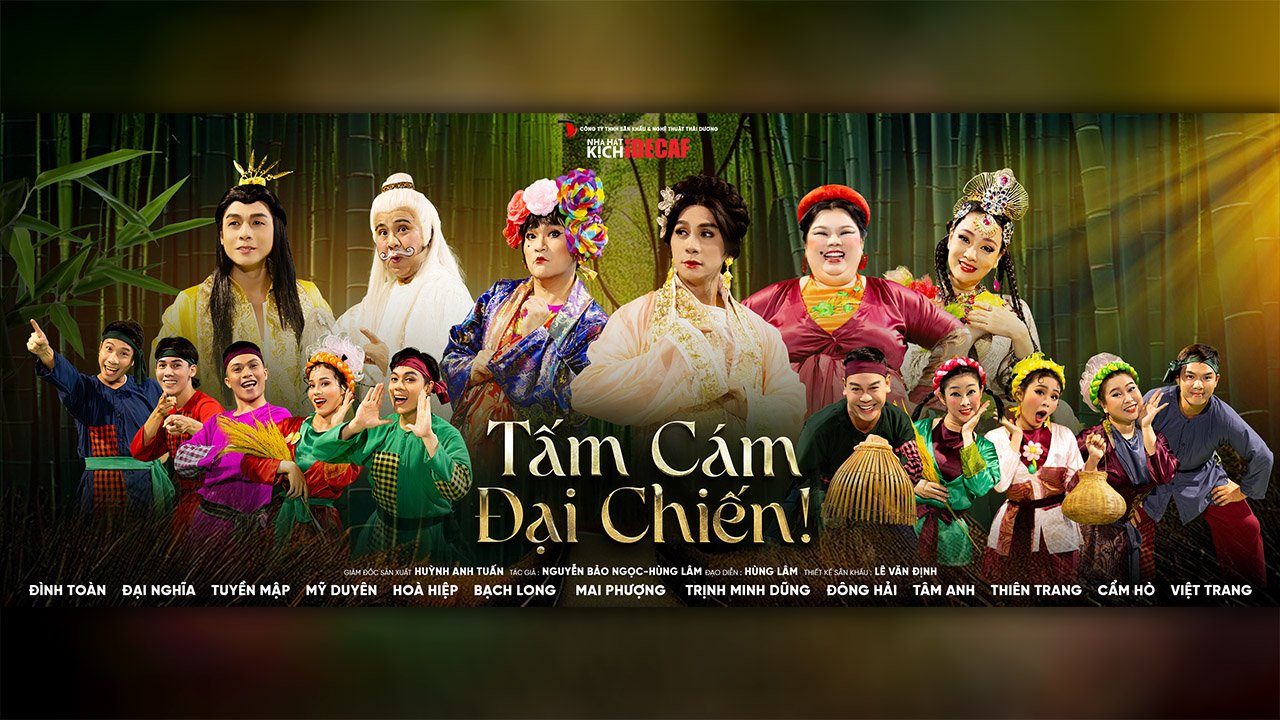
There is no date-by-date schedule on the website: its “Lịch diễn” (“Schedule”) section is empty. Dates appear in sales announcements and in weekly bills that the site posts as images. Tickets for the November 19–21, 2026, performances, for example, went on sale at 10:00 on November 8, online on Ticketbox, and the bill for those days reads: November 19 — “Tấm Cám đại chiến” (“The Great Battle of Tấm and Cám”), November 20 — “Một ngày làm vua” (“King for a Day”), November 21 — “Dưới bóng giai nhân” at the Children’s House stage; all at 19:30 (kichidecaf.com, bill uploaded November 8, viewed November 13, 2026). A week earlier, on November 12–15, the bill listed “Tấm Cám đại chiến” (the 12th), “Hồn ai nấy giữ” (the 13th) and “Lệ Chi viên” (the 14th, at the Children’s House stage), all at 19:30, and “Mẹ tôi là đàn ông” at 18:00 on Sunday, the 15th (kichidecaf.com, bill uploaded November 8, viewed November 15, 2026). For “Dưới bóng giai nhân,” see “What to see.”
A premiere in the works. The theater is preparing a historical drama, “Hùng khí triều Trần – Hưng Đạo đại vương Trần Quốc Tuấn” (“The Heroic Spirit of the Trần Dynasty: Grand Prince Hưng Đạo, Trần Quốc Tuấn”). Quang Thảo is both writer and director, the cast numbers more than 70, and the role of Trần Thủ Độ goes to a guest, People’s Artist Việt Anh (NSND — Nghệ sĩ Nhân dân, Vietnam’s highest honorary title for performers). As of October 6, 2026, the premiere was planned for late November (Tuổi Trẻ, October 6, 2026); by mid-October Việt Anh was already rehearsing, and on October 21 VnExpress wrote that the play would open in Ho Chi Minh City “vào cuối năm” — “at the end of the year” (VnExpress, October 21, 2026). Our sources give no exact date or venue.
The theater year.
- Tết (the Lunar New Year). A holiday season with a special bill: for Tết 2026, from the 1st to the 13th day of the first lunar month, the theater played eight productions, from comedies to the historical drama about Lê Văn Duyệt (Báo Văn hóa, February 27, 2026).
- Summer. A new edition of “Ngày xửa ngày xưa” at the Bến Thành Theatre: in 2026 it premiered on May 31 and ran until August 2 (Tuổi Trẻ, 2026).
- The Mid-Autumn Festival (Trung thu). Extra children’s shows: in 2026, six performances of the 37th edition on September 25–27 at the Bến Thành — on the 25th at 20:00, on the 26th at 16:00 and 20:00, and on the 27th at 09:30, 16:00 and 20:00 (Tuổi Trẻ, September 24, 2026).
Showtimes, tickets and practical tips
| Venues | main stage — 28 Lê Thánh Tôn, Sài Gòn Ward (comedies and dramas); the children’s musical and big productions — Bến Thành Theatre, 6 Mạc Đĩnh Chi; each show’s announcement names the venue |
| Showtimes | as scheduled; at 28 Lê Thánh Tôn, evenings at 19:30 (as of 2025); on the website’s weekly bills for November 2026, shows started at 19:30, and on Sunday, November 15, at 18:00; the children’s musical at the Bến Thành plays mornings, afternoons and evenings: in September 2026 at 09:30, 16:00 and 20:00 |
| Tickets | online through Ticketbox; the theater’s website, kichidecaf.com, announces when sales open, and its “buy” link leads to a search for Idecaf shows on Ticketbox; each production has its own price, and prices change |
| Box office | phone (028) 3823 9968, email [email protected] (theater website); ticket sales hours 08:30–11:30 and 14:00–20:30 — as given in the description of the website’s home page (still there on November 14, 2026; it is undated, so call ahead); the website’s weekly bills for November 2026 also list 0963 40 38 40 |
| Schedule | the website’s “Lịch diễn” (“Schedule”) section is empty; dates are in announcements on the website and on Ticketbox; the theater also has a Facebook page — facebook.com/skidecaf |
| Language | all performances are in Vietnamese; sources say nothing about subtitles or translation |
| Children | our sources give no rules on age or on tickets for children — ask the box office |
| The hall | 286 seats on a single level — orchestra seating, no balcony (seating plan on the theater’s website) |
Prices and hours change — check before you go.
How to get tickets in time. For the hits, tickets are gone in minutes. For the 35th edition of “Ngày xửa ngày xưa,” more than 10,000 tickets sold on Ticketbox in 15 minutes (Vietnam News, 2024). For “Đảo hoa hậu” (“Beauty Queen Island”), a show by the sister company, sales in spring 2026 opened at 14:00, the Ticketbox “phòng chờ” (“waiting room”) at 13:45, and about 3,000 tickets were gone in 10 minutes (Tuổi Trẻ, March 20, 2026). Tip: keep an eye out for sales announcements well ahead of time. In 2023 the theater warned audiences about scalpers and ticket fraud (Tuổi Trẻ, May 5, 2023), so the safe option is to buy on Ticketbox through the link on the theater’s website.
Parking. The IDECAF institute mentions a “Bãi giữ xe rộng và đáng tin cậy” (“a spacious and reliable parking area”) on its grounds (idecaf.gov.vn); to find out whether theatergoers may leave a motorbike or car there, ask the box office at (028) 3823 9968.
What to see nearby
Distances are our own measurements along OpenStreetMap routes (OSRM), taken on November 9, 2026, from the building on Lê Thánh Tôn Street, on foot.
- Saigon Opera House (Municipal Theatre) (≈380 m, about 0.2 mi / 5 min) — the Saigon Opera House, the theater’s nearest neighbor on the city’s stage scene.
- Mê Linh Square — Trần Hưng Đạo Monument (≈600 m, about 0.4 mi / 8 min) — a monument to the very commander who is the hero of Idecaf’s new historical drama.
- Ho Chi Minh City Book Street (Nguyễn Văn Bình) (≈620 m, about 0.4 mi / 8 min) — where, on August 25, 2024, Idecaf’s actors met readers of the comic book based on “Ngày xửa ngày xưa.”
- Bạch Đằng Wharf (≈660 m, about 0.4 mi / 9 min) — until the early 2000s, Thái Văn Lung Street, which the institute faces, also ran down to the river; then hotels cut it off from the waterfront (per Tim Doling).
- Saigon Central Post Office (≈720 m, about 0.4 mi / 10 min).
- Notre-Dame Cathedral Basilica of Saigon (Nhà thờ Đức Bà) (≈800 m, about 0.5 mi / 11 min).
- Museum of Ho Chi Minh City (≈980 m, about 0.6 mi / 13 min).
- Bến Thành Theatre (≈1.2 km, about 0.7 mi / 16 min) — Idecaf’s second venue, home of the children’s musical and the big productions.
- Rồng Vàng Water Puppet Theatre — a stage run by the same Thái Dương company.
- Bến Thành Market — the city center (for the distance, see “Where it is and how to get there”).
The Idecaf Drama Theatre is part of our guide to Ho Chi Minh City.
What to see
The 286-seat hall
The auditorium (khán phòng) belongs to the IDECAF institute. According to the institute’s website, it covers 200 m² (about 2,150 sq ft) and has 286 seats, modern lighting and sound suited to a range of genres — drama, concerts, conferences, film — plus a projector, a large screen, air conditioning and Wi-Fi; the institute also rents the hall out for events (idecaf.gov.vn).
The theater’s website has a seating plan. The hall is a single orchestra level with no balcony: 17 rows, A through Q, with a center aisle; two exits at the sides, halfway down the hall, and the entrance at the center of the back. We counted the seats on the plan: 14 in row A, 16 each in rows B, D, F, H, J, L, N and P, and 18 each in rows C, E, G, I, K, M, O and Q — 286 in all, exactly the institute’s figure. Twenty-seven seats on the plan are marked with the letter “S”; the plan doesn’t explain what the mark means.
The press sometimes gives a different number. In 2022 VnExpress wrote that the hall holds about 330 people and that there are more people wanting to come than there are seats. The official figure is 286.
The hall is older than the theater. A French archive lists a theater hall (salle de spectacle) among the institute’s facilities at the end of the 1990s, alongside an exhibition hall and a library (French Foreign Ministry archives). In 2018, after an 11-year gap, IDECAF and the Institut français du Vietnam (IFV, the French Institute in Vietnam) signed a cooperation agreement for 2018–2020, and it included upgrading the hall’s audiovisual equipment (SGGP, 2018).
The IDECAF courtyard, exhibitions and media library
The theater is just one part of the complex. The institute has an open garden courtyard with shade trees (“Sân vườn – không gian xanh,” “Garden courtyard — green space”), used for exhibitions and extracurricular activities; an exhibition hall; conference rooms and classrooms; and a French-language multimedia library, open to holders of a library card (idecaf.gov.vn).
The institute screens French films — its website has a “Phim/Cinéma” (“Film”) section. In 2018, according to Tuổi Trẻ, films were shown every Saturday at 15:00 with Vietnamese subtitles; the most recent screenings listed in that section date from 2022, on Saturdays, mostly at 16:00, so check the institute’s website for upcoming showings. It also hosts Francophonie evenings: on March 20, 2025, from 18:00 to 20:00, the institute opened its “Không gian Pháp ngữ” (“Francophone Space”) and held the “Đêm hội Pháp ngữ 2025” (“Francophonie Night 2025”); there is also a contest for songs in French (idecaf.gov.vn).
Exhibitions come and go. In October 2026 the garden courtyard hosted a photo exhibition about Thị Nại Lagoon, “Giữa dòng hợp lưu” (“Amid the Confluence”), which ran until November 1, while the exhibition hall showed “Regards partagés sur les paysages du Vietnam – Thiên nhiên Việt Nam từ những cái nhìn” (“Shared Views of Vietnam’s Landscapes – Vietnam’s Nature as Seen by Different Eyes”) by Manoël Pillard and Hà Nguyễn until October 17, organized together with the Ho Chi Minh City Vietnam–France Friendship Association (Tuổi Trẻ, October 10 and 17, 2026). To find out what’s on now, it’s best to check with the institute: (028) 3829 5451 or (028) 3829 1424 (idecaf.gov.vn).
“Ngày xửa ngày xưa”: the children’s musical
“Ngày xửa ngày xưa” (“Once Upon a Time”) is not a single show but a series: every summer brings a new edition, with a new fairy tale, new costumes and new sets. The stories come from the fairy tales, legends and books of many countries. There have been Vietnamese ones — the fairy tale “Tấm Cám” (about the sisters Tấm and Cám, with which the series began in 2000), the legend “Sơn Tinh Thủy Tinh” (“The Mountain Spirit and the Water Spirit”), the book “Dế mèn phiêu lưu ký” (“Diary of a Cricket”) — and, alongside them, “Aladdin,” “Snow White” and “Sinbad” (Vietnamese Wikipedia). The 34th edition, “Nàng công chúa và chiếc áo tầm gai” (“The Princess and the Nettle Shirt”), was based on Hans Christian Andersen’s “The Wild Swans” and was also the series’ first venture into the culture of Central America (Tuổi Trẻ, 2023); the 36th, “Hậu duệ Thần Mặt Trời” (“Descendants of the Sun God”), drew on Korean mythology, complete with dokkaebi goblins (Báo Văn hóa, 2025; Tiền Phong, 2026). The genre is the musical: songs, dances, costumes and, in the children’s program, elements of cải lương and hát bội as well (Vietnam News, 2022, 2025).
The 2026 edition. The 37th edition, “Học viện phép thuật” (“The Academy of Magic”), was written by Quang Thảo and directed by Đình Toàn (kichidecaf.com; Tuổi Trẻ, 2026). This time, Huỳnh Anh Tuấn said, the familiar “princess and prince” motif gave way to modern elements (SGGP, May 29, 2026): the story is set in an academy of magic, and its hero is the Ghost Doll (Búp Bê Ma quái), scary to look at but kind at heart, played by Đình Toàn himself (kichidecaf.com; Vietnam News, May 27, 2026). Tuổi Trẻ wrote that the story was inspired by “Harry Potter.” The show uses laser projections, and the actors learned magic tricks and circus acts for their roles: Tuyền Mập makes a table fly, Cẩm Hò and Đình Toàn perform on aerial straps, and Hồng Ánh and Đại Nghĩa play a pair of opponents, Cocola and Gato (Tuổi Trẻ, May 14, 2026).
Who’s in the audience. According to Tuổi Trẻ (2023), some fans started coming to “Ngày xửa ngày xưa” at the age of three or four and are still coming in their twenties; more than half the audience are teenagers who grew up with the program. The villains were usually played by Thành Lộc and Hữu Châu — and children still begged their parents to take them to see those actors. Huỳnh Anh Tuấn, the theater’s director, admitted that he comes to every performance… to watch the audience, and in 2022 he was surprised to find that most of the people at a children’s show were teenagers:
“Hóa ra 25 năm duy trì kịch thiếu nhi đã nuôi dưỡng cho chúng tôi lớp khán giả trẻ hôm nay.” “It turns out that 25 years of keeping children’s theater going have raised today’s young audience for us.” Huỳnh Anh Tuấn — Tuổi Trẻ, September 4, 2022
The eternal princess. Audiences long ago made the princess role the property of Meritorious Artist (NSƯT — Nghệ sĩ Ưu tú, a state honorary title one rank below People’s Artist) Mỹ Duyên, whom generations of children remember (Tuổi Trẻ, May 4, 2026). For the 34th edition (2023), writer Quang Thảo and director Đình Toàn planned something “mang tính… lịch sử” (“historic”) — giving her the role of a fairy instead. But the princess in that play had silent scenes in which she weaves shirts to turn her brothers, the princes, back into humans; those scenes had to be danced, and dance is Mỹ Duyên’s forte, so the role stayed hers. Tuổi Trẻ called her “công chúa trọn đời” — a “princess for life” (Tuổi Trẻ, August 26, 2024).
The adult repertoire
On its main stage at 28 Lê Thánh Tôn, Idecaf mostly plays comedies, often built on a familiar story: a classic play, a fairy tale, a legend.
“Hồn ai nấy giữ” (“To Each His Own Soul”; premiered September 28, 2025). A father and daughter drink a strange wine and swap souls (Báo Văn hóa, 2025). The theater’s website calls the play a comedy based on the classic story “Hồn Trương Ba, da hàng thịt” (“Trương Ba’s Soul in the Butcher’s Skin”). It was written by Trần Đăng Nhân and directed by Nguyễn Hùng Lâm, with sets by Lê Văn Định and choreography by Huỳnh Trung; the cast includes Đại Nghĩa, Hồng Ánh, Đình Toàn and Quốc Thịnh (Báo Văn hóa, 2025; kichidecaf.com).
“Quạ hồng tung cánh” (“The Pink Crow Spreads Its Wings”) — a satire on the fairy tale about a magic bird that carries the hero off to a hoard of gold (“Ăn khế trả vàng,” “Eat a Star Fruit, Pay in Gold”). Six actors play three or four roles each (kichidecaf.com).
“12 bà mụ” (“The Twelve Midwives”). A 2003 comedy, revived in 2007, 2013, 2022 and 2024; in 2022 it opened the theater’s second stage (Vietnamese Wikipedia; Tuổi Trẻ, 2022).
The second strand is historical and literary drama. In 2026 the theater’s artistic director, Đình Toàn, singled out three major historical and literary productions of Idecaf: “Người mang 9 án tử” (“The Man with Nine Death Sentences”), “Lệ Chi viên” and “Dưới bóng giai nhân” (Tuổi Trẻ, October 6, 2026).
“Đức thượng công Tả quân Lê Văn Duyệt – Người mang 9 án tử” (“His Excellency Lê Văn Duyệt, Commander of the Left Army: The Man with Nine Death Sentences”). The play is by Phạm Văn Quý and the director is Hoàng Duẩn; the cast includes Đình Toàn, Đại Nghĩa, Quang Thảo, Hoàng Trinh, Mỹ Duyên, Quốc Thịnh and others, together with performers from the children’s theater “Nụ Cười” (“Smile”) (kichidecaf.com). The action opens in 1820 in Gia Định, the old name of the Saigon region: Lê Văn Duyệt, hiding his identity, gathers evidence among the common people against Huỳnh Công Lý, a greedy deputy governor and father of the emperor’s favorite consort, Huệ Phi, and brings him to justice. Đình Toàn plays Lê Văn Duyệt, Đại Nghĩa plays Huỳnh Công Lý, Quang Thảo is Emperor Minh Mạng and Mỹ Duyên is Huệ Phi (SGGP, July 9, 2024). The production’s own story is told under “Modern history.”
“Lệ Chi viên” (“The Lychee Garden,” 2025) is a new version of the historical drama “Bí mật vườn Lệ Chi” (“The Secret of the Lychee Garden”), which Idecaf first staged in 2000 — a drama about the unjust execution of Nguyễn Trãi (Vietnam News, 2022). The original play is by Hoàng Hữu Đản; the new version was written and directed by Quang Thảo, who also plays Nguyễn Trãi, the role once played by Hữu Châu. Thanh Thủy has kept the role of Nguyễn Thị Anh. Đại Nghĩa, who sang in the chorus of this production twenty years ago, now plays the eunuch Tạ Thanh; Hồng Ánh, who in 2007 stood in for the actress Tú Trinh as Nguyễn Thị Lộ, now plays Ngô Thị Ngọc Dao; and Đình Toàn plays two kings, Lê Thái Tông and Lê Thánh Tông. For authenticity, the company traveled to the Lệ Chi Viên memorial site in Bắc Ninh Province and to Huế to study costumes and headdresses (Tuổi Trẻ review, reprinted on the theater’s website). In the play, Nguyễn Trãi tells Nguyễn Thị Anh:
“Một ngai vàng dựng lên bằng máu không tránh khỏi sẽ sụp đổ trong máu!” “A throne raised on blood cannot escape collapsing in blood!” Nguyễn Trãi’s line in “Lệ Chi viên,” as quoted in Tuổi Trẻ’s review, 2025
“Dưới bóng giai nhân” (“In the Shadow of a Beauty,” 2024) is a serious drama based on Nguyễn Du’s “Truyện Kiều” (“The Tale of Kiều”), Vietnam’s classic novel in verse. Quang Thảo wrote and directed it; it has more than 50 actors and more than 200 costumes made especially for the production, and it features chầu văn (ritual temple singing) and ngâm Kiều (the chanted recitation of “The Tale of Kiều”). Hồng Ánh plays Kiều, Thanh Thủy plays Hoạn Thư and Đại Nghĩa plays Từ Hải. It premiered on December 1, 2024, at the Bến Thành Theatre; according to Huỳnh Anh Tuấn, Idecaf had not invested on this scale since the musical “Tiên Nga” (Báo Văn hóa, October 31, 2024).
Legends and lore
“Hand over a duck!”: a backstage custom
“Ngày xửa ngày xưa” has a folklore of its own, and its main character is a duck. Since the 30th edition, “Hoàng tử, công chúa và 9 vị thần… bị bắt” (“The Prince, the Princess and the Nine Gods… Captured,” 2017), the company has had a penalty rule:
“Cứ hễ diễn viên nào ra diễn phạm lỗi quên lời, diễn sai là bị bắt nộp phạt cho cả đoàn một con vịt.” “Whenever an actor goes on stage and slips up — forgets a line or gets the acting wrong — they’re made to pay the whole company a fine of one duck.” Tuổi Trẻ, November 24, 2023, citing the “Ngày xửa ngày xưa” fan club
Missing an entrance gets you fined too. The duck, according to Tuổi Trẻ, has become the program’s “linh vật huyền thoại” — its “legendary mascot.” Audiences know the custom so well that when they spot a slip, they shout from their seats: “Nộp một con vịt” — “Hand over a duck!” In 2024 the crew jokingly “voted” Thanh Thủy (Cố Cố in that edition) the champion of fines, the fans put Mỹ Duyên in the top three as well, and Đại Nghĩa posted: “Tui thấy zịt bay rợp trời!” — “I see ducks blotting out the sky!” (tui and zịt are southern colloquial for “I” and “duck”). These days the “fine” can also be a pineapple, drinks, chicken curry or beef jerky, and Đại Nghĩa, a vegetarian, pays up in vegetarian rolls — which is why, the paper jokes, nobody ever goes hungry backstage at “Ngày xửa ngày xưa” (Tuổi Trẻ, November 24, 2023, and May 9, 2024).
The fans keep a chronicle of their own, too. The fan club has compiled a list of 22 “firsts” in the program’s history — the first song, the first Mid-Autumn Festival show, the first trailer, the first online ticket sale and more (Tuổi Trẻ, November 24, 2023). There is also a fan saying about how hard it is to get tickets: “Kiếp nạn đỏ ghế, sập web TicketBox này bắt đầu vào năm 2021…” — “This ordeal of ‘all seats red, TicketBox site down’ began in 2021…” (from a fan page, as retold by Tuổi Trẻ, November 24, 2023). According to the same fan chronicle, Thanh Thủy won one of her Mai Vàng awards for playing Lee Kim Chi in the 10th edition (2005) (Tuổi Trẻ, November 24, 2023).
Theater Ancestor Day and the “play-opening” offering
The theater announced its new name, “Nhà hát kịch Idecaf,” on September 25, 2023, the day of the Theater Ancestor commemoration (giỗ Tổ sân khấu), honoring the patron of the stage — a traditional festival of the Vietnamese theater (Tuổi Trẻ, September 25, 2023).
Work on a new production here begins with a rite. Before rehearsals for the historical drama “Hùng khí triều Trần” in fall 2026, the company held a “cúng khai vở” ceremony — a ritual offering marking the start of work on a play — and the incense was lit by People’s Artist Việt Anh, invited to play Trần Thủ Độ (Tuổi Trẻ, October 6, 2026). He explained with a dose of humor why they had asked him in particular:
“Tôi năm nay cũng 70 tuổi rồi. Nhà hát kịch Idecaf chắc không có bạn nào... đủ già để vào vai Trần Thủ Độ nên các bạn mới mời tôi.” “I’m already 70 this year. I guess the Idecaf Drama Theatre just doesn’t have anyone… old enough to play Trần Thủ Độ, so they invited me.” People’s Artist Việt Anh — Tuổi Trẻ, October 6, 2026
Our sources record no legends about the building or the site itself.
History
The earthen fort and Hospital Street
The history of this corner of Saigon is known from the research of Tim Doling, a historian of Saigon and the author of the guidebook “Exploring Hồ Chí Minh City” (Saigoneer and historicvietnam.com, 2015). We have no other sources on what happened to the site before the 20th century, so everything below follows his account.
It all began with a war. When French forces took Saigon in 1859, they put up a makeshift earthwork here:
“…a makeshift military fortification built by French forces in the area around the modern Thái Văn Lung-Lê Thánh Tôn junction during the 1859 conquest of Saigon” Tim Doling, “Saigon’s Famous Streets and Squares: Thái Văn Lung Street,” Saigoneer, October 5, 2015
Three years later, in 1862, Admiral Louis-Adolphe Bonard (1805–1867) founded the Military Hospital (Hôpital Militaire), and today’s Thái Văn Lung Street was laid out as the main road to its gate. For more than 35 years it was called the rue de l’Hôpital — Hospital Street. In 1897, two years after Louis Pasteur’s death, the Municipal Council renamed it rue Pasteur: it was in this hospital, according to Doling, that the first Pasteur Institute outside metropolitan France opened in 1891. The street ran through the very heart of the naval port, past the Marine Artillery and Naval Stores (Manutention) and the Port of War Directorate (Direction du Port de Guerre). And at its northern end, Doling writes, stood more of the navy’s services:
“…at its northern end on the site of the modern IDECAF, the Naval Health Service (Service de Santé Militaire and Direction de l’Intendance)” Tim Doling, Saigoneer, 2015
The Service de Santé Militaire was the military health service; the Direction de l’Intendance was the commissariat in charge of supplies. The memory of the fort lives on in the name of a hospital, too: many older Vietnamese people, Doling writes, still call the Grall Hospital “Nhà thương Đồn Đất” — “the Earthen Fort Hospital.”
Modern history
The French center’s modernist building
The fort’s name made it onto the map in 1955: the street was renamed Đồn Đất (“Earthen Fort”), and the name rue Pasteur moved to a neighboring street, the former rue Pellerin. The street has carried its present name, Thái Văn Lung, since 1995: it honors Thái Văn Lung (1916–1946), a lawyer, National Assembly deputy and native of Thủ Đức, who took part in the Resistance War against the French colonialists (kháng chiến chống thực dân Pháp) when they returned after World War II. Since the early 2000s, hotels have cut the street off from the waterfront and turned it into a cul-de-sac (Doling, Saigoneer, 2015).
The site changed as well. When, Doling doesn’t say:
“Following the departure of the French, the former offices of the Military Health Service were demolished and a French cultural center known as the Viện Văn hóa Pháp tại Sài Gòn was established on the site” Tim Doling, Saigoneer, 2015
(Viện Văn hóa Pháp tại Sài Gòn means “French Cultural Institute in Saigon.”) Saigoneer published a 1969 photo of this center on the corner of Đồn Đất Street (Saigoneer, 2015). Who designed it is stated in the updated version of Doling’s article on his own website: the institute’s modernist building is the work of “architect Nguyễn Quang Nhạc of the famous Hoa-Thâng-Nhạc architectural partnership” (historicvietnam.com). We have found no other source naming the architect.
Who the three partners were emerges from another Saigoneer article, on Saigon’s modernism:
“This local movement was spearheaded by a number of architects like Huỳnh Tấn Phát, Nguyễn Quang Nhạc, Nguyễn Văn Hoa, and Phạm Văn Thâng, who designed some of the city’s most iconic modernist buildings.” Saigoneer, “5 Iconic Buildings in Saigon That Showcase Vietnamese Modernist Architecture,” October 9, 2024
Saigoneer dates this movement — Vietnamese modernism — to the 1940s through the 1970s. That “Hoa-Thâng-Nhạc” stands for Nguyễn Văn Hoa, Phạm Văn Thâng and Nguyễn Quang Nhạc is our own reading, based on the matching names.
Doling doesn’t say when the building went up. A French archive offers a clue. A guide to the records of the cooperation and cultural action service (SCAC) of the French Consulate in Ho Chi Minh City (Archives diplomatiques, Nantes) distinguishes two institutions in Saigon: the Centre culturel français (CCF, French Cultural Center) and the Institut français (French Institute). Of the center it says:
“D'abord maison de la culture en 1955, … De nouveaux bâtiments sont construits et mis en service en 1963. … Il dispose également d'un auditorium et d'un centre d'apprentissage du français.” “First a house of culture, in 1955… New buildings were constructed and put into service in 1963. … It also has an auditorium and a French-language learning center.” “Historique des établissements culturels français à Hô Chi Minh-Ville” (“History of the French Cultural Institutions in Ho Chi Minh City”), appendix to the inventory of collection 804PO, Archives diplomatiques
According to the archive, the center had a library, a film library, a record library, film screenings, and drawing and photography workshops. The archive gives no address and does not say that the 1963 buildings are today’s IDECAF. That the modernist building on the corner of Thái Văn Lung and Lê Thánh Tôn is the 1963 complex is our own inference; we have found no document that confirms it.
From the French Institute to IDECAF
The institute tells its own story briefly:
“Trước năm 1982: Là "Viện Văn hóa Pháp tại Thành phố Hồ Chí Minh" thuộc Đại sứ quán Pháp tại Việt Nam. Năm 1982: Được Bộ Ngoại giao Việt Nam tiếp quản và được Sở Ngoại Vụ Thành phố Hồ Chí Minh trực tiếp quản lý, Viện đổi tên thành "Viện Trao đổi Văn hóa với Pháp".” “Before 1982: the ‘French Cultural Institute in Ho Chi Minh City,’ part of the French Embassy in Vietnam. In 1982: taken over by the Ministry of Foreign Affairs of Vietnam and placed under the direct management of the Ho Chi Minh City Department of Foreign Affairs, the Institute was renamed the ‘Institute for Cultural Exchange with France.’” idecaf.gov.vn, “IDECAF – Lịch sử hình thành” (“IDECAF: How It Came to Be”)
The institute’s mission is cooperation between Vietnam and France in culture, education and science and, as its website puts it, meeting the “nhu cầu học tập và thưởng thức nghệ thuật” — the “need for learning and for enjoying the arts” — of the people of Ho Chi Minh City and the southern provinces.
The French archive fills in some detail. In 1975, the year of the Liberation of the South and National Reunification (giải phóng miền Nam, thống nhất đất nước), the French Institute, according to the archive, “closed its doors,” but its work did not stop:
“L'institut français de Saïgon, puis d'Hô Chi Minh-Ville ferme ses portes en 1975. Son activité se poursuit jusqu'en 1982 sous l'aile du consulat. … En 1982, l'établissement change de statut et devient vietnamien, sous tutelle du ministère vietnamien des Affaires étrangères à Hanoï.” “The French Institute of Saigon, then of Ho Chi Minh City, closes its doors in 1975. Its activity continues until 1982 under the wing of the consulate. … In 1982 the institution changes status and becomes Vietnamese, under the supervision of the Vietnamese Ministry of Foreign Affairs in Hanoi.” Archives diplomatiques, appendix to the inventory of collection 804PO
In 1977 the French school Colette moved into the institute’s premises; the institute, the school and the consulate shared the premises until 1982, when they went their separate ways. Judging by the documents, the institute also coordinated the work of French cultural centers in other parts of the city and in the South. According to the archive’s inventory, in the 1980s and early 1990s it housed a section supporting the teaching of French (1982–1991) and held Francophonie competitions (1991) and regular screenings on 16 mm film (“Circuit 16 mm,” 1990–1991), and the collection includes a separate file titled “Théâtre — Manifestations” (“Theater — Events,” 1983–1991). By the end of the 1990s, according to the archive, the institute had a theater hall, an exhibition hall and one of the largest library and media centers in the city.
From here on, the milestones follow Vietnamese Wikipedia and the press. In January 2002 the institute opened a study-in-France office (EduFrance), and that November, for its 20th anniversary, it received the Labor Order, Third Class; a Center for Image and a multimedia library opened in 2003 and 2006; in November 2009 French Prime Minister François Fillon visited the institute, and 2010 brought the Labor Order, Second Class. In 2018, after an 11-year gap, the institute once again signed a cooperation agreement with the French Institute in Vietnam (see “The 286-seat hall”). The institute’s 40th anniversary was celebrated in November 2022; the ceremony was attended by Võ Văn Hoan, vice chairman of the city People’s Committee, and the institute was then headed by Nguyễn Ngọc Lan (SGGP; Báo Quốc tế, 2022).
The “Nụ Cười” puppets and the birth of the stage
The theater grew out of puppetry. In 1983 Huỳnh Anh Tuấn founded the puppet troupe “Nụ Cười” (“Smile”): “Vốn là người rất yêu múa rối và thích chơi với trẻ con” — “I had always loved puppetry and loved playing with children,” he recalled in 2022 (Tuổi Trẻ, September 4, 2022). On weekends the troupe performed all over the city — in Kỳ Hòa Park, at Đầm Sen Cultural Park and in Tân Bình Park. The city’s puppet troupe had its own stage at the Măng Non hall at the time, and Huỳnh Anh Tuấn decided to rent the IDECAF stage — “để Nụ Cười được diễn trong không gian sáng đẹp, có âm thanh, ánh sáng hoàn chỉnh,” “so that Nụ Cười could perform in a bright, attractive space, with complete sound and lighting.” From 1995 the troupe had a permanent home at IDECAF (ibid.). According to SGGP (2021), Huỳnh Anh Tuấn was Vietnam’s first private impresario to invest in a permanent children’s puppet stage.
Then chance meetings decided everything. At a foreign-language class, Huỳnh Anh Tuấn met the director Đoàn Khoa, who talked him into moving up from puppets to a professional children’s theater with regular shows. The actors Thành Lộc, Hoàng Trinh and Minh Ngọc were usually free on Sunday mornings, and with them the first play was staged — “Hoàng tử chăn lợn” (“The Swineherd Prince”). The children’s stage opened on August 10, 1997; it began with one performance a week, then four or five, and people stood in long lines for tickets. The director Hùng Lâm came on board to help, and next came “Ăn khế trả vàng” (“Eat a Star Fruit, Pay in Gold”) and “Ngư ông và tiên cá” (“The Fisherman and the Mermaid”) (Tuổi Trẻ, September 4, 2022).
The idea of a stage for adults, Huỳnh Anh Tuấn recalls, came from the artists themselves. He loved going to shows at the Small Stage Theatre (5B) — in those years, as he puts it, the only stage in the city that was really buzzing — admired Thành Lộc, and saw that the company there had so many artists that some got on stage only once every week or two. A new stage was needed so that Thành Lộc, Hữu Châu, Thanh Thủy, Minh Nhí, Trung Dân, Ái Như and Thành Hội could flourish. On September 2, 1997, about three weeks after the children’s stage opened, the Idecaf drama stage opened its doors (Tuổi Trẻ, September 4, 2022):
“Đến bây giờ tôi vẫn không hiểu sao mình liều đến vậy, cứ như một thằng điên, không lo lắng áp lực gì hết.” “To this day I don’t understand how I dared take such a risk — like a madman, without worrying about the pressure at all.” Huỳnh Anh Tuấn — Tuổi Trẻ, September 4, 2022
The official history on the theater’s website says the stage “ra đời” (“was born”) in September 1997 with the play “Khoảnh khắc tình yêu” (“A Moment of Love”) (kichidecaf.com). According to Vietnamese Wikipedia, “Khoảnh khắc tình yêu” and “Tình yêu cho 2 người” (“Love for Two,” after Guy Foissy’s play “Coeur à deux,” “Heart for Two”) were directed by People’s Artist Trần Minh Ngọc. The stage tried out different styles: for “Người mua hạnh phúc” (“The Happiness Buyer”) it brought in Kim Cương as a guest star; the director Hoa Hạ staged “Đèn lồng đỏ treo cao” (“Red Lanterns Hung High”) with Phương Hồng Thủy in the lead and an unusual well set in the middle of the hall; and in “Người đàn bà đức hạnh” (“The Virtuous Woman”), with Hồng Vân and Lê Vũ Cầu, a whole ensemble of traditional instruments played, with Hải Phượng on the đàn tranh (Vietnamese zither) and Nhất Dũng on drums. The number of performances a week kept growing, and there still weren’t enough tickets to go around (Tuổi Trẻ, September 4, 2022).
In that same year, 1997, according to SGGP, came “Cậu Đồng,” after Molière’s “Tartuffe,” adapted and directed by Trần Minh Ngọc; it went on to be performed more than 250 times (SGGP, 2020; the table in Vietnamese Wikipedia puts it in the 1998–1999 season). Thành Lộc joined Idecaf in 1997 and that same year received the “Nghệ sĩ có đóng góp to lớn” (“Artist of Great Contribution”) prize at the Cù Nèo Vàng awards (“Golden Cù Nèo”; a cù nèo is a pole with a hook at the end) run by the humor magazine Tuổi Trẻ Cười (VOH, 2023; Vietnamese Wikipedia). VnExpress (2022) writes that in the late 1990s and early 2000s Idecaf blew “luồng gió mới” — “a fresh wind” — into Saigon’s spoken drama; it names “Khoảnh khắc tình yêu,” “Cậu Đồng,” “Đứa con tiền kiếp” (“The Child from a Past Life”) and “Người mua hạnh phúc” as the hits of those years.
A fresh wind and the first awards
The awards came within a year. In 1998 “Khúc nguyệt cầm” (“Song of the Moon Lute”) won a second-class prize (Giải B) from the Theater Artists’ Association (Hội Nghệ sĩ Sân khấu); Thanh Thủy won gold at the Autumn Theater Festival for “Xóm nhỏ Sài Gòn” (“A Little Saigon Neighborhood”); and Thành Lộc, for “Cậu Đồng,” and Thanh Thủy each won a Mai Vàng (Vietnamese Wikipedia).
In 2000, the year the Thái Dương company was founded (see “At a glance”), Idecaf premiered the historical drama “Bí mật vườn Lệ Chi,” about the unjust execution of Nguyễn Trãi, with Hữu Châu and Thanh Thủy; it has been revived many times since (Vietnam News, 2022), and in 2007 it brought Mai Vàng awards to Thành Lộc, for directing, and to Hữu Châu, for his performance (Vietnamese Wikipedia). In 2025 the theater released a new version of it, “Lệ Chi viên” (see “The adult repertoire”).
The awards kept coming. Thành Lộc, according to the city broadcaster VOH, won seven individual Mai Vàng awards; his directing awards were for “Bí mật vườn Lệ Chi” (2007) and “Ngàn năm tình sử” (“A Thousand-Year Love Story,” 2009), and in 2012 “Vua thánh triều Lê” was named play of the year, with Thành Lộc as best actor. Lê Khánh won five Mai Vàng awards for her roles at Idecaf — in 2010, 2011, 2012, 2013 and 2015 (Vietnamese Wikipedia; VOH, 2023).
It wasn’t easy. “Năm 2009 tôi từng có ý định đóng cửa sân khấu Idecaf vì thấy khó gồng nổi” — “In 2009 I was thinking of closing the Idecaf stage because I felt I could hardly keep it going,” Huỳnh Anh Tuấn recalled (Tuổi Trẻ, September 4, 2022). The stage did not close.
“So the kids can really enjoy it”
Children’s theater took shape at Idecaf in 1997 around Huỳnh Anh Tuấn and a group of children’s-stage enthusiasts — Thành Lộc, the director Đoàn Khoa, the writer Nguyễn Thị Minh Ngọc and others. In 2000, after seeing “Tuổi thần tiên” (“The Fairy-Tale Age”), a children’s song-and-dance program at the Hòa Bình Theatre, they decided to put on a truly lavish children’s show on the big stage of the Bến Thành Theatre (Tuổi Trẻ, May 10, 2023). The paper gives the creators’ motto as:
“Để con nít coi cho sướng!” “So the kids can really enjoy watching!” Motto of the creators of “Ngày xửa ngày xưa,” as given by Tuổi Trẻ, May 10, 2023
The first edition, “Tấm Cám” (written by Hoàng Hải, directed by Hùng Lâm), ran from June 1 to 28, 2000, as a joint production with the Bến Thành Theatre, and the shows were also released on disc (Vietnamese Wikipedia). After that the program ran in the summer, at the Mid-Autumn Festival and at Christmas — and in lean years, mostly in the summer. According to Tuổi Trẻ, it was interrupted only once, in 2021, because of the COVID-19 pandemic; Vietnamese Wikipedia says the series returned in 2022 after two pandemic years. Every edition up to 2023 was performed in the Bến Thành’s big hall, with one exception: the 11th, “Cậu bé rừng xanh” (“The Boy of the Green Forest,” 2005), which played at the City Circus. 2005 is the only year with three editions: summer, mid-autumn and Christmas. And “Tấm Cám” is the only edition that was reworked into an adult play for the Idecaf stage (Tuổi Trẻ, June 17 and November 24, 2023). From the third edition, “Dế mèn phiêu lưu ký” (2002), there were two editions a year (Vietnamese Wikipedia).
Television. From 2000 to 2005, HTV aired the TV program “Chuyện ngày xưa” — 65 episodes, once a month, followed by many reruns. It was hosted by Thành Lộc together with the make-believe “Líu Lo group” (líu lo means “twittering”): Lu Lu the dog, played by Bạch Long; La La the parrot, by Thanh Thủy; Li Li the cat, by Hoàng Trinh; and Lí Lắc the clown, by Đình Toàn (Vietnamese Wikipedia).
The first ticket frenzy. It broke out in 2005 with the 9th edition, “Aladdin và đủ thứ thần” (“Aladdin and All Sorts of Genies”): people turned up in the morning and stood in long lines for tickets (Tuổi Trẻ, November 24, 2023). That edition was performed 24 times for some 24,000 spectators and won a Cù Nèo Vàng from Tuổi Trẻ Cười; the 10th, autumn edition, for the Mid-Autumn Festival, sold out all 15 performances before it opened. The 12th edition, “Nàng Bạch Tuyết lạc 7 chú lùn” (“Snow White Loses the Seven Dwarfs,” 2006), sold 27,000 tickets, and the 14th, “Sơn Tinh – Thủy Tinh” (2007), about 22,000 (Vietnamese Wikipedia). Until 2022 the record for a single edition stood at 37 performances (Tuổi Trẻ, June 17, 2023).
Why Idecaf. Idecaf was the only company in Ho Chi Minh City prepared to rent the Bến Thành’s big hall for lavish children’s shows, and Tuổi Trẻ explains why: even before Idecaf, the director had his own puppet troupe, “Nụ Cười,” and his own costume and set makers, so he didn’t have to hire them at great expense (Tuổi Trẻ, June 17, 2023). The children’s program runs only once a year, but it makes a profit, and, according to Huỳnh Anh Tuấn, its income covers the adult productions (SGGP, 2021). By 2012, again by his account, “Ngày xửa ngày xưa” had been performed more than 200 times, and Vietnam News wrote that the tickets often sold out a week ahead (Vietnam News, 2012).
Free shows and schools. According to Vietnam News (2022), since 2000 the children’s program has given more than 900 free performances for several thousand children and teenagers, including children from the city’s shelters. At the request of the city’s Department of Culture, the theater took puppet shows into schools — 30 to 35 a year, with 25 planned for 2021 (SGGP, 2021). Huỳnh Anh Tuấn dreams of a professional children’s theater and holds up the example of Japan, which has more than a hundred private children’s theaters (SGGP, 2021).
Holiday tales. From 2007, alongside the summer series, there were holiday children’s programs called “Chuyện thần tiên” (“Magical Tales”) — for Christmas, Tết and the Hùng Kings’ Commemoration Day (Giỗ Tổ Hùng Vương) — each running for 15 days at the Bến Thành and at Đầm Sen Park. Four editions came out in 2007–2011, and the fifth, “Cuộc phiêu lưu của cậu bé búp bê” (“The Adventures of the Doll Boy”), in January 2024 (Vietnamese Wikipedia), after a break that Tuổi Trẻ put at 14 years (Tuổi Trẻ, December 18, 2023).
“Tiên Nga” and twenty years
Idecaf celebrated its 20th anniversary twice. In 2016 the theater announced that it was marking 20 years and revived old productions for the occasion (PLO, July 28, 2016); the theater’s website, too, sums up “Sau 20 năm hoạt động” (“20 years of work”) as of the end of 2016. Yet in 2017 SGGP presented the musical “Tiên Nga” as a production “mừng 20 năm IDECAF” (“celebrating 20 years of IDECAF”) (SGGP, November 14, 2017). The difference lies in how the years are counted: 2016 was the stage’s twentieth year, while the full twenty years were completed in September 2017. That same summer of 2016, an adult version of “Tấm Cám” played to full houses (PLO, 2016).
“Tiên Nga.” The musical, based on Nguyễn Đình Chiểu’s verse tale “Lục Vân Tiên” (named after its hero; the show’s title combines the names of the poem’s two protagonists, Vân Tiên and Nguyệt Nga), opened on December 14, 2017, at the Bến Thành Theatre. It is based on a play by three writers — People’s Artist Năm Châu, Nguyễn Thị Minh Ngọc and Nguyễn Hồng Dung; Thành Lộc conceived the production, made the stage version and directed it, and played the poem’s author, Nguyễn Đình Chiểu, himself. He had nurtured the idea for four years. More than 40 performers were on stage; the composer Đức Trí, a graduate of Berklee (Berklee College of Music), wrote 26 songs and 15 pieces of music. Twenty-five performances were announced, and the press put the budget at more than 1 billion ₫ (SGGP, November 14, 2017; VnExpress and Vietnam News, 2022).
In 2018 the musical won the Mai Vàng for play of the year (Vietnamese Wikipedia). On April 19, 2019, at the Opera House (Nhà hát Thành phố), “Tiên Nga” won first prize in the theater category of the 2nd five-year Ho Chi Minh City Literature and Arts Awards (Giải thưởng Văn học nghệ thuật TP.HCM 5 năm lần thứ II), given for works from 2012–2017 (SGGP, April 20, 2019); Vietnamese Wikipedia assigns this award to 2018. An excerpt from the musical was also performed at the 2019 ceremony (VnExpress, 2022).
The pandemic, online tickets and records
2020. After more than two months closed because of COVID-19, the theater reopened on May 21, 2020, and all three of its first shows — “Mưu bà Tú” (“Madam Tú’s Scheme”), “Ác nhân cốc” (“Valley of Villains”) and “Tía ơi má dìa” — sold out (SGGP, May 26, 2020). In the summer “Cậu Đồng” came back with Thành Lộc and Hữu Châu: the two July performances sold out, and two more were added in August (SGGP, August 10, 2020).
2021. Tickets for the new edition of “Ngày xửa ngày xưa” went on sale on May 1 — for the first time, half online and half at the box office — and the website buckled under the rush. For the first time in the program’s twenty years at the Bến Thành, the balcony nearly sold out for the first 15 performances, even though seven or eight years earlier, according to Huỳnh Anh Tuấn, balcony tickets hadn’t been sold at all (SGGP, May 9, 2021; Tuổi Trẻ, November 24, 2023). But the season was canceled because of the pandemic (Vietnamese Wikipedia; Tuổi Trẻ, June 17, 2023).
2022. The series came back with its 33rd edition, “Cuộc phiêu lưu của thuyền trưởng Sinbad – Đại chiến nàng tiên cá” (“The Adventures of Captain Sinbad: The Great Battle with the Mermaid”). From that year on, according to Tuổi Trẻ, tickets have been sold only online, through Ticketbox, so that audiences don’t have to stand in line in the rain and the sun (Tuổi Trẻ, June 17 and November 24, 2023); in 2024, however, Vietnam News wrote that tickets for the 35th edition were on sale both at the Bến Thành Theatre box office and on Ticketbox (Vietnam News, April 10, 2024). About 13,000 tickets went in the first hours of sales; the edition was performed 55 times and seen by nearly 60,000 people (Tuổi Trẻ, June 17, 2023, and August 26, 2024). It won a second-class prize (Giải B) from the Ho Chi Minh City Theater Association (Hội Sân khấu TP.HCM) for 2022 (SGGP, January 12, 2023) and an award from the city’s Department of Culture, and an excerpt from the play went into the school textbook “Tiếng Việt lớp 5” (“Vietnamese Language, Grade 5”) (Tuổi Trẻ, November 24, 2023, and August 26, 2024).
That fall the theater turned 25. Under the banner “Ấn tượng 25 năm kịch Idecaf” (“Impressions: 25 Years of Idecaf Drama”), starting in November 2022, it revived “12 bà mụ,” “Tiên Nga,” “Bí mật vườn Lệ Chi,” “Ngàn năm tình sử” and “Vua thánh triều Lê” for 8–10 performances each (Tuổi Trẻ, November 6, 2022; VnExpress, 2022). Around the same time, Huỳnh Anh Tuấn observed that the teenagers who had grown up on the children’s shows were now an audience in their own right, and he decided to open a new stage for them (Tuổi Trẻ, September 4, 2022). On November 12, 2022, a second stage opened at the Youth Cultural House, 4 Phạm Ngọc Thạch: Nhà hát Thanh Niên (“Youth Theater”), conceived as a “sân khấu mở” (“open stage”) for young people, with shows every week. It opened with “12 bà mụ,” and all nine performances sold out in less than an hour (Tuổi Trẻ, November 6, 2022; VnExpress, 2022). The hall had about 700 seats (VnExpress, 2022).
2023. On the evening of May 4, 2023, about 14,000 tickets for the 34th edition, “Nàng công chúa và chiếc áo tầm gai,” sold out in roughly an hour and a half; the sales page was opened some 200,000 times, and the system froze now and then (Tuổi Trẻ, May 5, 2023). The production brought Thanh Thủy back to Idecaf after a break of more than ten years, and performers from the “Nụ Cười” puppet troupe took part as well. The edition was performed 62 times — “Vở đã xô đổ mọi kỷ lục của Ngày xửa ngày xưa suốt 23 năm qua,” “the show smashed every record ‘Ngày xửa ngày xưa’ had set in 23 years” — and closed on the evening of September 3 at the Bến Thành (Tuổi Trẻ, September 4, 2023). Looking back on the year, Huỳnh Anh Tuấn cited the figures for the 34th edition — 62 performances and nearly 70,000 spectators — and noted that the audience had become noticeably younger (VOH, December 24, 2023).
That same year Thanh Thủy, Trung Dân, Đại Nghĩa, Hồng Ánh, Bảo Trí, Quốc Thịnh and other artists returned to work with Idecaf (Tuổi Trẻ, August 3, 2023). Since September 2023, Đình Toàn has led the theater’s artistic side, and at the same time the stage took on the name of a theater (Tuổi Trẻ, September 25, 2023).
On December 16, 2023, at 19:00, the theater began posting old editions of “Ngày xửa ngày xưa” on its YouTube channel, “Kich Idecaf.” First came the 24th edition, “Chúa tể muôn loài” (“Lord of All Creatures”), in five episodes (the first one 23 minutes long), released on Saturdays at 19:00. The recordings came from the theater’s own in-house footage, preparing them took a month, and the point, according to Trầm Thanh Thảo, was to reach children who live far away (Tuổi Trẻ, December 18, 2023).
History goes to school: the Lê Văn Duyệt drama
On April 10, 2024, the historical drama “Đức thượng công Tả quân Lê Văn Duyệt – Người mang 9 án tử” opened on the stage of Nhà hát Thanh Niên. It tells the story of Lê Văn Duyệt (born 1764), a military leader (Tả quân, Commander of the Left Army) whom Emperor Minh Mạng appointed governor-general (Tổng trấn) of Gia Định for the second time in 1820 (SGGP, July 9, 2024). The play was written by Phạm Văn Quý, edited by Võ Tử Uyên and directed by Dr. Hoàng Duẩn (SGGP, 2024; Tuổi Trẻ, October 12, 2026). It launched the program “Sử Việt học đường” (“Vietnamese History in Schools”) — historical plays for schoolchildren and students (Tuổi Trẻ, February 25, 2026; Vietnamese Wikipedia).
On July 10, 2024, the theater gave a special performance for Lê Văn Duyệt’s 260th anniversary (1764–2024) together with the management of his memorial — the tomb of Lê Văn Duyệt (Lăng Lê Văn Duyệt) — and the 700-seat hall was full, even though it was a weekday (SGGP, July 9, 2024; Báo Văn hóa, July 12, 2024). The production won a gold medal at the 1st Ho Chi Minh City Theater Festival (Liên hoan sân khấu TP.HCM lần thứ nhất; the awards were presented on November 29, 2024, at the Opera House — SGGP, November 30, 2024) and a second-class prize (Giải B) from the Ho Chi Minh City Theater Association for 2024 (SGGP, January 9, 2025), and was the only historical play in the program of the “Những ngày văn học nghệ thuật TP.HCM” (“Ho Chi Minh City Literature and Arts Days”) in October 2025 (Tuổi Trẻ, February 25 and October 12, 2026). The same text was also staged as cải lương: the version by the troupe “Sân khấu cải lương mới Đại Việt” (“Đại Việt New Cải Lương Stage,” directed by Hoa Hạ) won silver at the National Cải Lương Festival in Cần Thơ in 2024 (Tuổi Trẻ, October 12, 2026).
By February 2026 the drama had been performed about 50 times; schools book it as an extracurricular history lesson, and for Tết 2026 it was the only historical play on Idecaf’s bill (Tuổi Trẻ, February 25, 2026). On November 25, 2026, for Vietnam Culture Day (November 24), the production is to be performed at the Ho Chi Minh City University of Culture (Trường đại học Văn hóa TP.HCM): students in its cultural industries program booked it as their final project for an event-management course (Tuổi Trẻ, October 12, 2026).
The historical strand goes on. As early as fall 2023, the theater listed among its plans the plays “Trần Thủ Độ – Anh hùng và gian hùng” (“Trần Thủ Độ: Hero and Schemer”) and “Nữ đại đế Mê Linh” (“The Great Empress of Mê Linh”) (Tuổi Trẻ, September 25, 2023); our sources don’t say whether they were ever staged. Trần Thủ Độ will appear in the new drama “Hùng khí triều Trần,” about the commander Trần Quốc Tuấn, whose premiere the theater planned for late November 2026 (Tuổi Trẻ, October 6, 2026).
Sinbad, comics and cinema
The 35th edition (2024). “Cuộc phiêu lưu của thuyền trưởng Sinbad: Huyền thoại mắt thần” (“The Adventures of Captain Sinbad: The Legend of the Magic Eye”) took its hero to Egypt. Quang Thảo wrote it and Đình Toàn directed; it premiered on April 30, 2024, at the Bến Thành. Even before the premiere, more than 10,000 tickets sold on Ticketbox in 15 minutes (Vietnam News, April 10, 2024). The director told the paper:
“We spent VNĐ1 billion (US$40,000) on the production. We hope our show will encourage children to use their imaginations to create different worlds and characters” Đình Toàn — Vietnam News, April 10, 2024
For the show, 150 new costumes were made and 3D sets built, and Đình Toàn built most of the action around laser projections; in advance, the theater said it would count 40–45 performances as a success (Tuổi Trẻ, April 24, 2024). It played 40 (Báo Văn hóa, August 25, 2024). This edition brought Đại Nghĩa back to the series after more than ten years (Tuổi Trẻ, April 24, 2024).
The comic book. In July 2024 a comic book based on the 33rd edition came out — “Cuộc phiêu lưu của thuyền trưởng Sinbad” (“The Adventures of Captain Sinbad”): 97 pages, published by Phanbook and Dân Trí, with art by the Comicola studio. The idea came from Phan Thị Lệ, the director of Phanbook and a friend of Huỳnh Anh Tuấn’s for more than forty years: “Tuấn ơi có dám làm truyện tranh không?” — “Tuấn, would you dare to make a comic book?” The lead artist, Phan Kim Thanh, a fan of “Ngày xửa ngày xưa” since middle school, drew the characters with the recognizable features of the actors. Huỳnh Anh Tuấn noted that this was a rare case and one that went “khá… ngược” — “rather… the other way around”: usually books and stories get turned into plays and films, but here a children’s play became a comic book (Báo Văn hóa and Tuổi Trẻ, August 25–26, 2024). On August 25, 2024, the actors met readers on Ho Chi Minh City Book Street, and a representative of the theater said:
“Chúng tôi coi khán giả như là "chủ nợ" của Ngày xửa ngày xưa nên luôn cố gắng duy trì, đảm bảo chất lượng vở diễn qua từng số để trả nợ những yêu thương của người xem.” “We see our audience as the ‘creditors’ of ‘Ngày xửa ngày xưa,’ so we always try to keep it going and guarantee the quality of the show with every edition, to repay the debt of love our viewers have given us.” A theater representative — Tuổi Trẻ, August 26, 2024
2025. Huỳnh Anh Tuấn named harmony, balance and renewal as the theme for the year of Ất Tỵ (the Year of the Snake in the lunar calendar) (KTSG Online / Tuổi Trẻ, January 29, 2025). In May came “Lệ Chi viên,” in the summer the 36th edition, “Hậu duệ Thần Mặt Trời,” based on Korean mythology (on its dates, see “What we don’t know”), and on September 28 the comedy “Hồn ai nấy giữ.”
The second stage moves (2026). On March 1, 2026, the last performance took place on the stage of the Youth Cultural House: the venue was handed back because the building is to be rebuilt (Tuổi Trẻ, March 20, 2026). The sister theater — Nhà hát kịch Thanh Niên (“Youth Drama Theater”), which shares a manager with Idecaf, Trầm Thanh Thảo, and is run by the director Hồng Ngọc — moved its hit “Đảo hoa hậu” to the Bến Thành, and since April it has been playing on the stage of the city’s Children’s House (Nhà Thiếu nhi TP.HCM), in a 450-seat hall: on April 26 the comedy “Nữ hoàng giải trí” (“Queen of Entertainment”) opened there, and all 450 seats sold out in 30 minutes (Tuổi Trẻ, March 20 and April 12, 2026).
The 37th edition (2026). On May 13, “Học viện phép thuật” was shown to the artistic council of the city’s Department of Culture (kichidecaf.com), and on May 31 it premiered at the Bến Thành. More than 7,000 tickets for the first eight performances were sold before the poster was even out (Tuổi Trẻ, May 4, 2026). By August 2 the show had played 40 times, to more than 900 people per performance, about 37,000 tickets in all; Tuổi Trẻ called it the most successful children’s production of the summer in Ho Chi Minh City. For the Mid-Autumn Festival the theater scheduled six more performances — according to Tuổi Trẻ, more than any other children’s play that festival season; with them, the edition reached 46 performances (Tuổi Trẻ, August 1 and September 24, 2026).
Cinema. On July 17, 2026, the 36th edition, “Hậu duệ Thần Mặt Trời,” opened in Lotte Cinema theaters nationwide — the first production of the series to get a commercial cinema release. It was filmed by a professional crew in 4K; the film runs 105 minutes and is rated P, for all ages (Tiền Phong; SGGP, July 2, 2026). In two days, according to Trầm Thanh Thảo, 10,000 tickets were sold; Lotte Cinema called the start very encouraging. The actors were to go on a cinema tour of five theaters — in Ho Chi Minh City, Biên Hòa, Cần Thơ and Long Xuyên — and fans organized an early screening themselves, to a full house. The manager admitted that Idecaf had only ever made stage shows and that the theater knows nothing about film (Tuổi Trẻ, July 19, 2026); if things go well, the theater promises to keep the project going (SGGP, July 2, 2026).
To keep the brand alive, Huỳnh Anh Tuấn said in 2026, “điều quan trọng nhất là phải luôn tự đổi mới” — “the most important thing is to keep renewing ourselves” (SGGP, May 29, 2026).
The people of Idecaf
Huỳnh Anh Tuấn — founder (1997), director and producer; the press calls him “bầu Tuấn” (a bầu is a troupe owner or impresario). He started out with the “Nụ Cười” puppet troupe (1983); by 2021 he had 38 years of puppet shows for children and 23 years of children’s drama behind him (SGGP, 2021). In 2022 he said: “kịch không đổi mới sẽ chết” — “theater that doesn’t renew itself will die” (VnExpress, 2022).
Thành Lộc — one of Idecaf’s leading stars (he joined in 1997) and a co-founder of the Thái Dương company; he served as deputy director for artistic affairs and as artistic director of “Ngày xửa ngày xưa,” and hosted “Chuyện ngày xưa”; his acclaimed roles include those in “Cậu Đồng,” “Người trong bóng tối” (“The Man in the Dark”) and “Vua thánh triều Lê.” Before Idecaf he worked with the Youth Drama Troupe (Đoàn kịch Trẻ) and at the Small Stage 5B (Vietnamese Wikipedia; VOH, 2023).
Veterans. Meritorious Artist Hữu Châu — Mai Vàng awards for “Cái tráp vàng” (“The Golden Casket,” 2000) and “Bí mật vườn Lệ Chi” (2007), and a Cù Nèo Vàng for his production of “Lẩu trăn” (“Python Hot Pot,” 2012). Thanh Thủy — Mai Vàng awards in 1998, 2005 and 2007 and a Mai Vàng for directing (2003); La La the parrot in the “Líu Lo group”; today Nguyễn Thị Anh in “Lệ Chi viên” and Hoạn Thư in “Dưới bóng giai nhân.” Meritorious Artist Bạch Long, a star of cải lương, has played in “Ngày xửa ngày xưa” since its early years (Lu Lu the dog) and is in the cast of the 36th and 37th editions; Idecaf also has a children’s cải lương stage, “Đồng Ấu Bạch Long” (“Bạch Long Children’s Troupe”) (Vietnamese Wikipedia; Vietnam News, 2026; Tiền Phong and Tuổi Trẻ, 2026).
The current team. Đình Toàn (Vũ Đình Toàn) — head of the artistic side since September 2023, director of the latest editions of “Ngày xửa ngày xưa,” from the 34th through the 37th, and the lead in many productions, Lê Văn Duyệt among them; in the “Líu Lo group” he was Lí Lắc the clown (Tuổi Trẻ, 2023; SGGP, 2024). Quang Thảo — actor and playwright; his full name is Mai Khắc Thảo, which is how he is credited on the 37th edition’s page (kichidecaf.com). He wrote editions 34 through 37 (and the earlier 24th), “Dưới bóng giai nhân,” the new version of “Lệ Chi viên” and “Hùng khí triều Trần.” Meritorious Artist Đại Nghĩa and Hồng Ánh are the leading actors of recent years: Từ Hải and Kiều in “Dưới bóng giai nhân,” Gato and Cocola in “The Academy of Magic.” Meritorious Artist Mỹ Duyên is the series’ “eternal princess.” Trầm Thanh Thảo was in charge of ticket sales in spring 2023, and since late 2023 he has spoken for the theater in the press as its manager (Tuổi Trẻ, 2023–2026).
Directors and writers. The first productions were directed by People’s Artist Trần Minh Ngọc (“Cậu Đồng,” “Khoảnh khắc tình yêu”), Đoàn Khoa and Hùng Lâm (the first editions of “Ngày xửa ngày xưa”); over the years Hoa Hạ, People’s Artists Phạm Thị Thành and Trần Ngọc Giàu, Meritorious Artists Đoàn Bá and Bảo Quốc, and Nguyễn Thị Minh Ngọc have also worked here (Vietnamese Wikipedia). The director Lê Hoàng staged “Ca sĩ ngôi sao” (“Star Singer,” 2011), “Mưu bà Tú” (2020) and “Alo! Lộ hàng” (“Hello! Exposed!,” 2022) here (Vietnamese Wikipedia). The composer of “Tiên Nga” is Đức Trí (SGGP, 2017).
Alumni. The actor Lê Dương Bảo Lâm came out of “Ngày xửa ngày xưa,” and Steven Nguyễn started at Idecaf as a ticket checker and an extra (Vietnamese Wikipedia).
Reference
What we don’t know
- When the building went up, and who built it. Only Tim Doling names the architect, Nguyễn Quang Nhạc; neither he nor the institute’s website gives a construction date. That these are the French cultural center’s buildings put into service in 1963 is our own inference from the French Foreign Ministry archive, which gives no address.
- What was staged in the hall from 1982 to 1997, apart from the “Nụ Cười” puppet shows from 1995 on and the “Circuit 16 mm” screenings of 1990–1991; the “Théâtre — Manifestations” file (1983–1991) in the French archive’s inventory doesn’t say where those theater events took place.
- Dates and figures on which sources disagree. The premiere of “Cậu Đồng”: 1997 (SGGP) or the 1998–1999 season (the table in Vietnamese Wikipedia). The 25th anniversary of “Ngày xửa ngày xưa”: 2025 (Vietnam News) or 2026 (Tuổi Trẻ). The 36th edition was performed 25 times through June 29, 2025 (Vietnam News), or ran from May 24 to October 5, 2025 (Vietnamese Wikipedia). It opened in cinemas at 20 Lotte Cinema complexes (Tiền Phong, SGGP) or in 36 cinemas (Tuổi Trẻ, July 19, 2026) — possibly two different ways of counting. The hall of Nhà hát Thanh Niên: about 700 seats (VnExpress, 2022; Báo Văn hóa, 2024), yet in 2026 Tuổi Trẻ described 200-odd tickets as roughly half the hall.
- A third stage. In December 2023 Huỳnh Anh Tuấn was planning a third stage, with 200 seats, to be housed in the “Nụ Cười” (“Smile”) theater at the Workers’ Cultural Palace (Cung văn hóa lao động) — “Nếu như không có gì thay đổi” (“if nothing changes”) (VOH, December 24, 2023). We don’t know whether it opened.
- Practical details: whether the ticket sales hours from the website’s description (08:30–11:30 and 14:00–20:30) still apply; rules for children (from what age they are admitted, whether a child needs a ticket); whether there are subtitles or translation; whether the hall is wheelchair accessible; whether theatergoers can leave their vehicles in the institute’s parking area.
- When “Hùng khí triều Trần” premieres: in October 2026 it was announced both for late November (Tuổi Trẻ) and for the end of the year (VnExpress); we found no exact date or venue.