
Ho Chi Minh City: 10 places to start with
Independence Palace, Notre-Dame, Bến Thành Market, Củ Chi…
Read the guide →Places in Ho Chi Minh City: what to see and where to go
49 places with opening hours, tickets and history — each guide checked against official sources.
Culture & history
All 28 →The essentials worth seeing at least once
Independence Palace (Reunification Palace)
Dinh Độc Lập (Hội trường Thống Nhất)
A French magazine of 1872 compared it to the Tuileries; Ngô Đình Diệm named it the Independence Palace; after 1975 it became Hội trường Thống Nhất, Reunification Hall. People shelled it, bombed it and surrendered in it: on April 30, 1975, tanks came through the gates and the last president of the Republic of Vietnam announced his capitulation. Today it is a special national monument with a bunker and a helicopter on the roof — and a working government hall.
Saigon Central Post Office
Bưu điện Trung tâm Sài Gòn (Bưu điện Thành phố Hồ Chí Minh)
The yellow post office across from Notre-Dame Cathedral was completed in 1891, and it still does the job it was built for. Guidebooks credit it to Eiffel, the documents of the day name a different architect, and for thirty years Saigon’s last hired letter writer sat at a wooden table in its main hall, writing other people’s letters.
Binh Tay Market — Cho Lon (Chinatown)
Chợ Bình Tây (Chợ Lớn mới) — район Chợ Lớn
Chợ Lớn — the “Big Market” — is the old Chinese city on the western side of Ho Chi Minh City. At its heart stand Bình Tây Market, under tier upon tier of tiled roofs, opened at the Moon Festival of 1928 on the site of a filled-in dock (the city built it, while the merchant Quách Đàm gave the land and 242,000 piasters), and the temple of the sea goddess Thiên Hậu, where on the 28th day of the twelfth lunar month (in 2026, February 15, the day before New Year’s Eve) people wait from 4:00, well before dawn, for the imprint of an old seal. Around them lie a street of lanterns, a street of medicines and the Nguyên Tiêu (Lantern) Festival of the first full moon of the lunar year, now part of Vietnam’s national heritage.
Ben Thanh Market
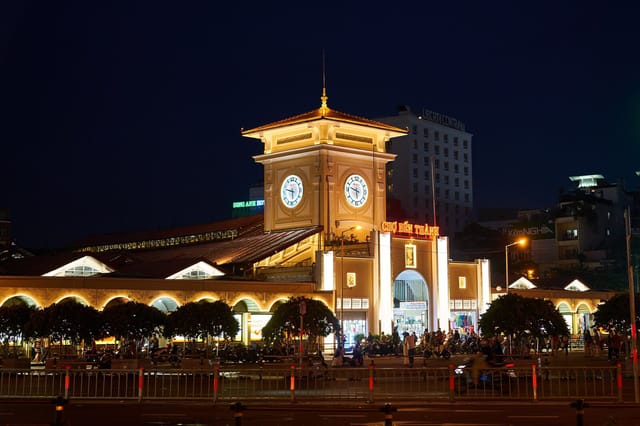
Chợ Bến Thành
Saigon’s central market, raised in 1914 on a drained swamp: the “citadel” with sixteen gates and a clock tower outlived a demolition scheme in 1971 and the building of the metro, and today it is a protected monument with some 1,500 stalls and the metro’s main station right outside the door.
Saigon Zoo and Botanical Gardens
Thảo Cầm Viên Sài Gòn
This botanical garden, founded by a French admiral in 1864 on wasteland beside the Thị Nghè canal, is one of the oldest working zoos in the world and a green island in the middle of Ho Chi Minh City. Inside the same wall stand the History Museum of Ho Chi Minh City, which opened in 1929 and holds twelve national treasures, and the Hùng Kings Temple, built as a “Temple of Remembrance” for Vietnamese who died in the First World War.
War Remnants Museum
Bảo tàng Chứng tích Chiến tranh
The museum at 28 Võ Văn Tần opened on September 4, 1975, four months after the Liberation of the South and National Reunification (giải phóng miền Nam, thống nhất đất nước), in a building that had housed American offices — on the very ground where Emperor Minh Mạng was born in 1791. In fifty years it has counted more than 25 million visits, and by its own account it is the only museum in Vietnam that belongs to the International Network of Museums for Peace. Inside are the “Requiem” photo hall, a guillotine, a reconstruction of the “tiger cages” of Côn Đảo, and a courtyard where American military hardware stands on display.
Museum of Ho Chi Minh City
Bảo tàng Thành phố Hồ Chí Minh
The building of 1885–1890 was meant to be an exhibition hall for the goods of Cochinchina (Cochinchine, the French name for Nam Kỳ, the south of Vietnam), but it turned out a palace: lieutenant governors and governors lived in it, in August 1945 the red flag with the yellow star went up over it, and in 1962–1963 a bunker was dug beneath it. Since 1978 it has been a museum — first of the revolution, now of the whole city: almost 400,000 documents and objects, two national treasures and evening programs the building had never had before.
Cu Chi Tunnels
Địa đạo Củ Chi (Khu di tích lịch sử Địa đạo Củ Chi)
An underground network in the former district of Củ Chi, 45–60 km northwest of downtown Ho Chi Minh City: secret shelters in the 1940s, headquarters and field hospitals in the 1960s, and the fighting against the American and Australian “tunnel rats” who came down into them. Today it is two memorial sites, Bến Dược and Bến Đình, more than a million visitors a year, and a place on UNESCO’s Tentative List of World Heritage.
Entertainment
All 21 →Where to go in the evening, with kids or friends
Dam Sen Cultural Park
Công viên Văn hóa Đầm Sen
According to VnExpress, one of Ho Chi Minh City's oldest theme parks: more than 30 rides, a zoo with Sumatran orangutans, an aquarium shaped like a crab, gardens and plazas around a lake — and, right next door, the Đầm Sen Water Park.
SECC — Saigon Exhibition and Convention Center
SECC — Trung tâm Hội chợ và Triển lãm Sài Gòn
An exhibition and convention center in the south of Ho Chi Minh City, in the Phú Mỹ Hưng area: two linked exhibition halls, conference rooms and an outdoor event ground. Most of the calendar is trade shows — 79 of them in 2025, according to the center — but several times a year the doors open to everyone: a travel fair with days for the general public, a gaming festival, and concerts by groups from the Republic of Korea and by Vietnamese artists.
Saigon River Cruises (Bach Dang Wharf)
Du thuyền trên sông Sài Gòn (Bến Bạch Đằng)
There is more than one way to see Ho Chi Minh City from the Saigon River: on the city water bus from Bạch Đằng Wharf in the center, on a double-decker sightseeing boat, or over dinner aboard a restaurant boat that sets out from Saigon Port in the evening.
Military Zone 7 Stadium
Sân vận động Quân khu 7
An open-air stadium for about 20,000 spectators, a couple of kilometers from Tân Sơn Nhất Airport. In 2003 and 2007 it hosted the Southeast Asian Games and the AFC Asian Cup, and since 2008, when professional football left, it has been rented out for concerts, cultural events and amateur matches — and the only way in is to come to one of them.
Bitexco Financial Tower
A skyscraper shaped like a lotus bud in the center of Ho Chi Minh City — when it opened in 2010, the tallest building in the country. From the Saigon Skydeck on the 49th floor, the city and the Saigon River spread out a full 360 degrees around you, and above the deck a helipad juts out from the body of the tower.
Landmark 81
Landmark 81 (Vinhomes Central Park)
A 461.2-meter (1,513-foot) skyscraper on the west bank of the Saigon River, on the site of the former Tân Cảng port, has been Vietnam’s tallest building since 2018. Its 79th to 81st floors house the Landmark 81 SkyView observation deck: glass walls that take in the whole city, a café, a restaurant and SkyTouch, an open-air platform that visitors step out onto in safety gear more than 380 meters (about 1,250 feet) above the ground.
Van Thanh Tourist Area
Khu du lịch Văn Thánh (48/10 Điện Biên Phủ)
A green space of water, lawns and restaurants a few hundred meters off Điện Biên Phủ Street, a few kilometers from the center of Ho Chi Minh City. Every spring it hosts the Saigontourist Group food festival, which the World Culinary Awards have named the best in the world, and since late 2024 its back gate has opened straight onto a station of the city’s first metro line.
Grand Park (VinWonders Grand Park), Vinhomes Grand Park
Công viên Grand Park (VinWonders Grand Park)
A VinWonders amusement park in the Vinhomes Grand Park residential area in eastern Ho Chi Minh City, opened on December 6, 2024. By day it runs a water park with a wave pool and slides; toward evening, an amusement park with a circus show on the lawn; and all around it lies a 36-hectare (about 89-acre) park with a sandy beach by a lake.
About this section
The Places section of CityGuide.vn is a guide to Ho Chi Minh City in two parts. Culture & history: temples and pagodas, museums, the old quarter, monuments and historic theatres — the story, what to see and how to visit. Entertainment: observation decks, parks, aquariums, music clubs — opening hours, tickets and tips before you go.
Every page has the Vietnamese address, opening hours, ticket prices, the official website and a map. We write from official sources and reputable press, list the sources and update pages when hours or prices change. Events held at these places are in the city's event listings.