In its January–February 1895 issue, the Paris trade journal Le Moniteur des architectes printed an announcement: the city of Saigon was opening a competition for the design of a new theater. The terms were strict: “Le maximum de la dépense est fixé à 700,000 francs. Tout projet dépassant ce chiffre sera rejeté” — “The maximum expenditure is set at 700,000 francs. Any design exceeding this figure will be rejected.” The competition was won by the Paris architect Eugène Ferret, but the theater did not stay within that sum: according to the historian Tim Doling, it cost more than 2.5 million francs. And in 1902 the prominent colonial writer Joseph Chailley-Bert called the theater’s annual subsidy “inexcusable” in a city that still lacked the equipment no great port can do without.
The building has had several lives. For more than forty years it was the colony’s stage: troupes that sailed out from France every season, Massenet’s La Navarraise and operettas, Emma Calvé, quarrels over subsidies — and a Vietnamese newspaper that greeted the cancellation of a theater season with the words “De l’eau, mais pas de théâtre” — “Water, yes; theater, no.” In 1943 the statues of the Muses and the garlands began to come off the façade; in 1944 the building was damaged by a bomb. From the mid-1950s until 1975 it was the parliament building (trụ sở Quốc hội) of the Saigon government (chính quyền Sài Gòn); from 1967 its lower chamber (Hạ nghị viện) sat here, and among the deputies were undercover intelligence agents. One of them, according to a military intelligence document, was one of the three people assigned to draft the surrender statement read out on the radio on April 30, 1975.
Today the 468-seat auditorium belongs to HBSO, the city’s symphony orchestra, opera and ballet company: in the fall of 2025 it staged the complete Swan Lake here for the first time. Since 2013 the same stage has also been home to À Ố Show, a bamboo circus. Under the square in front of the façade there is a metro station whose tracks, according to the operator, were laid so as not to affect the building above. And the theater itself is waiting for a major restoration budgeted at 337.2 billion ₫ — and for a new hall in Thủ Thiêm that the city has been promising to build since 2018 and now calls, in its own words, a “món nợ”: a debt it owes.
This article is about the theater before the theater and the competition of 1895; about three architects, only two of whom are borne out by documents; about five opening dates and a premiere that is wrongly placed on opening night; about money, tenors and a mayor brought down by “the theater question”; about the years when deputies sat in the auditorium; and about how to get inside a building that admits no one without a ticket.
At a glance
Saigon and Hanoi: two theaters of one era
The historian J. Kleinen lists the three great municipal theaters of French Indochina this way: “celui de Saigon, inauguré en 1900, celui de Hanoi commencé en 1901 et inauguré en 1911, et celui de Haiphong ouvert en 1904” — “that of Saigon, inaugurated in 1900; that of Hanoi, begun in 1901 and inaugurated in 1911; and that of Haiphong, opened in 1904.” The Saigon theater is the first of the three. It has a great deal in common with the Hanoi theater, about which we have a separate article, and the comparison comes out almost as a mirror image.
| Saigon | Hanoi | |
|---|---|---|
| Competition | 1895: announced in the Paris journal Le Moniteur des architectes, with a cost ceiling of 700,000 francs | 1895: “at least 800 seats,” about 40,000 piastres not counting furniture |
| Competition winner | Eugène Ferret, a Paris architect | Henri Knosp — furniture maker, architect, contractor and conductor of the Philharmonic Society’s orchestra |
| Who built it | Guichard, with “numerous modifications” to the design | Harlay, then Lagisquet |
| Construction | about 1897–1899 | June 7, 1901 — 1911 |
| Opening | early 1900, apparently during Prince Valdemar’s visit | December 9, 1911, an amateur gala |
| Seats then | 800 (1911) | 870 |
| Seats now | 468 | 598 (according to the theater, after 1997) |
| The “model” myth | “a copy of the Petit Palais” (and, by mistake, “the Garnier”) | “modeled on the Opéra Garnier” |
| Who sat in the hall | the parliament of the Saigon government; from 1967, its Lower House (mid-1950s–1975) | the National Assembly of Vietnam (Quốc hội): its first sessions and the country’s first constitution (1946) |
| Major restoration | 1996–1998, for Saigon’s 300th anniversary | 1995–1997, for the Francophonie Summit |
| Monument status | national, 2012 | national, 2011 — together with August Revolution Square |
| In 2026 | open; a 337.2-billion-₫ restoration still at the paperwork stage | closed for restoration after January 31, 2026, for about two years |
| New large theater | a project in Thủ Thiêm; since April 2026 a public–private partnership, prospective investor Sun Group | under construction by Sun Group near West Lake, completion expected in 2027 |
People link the two theaters as well. Claude Bourrin played two roles at the opening of the Hanoi theater in 1911, and in the 1920s, as a critic in Saigon, wrote La Cabale. Maurice Maréchal played in Saigon in 1935 and 1937, and in April 1937 in Hanoi too; Xenia Zarina danced in Hanoi in December 1937 and in Saigon in January 1938. In 1928 Mayor Rouelle proposed a single opera company for Saigon, Hanoi and Hải Phòng. And Governor-General Paul Doumer, host of the Saigon festivities of January 1900, was the very man from whom a Hanoi newspaper, in 1898, advised the city to ask for land for its theater.
There is a difference of character, too. The Hanoi theater became a political stage: in August 1945 the flag with the yellow star was unfurled from its balcony. The Saigon theater was popularly called “Nhà hát Tây,” the theater for the French — and in 1930 a Vietnamese newspaper welcomed the cancellation of its theater season. In 2026 the Hanoi theater stands closed, while the Saigon one is playing Swan Lake and a bamboo circus.
The theater on a world timeline
The Saigon theater is the same age as the Paris Exposition Universelle of 1900. It went up at the same time as the Petit Palais (1897–1900), and its architect, Eugène Ferret, was building the pavilion of the Korean Empire at that very exhibition. When the scaffolding came down from the theater in December 1899, Paris was still building its exhibition; when, in January 1900, the program of the Danish prince’s visit promised “a grand performance at the new theatre,” the Petit Palais still had until April to be finished.
World politics had a seat in the auditorium from the very first year. In December 1900 Massenet’s La Navarraise was applauded by soldiers back from the suppression of the Boxer Rebellion in China. Around 1910 Emma Calvé sang here. The book by Nguyễn Đức Hiệp, Doling and Võ Chi Mai says that the theater also welcomed the Indian writer Rabindranath Tagore (the book gives no date).
In the middle of the century the square in front of the theater became a location for world cinema: in 1957 Joseph L. Mankiewicz filmed The Quiet American here, from Graham Greene’s novel. Half a century later a bamboo circus set out from this stage: À Ố Show, born here in 2013, played the Royal Opera House Muscat in 2018 and the Sydney Opera House in 2019. And in 2026 the conductor on the podium here was Zahia Ziouani, who, according to Tuổi Trẻ, had conducted at the closing of the Paris Olympics two years before.
Plan your visit
Where is the Saigon Opera House, and how far is it from the sights?
The theater stands in the very heart of old Saigon, on Lam Sơn Square — Công trường Lam Sơn. That is the name of the public space around the building between Đồng Khởi and Hai Bà Trưng streets. According to VnExpress (2023), the façade looks out onto Đồng Khởi Street — toward a small garden, Công viên Lam Sơn, and toward Nguyễn Huệ Walking Street. The theater sits at the intersection of Đồng Khởi Street and Lê Lợi, the boulevard that runs from here to Bến Thành Market. On either side of it stand two old hotels, the Continental and the Caravelle.
The address is 07 Công trường Lam Sơn, phường Sài Gòn. Sài Gòn Ward (phường Sài Gòn) came into being with the administrative reform of July 1, 2025, when Ho Chi Minh City abolished its districts. The new address is the one used on their website by the producers of À Ố Show, Lune Production (“07 Cong Truong Lam Son, Saigon Ward,” 2026), and by the Vietnamese and English Wikipedias; the website of the HBSO orchestra, which works in the same building, still gives the old one — “P. Bến Nghé, Q.1,” that is, Bến Nghé Ward, District 1.
Under the square in front of the theater is the underground metro station Nhà hát Thành phố (code L1-02), the second station on Line 1, Bến Thành–Suối Tiên: it is 0.6 km from the Bến Thành terminus, and the next stop is Ba Son. There is more about the station in “The theater above the metro.”
Almost all the main sights of central Saigon are within a quarter of an hour’s walk: the cathedral, the post office, the Independence Palace, Bến Thành Market, the riverfront. Distances, walking times and taxi fares by our own calculation are listed under “What to see nearby.”
HBSO and the building’s managers: who lives in the theater?
The building’s main resident today is Nhà hát Giao hưởng Nhạc Vũ kịch TP.HCM — in English, the Ho Chi Minh City Ballet Symphony Orchestra & Opera, or HBSO for short: a symphony orchestra, an opera and a ballet under one roof. It was created by a decision of the city People’s Committee dated June 21, 1993, signed by its vice chairman, Trang Văn Quý. The official HBSO website gives the decision number twice, and differently: in the history text it is No. 955/QĐ-UB, in the footer of the same page No. 995/QĐ-UB; one of the figures is a typo.
At first the company had a modest name — Nhà hát Giao hưởng và Thính phòng, the Theater of Symphonic and Chamber Music; then it became Nhà hát Giao hưởng và Vũ kịch TP.HCM, the Theater of Symphony and Ballet, and since September 9, 2006, it has carried its present name. The renaming fell on the company’s birthday: it gave its first program of classical music at the Nhà hát Thành phố on September 9, 1994, and ever since, September 9 has been HBSO’s birthday. In September 2026 HBSO marked its 33rd anniversary with two evenings of Madama Butterfly on September 11 and 12. The address HBSO gives on its website is “Số 7 Công Trường Lam Sơn” — the theater building itself; the orchestra’s box office is in the basement.
HBSO is headed by the conductor Lê Ha My — “TS Lê Ha My” on the 2026 program pages (TS stands for a doctorate) — its director and artistic director; his deputy is Nguyễn Thoại Hường. Our place record names Meritorious Artist (NSƯT) Trần Vương Thạch as the director; in 2026 the HBSO website lists him as a conductor — he is on the podium, for example, at the concert of October 10, 2026.
The building itself does not belong to HBSO. According to Vietnamese Wikipedia, the theater was managed directly by the Trung tâm Tổ chức Biểu diễn và Điện ảnh Thành phố — the City Center for Performance and Film, known as Saigon Concert — a unit of the city’s Department of Culture and Sports (Sở Văn hóa và Thể thao). In 2022 its director was Nguyễn Hoài Hương. On March 3, 2025, the department announced a reorganization: the Phương Nam Art Theater, the City Center for Light Music and the Center for Performance and Film “được sắp xếp lại thành Trung tâm Nghệ thuật TP” — “were reorganized into the City Arts Center.” The director of the new center in 2026 is Lê Hồng Sơn. On July 22, 2026, right in the Nhà hát Thành phố, the center signed a memorandum with the City Tourism Promotion Center (Trung tâm Xúc tiến Du lịch TP.HCM) for 2026–2030 on turning performances into a tourism product: packages, “vé trải nghiệm” (“experience tickets”), and programs for MICE business travel and the “night-time economy.” Whether the building is now managed by this center, the texts we have read do not say outright.
The theater above the metro
Under the square in front of the theater lies a four-level underground station on the first line of the Saigon metro. Line 1, Bến Thành–Suối Tiên, began commercial service on December 22, 2024: 19.7 km, of which 2.6 km are underground and 17.1 km elevated, with 14 stations, three of them underground — Bến Thành, Nhà hát Thành phố and Ba Son. The line cost 43.7 trillion ₫ (Tuoi Tre News, November 22, 2024).
Nhà hát Thành phố station (code L1-02) was built under contract package CP1b, from August 21, 2014. It is 190 m long and 26 m wide, and it goes four levels down.
| Level | What is there |
|---|---|
| B1 | concourse, ticket offices and machines, fare gates, passenger information desk |
| B2 | platform |
| B3 | staff rooms, emergency control center, electrical and ventilation equipment |
| B4 | platform |
In 2022 Thanh Niên described the four levels as unique to this station: “Khác với những ga ngầm khác chỉ có 2 - 3 tầng, ga ngầm metro Nhà hát có 4 tầng hầm” — “Unlike the other underground stations, which have only two or three levels, the Nhà hát underground station has four.” The paper wrote this in a report in which Lê Minh Triết, director of the metro operator HURC1, described the station. Yet the neighboring terminus, Bến Thành, also has four underground levels, according to CafeF (2026) and Vietnamese Wikipedia: the concourse is on B1 and Line 1 on B2, while B3 and B4 are reserved for future Lines 4 and 2. What really sets Nhà hát apart is that Line 1’s platforms here are on two levels, B2 and B4, whereas at Bến Thành they are on one, B2. The same Thanh Niên report explains how the tracks are laid here.
Tracks under the theater “Đây cũng là ga duy nhất trong 3 ga ngầm có 2 đường ray song song để tránh ảnh hưởng tới công trình Nhà hát TP phía trên. Cùng với đó, các hoa văn, họa tiết trên trần nhà ga được trang trí theo phong cách cổ điển, tương tự như thiết kế của Nhà hát TP phía trên mặt đất.” “This is also the only one of the three underground stations with two parallel tracks, so as not to affect the Municipal Theater building above. In addition, the patterns and motifs on the station ceiling are decorated in the classical style, similar to the design of the Municipal Theater above ground.” Thanh Niên, December 3, 2022, citing HURC1
Back in 2020, while the station was being finished, the news site CafeF wrote (we know this from the article’s teaser) that all its ornaments, wall colors and lighting had been designed “theo lối kiến trúc của Nhà hát Thành phố” — “in the architectural manner of the Municipal Theater”: each underground station has an architecture of its own, matched to the landmark above it. The station is about 33 m deep, according to Vietnamese Wikipedia.
The construction changed the square as well. For almost six years from 2014, the space in front of the theater between Nguyễn Huệ and Đồng Khởi stood behind construction fencing. In 2020 the city’s urban railway authority (MAUR) handed the plot back to the city, and a small garden was laid out there, one that “sẽ khôi phục lại công viên Lam Sơn trước đây” — “will restore the former Lam Sơn park.” In 2025 the station’s underground level was connected to the basement of the neighboring Union Square shopping center.
Nhà hát Thành phố is the second station on the line: it is 0.6 km from the Bến Thành terminus, and the next station is Ba Son. According to the operator’s figures for late 2024, trains run from 5:00 to 22:00. Almost 125 years separate the theater from the station beneath it: the building opened at the beginning of 1900, the station on December 22, 2024.
À Ố Show: a bamboo circus in an opera house
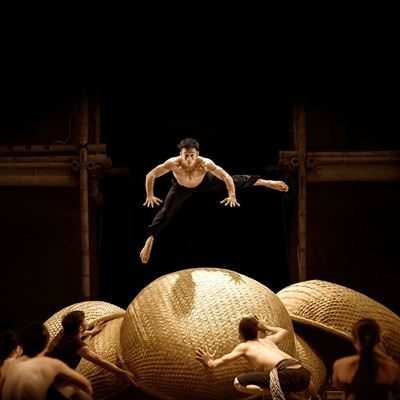
Besides HBSO, the theater has a second permanent resident — and it is neither opera nor ballet. Since 2013 the stage has been home to À Ố Show, a bamboo circus: acrobatics, dance and live music inspired by the work songs of southern Vietnam. It is produced by Lune Production, a company founded in Ho Chi Minh City in 2012 (it was formerly part of Square Group).
The company’s website explains the name like this: “The name ‘A O’ derives from ‘Lang Pho’, which means ‘village and city’” — in Vietnamese, Làng Phố. The creators are the director Tuấn Lê, a juggler who had lived in Germany from the age of 14; the music director Nguyễn Nhất Lý; the creative director Nguyễn Lân Maurice, of Cirque Plume; and the choreographer Nguyễn Tấn Lộc.
Lune’s chronology shows how many of its shows got their start in this hall.
| When | What |
|---|---|
| February 2013 | premiere of À Ố Show at the Saigon Opera House |
| March 2014 | “Làng Tôi – My Village” runs at this theater for several months |
| September 2014 | the dance show “The Mist” (directed by Nguyễn Tấn Lộc, Arabesque) begins its run here |
| June 2015–2017 | À Ố’s three-year European tour |
| August 2016 | first performance of “Teh Dar” at the Saigon Opera House |
| February 21, 2018 | Lune opens a venue of its own, the Hoi An Lune Center |
| April 2018 | À Ố at the Royal Opera House Muscat (Oman) |
| June 2019 | À Ố at the Sydney Opera House |
The press dates two entries in this chronology differently. Lune puts the premiere of À Ố in February 2013, but Việt Nam News wrote on April 3, 2013, that trial performances had run in January and that the show was officially launched at the end of March, in time for the city’s Tourism Days on April 1–7. According to Lune’s chronology, the Hội An venue opened on February 21, 2018; Tuổi Trẻ gives the first performance there, “The Mist,” as the evening of February 22 (the introduction to the same report says “from the evening of the 23rd”).
For fall 2026, À Ố Show is the only one of the shows playing in Saigon (Lune’s website moves the next date forward day by day: on October 10 it gave October 11, on October 15, October 16, and on October 26, October 27). “Teh Dar” plays in Hội An, and from November 3, 2026, “Làng Tôi” runs at the new Hanoi Lune Center for the Bamboo Circus at 42 Tràng Tiền Street in Hanoi — the very street that leads to the Hanoi Opera House. “The Mist” is no longer on the bill.
Seats for À Ố Show at the Saigon Opera House come in three categories; prices vary — check at Lune’s box office or on the website luneproduction.com. Tickets are sold on Lune’s website, by e-mail and at Lune’s own box office in the theater. According to the company’s official rules, the show lasts about an hour with no intermission. For the house rules, see “Frequently asked questions.”
Swan Lake, The Nutcracker and “Autumn Melody”: the sellouts of 2025
On October 11 and 12, 2025, HBSO presented the complete Swan Lake at the Nhà hát Thành phố — three acts, more than two hours — in a staging by the Norwegian choreographer Johanne Jakhelln Constant, under the artistic direction of Lê Ha My. Odette was danced by Đỗ Hoàng Khang Ninh, and Odile by the Japanese guest artist Chika Tatsumi. Tickets sold out as soon as they went on sale, and the theater announced two more performances for early November. “Ba tầng khán phòng chật kín khán giả” — “all three levels of the auditorium were packed,” wrote Tuổi Trẻ.
Lê Ha My told the paper that when the familiar music began, he was moved to tears.
“Missing Russia, and pride” “Đó là cảm xúc hòa lẫn giữa nỗi nhớ nước Nga, nơi tôi từng sống và học tập, với niềm tự hào khi cuối cùng HBSO đã dựng được kiệt tác này tại TP.HCM.” “It was a feeling that mingled my longing for Russia, where I once lived and studied, with pride that HBSO had at last staged this masterpiece in Ho Chi Minh City.” Lê Ha My, director of HBSO (Tuổi Trẻ, October 15, 2025)
Sources differ on the sense in which this production was a “first,” and the difference matters. Báo Văn Hóa, citing HBSO, put it broadly: “đây là lần đầu tiên khán giả Việt Nam được thưởng thức trọn vẹn tác phẩm ballet trứ danh này trên sân khấu trong nước” — “this is the first time Vietnamese audiences have been able to enjoy this famous ballet in full on a stage at home.” That is inaccurate: as we wrote in our article on the Hanoi Opera House, a complete Swan Lake was first staged in Vietnam as far back as 1985, with Soviet specialists, and on October 7, 2019, the Vietnam National Opera and Ballet performed it in Hanoi in four acts. Tuổi Trẻ is more precise: “lần đầu tiên khán giả Việt được thưởng thức trọn vẹn … Hồ thiên nga do các nghệ sĩ Việt biểu diễn ngay tại Nhà hát TP.HCM” — “for the first time Vietnamese audiences have enjoyed in full … a Swan Lake performed by Vietnamese artists, right here at the Ho Chi Minh City Municipal Theater.” HBSO created the production together with the city’s secondary dance school (Trường Trung cấp Múa) and the Sasa Ballet studio, with the support of the city’s Department of Culture.
Two months later, on December 5–7, 2025, the same stage hosted Tchaikovsky’s The Nutcracker — a revival of HBSO’s production — and all three evenings sold out (VnExpress). The paper singled out live sound as the highlight of the production: the HBSO orchestra and the HBSO women’s chorus performed; the choreography was again by Johanne Jakhelln Constant, with Lê Ha My conducting.
And in August 2025 the theater hosted HBSO’s festival “Giai điệu mùa thu” — “Autumn Melody”: its 14th edition, and an anniversary one, marking the festival’s 20 years — seven programs from August 15 to 24. Tickets were given out through a registration link, and according to Tuổi Trẻ they “burned” — “cháy vé,” sold out — as soon as the link was posted. It was at this festival that excerpts from the future Swan Lake were first shown. The festival opened with an evening of Vietnamese music, “Bay lên Việt Nam” (“Fly Up, Vietnam”).
“Turning to our roots” “Qua đêm hòa nhạc Bay lên Việt Nam, chúng tôi mong muốn hướng về nguồn cội với kho tàng khí nhạc Việt Nam, với sự tôn vinh những nhạc sĩ Việt, nhà soạn nhạc Việt và các tác phẩm Việt Nam đã đi cùng năm tháng…” “With the concert Bay lên Việt Nam we wanted to turn to our roots, to the treasury of Vietnamese instrumental music, honoring Vietnamese musicians and composers and the Vietnamese works that have come with us through the years…” Conductor Lê Ha My (Tuổi Trẻ, August 16, 2025)
The 2026 season: from Verdi to Madama Butterfly
HBSO’s 2026 calendar shows best what a year on this stage looks like. All performances are at the Nhà hát Thành phố and begin at 20:00; ticket prices vary — check at the HBSO box office or on the website hbso.org.vn.
| Date | Program |
|---|---|
| December 20–21, 2025 | HBSO Christmas concert |
| January 10, 2026 | an evening for the 125th anniversary of Verdi’s death: the chorus “Va, pensiero” and arias from Rigoletto, Il trovatore and La traviata; conductor Lê Phi Phi, soloists NSƯT Phạm Khánh Ngọc, Đào Mác and others |
| March 14, 2026 | “Hòa nhạc Mùa Xuân,” the spring concert that opens the season |
| March 28, 2026 | the ballets Carmen and L’amour sorcier (Love, the Sorcerer) — for the first time with a live orchestra; conductor NSƯT Trần Vương Thạch |
| April 4, 2026 | a Mozart evening: Piano Concerto No. 27, K. 595, soloist Lưu Đức Anh; conductor NSƯT Trần Vương Thạch |
| April 19, 2026 | “A Night of Debussy & Ravel”: conductor Zahia Ziouani, soloist Lưu Hồng Quang |
| May 30–31, 2026 | Prokofiev’s ballet Cinderella (Cô bé Lọ Lem), choreography by Johanne Jakhelln Constant |
| June 20, 2026 | Tchaikovsky, Mussorgsky, Bartók; conductor Kalle Kuusava |
| July 18, 2026 | “Bach, Mozart & Saint-Saëns” — the date in HBSO’s season listing; the program’s own page on the same website gives September 28, 2025 |
| August 15, 16, 22 and 23, 2026 | Swan Lake |
| September 11–12, 2026 | Puccini’s Madama Butterfly, a concert version with Vietnamese and English surtitles, for HBSO’s 33rd anniversary |
| September 26, 2026 | a Tchaikovsky evening; conductor Lê Ha My |
| October 10, 2026 | “A Night of Virtuoso Concertos”: Dvořák, a violin concerto by Hoàng Cương, Brahms; violinist Stéphane Trần Ngọc (Paris), pianist Lưu Hồng Quang; conductor NSƯT Trần Vương Thạch |
Behind the lines of the calendar are several stories. Zahia Ziouani, who conducted the Debussy and Ravel evening on April 19, 2026, was, according to Tuổi Trẻ, on the podium at the closing ceremony of the 2024 Paris Olympics. The pianist Lưu Hồng Quang, soloist that evening and at the concert on October 10, studied in Montreal with Đặng Thái Sơn.
According to Thanh Niên, Madama Butterfly was heard in this hall for the first time. It was a concert version in two acts and three parts, prepared together with the Consulate General of Italy; the Italian Roberto Fiore conducted, and the role of Cio-Cio-San was sung by Meritorious Artist (NSƯT) Phạm Khánh Ngọc. A full staging of the opera is promised for 2027. “For the first time,” however, should be taken narrowly: music from this opera was heard here in colonial times too. At a charity gala on October 18, 1924, one of the amateur singers “a ravi le public dans le grand air de Mme Butterfly” — “delighted the audience with Madame Butterfly’s great aria” (L’Impartial, October 20, 1924) — and in 1927 Mathilde Pradon wrote that Saigon staged the same operas as Paris, naming Madame Butterfly among them (Saïgon sportif, January 7, 1927).
The same season brought a very different genre. In early October 2026 the musical “Sự tích quả dưa hấu” — “The Legend of the Watermelon,” based on the tale of Mai An Tiêm, who was banished to a desert island — opened here. It was made by a Broadway team: book by Nicole Jones-Dion, direction and choreography by Spencer Liff, music by Doug Katsaros, produced by Gabriel Barre; the associate director was Lê Hoàng Giang and the co-choreographer Nguyễn Tấn Lộc. Denis Đặng played Mai An Tiêm and Myra Trần the princess Mỹ Linh, with a live orchestra. The Thanh Niên reviewer praised the production’s scale but pointed to “cưỡng âm,” forced tones: in places the melodies fight the tones of the Vietnamese language, and the words sound unnatural.
Can you tour the Saigon Opera House? A tour that may not exist
The building’s main practical rule is strict: inside only with a ticket. “Để vào tham quan bên trong Nhà hát, bắt buộc phải mua vé coi show” — “To visit the inside of the theater, you must buy a ticket for a show,” Thanh Niên wrote in December 2022. A month earlier the same paper, quoting the director of Saigon Concert, had put it even more bluntly: “Nhà hát TP.HCM từ trước đến nay chưa mở cửa cho du khách tham quan” — “The Ho Chi Minh City Theater has never yet been open to sightseeing visitors.”
That was precisely when someone tried to change it. In November–December 2022 Saigon Concert, together with the metro operator HURC1 and the travel company Saigontourist, was trialing a “theater plus metro station” tour and promised to launch it in early December, in time for Ho Chi Minh City Tourism Week. The route was planned like this: the metro station (about 30 minutes) — the lobby and the “phòng khánh tiết,” the formal reception room — the first and second tiers — backstage — the dressing rooms, where costumes from À Ố Show and the conductors’ concert suits were to be on display — the “Hội quán Opera House” (the theater’s clubroom), where guests would be treated to Saigon bánh mì sandwiches and to tea in cups with the theater’s logo — and a mini-lesson with the performers.
“Not only with a ticket” “Quan trọng nhất là bạn không chỉ có thể vào Nhà hát khi có vé xem show như trước đây.” “Most important of all, a ticket to a show will no longer be the only way into the theater, as it was before.” Huỳnh Thị Đoan Thùy, the theater’s sales department (Thanh Niên, December 3, 2022)
The director of Saigon Concert, Nguyễn Hoài Hương, insisted that the tour’s purpose was “không phải để kinh doanh, bán vé lấy tiền” — “not business, not selling tickets for money”: the theater wanted to show the value of the building, and the metro wanted to get city residents used to the new transport. We have found no confirmation whatsoever that this tour ever got going, or that it exists in 2025–2026. In July 2026 the new City Arts Center and the City Tourism Promotion Center (Trung tâm Xúc tiến Du lịch TP.HCM) agreed to develop “vé trải nghiệm” — “experience tickets” — and packages for tourists together; what exactly they will include has not yet been announced. Our place record (September 2026) works on the same rule: inside only with a ticket to a performance.
The façade as a backdrop: weddings, a midnight marathon and tour buses
For those not going to a performance, the theater is above all a façade — and the façade lives a life of its own, whatever is on the bill.
A “coordinate” for photos “Không khó để bắt gặp hình ảnh những cô dâu, chú rể rạng rỡ tới chụp ảnh cưới hay những người mẫu ảnh tới chụp hình trước Nhà hát TP. Đây cũng là ‘tọa độ’ check-in lý tưởng cho bất kỳ du khách nào lần đầu đến với TP.HCM.” “It is not hard to come across radiant brides and grooms arriving for their wedding photos, or models on a photo shoot, in front of the Municipal Theater. It is also an ideal ‘coordinate’ for a check-in photo for any visitor coming to Ho Chi Minh City for the first time.” Thanh Niên, December 3, 2022
On March 22, 2026, the runners of the night race VnExpress Marathon Ho Chi Minh City Midnight 2026 — a record 13,000 of them — streamed past the theater: the course also passed the Independence Palace, the Notre-Dame Cathedral and the Central Post Office. On public holidays the center turns into a stage: on July 1, 2026, for the 50th anniversary of Saigon–Gia Định receiving the name of Hồ Chí Minh (July 2, 1976), thousands of people watched a 3D projection-mapping show — not on the theater’s façade, though, but on the building of the city People’s Committee, the former city hall at the end of Nguyễn Huệ. After that first night Tuổi Trẻ reported that the show would continue on July 2 and 3; the same paper’s preview of June 25 had given different dates — a dress rehearsal on June 29 and shows on the evenings of July 1 and 2.
The square has its problems as well. On February 7, 2026, the city’s road infrastructure management center asked the police to fine — including by camera — the open-top double-decker tour buses that “thường xuyên dừng xe, đỗ xe tại giao lộ, khu vực Nhà hát thành phố (trước giao lộ Đồng Khởi - Lê Lợi) không đúng quy định” — “regularly stop and park at the intersection, in the Municipal Theater area (in front of the Đồng Khởi–Lê Lợi intersection), in breach of the rules.” The document names no official tour-bus stop at the theater itself.
Tickets, box offices and how to get inside
| Address | 07 Công trường Lam Sơn, phường Sài Gòn, TP. Hồ Chí Minh; the HBSO website still gives the old address, with “P. Bến Nghé, Q.1” |
| Coordinates | 10.77671, 106.70322 |
| Getting inside | only with a ticket to a performance; we found no tours without a ticket in 2025–2026 |
| Façade and square | public city space, free access |
| HBSO: curtain time | 20:00 (2026 calendar) |
| HBSO: tickets | prices vary — check at the HBSO box office or on the website hbso.org.vn |
| HBSO box office | in the theater’s basement; Mon–Fri 8:30–16:30; Sat, Sun and public holidays 9:00–12:00 — according to the booking page on the HBSO website (it still carries the rules of the 2017 season, so it is best to check the hours by phone); tel. (028) 3823 7295; tickets once sold are not refunded |
| À Ố Show (Lune Production) | three seat categories; prices vary — check on the website luneproduction.com or at Lune’s box office; about an hour, no intermission |
| À Ố Show tickets | luneproduction.com (online sales close 2 hours before the show), [email protected], Lune’s box office in the theater; tel. +84 845 181 188 |
| Metro | Nhà hát Thành phố station (L1-02), Line 1 — under the square in front of the theater; trains 5:00–22:00; single ride 7,000–20,000 ₫ in cash or 6,000–19,000 ₫ cashless, depending on distance; day pass 40,000 ₫, three-day pass 90,000 ₫, monthly pass 300,000 ₫ — fares approved by the city on November 21, 2024 (SGGP; Tuổi Trẻ News); check before you go |
| Prices and hours change — check before you go. |
When to go. You can look at the façade and the square at any time. HBSO performances in the 2026 calendar begin at 20:00; the dates of À Ố Show are on Lune’s website (we did not find the start time on the official site — check when you buy). The most popular programs sell out fast: in 2025 Swan Lake sold out as soon as tickets went on sale, all three evenings of The Nutcracker were sold out, and the tickets for the “Giai điệu mùa thu” festival, given out by registration in August, were gone as soon as the link was posted. As of March 2026 the major restoration had not yet begun, and HBSO’s calendar is filled through October 2026; before you go, check whether part of the building is closed.
How to get there.
- Metro. Nhà hát Thành phố station is right under the square; it is one stop, 0.6 km, from the Bến Thành terminus.
- On foot. The cathedral, the post office, Bến Thành Market and the Independence Palace are all within a quarter of an hour’s walk; distances and times are listed under “What to see nearby.”
- Taxi. It is easiest to book a car in an app — Grab, Green SM or Be: you see the fare before the ride. Short trips around the center come to about 30,000–50,000 ₫ by our calculation at 2026 rates (Green SM: 30,500 ₫ for the first 2 km; GrabCar: from 28,473 ₫ plus the platform fee).
- From Tân Sơn Nhất Airport. It is about 7.6 km by road from international Terminal T2 and about 7.9 km from domestic Terminal T1. An app-booked taxi, by our calculation, costs roughly 90,000–120,000 ₫ from T2 and 90,000–125,000 ₫ from T1, excluding traffic, night surcharges and airport fees; the app will show the exact fare before you book.
- City bus. Route 155 is one of 17 electric feeder buses that have served Metro Line 1 since December 22, 2024. At its launch it was named “Bến xe Buýt Sài Gòn – Nhà Hát Thành Phố” (Saigon Bus Station – Municipal Theater); the feeder buses run on the metro’s hours, from 5:00 to 22:00 (VOH, December 20, 2024). In the city’s official route list published in June 2026 it appears as “Ga Bến Thành – Nhà hát Thành phố” (Bến Thành Station – Municipal Theater) (the city’s Public Transport Management Center, Trung tâm Quản lý Giao thông Công cộng; VOV, June 22, 2026). The sources do not say exactly where it stops at the theater.
- Tour bus. Open-top double-decker buses often stop at the Đồng Khởi–Lê Lợi intersection, but in February 2026 the city called these stops a violation and asked the police to issue fines; the document names no official stop at the theater itself.
Good to know.
- The building has two box offices: HBSO’s, in the basement, and Lune Production’s; tickets for À Ố Show and for HBSO concerts are sold by different organizations.
- At À Ố Show you may not take food or drinks into the auditorium — only bottled water (Lune’s rules).
- We found no official rules from either HBSO or Lune on dress code, children’s ages or access for wheelchair users — ask at the box office.
- Addresses with “Quận 1” (District 1) and “phường Bến Nghé” are out of date: since July 1, 2025, the theater has been in phường Sài Gòn.
- “Nhà hát Lớn” in a listing without a city name may mean the Hanoi Opera House (Hải Phòng has a “Nhà hát Lớn” of its own as well). The Saigon theater was called that in the 1920s, but its name today is Nhà hát Thành phố; check the address.
What to see nearby
Distances and walking times are measured from the theater (point 10.77671, 106.70322) along OpenStreetMap routes (OSRM). Taxi fares are estimates calculated from published 2026 rates (Green SM: 30,500 ₫ for the first 2 km; GrabCar: from 28,473 ₫ plus the platform fee); in traffic and at night they come to more.
Up to 15 minutes on foot
- À Ố Show (Lune Production): in the theater itself.
- The “café apartment” at 42 Nguyễn Huệ (≈525 m): about 7 minutes; the building stands on Nguyễn Huệ Walking Street.
- Rex Hotel Saigon (≈550 m): about 7 minutes.
- Bạch Đằng Wharf and the water-bus pier (≈575 m): about 8 minutes; this is the river across which a footbridge from the new theater in Thủ Thiêm to Nguyễn Huệ was to have been built.
- Nguyễn Huệ Walking Street (≈640 m to the middle): about 9 minutes; at its end stands the former city hall, on whose façade a 3D mapping show was projected in July 2026.
- Saigon Central Post Office (≈650 m): about 9 minutes.
- Notre-Dame Cathedral Basilica of Saigon (Nhà thờ Đức Bà) (≈730 m): about 10 minutes; the cathedral has its own myth about “Marseille” materials.
- Nguyễn Văn Bình Book Street (≈790 m): about 11 minutes.
- Bến Thành Market (≈860 m): about 12 minutes along Lê Lợi Boulevard; in the 1890s the theater’s opponents proposed spending its money on this market.
- Museum of Ho Chi Minh City (≈910 m): about 12 minutes.
- Bitexco Financial Tower (≈950 m): about 13 minutes.
- Independence Palace (Dinh Độc Lập) (≈1 km): about 14 minutes; the story of the surrender text leads there, to April 30, 1975 (see “Ba Lễ, agent H3”).
- Mê Linh Square: the former Place Rigault-de-Genouilly, to which the Doudart de Lagrée memorial was moved in 1895 to make way for the theater.
Farther afield
- Ho Chi Minh City Museum of Fine Arts (≈1.2 km): about 16 minutes; taxi ≈30,000–50,000 ₫.
- Turtle Lake (Hồ Con Rùa) (≈1.25 km): about 17 minutes; taxi ≈30,000–50,000 ₫.
- Nhà Rồng Wharf — Ho Chi Minh Museum (≈1.3 km): about 18 minutes; taxi ≈30,000–50,000 ₫.
- September 23 Park (Công viên 23 tháng 9) (≈1.6 km): about 21 minutes; taxi ≈30,000–50,000 ₫.
- Tao Đàn Park (≈1.6 km): about 21 minutes; taxi ≈30,000–50,000 ₫.
- War Remnants Museum (Bảo tàng Chứng tích Chiến tranh) (≈1.6 km): about 22 minutes; taxi ≈30,000–50,000 ₫.
- Bùi Viện Walking Street (≈1.7 km): about 23 minutes; taxi ≈30,000–50,000 ₫.
- Jade Emperor Pagoda (Chùa Ngọc Hoàng) (≈2.2 km): about 29 minutes; taxi ≈40,000–65,000 ₫.
- Tân Định Church, the “Pink Church” (≈2.3 km): about 31 minutes; taxi ≈35,000–55,000 ₫.
- Vĩnh Khánh Food Street (≈2.4 km): too far to walk, better by taxi ≈35,000–60,000 ₫.
- Southern Women’s Museum (≈2.6 km): too far to walk, better by taxi ≈40,000–60,000 ₫.
- Hòa Bình Theatre: the city approved its 275-billion-₫ renovation at the same 2023 session as the restoration of the Municipal Theater.
Landmark: the Line 1 metro stations — Nhà hát Thành phố, right under the square in front of the theater (≈340 m to the station’s point on the map, about 5 minutes on foot), Ba Son (≈960 m, about 13 minutes) and Bến Thành (≈1 km, about 13 minutes).
Landmark: Tân Sơn Nhất Airport — international Terminal T2 (≈7.6 km by road, about 10 minutes by car without traffic, taxi ≈90,000–120,000 ₫) and domestic Terminal T1 (≈7.9 km, about 10 minutes, taxi ≈90,000–125,000 ₫).
The Municipal Theater is part of our guide to Ho Chi Minh City; look for performances and festivals in the city events calendar.
What to see
The façade: Erechtheion caryatids, angels with a lyre and the head of Pan
The best description of the façade we have found is a 2023 VnExpress photo report, made ahead of the major restoration. Let us follow it from the entrance to the center.
The caryatids. At the main entrance, on pedestals, stand “hai bức tượng nữ thần bán thân đỡ cột cao khoảng 4,5 m … theo phong cách Erechtheyon Hy Lạp” — two half-length figures of goddesses, about 4.5 meters tall, supporting columns, “in the style of the Greek Erechtheion,” that is, after the famous Porch of the Caryatids in Athens. According to VnExpress, the caryatids were taken down while the building served as a hall of deputies and were restored in 1998; and the “two statues of the goddesses of the arts” restored in 1998 are, for Tuổi Trẻ, one of the theater’s main photo spots.
The great arch. In the center of the façade is a great arch. At its top two angels sit side by side, with a lyre between them — “cây đàn Lyre đặc trưng của thần thoại Hy Lạp,” “the instrument emblematic of Greek mythology.” Around the arch run reliefs of the head of Pan, “vị thần âm nhạc đồng quê,” “the god of pastoral music.”
The small arch. Within the great arch is a smaller one, with a mural: “bức bích hoạ vẽ 5 vị thần trên nền gạch men” — five deities painted on a ground of glazed tiles. At the center the composition looks like a temple with a goddess inside, and at the bottom is the inscription “Nhà hát thành phố,” which replaced the French “Théatre Municipal.” Who made the mural and the façade sculptures, we have not been able to establish.
Reliefs and the entrance. The façade, the columns and the side walls carry reliefs: musical instruments, garlands, angels, deities. The main entrance consists of three arched doors; a large chandelier hangs from the lobby ceiling. Along the sides of the building are staircases with iron railings, and columns and ceilings covered in molded relief. The theater itself is “một trệt, hai lầu” — a ground floor and two upper floors; the side façades have rows of arched windows with projecting balustrades in the French classical manner.
The façade in the 1895 design was 33 meters wide. We have not found the height of the building in any source.
Journalists have not agreed on what to call the style. Vietnamese Wikipedia speaks of the “flamboyant” style of the Third Republic, VnExpress and PLO of “Flamboyant Gothic,” Thanh Niên in 2022 of baroque, and the French Wikipedia of Beaux-Arts. None of these labels is backed by a document of the period; the most cautious description is the ornate ceremonial style of the Third Republic.
Inside: a 468-seat auditorium — and where the “1,800” came from
Only ticket holders are allowed inside, so most people know the auditorium from photographs and descriptions. VnExpress (2023): “Khán phòng với gần 500 chỗ ngồi, trong đó tầng trệt có 338 ghế, hai tầng lầu có 130 ghế” — “an auditorium with nearly 500 seats, of which 338 are on the ground floor and 130 on the two upper tiers.” The ceiling is vaulted, with delicate ornament “mang đậm phong cách kiến trúc flamboyant,” “strongly marked by the flamboyant style,” plenty of reliefs and classical light fittings; around the ceiling of the top tier run ventilation openings decorated with wreaths. Programs of every genre, the paper writes, are staged here: classical music, the national traditional arts, ballet.
Lune Production, which stages À Ố Show here, adds details of its own (this is the website of a resident producer, so a weak basis): the auditorium is oval, with 468 seats; the building is raised two meters above street level and has double doors — against street noise; the total floor area is 3,200 m²; the lobby has crystal chandeliers and a polished granite floor.
The number of seats is a question that trips up many sources. Our place record logged it as a discrepancy: “about 500 (338 + 130)” in VinWonders and “468” elsewhere. But there is no discrepancy: 338 + 130 = 468, and “gần 500,” “nearly 500,” is the same figure rounded. The best-confirmed current figure is 468; it is given by VnExpress, Lune and Vietnamese Wikipedia (“468 (2009)”).
The historical sequence looks like this:
| When | Seats | Source |
|---|---|---|
| 1896–1911 | 800 | the 800-seat “Grand-Théâtre de Saigon” design (Doling); the 1911 monograph: the hall “peut contenir huit cents spectateurs,” can hold eight hundred spectators |
| — | 738 | New Grove Dictionary of Opera (1992) |
| before 2007 | 559 | Vietnamese Wikipedia |
| after the 2007–2009 renovation | 500 | Vietnamese Wikipedia, citing an inaccessible 2007 document of the French Consulate General; the English Wikipedia also gives 500 |
| today | 468 (338 + 130) | VnExpress (2023), Lune (2026) |
The figure of “1,800 seats,” on the other hand — repeated by the Vietnamese, English and French Wikipedias, the magazine Vietcetera and amateur websites — is not supported by any document of the period, and it does not square with the 800 seats of 1911. Most likely it is an error: a stray “1,” or a mix-up with another building. We have not found an official figure from the theater’s management: its website does not open.
The 1911 monograph contains one more puzzling detail: the hall was “pourvue d’un plafond mobile,” fitted with a movable ceiling. How it worked, and whether it survives, the sources do not explain.
The building’s area is also given differently: “more than 2,000 m²” of built-up footprint (VnExpress, 2023), “2,016 m²” (Thanh Niên, 2022) and 3,200 m² of total floor area (Lune). These are different measurements, and they do not contradict one another.
Lam Sơn Square: from Place Francis Garnier to a garden above the metro
The square in front of the theater has had several names. It was called Place du Théâtre, Theater Square, and before that Place Francis Garnier, after the statue of Garnier that stood here from 1887. In 1945, after Japan’s surrender, in the first days of the August Revolution in Saigon, Garnier’s statue was taken down — together with the statue of Admiral Rigault de Genouilly on the neighboring square, today’s Mê Linh. Since the mid-1950s the square has been called Công trường Lam Sơn (according to the book by Nguyễn Đức Hiệp, Doling and Võ Chi Mai, in an excerpt published by Thanh Niên on July 17, 2024).
On the corner of Đồng Khởi and Lê Lợi, opposite the Continental Hotel, the Givral café-restaurant did business from the 1960s until 2010. At the beginning of the 20th century the same spot was home to M. Pancrazi’s “Café de la musique” (Music Café), and later to the Pharmacie Solirène.
Lam Sơn Square itself, according to Vietnamese Wikipedia, is the public space around the theater between Đồng Khởi and Hai Bà Trưng; in front of the entrance is the Công viên Lam Sơn garden. The story of the “Tình mẫu tử” fountain and of the trees cut down in 2014 is told in the section “The monument facing the chamber.” The plot behind the theater was a parking lot until 2017; in 2018 a flower garden was laid out there.
The streets around the theater may soon become pedestrian-only. In April 2026 Thanh Niên reported plans to extend the network of walking streets in the center: among them Đồng Khởi, from Nguyễn Du to Lê Lợi, and Lê Lợi, from Nguyễn Huệ to the Quách Thị Trang roundabout (today the main walking streets are Nguyễn Huệ Walking Street and Bùi Viện Walking Street). The theater stands right at the junction of Đồng Khởi and Lê Lợi. For now, though, it is only a plan.
The Continental and the Caravelle: neighbors on either side
The theater stands between two hotels, and each has a theater story of its own (we follow the book by Nguyễn Đức Hiệp, Doling and Võ Chi Mai, excerpts from which Thanh Niên published on July 17 and 18, 2024).
The Continental stands on one side of the theater. It was built by the businessman and contractor Pierre Cazeau, opposite the Hôtel Favre on rue Catinat. At the end of the 19th century the building served for a time as the town hall, before the present city hall was built. The café-restaurant on the ground floor and the sidewalk in front of it “nhìn ra nhà hát và quảng trường nhà hát,” looked out onto the theater and the theater square, and from the late 19th century until the 1970s they were the meeting place of politicians, planters, merchants and officials; Mayor Paul Blanchy was a regular. Theatergoers came here after performances too: after a charity evening in August 1925 the columnist of Saïgon sportif noted: “Après la représentation, ce fut l’arrêt obligatoire au Continental” — “After the performance came the obligatory stop at the Continental.” The hotel was bought by the Duke of Montpensier, who in 1908 set off from here on the first automobile journey from Saigon to Angkor. From here the accounts diverge. According to the book, in 1933 the duke sold the hotel to a Corsican, Mathieu Franchini. The Saigon newspapers of the day tell it differently, and earlier: on January 15, 1931, the “Continental Palace” and its annexes were sold at public auction, and nobody bid above the starting price. “…le Continental était adjugé à M. Franchini” — “…the Continental went to Mr. Franchini,” L’Écho annamite reported the next day, adding on January 26 that he would take over the management on February 1. Mathieu’s son, Philippe Franchini, managed the hotel until 1975. He is the same Philippe Franchini, a historian and writer born in 1928, who edited Saigon 1925–1945 (1992), the book we quote in the sections “When did the Saigon Opera House open?” and “The 1944 bomb”: the catalog of the National Library of France (BnF) lists it under the same author as his autobiography Continental Saigon.
The Caravelle stands on the other side of the theater, across from the Continental, on the corner of Đồng Khởi and Lê Lợi. It was right here, on the corner of Boulevard Bonard and rue Catinat, that the earlier, smaller municipal theater stood. In 1902 Marcel Bénard of the firm Bénard Frères et Cie opened the Hôtel et Café de la Terrasse on the spot, at 19, place du Théâtre; the building went up at the same time as the theater. The hotel closed in 1927, and from 1940 the site was occupied by the Hôtel du Théâtre. In the late 1950s the building was reconstructed by Vietnamese and French architects with the participation of Air France, and at Christmas 1959 a hotel opened that was named after the Air France aircraft, the Caravelle. At the time it was the tallest building in Saigon; it housed the bureaus of CBS News and ABC News and, in the 1960s and early 1970s, the embassies of Australia and New Zealand. After 1975 the hotel was called Độc Lập (Independence), and in 1998 a 24-story tower was built beside it and the Caravelle name came back.
Legends and lore
The Petit Palais myth — and the Garnier one
The second story that keeps doing the rounds (the first, about who designed the building, is in the section “Who designed the Saigon Opera House?”) is about where the theater got its façade. Vietnamese Wikipedia says: “Cửa mặt tiền chịu ảnh hưởng nghệ thuật khá rõ nét của Petit Palais cất cùng năm tại Pháp” — “The façade shows quite a clear artistic influence of the Petit Palais, built in the same year in France.” Doling is more careful: Ferret “reportedly had taken his inspiration from the Petit Palais.” The English and French Wikipedias, Nhân Dân and Thanh Niên repeat the same idea.
Let us check the dates. The Saigon competition closed on April 15, 1895, and Ferret’s design was approved on November 21, 1895. In early 1895 Charles Girault, the future architect of the Petit Palais, was only just receiving his prize for the general plan of the 1900 exhibition — as reported in the very issue of Le Moniteur des architectes that printed the terms of the Saigon competition. Construction of the Petit Palais began on October 10, 1897, and ended in April 1900. So the two buildings did go up at the same time, in 1897–1900, but in 1895 Ferret could not have copied a façade that did not yet exist. More likely, they are two examples of the same ceremonial, “exhibition” architecture of the Third Republic. Nor did a Petit Palais design exist yet in 1895: the grand architectural competition for the exhibition palaces was announced in France’s official gazette, the Journal officiel, on April 22, 1896, and Girault signed his prize-winning drawing of the Petit Palais main façade on July 4, 1896 (Rmn – Grand Palais). Ferret’s design, approved in November 1895, is older than that drawing, let alone the start of construction.
There is a second version, even further from the truth. “Lấy cảm hứng từ nhà hát Opera Garnier ở Paris” — “inspired by the Opéra Garnier in Paris,” VnExpress (2023), the newspaper PLO (2023) and the VinWonders guide write of the Saigon theater. But “modeled on the Opéra Garnier” is the phrase used about a different theater, the one in Hanoi; the Saigon theater inherited it by mistake, and its own myth is the Petit Palais. The result is a symmetrical pair: the Hanoi theater supposedly copies the Garnier, the Saigon one the Petit Palais.
The story does have a genuine rhyme, though. At the very Exposition Universelle of 1900 for which the Petit Palais was built, Eugène Ferret — “author of the Saigon theater” — was building the pavilion of the Korean Empire.
Carpezat’s workshop and the myth that “everything came from France”
Almost every account of the theater includes a line about French materials. VinWonders: “hầu hết các vật liệu xây dựng và họa tiết trang trí đều được đặt hàng sản xuất và vận chuyển từ Pháp sang” — “almost all the building materials and decorative motifs were ordered, manufactured and shipped over from France.” VnExpress in 2023 says much the same, almost word for word. Vietnamese Wikipedia and Nhân Dân are more specific: all the decorative models, the façade reliefs and the interiors were drawn by “a renowned artist in France” and sent from there — though they name neither the artist nor a source. And Lune Production, the producer of À Ố Show, writes of the stone carving, the statues at the entrance, the crystal chandeliers and the granite floor of the lobby — “all built with materials imported from France.”
How much of this can be confirmed? One thing — and a rather striking one. The report of the international jury of the 1900 Exposition Universelle says of the Paris decorator Eugène Carpezat, one of the regular scene painters of the Paris Opéra: “Il a décoré les salles de la Zarzuela, à Madrid, le théâtre de Saigon, etc.” — “He decorated the halls of the Zarzuela in Madrid, the Saigon theater, etc.” So decorative work for Saigon really was done by a Paris workshop — the workshop of a Paris Opéra decorator. It is also confirmed that the colony bought its scores in France (see “The State as counterfeiter”).
What we have not found is a single document showing that “almost all” the building materials arrived by sea from France. When the design was approved in 1895 there was talk of tiles instead of wooden floors, and in 1896 the council chose the timber — but which timber, and from where, is unknown. The verdict: “everything from France” is an exaggeration without a source; “the decoration was done in Paris” is partly confirmed. A similar myth lives on at the neighboring Notre-Dame Cathedral Basilica of Saigon: there it is “all the bricks came from Marseille,” while the only Marseille material documented there is the roof tile.
History
Before the theater: the admiral’s house, a hall that “could not burn” and a prima donna from Le Moustique
French theater in Saigon is almost forty years older than the present building. The sources disagree on exactly how it began. Vietnamese Wikipedia says that in 1863 the French invited a troupe to entertain the expeditionary corps, and that at first it performed, as a temporary arrangement, in the wooden house of the admiral’s residence on Place de l’Horloge (Clock Square), at the corner of today’s Nguyễn Du and Đồng Khởi streets. The historian Tim Doling, author of the book Exploring Hồ Chí Minh City (2014), starts the story earlier: in 1861–1862 the prefabricated wooden buildings of the first Governor’s Palace were shipped in from Singapore for Admiral-Governor Bonard, and until 1872 visiting French troupes played in its “Salle de spectacles,” its hall for performances. The book Kiến trúc đô thị và cảnh quan Sài Gòn – Chợ Lớn xưa và nay (The Urban Architecture and Landscape of Saigon–Chợ Lớn, Past and Present) by Nguyễn Đức Hiệp, Tim Doling and Võ Chi Mai names yet another place: a temporary wooden theater stood near Place de Genouilly — today’s Mê Linh Square.
In 1872, according to Doling, the city built its first real theater, on the spot where the Caravelle Hotel stands today. It was made of wood and burned down: in 1881, according to Doling’s 2015 article, or around 1881, according to the updated version on his website, which flags the date as unverified. It was rebuilt, this time in durable materials — the following year by one account, while by the other the theater opened in 1884. In 1887 the Paris newspaper Le Figaro described it with a touch of irony (the quotation comes via Doling): “it is simple and the architecture is very primitive – but it is impossible to burn down!”
The old theater had its admirers, too. “It’s so pretty, our Saïgon theatre, with its boxes decorated with hanging plants and its wide verandahs filled with flowers! What more wonderful setting could there be in which to meet pretty ladies wearing the latest fashions, officers in uniforms embroidered in gold, elegant gentlemen, and mandarins dressed in rich silk costumes?” wrote La Revue hebdomadaire in August 1893 (the quotation is in Doling’s English translation; we have not found the French original). Two decades later, according to Doling, George Dürrwell fondly remembered the old theater as “so small and so simply decorated, yet so cosy and intimate, surrounded by lawns and shaded by large trees.”
A theater the breeze blew through “Ce théâtre, construit légèrement, est assez élégant ; il est combiné de manière à laisser circuler le plus possible l’air autour des spectateurs.” “This theater, lightly built, is rather elegant; it is designed so that the air can circulate as freely as possible around the spectators.” The official guide Les colonies françaises : notices illustrées (The French Colonies: Illustrated Notes), vol. 3 (Cochinchina), Paris, 1889. The same guide explains why the theater could exist at all: it was subsidized by the colony, without which it could not have borne the company’s “double journey” from France and back and the transport of all its effects.
The hall served more than the stage. Henri Cordier’s bibliography Bibliotheca Indosinica (Indochinese Library) lists a pamphlet titled “Cochinchine. — Réunion publique du 27 Mars 1885 au Théâtre de Saigon” — the report of a public meeting held at the Saigon theater on March 27, 1885. The theater had its own celebrities as well. In December 1887 the Tonkin newspaper L’Avenir du Tonkin reported that a satirical sheet called Le Moustique (The Mosquito), which styled itself the “organe de la gaieté coloniale,” the “organ of colonial merriment,” had come out with a photograph of “the prima donna of the Saigon theater” in its very first issue.
A document of 1895 confirms where the old theater stood: the new building was to rise “on the embankment of Boulevard Bonard, between the present town hall and theater” (“entre la mairie et le théâtre actuels”). So the old theater stood very close to the present one. Doling and Vietnamese Wikipedia both place it on the site of the future Caravelle Hotel.
Offenbach instead of Gluck: the first seasons and “royalties from China”
One sentence is enough to show what the old theater played. On June 3, 1880, the newspaper Courrier de l’Indochine wrote that the first Saigon theater specialized not in the operas of Gluck or Mozart but in “the works of Offenbach, Lecocq and other geniuses of the comic genre” (quoted by Doling, in his English translation).
In the fall of 1880 Paris heard about it too. Jules Prével, a columnist for Le Figaro, announced — and the music weekly Le Ménestrel reprinted — that Peragallo and Roger, agents of the Société des auteurs et compositeurs dramatiques, the French society of dramatic authors and composers, “viennent de recevoir de Saigon les premiers droits d’auteurs que l’on ait touchés en Chine !” — “have just received from Saigon the first authors’ royalties ever collected in China!” Parisian columnists, evidently, placed Saigon somewhere “in China.” Programs of the Saigon theater came with the money — programs that “resemble those of our provincial towns.” They show what had been played the season before: La Fille du régiment (The Daughter of the Regiment), Galathée, Les Noces de Jeannette (Jeannette’s Wedding), Offenbach’s La Belle Hélène (Fair Helen), M. Choufleuri, Tromb-al-Cazar and Le Mariage aux lanternes (The Marriage by Lantern Light), Lecocq’s Giroflé-Girofla and La Petite Mariée (The Little Bride), Les Cloches de Corneville (The Bells of Corneville) and Les Dragons de Villars (The Dragoons of Villars). Operetta and opéra comique almost to the last title.
The company was recruited in France every year. The city — from the 1870s, according to Doling — engaged a director-impresario, who brought the performers out from metropolitan France. In August 1884 Le Ménestrel wrote about a “directeur audacieux,” a bold director, M. Pontet, who “va diriger le théâtre de Saigon” — “is going to run the Saigon theater”: the government had guaranteed him 1,030 francs per performance plus free passage for his artists and their baggage. The company — about twenty names — was to sail from Brest on August 23 aboard the steamer Shamrock.
They sang Carmen here, too. Around 1887–1888 the Brussels journal Guide musical, citing Le Monde artiste, reported: “Au théâtre de Saigon, Carmen vient d’obtenir un grand succès” — “At the Saigon theater, Carmen has just enjoyed a great success.” It was performed by Louis Achard’s opera company: Mlle Lacourrière as Carmen, Mlle de Geneffe as Micaëla, Brisac as Don José and Dejan as Escamillo. In April 1893 the artists of the Saigon theater gave Pailleron’s Les Souliers de bal (The Ball Slippers) “before a well-filled house” (“devant une salle bien remplie”), and by then the management for the following season, 1893–1894, had already been entrusted to Montagne and J. Sperte.
“The State as counterfeiter”: director Achard and a pirated Mignon
In 1888 Louis Achard, “directeur du Théâtre-Français de Saigon en Cochinchine” — “director of the French Theater of Saigon in Cochinchina” — came to Paris to recruit a new company; the government had granted him a subsidy of 100,000 francs. And then Le Ménestrel raised a scandal. The journal accused Achard of staging Ambroise Thomas’s Mignon and Le Songe d’une nuit d’été (A Midsummer Night’s Dream) from illicit copies of the scores. But it did not name the director as the main culprit. The music for Saigon was bought directly from the publishers by the colonial directorate of the Navy Ministry, which, apparently finding the price too high, simply did without a license: “on a passé outre,” the journal wrote, “they went ahead regardless.”
A sign of republican times “Nous sommes donc fondés à dire que l’État s’est fait contrefacteur en la circonstance, ou que tout au moins il a protégé sciemment la contrefaçon. C’est un signe des temps républicains.” “We are therefore entitled to say that in this instance the State turned counterfeiter itself, or at the very least knowingly protected the counterfeiting. It is a sign of republican times.” Le Ménestrel, 1888
How the affair ended, we do not know: soon afterward the journal reported Achard’s sudden death at Boulogne-sur-Mer. A telegram from Paris dated August 4, 1888, announced it as well, and on August 6 Saigon cabled that Achard would be replaced by Degred and that the company’s engagement would stand. Degred hired 42 artists, who were to sail from Marseille on August 26, 1888. The colony, meanwhile, paid for the music as a separate line item.
Ten thousand for sheet music “En plus d’une subvention, la Cochinchine alloue, pour chaque année, une somme de 10.000 francs rien que pour l’achat de partitions avec orchestre.” “In addition to a subsidy, Cochinchina allots each year a sum of 10,000 francs solely for the purchase of orchestral scores.” L’Avenir du Tonkin, August 11, 1888
A tenor for 4,000 francs: who paid for the opera?
In the early 1890s the Saigon theater was maintained not by the city but by the colony — by the Colonial Council (Conseil colonial) of Cochinchina. The minutes of its session of January 18, 1893, printed in the official journal of Indochina, show how that worked. The council was arguing over whether to give the season a subsidy of 100,000 francs or 120,000.
Eugène Cuniac defended the decisions of the theater commission. The subsidy, he said, covered “à peine les deux tiers,” barely two-thirds, of the expenses, and there were no musicians to be had locally: “on ne devait pas compter trouver ici un complément d’orchestre quelconque” — “one could not count on finding any supplement to the orchestra here at all.”
Councilor Jourdan argued against him. He complained about the market for singers: “il est impossible d’avoir un ténor convenable, par exemple, à moins de 3.000 ou 4.000 francs par mois” — “it is impossible, for example, to get a decent tenor for less than 3,000 or 4,000 francs a month.” And about the public: “s’il y a des amateurs pour l’opérette, il n’y a presque personne au théâtre les soirs d’opéra-comique” — “if there are enthusiasts for operetta, there is almost nobody at the theater on opéra comique nights.” To the point about empty seats Cuniac had a reply worthy of a parliament.
The opera and the vacuum pump “Je ne sache pas que l’opéra fasse l’effet d’une machine pneumatique : le vide ne se produit pas dans la salle.” “I am not aware that the opera has the effect of an air pump: no vacuum forms in the auditorium.” Eugène Cuniac at the session of the Colonial Council of Cochinchina, January 18, 1893 (Journal officiel de l’Indo-Chine française, March 9, 1893)
Cuniac’s proposal won: 120,000 francs, but with new obligations for the director — more chorus singers and the entire orchestra brought from France. For the company’s passage the council voted 15,100 piastres — enough, as the lieutenant governor explained, for four more second-class berths and ten more third-class berths than the year before. He also reminded the council that the colony owned 40,000 francs’ worth of scores which, if they went unused, “risked being destroyed by woodworm” (“détruite par les poux de bois”). And the chairman reported that the Paris publisher Choudens was offering another 13 scores for 10,000 francs.
Cuniac, a lawyer by profession, was himself mayor of Saigon at the time — from May 1, 1892, to April 26, 1893; he was mayor in 1890–1891 and 1902–1906 as well, and again in 1915. By the count of L’Avenir du Tonkin (1928), he led the city four times, for more than twelve years in all. Under the French, the square in front of Bến Thành Market bore his name.
Artists’ graves: a stage that killed
The colonial stage was dangerous work. On December 19, 1892, a musician of the theater died in Saigon, on rue La-Grandière, at the age of 43 — one notice of January 1893 calls him Édouard-Louis Lejars, another the double-bass player Legeard (Édouard). In 1902 the baritone Lassaly died. And in 1912 the municipal commission decided to take over the upkeep of the graves of “the artists, chorus singers and musicians of the municipal theater” buried in the Saigon cemetery — and to set aside a plot in advance for those who might die in the future.
P. Nury, director of the 1911–1912 season, wrote that performers were afraid to come to Saigon, “dont le climat est réputé malsain” — “whose climate is reputed to be unhealthy.” How his season was organized and how it ended for him is told in “A season by the 1912 rules.”
1895: a site between the town hall and the old theater, and a competition with a cost ceiling
According to Doling, the authorities had decided as early as 1893 that Saigon needed a bigger and more imposing theater. The documented story begins in 1895. An index of archival minutes compiled by André Baudrit, the historian of Saigon’s streets (Guide historique des rues de Saïgon — A Historical Guide to the Streets of Saigon, 1943), lists three sessions of the municipal council: May 15, 1895 — “Choix de terrain pour la construction du théâtre,” the choice of a site for the theater (on the same day the council also chose a site for a new town hall); July 29, 1895 — “Construction du théâtre,” the construction of the theater; and March 18, 1896 — “Choix de bois pour le théâtre,” the choice of timber. We have not read the minutes themselves: Baudrit cites the town hall’s registers of deliberations (vol. 9, pp. 299, 324–326 and 487), and their text is not online. In these years the city was run by Mayor Paul Blanchy (from April 26, 1895, to January 14, 1902), who was also president of the Colonial Council.
The site chosen was a stone’s throw from the old theater — on the terre-plein, the raised embankment, of Boulevard Bonard (today’s Lê Lợi), between the old town hall and the old theater. The town hall was to be demolished.
The competition was announced before the site had even been chosen. The notice appeared in the January–February 1895 issue of the Paris professional journal Le Moniteur des architectes.
The terms of the competition, 1895 “La ville de Saigon ouvre un concours public pour l’étude d’un projet relatif à la construction d’un nouveau théâtre. Les projets devront être parvenus à la mairie de Saigon le 15 avril 1895. Le maximum de la dépense est fixé à 700,000 francs. Tout projet dépassant ce chiffre sera rejeté.” “The city of Saigon is opening a public competition for the design of a new theater. Designs must reach the Saigon town hall by April 15, 1895. The maximum expenditure is set at 700,000 francs. Any design exceeding this figure will be rejected.” Le Moniteur des architectes, 29th year, nos. 1–2, January–February 1895, pp. 19–20
The prizes were set at 5,000 francs for first place, 3,000 for second and 2,000 for third. The key condition came at the end: “L’auteur du projet classé n° 1 sera chargé de la direction des travaux” — “The author of the design placed first will be put in charge of the works.” That condition would be fulfilled only in part (see the following sections).
The same issue printed the results of another competition — for the general plan of the 1900 Exposition Universelle in Paris: prizes of 6,000 francs each went to Girault, Hénard and Paulin. Charles Girault would go on to build the Petit Palais for that exhibition — and this neighbor on the journal’s page would later play a part in the story of the Saigon theater, as the subject of a myth (see “The Petit Palais myth — and the Garnier one”).
In the same year, 1895, Hanoi also announced a competition for a theater of its own. How the two competitions differed and how they ended is told in “Saigon and Hanoi: two theaters of one era.”
November 21, 1895: Ferret’s design is approved — one-tenth larger
The sources disagree about who else took part in the competition. According to Doling, the shortlist comprised the designs of Ferret, Genet and Berger. The book Doling wrote with Nguyễn Đức Hiệp and Võ Chi Mai, citing the newspaper La Dépêche coloniale illustrée of 1907, gives a different set of contestants: Ferret, Genet and Shepherd. Both lists have the same winner — Eugène Ferret.
The contemporary record is a note in the “Nouvelles de Cochinchine” column of L’Avenir du Tonkin of November 23, 1895. On November 21 the lieutenant governor of Cochinchina had approved the “projet de théâtre présenté par M. Ferret et qui a été classé premier lors du concours” — “the theater design submitted by M. Ferret, which was placed first in the competition.” He approved it with amendments, and the very first of them concerned its size.
Amendments to the design, November 1895 “Plusieurs modifications y ont été apportées, entre autres un agrandissement d’un dixième ; les parquets seront carrelés au lieu d’être en bois, les fauteuils devront se lever automatiquement, etc.” “Several modifications have been made to it, among them an enlargement by one-tenth; the floors will be tiled instead of wooden, the seats will have to tip up automatically, etc.” L’Avenir du Tonkin, November 23, 1895
The note goes on to sketch the future square. The theater would stand “sur le terre-plein du boulevard Bonard,” on the Boulevard Bonard embankment, with a façade 33 meters wide. The two streets along the edges of the embankment would be moved back to make room for gardens on both sides of the theater, and “la mairie actuelle disparaîtra” — “the present town hall will disappear.” Ferret was expecting assistants from France, the detailed drawings would be started at once and the works in January. The works did not start in January 1896 (see “The tender nobody came to”), but the gardens beside the theater are still there: in 2023 VnExpress described the greenery on both sides of the building and behind it.
Who designed the Saigon Opera House? Ferret, Guichard, Audouin and “Félix Olivier”
Look up the Saigon theater online and almost everywhere you will read the same three names: Félix Olivier, Ernest Guichard and Eugène Ferret. That is what Vietnamese Wikipedia, the newspaper Nhân Dân and the VinWonders travel guide (on which our place record was originally based) all say — and each of them shares out the roles differently. The documents of the period tell a simpler and more interesting story.
Eugène Ferret: streetcars and a Korean pavilion
The winner of the competition was Eugène Alexandre Nicolas Ferret (1851–1936), a Paris architect who was also a businessman: the founder and administrator of the Compagnie française des tramways de l’Indochine, the French Tramway Company of Indochina (1890). In 1900 he was introduced first and foremost as the man behind the Saigon theater. At the 1900 Exposition Universelle in Paris he was given the official pavilion of the Korean Empire to build, and the guide published by the Bon Marché department store presented him like this:
“Author of the Saigon theater” “…son pavillon officiel, dont la construction a été confiée à M. E. Ferret, architecte, auteur du théâtre de Saïgon.” “…its official pavilion, the construction of which has been entrusted to M. E. Ferret, architect, author of the Saigon theater.” Guide illustré du Bon Marché. L’Exposition et Paris au vingtième siècle (The Illustrated Bon Marché Guide: The Exposition and Paris in the Twentieth Century), 1900, pp. 108–109
Guichard: he built it — and changed it
The clearest evidence of authorship is the “Monographie des rues et monuments de Saïgon,” a survey of Saigon’s streets and monuments published in 1911 by the Revue indo-chinoise. The theater, its author writes, “est dû aux plans de FEERÉ [sic in the transcription; Ferret is meant], architecte parisien, lauréat du concours ouvert entre les spécialistes français” — “was built to the plans of Ferret, a Parisian architect, winner of the competition open to French specialists.”
Guichard and the “numerous modifications” “Les travaux d’exécution furent conduits par GUICHARD, architecte diplômé de la ville de Paris, qui dut apporter de nombreuses modifications au plan primé.” “The construction work was directed by Guichard, a certified architect of the City of Paris, who had to make numerous modifications to the prize-winning design.” “Monographie des rues et monuments de Saïgon,” Revue indo-chinoise, 1911, p. 472
So the competition’s condition — that the winner would direct the works — was met only in part: the design was Ferret’s, but it was Guichard who ran the building site. The New Grove Dictionary of Opera (1992, entry “Saigon”) tells it the same way, only with a wrong date: “The idea of building a theatre took root in 1883, and in 1894 the architect Ferret began the construction. Guichard completed the work in 1900.” In 1894, as the documents show, there was not even a competition yet.
Audouin: whose drawings hung in Paris?
A third name appears in the catalog of the International Exhibition of Theater and Music (Exposition internationale du théâtre & de la musique), held in Paris from July to November 1896 in the Palais de l’Industrie. Group II (“Architecture, equipment and accessories of the theater”) lists under No. 176: “Audouin (A.), architecte. Plans et vues du théâtre de Saïgon” — “Audouin (A.), architect. Plans and views of the Saigon theater.” Doling writes that this exhibition showed Ferret’s winning plans for the 800-seat “Grand-Théâtre de Saigon.” Yet the catalog names A. Audouin as their author. Who he was — Ferret’s co-author, one of the assistants Ferret was expecting from France in 1895 or another entrant in the competition — we have not been able to establish.
“Félix Olivier”: a name without a document
Félix Olivier, on the other hand, does not appear in any source of the period at all, and neither does the first name “Ernest” for Guichard. The English and French Wikipedias and the magazine Vietcetera call Olivier the designer and Guichard and Ferret the men who supervised construction; in 2023 VnExpress put it briefly: “do kiến trúc sư Félix Olivier thiết kế” — “designed by the architect Félix Olivier”; in 2022 the newspaper Thanh Niên said the opposite: “Eugène Feret thiết kế, Ernest Guichard thi công” — “designed by Eugène Ferret, built by Ernest Guichard.” The amateur website belleindochine, which repeats the trio of names, quotes on the same page from Arnaud Le Brusq’s book Vietnam à travers l’architecture coloniale (Vietnam through Its Colonial Architecture, 1999), and the Vietnamese and French Wikipedias, when they name the three architects, cite that very belleindochine page. Perhaps the trio came out of popular literature of the 1990s and spread across the internet from there. There is yet another name, too, “Joseph-Victor Guichard”: that is what a University of Trier research project, “Augustus in Saigon,” calls the builder, on a page titled “Architect(s) of the 1895 Saigon Opera House” that we know only from a search-engine summary (the page itself would not open). Judging by that summary, the project itself advises viewing the attributions “in a cautious light.” We follow that advice: Ferret designed the theater, Guichard built it, and the rest awaits the archives.
The tender nobody came to
The works promised for January 1896 did not begin in January. On May 16, 1896, L’Avenir du Tonkin carried a brief report from Saigon: “Aucun adjudicataire ne s’étant présenté pour les travaux du nouveau théâtre, il sera procédé ultérieurement à un appel d’offres” — “As no contractor came forward at the auction for the works on the new theater, a call for tenders will be held at a later date.” Two months earlier, on March 18, 1896, the municipal council had discussed the choice of timber for the theater — which timber, and from where, we do not know: the minutes of that session are not online.
The sources disagree on when construction began. Doling says late 1896. The 1911 monograph says “construit de 1897 à 1899,” built from 1897 to 1899; so does PLO in 2023: “được xây năm 1897,” built in 1897. Vietnamese Wikipedia, VnExpress (2023) and our place record give 1898: “được khởi công năm 1898 và hoàn thành sau hai năm” — “begun in 1898 and completed two years later.” New Grove gives 1894, but that is a mistake: in 1894 there was neither a competition nor a design. If the documents of 1895–1896 are to be believed, construction could not have started before late 1896; 1898 may be the year the main works got under way, but we have found no confirmation of that.
By 1898 construction was in full swing and needed money. In September 1898 the acting mayor, Dr. Monceaux, explained that of all the city’s works only the theater needed funds immediately.
“The city hopes to open the monument at the start of the 1899–1900 season” “La construction est, en effet, poussée avec activité, et la Ville espère inaugurer le monument à l’ouverture de la saison 1899-1900.” “Construction is indeed being pushed forward energetically, and the City hopes to inaugurate the monument at the opening of the 1899–1900 season.” Journal officiel de l’Indochine française, September 15, 1898, pp. 1119–1120
The season opened in October, and this sentence would resurface in the story of the opening date (see “When did the Saigon Opera House open?”). In 1899 alone, Monceaux said, the construction would absorb “un crédit de 400.000 piastres environ” — an appropriation of about 400,000 piastres.
“More than a million” — but a million what? How much the theater cost
The money for the building came out of several pockets. In 1893 the colony granted the city 500,000 piastres for a whole program of works — water supply, sewers and the theater; in 1896–1898 it gave new subsidies; and in 1898 the city asked the colony to guarantee a loan of 2,500,000 francs. The final price of the theater, however, differs from source to source.
The starting point is the competition’s ceiling: 700,000 francs (1895). After that there are only estimates. The 1911 monograph: “Le coût de cet élégant monument … dépassa le million” — “the cost of this elegant monument … exceeded a million.” In 1902 Joseph Chailley-Bert, a prominent colonial figure, also writes of “plus d’un million,” “more than a million.” Neither says a million of what — francs or piastres — although Chailley-Bert gives sums in piastres right alongside. Doling puts it at “over 2.5 million francs.”
The most precise figure, according to the book by Nguyễn Đức Hiệp, Doling and Võ Chi Mai, was given by the newspaper La Dépêche coloniale illustrée on April 15, 1907: the theater cost exactly 914,490 piastres and 27 cents — 2,500,275 francs at the rate of exchange (we cite it from the Vietnamese translation in the book; we have not seen the French original). If the “million” of the 1902 and 1911 authors means piastres, it is close to the 1907 figure of about 0.9 million piastres; if it means francs, it is a very cautious estimate: the 1907 count came to two and a half times as much. By the 1907 count, as by Doling’s, the theater cost more than three and a half times the competition’s ceiling.
People argued about this money from the start. According to the book, in the 1890s many Frenchmen in Saigon and on the city council thought the theater too expensive when the city needed other works more urgently: filling in the Boresse swamp for a new Bến Thành Market and sorting out the water supply. The 1907 article sums up the dispute like this (quoted from the Vietnamese translation in the book; we have not seen the French text): one camp spoke of “three million [francs] wasted,” another wrote that “it must swallow at least four million,” still others did not hesitate to call it “a five-million folly”; and the most moderate and best-informed, who could not agree on the figures either and named no exact sum, concluded that “the theater will cost a million” — and asked whether it would not have been better to build the market and the sewers, clear the Boresse swamp and give the city water.
The best-known rebuke came from Chailley-Bert, in his book on ten years of French colonial policy.
“This is inexcusable” “…une subvention annuelle de 83 333 piastres pour le théâtre de Saigon (après qu’on a déjà dépensé une somme énorme, plus d’un million, pour la construction du théâtre lui-même). Cela est inexcusable, quand on songe que ce même Saigon manque encore de l’outillage indispensable aux grands ports…” “…an annual subsidy of 83,333 piastres for the Saigon theater (after an enormous sum, more than a million, has already been spent on building the theater itself). This is inexcusable when one considers that this same Saigon still lacks the equipment indispensable to great ports…” Joseph Chailley-Bert, Dix années de politique coloniale, Paris, 1902, p. 91
December 21, 1899: the scaffolding comes down, the trees are felled
One of the first people to describe the new building without its scaffolding was the Saigon correspondent of L’Avenir du Tonkin. His “Lettre de Cochinchine” (Letter from Cochinchina), dated December 27, 1899, and signed with the initial “P.,” appeared in the paper on January 11, 1900.
“Saigon can only be proud of it” “Le nouveau théâtre municipal de la ville de Saïgon a été dépouillé jeudi dernier de tous les échafaudages et paillotes qui dérobaient sa vue aux passants. C’est un monument d’une jolie architecture et dont Saïgon ne pourra que se glorifier.” “Last Thursday the new municipal theater of the city of Saigon was stripped of all the scaffolding and straw sheds that hid it from passersby. It is a monument of handsome architecture, of which Saigon can only be proud.” L’Avenir du Tonkin, January 11, 1900. Going by the date of the letter, “last Thursday” was December 21, 1899
The city sacrificed trees for the new building. The two inner rows of trees on Boulevard Bonard between rue Catinat (today’s Đồng Khởi) and Boulevard Charner were cut down so that, as the correspondent put it, they would not hide the majesty of “cette imposante construction” — “this imposing structure” — from people walking up Boulevard Charner. The statue of Francis Garnier, he wrote, “certainly does not complain” about the clearing made around it, and stood out all the better for it.
The statue has a history of its own, recorded by the same 1911 monograph. Tony Noël’s monument to Garnier was put up on Boulevard Bonard in 1887 and unveiled on July 14. Building the theater remade the middle of the boulevard: its groves, planted in quincunx rows, were cut down and replaced by lawns crossed with paths, and in 1910 the statue was moved. The boulevard had been cleared of another monument even earlier. A memorial to the Mekong explorer Ernest Doudart de Lagrée stood on Boulevard Bonard roughly where the theater is now; in 1895, when the theater was still only being planned, it was moved to Place Rigault-de-Genouilly — today’s Mê Linh Square (Baudrit cites a session of the municipal council of August 31, 1895). Garnier’s statue did not keep its place on the square forever, either: in 1945, in the first days of the August Revolution (Cách mạng Tháng Tám) in Saigon, it was taken down (more on this in the section on Lam Sơn Square).
Prince Valdemar and “a grand performance at the new theatre”
A little more than three weeks after the scaffolding came down, the Danish cruiser Valkyrien arrived in Saigon with Prince Valdemar on board (the English-language press of the day spelled him Waldemar). The cruiser had come by way of Singapore and Bangkok and went on from Saigon to Hong Kong (China) — and it is the Hong Kong newspapers that have preserved the chronicle of the visit for us.
According to The China Mail (February 3, 1900), the prince stayed in Saigon from January 14 to 19. On the very first day he paid an official call on the Governor-General of Indochina, Paul Doumer — the man after whom the bridge across the Red River in Hanoi, today’s Long Biên Bridge, would be named. In the evening there was an official dinner at the Governor’s palace, followed by a ball. On the morning of January 16 the prince attended a review of 3,500 troops on Boulevard Norodom, and in the evening the military officers entertained him. The festivities ended on January 18 with a ball aboard the French flagship d’Entrecasteaux, from whose deck the guest watched a “Venetian fête” on the river. On the morning of the 19th Valkyrien sailed for Hong Kong.
On January 23, 1900, The Hong Kong Telegraph printed the program of festivities drawn up in advance — and the theater was on it.
The program of the visit, January 1900 “The events arranged for are:—Reception at Government House; dinner followed by a ball, torchlight procession, review of the garrison, horse races, dinner at the Military Club, a grand performance at the new theatre, regatta, ball on board a man-of-war, grand Chinese dragon procession…” The Hong Kong Telegraph, January 23, 1900, “French Indo-China.” The paper came out after the visit, but it printed the program drawn up in advance — which, the item says, had been laid before the prince for his approval
We have not been able to find an account of the performance itself, either in the Hong Kong press or in the collection of Saigon colonial newspapers. But “a grand performance at the new theatre” on the program of a royal visit is evidence that by then the new building was ready to receive an audience.
When did the Saigon Opera House open? Five opening dates
When did the Saigon theater open? There are at least five answers.
January 1, 1900. The most popular date: it is given by the Vietnamese and English Wikipedias, by our place record and by the newspaper Thanh Niên in 2022 (“được khánh thành vào 1.1.1900” — “was inaugurated on 1.1.1900”). We have not been able to find a single document that names this day. Official Vietnamese sources and the major newspapers say simply “1900” or “early 1900” (Nhân Dân: “đầu năm 1900”; SGGP in 2025 and PLO in 2023: “1900”). To all appearances, January 1 is a “round” date with no source behind it.
January 15, 1900. That is Doling’s date: the theater was inaugurated “in the presence of Saigon mayor Paul Blanchy and Prince Waldemar of Denmark.” The China Mail does not mention a performance: its report has the call on Doumer, the dinner and the ball on January 14, the review and the evening with the military on the 16th, and the ball on the flagship on the 18th — and says nothing at all about January 15 and 17.
January 17, 1900. The New Grove Dictionary of Opera (1992): “the Nouveau Théâtre (cap. 738) was inaugurated, in an unfinished state, on 17 January with a gala performance —in honour…” (we have not read the rest of the sentence: all we have is a fragment of the text). Lune Production gives the same day: “January 17th, 1900: The first show of the Opera House was performed by French actors and actresses.” So does Thanh Niên (2022), for which the theater was inaugurated on January 1 and held its first performance on the 17th. This date falls within the days of the prince’s visit.
October 1899. The 1911 monograph: the theater was “construit de 1897 à 1899 et inauguré au mois d’octobre de cette dernière année” — “built from 1897 to 1899 and inaugurated in October of the latter year.” The chronology in the book Saigon 1925–1945, edited by Philippe Franchini (1992), repeats this version: “1899 • Inauguration du grand théâtre de Saigon” — “1899 • Inauguration of the Saigon grand theater.” But in October 1899 the theater still stood in scaffolding, which came down only on December 21. And in December 1900 Le Ménestrel described the theater as inaugurated “this year.” Most likely the 1911 author took the plan of 1898 — “to inaugurate the monument at the opening of the 1899–1900 season,” that is, in October — for an accomplished fact.
October 1900 — and January 1902. The article in La Dépêche coloniale illustrée (1907), in the Vietnamese translation quoted in the book by Nguyễn Đức Hiệp, Doling and Võ Chi Mai, states that the official opening “chắc hẳn” — “surely” — took place in October 1900, while it was the festivities of January 1902 in honor of the Danish crown prince and princess that gave the theater the occasion for a “real” opening gala. The book adds that the building was not completed until 1901. We have found no other evidence of a Danish visit in January 1902; the Hong Kong newspapers wrote about a Danish prince in Saigon in January 1900.
Our reading The most likely version is January 1900, during Prince Valdemar’s visit (January 14–18): the program of the visit includes “a grand performance at the new theatre,” and both specific dates — January 15 in Doling, January 17 in New Grove and at Lune — fall within those days; The China Mail’s account is silent about the evenings of January 15 and 17, so it cannot settle the choice between them. The words “in an unfinished state” may also explain the later confusion: if the theater was still being finished in 1901, later authors may have taken another celebration for the “real” opening. January 1, 1900, finds no confirmation. Officially, the date is “1900,” with no day given.
Massenet’s La Navarraise: a premiere a year after the opening
The opening has a legend of its own. According to Doling, “the inaugural performance featured the Asian premiere of Jules Massenet’s opera La Navarraise.” The primary source tells a different story. On December 30, 1900, the Paris journal Le Ménestrel reprinted a dispatch from Saigon that had appeared in Le Figaro.
“4,000 leagues from Paris” “Une première à Saigon ! Au nouveau théâtre de Saigon, une merveille d’architecture inaugurée cette année, on a donné ces jours derniers la première de la Navarraise, le poignant drame lyrique de Massenet. Succès énorme. Nos braves soldats, retour de la campagne de Chine, ont ainsi pris contact avec un peu de la France en applaudissant avec enthousiasme l’œuvre du maître. On s’accorde à Saigon à féliciter chaleureusement les directeurs du nouveau théâtre, MM. Aristide Boyer et Baroche, qui ont su faire de la capitale de la Cochinchine un véritable centre d’art... à 4.000 lieues de Paris.” “A premiere in Saigon! At the new theater in Saigon, an architectural marvel inaugurated this year, the premiere of La Navarraise, Massenet’s poignant lyric drama, was given in the last few days. A huge success. Our brave soldiers, back from the China campaign, thus touched a little piece of France as they applauded the master’s work with enthusiasm. All Saigon is unanimous in warmly congratulating the directors of the new theater, MM. Aristide Boyer and Baroche, who have succeeded in making the capital of Cochinchina a true center of art… 4,000 leagues from Paris.” Le Ménestrel, December 30, 1900 (reprinted from Le Figaro)
So La Navarraise was first performed in Saigon in December 1900 — almost a year after the opening. In the audience sat soldiers back from the “China campaign,” that is, from the suppression of the Boxer Rebellion of 1900. The same item appeared in the magazine Le Monde artiste illustré on January 13, 1901; the book by Nguyễn Đức Hiệp, Doling and Võ Chi Mai, quoting it, calls this the “first performance” at the theater. Doling himself, in a later post on his website (“Massenet Première in Saïgon, 1900”), dates the report to December 30, 1900. The Asian premiere of La Navarraise — possibly; the opening-night premiere — no.
Boyer, Baroche and the first management’s debts
Doling names three men as the first directors of the new theater: Boyer, Baroche and Compile. According to him, the authorities announced their appointment “with great fanfare” before the opening, passing over the incumbent director, Paul Maurel. The decision was controversial and, Doling writes, must have been painful for Maurel himself: the senior of the new partners, Aristide Boyer, had worked under him for several years as secretary general of the old theater.
A document confirms the partners. On March 21, 1900, a partnership called “Boyer, Baroche et Cie” was registered in Marseille for the “expl. et direction du théâtre municipal de Saïgon” — the operation and management of the Saigon municipal theater — with a capital of 3,000 francs (Les Archives commerciales de la France, April 7, 1900).
The management’s terms were these. According to Doling, the new theater received an operating subsidy of 200,000 francs a year: 120,000 for the directors, paid at 20,000 a month; 70,000 for the company’s travel; and 10,000 for renewing and maintaining the equipment. The 1907 article, as retold in the book, breaks the same 200,000 francs down almost identically — 70,000 for the company’s journey from Marseille to Saigon, 20,000 a month for six months for the director and 10,000 for the company’s effects — and describes a six-month season, from October to March. Doling writes that because of the heat the season at first lasted four months, October to January, and that by 1910 it had been extended to April.
The first management, according to Doling, came to an inglorious end: within five months of the opening the directors had “accumulated a considerable amount of debts” and resigned, and the contrite city councilors invited Maurel back to clear up the financial mess. Here the sources conflict: in December 1900 Le Ménestrel praises “the directors of the new theater, MM. Aristide Boyer and Baroche,” and their partnership was registered only in March 1900. It looks as if this concerns the 1900–1901 season: on April 2, 1900, L’Avenir du Tonkin reported that it was for the 1900–1901 season that the management of the theater was going to “M. Lan,” with his partners “Bozer” and “Barache” (spelled so in the item). Who ran the 1899–1900 season, we have not been able to establish.
Maurel really did come back: by March 1902 the newspaper Opinion (as quoted in L’Avenir du Tonkin) was already berating the “direction Maurel and C°” — the Maurel & Co. management. And Boyer came back too — in 1906 he was director once again: for a performance at the Governor-General’s palace on January 20, 1906, on the occasion of a visit by the English squadron, he was paid 700 piastres.
A season by the 1912 rules, and a custodian who painted the scenery
Until the end of the 1920s the theater lived by a single model: every season started from scratch. Each year the city — on the colony’s subsidies — put the season out to tender, and a director-impresario recruited three companies in France — opera (with opéra comique), operetta and drama — and brought them out by steamer. In 1899 the Colonial Council voted for a budget line called “Subvention à la Ville de Saïgon pour entretien de son théâtre,” a “subsidy to the City of Saigon for the upkeep of its theater”: 81,800 piastres, including the company’s passage and the scores.
What such a season looked like from the inside can be seen in the newspaper L’Indochine libérale of April 27, 1912. Director Nury’s 1911–1912 season ran from October 24, 1911, to March 9, 1912, and ended at a loss; the city reimbursed him for about a quarter of it — 4,700 francs. New rules were approved at the same time.
| The 1912 rules | As set down |
|---|---|
| Curtain up | 8:45 in the evening |
| End of the performance | between 23:15 and 00:30 |
| Intermissions | 5 minutes each |
| Fridays | the director may perform on Fridays, when the mail from France arrives in Saigon |
| First three rows of the orchestra (main-floor) seats and first row of the balcony | 6 francs |
| The rest of the orchestra seats | 4 francs |
| “Stalles de parquet” (the cheap seats of the orchestra) | 2 francs |
| Takings from a full house | 2,666 francs (2,843 before the change of rates) |
| Share in the season’s profits | the chorus singers received 60 piastres each and the musicians 33; it was decided that in future it would be divided equally |
The same report features a man whom the newspapers call the theater’s custodian (conservateur du théâtre) in both 1912 and 1933: M. R. Bassouls. He painted scenery himself and was voted a bonus of 166 piastres, and in 1933 he built the models for Princess Turandot. The custodian’s post existed from the very first years: as early as 1900 there is a mention of M. A. Blanc, “conservateur du théâtre de Saïgon” (in what context is unclear: it is only a fragment of text in the bulletin of the Anthropological Society of Paris). In 1925, according to L’Écho annamite, the wife of the theater’s custodian lived at “13, place du Théâtre,” on the theater square itself.
Mlle Dolnay, “cascades of crystal” and a quarter-full house
The 1912–1913 season under director E. Gabel opened in style — with three performances on three evenings in a row, all three to a “salle comble,” a full house: Lucia di Lammermoor on Friday, October 18, 1912, then La Mascotte and Mignon. The reviewer of Saïgon sportif could not say enough about the coloratura soprano Mme Chambellan — a singer of the Paris Opéra-Comique, as the critic Mathilde Pradon would introduce her in 1927: “Mme Chambellan, de l’Opéra-Comique.”
“Not notes but cascades of crystal” “Ce ne sont pas des notes, mais des cascades de cristal qui s’égrènent du gosier de la meilleure chanteuse légère que nous ayons eue depuis longtemps…” “These are not notes but cascades of crystal that pour from the throat of the best light soprano we have had in a long time…” Saïgon sportif, October 26, 1912
On October 22 came Werther. But Saigon also had a star of its own, a local one — the dramatic soprano Mlle Dolnay. That was the stage name of Marie Marchot (1885–1945), who came from near Liège and was the maternal half-sister of Jean Commaille, the first conservator of Angkor, murdered in 1916. In 1914 she married a Saigon printer, Hippolyte Ardin, and afterward performed as Mme Ardin (the biography comes from a note by the compiler of the colonial press collection).
Fourteen years later Pradon recalled 1913: Gabel had staged Quo Vadis, an opera then in fashion in France, with the same Chambellan and Mlle Dolnay.
One premiere for the whole city “…la pièce obtint un succès formidable ; à la seconde représentation, il n’y avait plus qu’un quart de salle...” “…the piece was a tremendous success; at the second performance, the house was only a quarter full…” Mathilde Pradon, Saïgon sportif, January 7, 1927
According to Pradon, that was how it went in Saigon with any new production: at the premiere the house was full, and at the second performance the seats were “presque vides,” almost empty.
World War I: an evening for Belgian refugees
World War I reached the Saigon stage in the form of charity evenings. On March 11, 1915, the theater hosted a lecture evening in aid of Belgian refugees. Its listed patrons were the Governor of Cochinchina, Gourbeil; Mayor Eugène Cuniac — the same man who had defended the opera in the Colonial Council in 1893; and the Belgian consul. The net takings came to 10,919 piastres; the Banque de l’Indochine exchanged them at a preferential rate for 26,000 francs, and on March 23 the money was wired to the Belgian government in Le Havre (Les Annales coloniales, April 24, 1915). On January 6, 1917, an evening was given here in aid of the society “Saïgonnaise Patriotique” (the Patriotic Society of Saigon).
Visiting stars: from Emma Calvé to Xenia Zarina
The most famous name among the visiting artists is Emma Calvé, the great French singer. Around 1910 she gave a recital at the “Grand théâtre de Saïgon” with the tenor Gaspari of La Scala and the pianist Pintel: the Habanera from Carmen, the stanzas from Sapho and other numbers, and Calvé also sang the role of Santuzza in Cavalleria rusticana. The year is known only approximately: the correspondence from Saigon in the Paris journal S.I.M. Revue musicale (1911) mentions Governor-General Klobukowski, who governed Indochina in 1908–1911. The correspondent also noted that the theater was “approprié dans sa construction aux habitudes de confortable et d’aération des pays tropicaux” — built to suit the tropics’ habits of comfort and ventilation — and reported that the season ran from October to April.
In the 1930s, according to the colonial press collection, the theater’s visitors included:
- The Sakharoffs, dancers — November 1934; the paper called their performance a “prestigieuse exhibition,” a brilliant display.
- Lucie Dewinsky, a singer “de l’Opéra de Paris” (of the Paris Opéra) — August–September 1935.
- Maurice Maréchal, cellist — in November 1935, according to La Dépêche d’Indochine, he played twice “devant une salle restreinte, mais de haute qualité,” before a small but discerning audience. His second visit went worse: “C’est devant une salle aux trois-quarts vide que Maurice Maréchal a donné, hier soir, son premier récital” — “It was before a house three-quarters empty that Maurice Maréchal gave his first recital last night” (La Dépêche d’Indochine, April 10, 1937). The program included the concerto by Darius Milhaud dedicated to Maréchal himself.
- Gil-Marchex, pianist — December 1937.
- Xenia Zarina (Xénia Zarina), dancer — January 21, 1938, in the artistic part of an evening marking the centenary of J. B. E. Luro: Japanese, Balinese, Javanese and Burmese dances, which, according to the paper’s announcement, she was showing in Saigon for the first time.
These tours tie the Saigon stage to Hanoi’s. In April 1937 the same Maréchal also played at the Hanoi Opera House, and in Hanoi, too, the Milhaud concerto dedicated to him was heard. A month before Saigon, in December 1937, Xenia Zarina danced at a Hanoi gala of the Pro Musica society — Russian classics alongside Japanese, Burmese and Balinese dances (there is more in our article on the Hanoi Opera House).
The theater had an Asian celebrity of its own, too. In 1928 a Chinese actor whom the paper recorded as “Tja-Ching-Nung” performed here — a player of female roles and the “idole,” the idol, of the Chinese of Chợ Lớn.
December 24, 1921: the Vietnamese troupe “Tâm-ich bang” on the municipal stage
When Vietnamese performers first appeared on this stage cannot be said for certain. Lune Production’s chronology gives November 18, 1918: “The first time Vietnamese organized a performance at the Opera House, which is a play mixed with Cai Luong” — cải lương being the musical theater of southern Vietnam. The website cites no document for this date.
The earliest record we found in the colonial press dates from December 1921. On Thursday, December 29, the newspaper L’Écho annamite reported that “samedi dernier,” last Saturday — that is, December 24, 1921 — “la troupe théâtrale moderne « Tâm-ich bang »,” “the modern theater troupe ‘Tâm-ich bang,’” belonging to M. Lê Văn Sanh (61, boulevard Testard, Chợ Lớn), had given its first performance at the Théâtre municipal. It played a piece whose title the paper printed as “Môt lòng tri trong” and rendered in French as “la fidélité à la foi jurée” — “faithfulness to a sworn oath.” The proceeds went “au profit des aveugles de la guerre en France,” to men blinded in the war in France, and the Governor of Cochinchina, Quesnel, was in the audience. Whether this was the first appearance of a Vietnamese troupe in the building at all, we do not know.
For comparison: on the Hanoi opera stage, Molière’s Le Malade imaginaire (The Imaginary Invalid) was performed in Vietnamese on April 20, 1920, and on October 22, 1921, came Vũ Đình Long’s play Chén thuốc độc (The Cup of Poison), from which Vietnam dates the birth of kịch nói — spoken drama on the European model (there is more in our article on the Hanoi Opera House). Two months after the Hanoi premiere, a “modern troupe” of Saigon’s own took the stage here.
Later on, the colonial press repeatedly notes Vietnamese performances on this stage: the troupes of Phước Cường (1929) and Tân Hí Ban; a Vietnamese sketch, “Chức Nữ Ngưu Lang,” about the Weaver Girl and the Cowherd (1932); the amateurs of the “Amis de l’Art” (Friends of Art), who in 1937 performed Molière adapted into Vietnamese; and Henri Ghéon’s farce “Còn nữa” (“There’s More”) in a translation by Nguyễn Văn Mô (1939).
“Nhà hát Tây”: a theater for the French
The theater has had several names, and each says something about its time. In French documents before 1900 it is the “théâtre de Saïgon”; the 1896 design, according to Doling, was called the “Grand-Théâtre de Saigon”; in 1899 people wrote “nouveau théâtre municipal” (new municipal theater), and afterward, until the 1950s, simply “Théâtre municipal,” the Municipal Theater; New Grove calls it the “Nouveau Théâtre,” the New Theater. But we have not come across the form “L’Opéra de Saïgon,” which our place record gives, in any document of the period. In English the theater is known today as the Saigon Opera House — that is what the producers of À Ố Show call it, for example.
In Vietnamese, writes the newspaper Nhân Dân, in the 1920s the building was called Nhà hát lớn Sài Gòn — the “Grand Theater of Saigon.” But in everyday speech the people of Saigon called it something else.
“The Western Theater” “Người dân Sài Gòn thường gọi Nhà hát Tây bởi ban đầu Nhà hát chỉ vốn dành cho người Pháp.” “The people of Saigon often called it Nhà hát Tây, the ‘Western Theater,’ because at first the theater was meant only for the French.” Nhân Dân, “Thành phố Hồ Chí Minh xưa và nay qua một số công trình biểu tượng” (“Ho Chi Minh City Past and Present through Some of Its Iconic Buildings”)
French sources show the same thing. The official guide of 1889, still speaking of the old theater, wrote about the Vietnamese in the language of the colonial administration (the words “indigènes,” “natives,” and “annamites,” “Annamites,” are colonial designations for the Vietnamese; we use them only within the quotation).
The view of a colonial guidebook, 1889 “Les indigènes, même ceux qui comprennent le français, ont peu de goût pour notre théâtre ; ils lui préfèrent le théâtre chinois, ou, mieux encore, les théâtres annamites ambulants…” “The natives, even those who understand French, have little taste for our theater; they prefer the Chinese theater to it, or, better still, the itinerant Annamite troupes…” Les colonies françaises : notices illustrées, vol. 3, Paris, 1889
Twenty years later, around 1910, the correspondent of S.I.M. Revue musicale summed up the new theater’s audience in a single sentence: “Les auditeurs sont tous européens, les chinois et les annamites se mêlent rarement, et en petit nombre à cette société” — “The listeners are all Europeans; the Chinese and the Annamites mix with this society rarely, and in small numbers.” Only after the reunification of the country, Nhân Dân writes, did Nhà hát lớn Sài Gòn receive its present name: Nhà hát Thành phố, the Municipal Theater.
“Water, yes; theater, no”
The longer the theater lived, the louder grew the question of whom it was being kept for. In 1923 the city decided to hold a theater season only once every two years. Councilor Tholance’s arguments were simple: the experience of the previous season had cost the city 40,000 piastres, and a company “digne de Saïgon,” worthy of Saigon, required 80,000–100,000 (Les Annales coloniales, May 17, 1923).
Seven years later, in June 1930, the cancellation of the season was welcomed by L’Écho annamite — the French-language newspaper of the Vietnamese, headed by the municipal councilor Nguyễn Phan Long. The article’s headline, “De l’eau, mais pas de théâtre,” “Water, yes; theater, no,” echoed the dispute of the 1890s, when opponents of the building had asked whether it would not be better to give the city water first. And the paper put its main argument like this (the word “annamite” here is the period name for the Vietnamese, used by the French-language Vietnamese press as well):
Who pays, and who goes “…la majorité annamite, principale pourvoyeuse des finances de notre ville, ne va pas au théâtre, pour la simple raison qu’elle ne comprend rien aux beautés littérales du français, et pour cause !” “…the Annamite majority, the main provider of our city’s finances, does not go to the theater, for the simple reason that it understands nothing of the literary beauties of French — and small wonder!” L’Écho annamite, June 25, 1930
The city kept the theater on the taxes of the Vietnamese majority, while it was the French who watched the shows — that is how L’Écho annamite saw it.
Claude Bourrin’s La Cabale
One of the theater scandals of the 1920s began with reviews. The city gave the 1924–1925 season to a company called Indochine Films et Cinémas, with a subsidy of 80,000 piastres. The company’s chairman was J. de la Pommeraye — who was also president of the Saigon Chamber of Commerce. And the secretary general of that same chamber, Claude Bourrin, who reviewed performances for the Courrier saïgonnais, tore the troupe apart in a pamphlet titled La Cabale — “The Cabal.” Soon afterward he was transferred to Hanoi, as director of the commercial school.
In 1925 Bourrin published a note he had received from his superior on October 31, 1924, the day after his review of La Mascotte.
A note from the chamber’s president, 1924 “Calmez votre esprit critique… n’oubliez pas que le Courrier saïgonnais ne doit pas faire de la contre-publicité pour les sociétés dans lesquelles j’ai de gros intérêts.” “Calm your critical spirit… do not forget that the Courrier saïgonnais must not run counter-publicity against companies in which I have large interests.” J. de la Pommeraye to Claude Bourrin, October 31, 1924; Bourrin quoted the note in an open letter to the editor of L’Opinion (written in Hanoi, April 21, 1925), which L’Écho annamite reprinted on May 1, 1925
By Bourrin’s reckoning, the concessionaires made a net profit at least equal to the subsidy itself — 80,000 piastres; L’Écho annamite called the profits “scandaleux,” scandalous. The paper also linked the affair to Nguyễn Phan Long’s decision to run in the municipal elections of 1925.
Claude Bourrin was a man of two theaters. According to the historian J. Kleinen, he had been an actor with the Paris company of the Vieux-Colombier and a pupil of the theater reformer Jacques Copeau; he first came to Tonkin as early as 1898 and for years lived now in Indochina, now in France; in the 1930s he headed the economic services of the Government-General, and he left Indochina for good only in 1952. He wrote a book, Le Vieux Tonkin, 1884–1889 (Old Tonkin, 1884–1889; Saigon, 1935). According to records of 1929, he was born on April 13, 1880, and had been in government service since September 16, 1898. In Saigon, Bourrin was a critic, an impresario and the director of amateur seasons from 1924 to 1939. And in Hanoi, on December 9, 1911, he played two roles at the opening of the opera house — the program for that evening is kept among his papers in France.
1928–1930: the mayor brought down by “the theater question,” and opera canceled
In December 1928 the theater cost Saigon its mayor. Mayor Rouelle, who was also the general agent of the Chargeurs réunis shipping line, resigned over “the theater question.” The pretext was the “Eyman–Amato incident”: the baritone Amato had been promised a part in The Merry Widow in writing, the part was given to someone else, and the singer sued the city. Nguyễn Phan Long wrote in L’Écho annamite on December 27, 1928, that the incident was only the last straw and that the real causes of the resignation lay in the mayor’s conflict with the governor. The theater, he said, had already caused the mayor trouble: as the shipping line’s agent, Rouelle had agreed to carry Eyman’s company at a reduced fare, but in the meantime the fares had gone up, and the financial control office refused to approve the overrun. Among the governor’s grievances was also the fact that Rouelle had made the Théâtre municipal available for an election meeting of Phan Văn Trường — this is known from a single source.
Meanwhile the whole system of seasons was cracking. In 1928–1930 the city ran the theater as a “régie,” under direct municipal management, hiring the director itself. It budgeted 40,000 piastres for the season, while the administration of Cochinchina reckoned that 85,000 were needed: the city was counting on takings of 1,000 piastres a night, when even in good seasons the average had not exceeded 600. In 1928 Rouelle proposed a solution on the scale of the whole colony: one company for Saigon, Hanoi and Hải Phòng.
| The “one company” plan (1928) | |
|---|---|
| Subsidy | 84,000 piastres: Saigon 50,000, the Government-General 6,000, Tonkin 8,000, Hanoi and Hải Phòng 10,000 each |
| Lyric company | at least 36 people |
| Drama | 12 |
| “Cabaret” | 8 |
| Orchestra | 19 musicians |
But Saigon canceled the 1929–1930 season, by 10 votes to 2, and the 1930–1931 season as well. Claude Bourrin explained to the council what real opera cost: if it wanted opéra comique of the standard of Carpi’s Italian company, then “tablez plutôt sur une subvention de 100.000 piastres” — “count, rather, on a subsidy of 100,000 piastres.”
Not a movie house: talkies, a 20-piastre rent and exhibitions in the foyer
In 1931 the theater was tempted to change genres. Messrs. Schwartz and Eminente asked to rent the Théâtre municipal for talking pictures. The city’s finance committee said no: the theater “ne sera pas transformé en salle de cinéma” — “will not be turned into a movie house” (Les Annales coloniales, August 22, 1931). The irony is that seven years earlier the city’s theater season had been run by a company with “Cinémas” in its name.
The hall did become cheaper, though. In 1932 the rent was cut from 200 to 115 piastres a night, and to 75 for charity evenings and visiting performers. For 1933 it was set at 20 piastres a day, and at 3 piastres for art exhibitions.
The foyer had long served as a picture gallery. From 1924 artists exhibited here regularly: Jules Galand (1924), Louis Rollet (1931–1932) and the Vietnamese painter Phạm Khánh, whose exhibition in 1938 was opened by Governor Rivoal. In those same years the foyer of the Hanoi theater was an exhibition hall too.
Vichy on stage: the Passion of Christ and a lecture on Rostand
World War II brought the Vichy regime into the theater. From 1940 to 1943 the stage served Marshal Pétain’s “National Revolution,” as the regime called its ideology. There were charity galas for the “Secours National,” the National Relief (1941–1942). On March 8, 1942, the “Journée du Légionnaire,” the Legionnaire’s Day, was marked with a lecture titled “Edmond Rostand et l’esprit français” — “Edmond Rostand and the French spirit.” On January 2–3 and 9–10, 1943, the theater staged La Passion du Christ (The Passion of Christ); the first performance was attended by the Governor-General, Vice Admiral Jean Decoux.
Rostand was a topic in Hanoi as well: in December 1942 a lecture about him was given from the stage of the Hanoi theater, and scenes from Cyrano and Chantecler were performed by none other than Claude Bourrin and his wife.
Vietnamese names were heard under the same roof. In 1943 the writer Phạm Quỳnh gave a lecture titled “Đỗ Hữu Vị,” about the aviator of that name; a catalog lists it as a “conférence donnée au Théâtre municipal de Saïgon,” a lecture given at the Saigon Municipal Theater (we know this from a fragment of the catalog). And in January 1944, Baudrit writes, the models for a future monument to the aviator Đỗ Hữu Vị were put on display in the theater.
1943: away with the “pastries” — Admiral Decoux’s façade
The Vichy regime also went after the façade itself. The historian Sébastien Verney explains why in his book on Indochina under Vichy (2012). Saigon, the capital of the colony, was the most vivid example of the “republican” architecture that irritated Admiral Decoux. The theater’s façade, too, was marked for remodeling.
“Bare-breasted muses” and “pastries” “La façade du théâtre prévoit ainsi de perdre ses décorations exubérantes et dégradées, telles les muses aux seins nus ou tels les masques de tragédie grecque considérés comme « pâtisseries », au profit de lignes courbes et d’une voûte formée d’une demi-coupole.” “The theater’s façade is thus to lose its exuberant and dilapidated decorations, such as the bare-breasted muses or the masks of Greek tragedy considered ‘pastries,’ in favor of curved lines and a vault in the form of a half-dome.” Sébastien Verney, L’Indochine sous Vichy, Riveneuve, 2012, p. 120 — based on the item “Modernisation de la façade du théâtre de Saigon” (Modernizing the Saigon Theater’s Façade) in Indochine hebdomadaire illustré, No. 160, September 23, 1943
The new style, according to Verney, was close to Mussolini’s “classicisme fasciste,” fascist classicism, and it was to the admiral’s taste: he launched the works in 1943. Vietnamese Wikipedia lists what was taken off the façade then: “tượng nữ thần nghệ thuật, các dây hoa, hai cây đèn” — the statues of the goddesses of the arts, the garlands and two lamps — “nhằm trẻ trung hóa phong cách kiến trúc,” “to rejuvenate the architectural style.” Philippe Franchini (1992) also starts from that year: “A partir de 1943, le théâtre municipal de Saigon…” — “From 1943 on, the Saigon municipal theater…” (we have not read the rest of the sentence).
VnExpress (2023) has a different version: the two caryatids at the entrance and some of the façade reliefs were removed while the parliament and the Lower House of the Saigon government were sitting in the building. The “Augustus in Saigon” project, citing Corfield (2013), writes that the façade stopped matching its 1900 look as early as 1943, because the decoration was too expensive to maintain, and that by 1956, when the parliament was already sitting in the building, most of the carvings and reliefs were gone; this points rather to 1943, although the caryatids are not mentioned separately. Perhaps different things were removed at different times; we have found no document that would settle it. Part of the decoration was put back only in 1998 (see “The 1996–1998 restoration”).
The 1944 bomb and an auditorium turned shelter
The war years are the least known part of the building’s life. Vietnamese Wikipedia, the newspapers SGGP (2025) and PLO (2023), and Doling agree on the main point: in 1944 the theater was badly damaged by a bomb; Wikipedia, SGGP and Doling specify that it was in an Allied air raid. “…bị phi cơ Đồng Minh oanh tạc… phải ngưng hoạt động” — “…was bombed by Allied aircraft… and had to cease operating,” writes Wikipedia; “bị trúng bom hư hại nặng, ngừng hoạt động” — “was hit by a bomb, badly damaged and ceased operating,” writes PLO.
Philippe Franchini (1992) gives more detail about the bomb: “…bombe, sans doute égarée, tombe sur le théâtre de Saigon et en détruit tout l’intérieur” — “…a bomb, no doubt a stray one, falls on the Saigon theater and destroys its entire interior” (this fragment is all we know of the text). The historian Verney adds in a note to his book: “Endommagé par une bombe, le théâtre est restauré au cours des années cinquante” — “Damaged by a bomb, the theater was restored in the course of the 1950s.” None of the sources we read gives the exact date of the raid. What happened to the theater after the Japanese coup of March 9, 1945, and in the days of the August Revolution, we have not been able to find out. Lune Production says briefly that the theater was closed from 1945 to 1955.
After that the building became temporary housing. According to Doling, following “basic repairs in the early 1950s” and the Geneva Agreements of 1954, the theater served as temporary accommodation for “homeless migrants from the north.” The Vietnamese and English Wikipedias say otherwise: that it housed French civilians who had moved from the North to the South (“thường dân Pháp từ miền Bắc di cư vào Nam”); the magazine Vietcetera speaks of French civilians evacuated from the North and places this before 1954. We have found no primary source for any of these versions.
Modern history
The Quiet American on the theater square
In 1957 the square in front of the theater became a Hollywood film set. The July issue of Cahiers du cinéma (No. 73, in the column “La photo du mois,” Photo of the Month) printed a still from the shooting of Joseph L. Mankiewicz’s The Quiet American, based on the novel by Graham Greene — “sur la place du Théâtre de Saigon,” on the Saigon theater square — with Michael Redgrave and Audie Murphy.
The magazine explained what was being filmed. At noon on rue Catinat, Mankiewicz was re-creating one of the key episodes of Greene’s novel — the explosion on the square by the theater: “Scène que Mankiewicz a reconstituée avec un luxe de moyens assez effarant…” — “A scene that Mankiewicz re-created with a rather staggering lavishness of means…” Rubble and scrap were dumped on the sidewalks, car wrecks were set alight, and “wounded” extras, fake firemen and fake orderlies were brought on; according to the magazine, the scene was shot about ten times.
So in 1957 Hollywood was filming a scene from the novel against the backdrop of the building in which the parliament of the Saigon government was then sitting.
The parliament building, then the Lower House: a hall of deputies (1955–1975)
After the repairs of the mid-1950s the building became the meeting place of the legislature of the Saigon government. On this the sources agree; they differ on the year and on the name. Vietnamese Wikipedia: “Năm 1955, nhà hát được tu bổ cải tạo … trụ sở Quốc hội (sau gọi là nhà Hạ nghị viện)” — “In 1955 the theater was repaired and converted … [into] the seat of the parliament (later called the Lower House building).” Doling: “After 1955… transformed into a National Assembly building.” The English Wikipedia gives 1956–1967. Verney: the theater was restored “au cours des années cinquante,” in the course of the 1950s, to become the parliament building. PLO (2023): the repairs came “hơn 10 năm sau,” more than ten years after the bomb of 1944, and the building served as the “trụ sở Quốc hội rồi Hạ nghị viện,” the seat of the parliament and then of the Lower House. In 2023 VnExpress called it the “toà nhà Quốc hội và Hạ Nghị viện của chính quyền Sài Gòn” — the parliament and Lower House building of the Saigon government.
How the assembly itself changed is best seen from Vietnamese Wikipedia (a weak basis; we have not read the primary sources):
| Years | Assembly | What is known |
|---|---|---|
| 1956–1963 | Quốc hội, a single-chamber parliament | 123 deputies under the 1956 constitution; after the 1963 coup, a break |
| 1966–1967 | Quốc hội Lập hiến, the Constituent Assembly | 117 seats, elected on September 11, 1966; the constitution was adopted on March 18, 1967, and promulgated on April 1, 1967. Whether the assembly sat in this building has not been established |
| 1967–1975 | Hạ nghị viện, the lower chamber of a two-chamber parliament | elected on October 22, 1967, and opened on October 31, 1967, “tại trụ sở Quốc hội,” at the parliament building; first term (1967–1971) — 137 deputies, second — 159, elected on August 29, 1971 (English Wikipedia; U.S. State Department documents; Vietnamese Wikipedia gives August 19, 1971); 18 standing committees |
Wikipedia states plainly where the lower chamber sat: “Trụ sở Hạ nghị viện là Tòa nhà Quốc hội ở Công trường Lam Sơn, sau năm 1975, nơi này được chuyển thành Nhà hát Thành phố Hồ Chí Minh” — “The seat of the Lower House was the parliament building on Lam Sơn Square; after 1975 it was turned into the Ho Chi Minh City Municipal Theater.” The upper chamber, the Thượng nghị viện, sat not here but in Diên Hồng Hall — the former Chamber of Commerce, which since 2000 has housed the HOSE stock exchange; Doling says the same. The English Wikipedia, which puts both chambers in the theater, is mistaken.
Hence a correction to our place record, which calls the building the “Hạ nghị viện” for the whole of 1955–1975. The lower chamber came into being only in 1967; until 1963 a single-chamber assembly sat here. The Vietnamese sources are more precise: “trụ sở Quốc hội rồi Hạ nghị viện” (PLO), “toà nhà Quốc hội và Hạ Nghị viện của chính quyền Sài Gòn” (VnExpress) — the building of the parliament and then of the Lower House of the Saigon government.
The monument facing the chamber and the “Mother’s Love” fountain
The square in front of the chamber became part of politics, too. According to Vietnamese Wikipedia, in 1967 the authorities put up a nine-meter monument to the marines in front of the building, its figures “trong tư thế xung phong hướng vào trụ sở Hạ viện,” “in a charging pose, facing the chamber building.” Wikipedia also records a piece of the city’s lore from those years: “Dư luận đương thời cho đó là một điềm gở khi quân đội ‘chĩa súng’ vào Quốc hội” — “Public opinion at the time saw it as a bad omen, the army ‘pointing its guns’ at the parliament.” We have found no other confirmation of this story.
After April 30, 1975 — the day of the liberation of the South and the reunification of the country (giải phóng miền Nam, thống nhất đất nước) — the monument was demolished. Its pedestal found a new use more than twenty years later: for the city’s 300th anniversary, a fountain with the sculpture “Tình mẫu tử” — “Mother’s Love” — by the sculptor Nguyễn Quốc Thắng was set up on it. According to one Wikipedia article, the city council approved the fountain and sculpture in December 1997; according to another, on Lam Sơn Square, the granite sculpture was installed “around 1998.” The fountain survived until 2014, when it was removed, along with almost all the trees in front of the theater, as construction of the metro station under the square began.
Ba Đệ, agent U4: an intelligence officer in the Lower House leadership
An unexpected chapter in the story of these walls: intelligence agents in the deputies’ seats. The first of them was profiled in 2015 by the government’s online newspaper, Báo Điện tử Chính phủ.
Đinh Văn Đệ, known as Ba Đệ, was born in 1924. He made a career in the army and administration of the Saigon government: after 1963 he was mayor of Đà Lạt, and in 1966 he was promoted to colonel and became governor of Bình Thuận Province. At the end of 1967 he resigned the governorship to run for the Lower House — and won. Revolutionary intelligence had been looking for a way to approach him even before the election, and in 1969 he officially became an “điệp viên nằm vùng” — an agent working inside the enemy camp — under the code number U4. The paper describes him as a “sĩ quan mang cấp Thượng úy của Quân giải phóng miền Nam Việt Nam” — an officer with the rank of senior lieutenant in the Liberation Army of South Vietnam. It gives his post in the chamber as “Chủ tịch Văn phòng Hạ nghị viện,” literally “chairman of the Bureau of the Lower House”; Vietnamese Wikipedia describes him, as of 1975, as a deputy speaker of the chamber and the head of its defense committee.
The Vietnam Defense Intelligence Museum (Bảo tàng Tình báo Quốc phòng Việt Nam) keeps a four-page secret letter that Nguyễn Đức Trí, head of intelligence for B2 (the code name for the southern theater of the war), began sending to him on May 22, 1973 — after the Paris Agreement had been signed. Among the assignments and news it contains words of encouragement: relatives and friends were angry with Ba Đệ for having become a “quan lớn,” a big official, on the other side.
A letter to agent U4, 1973 “… Chúng ta biết chấp nhận cái nhục nhỏ để giành cái vinh lớn cho dân tộc, sẵn sàng chịu đựng sự hiểu lầm của người khác, kể cả người thân của mình…” “…We know how to accept a small humiliation in order to win great glory for the nation, and we are ready to bear the misunderstanding of others, even of our own families…” Nguyễn Đức Trí to agent U4; the letter is kept at the Vietnam Defense Intelligence Museum (Báo Điện tử Chính phủ, April 17, 2015)
On March 13, 1975, two days after the liberation of Buôn Ma Thuột, the Saigon assembly sent Ba Đệ with a group of other officials to the United States to persuade Congress to continue its aid. Speaking there, the paper writes, he “khéo léo phác thảo một bức tranh đen tối” — “skillfully painted a dark picture” of the situation at the front and of the discord in Nguyễn Văn Thiệu’s government. Formally, this was just what Thiệu had asked for; in reality, in the paper’s assessment, it only strengthened those in Congress who wanted the aid stopped.
Ba Lễ, agent H3: the deputy for Gò Công and the text of the surrender
The Lower House’s second intelligence agent was Nguyễn Văn Lễ, or Ba Lễ. His story was told in 2011 by the newspaper Người Lao Động, citing a document of military intelligence — Tổng cục II, the General Department II, of the Ministry of Defense.
He joined the A20 intelligence network in 1963 under the code number H3; the network was led by his cousin Nguyễn Đức Trí (Sáu Trí). Some years later, with his superiors’ approval, Ba Lễ stood for the Lower House in his native Gò Công, won a large share of the vote and became chairman of the chamber’s committee on labor, social affairs and veterans. The seat gave him connections through which top-secret information passed. In April 1969 he passed on word of a planned B-52 strike on the base of the Trung ương Cục — the Central Office for the South — at Sóc Mông (Tây Ninh Province); the headquarters were evacuated before the bombing.
His work was summed up in an official document of Tổng cục II, No. 777/TC2: 37 years of revolutionary activity, 30 of them inside the enemy camp. And one sentence in that document connects the theater on Lam Sơn Square with the last day of the war.
Document No. 777/TC2 “Đồng chí là một trong ba người được giao thảo tuyên bố đầu hàng để Dương Văn Minh đọc trước Đài Phát thanh và chứng kiến sự đầu hàng đó.” “The comrade [Nguyễn Văn Lễ] was one of the three people assigned to draft the surrender statement for Dương Văn Minh to read at the radio station, and he witnessed that surrender.” Tổng cục II, Ministry of Defense, document No. 777/TC2 (as quoted by Người Lao Động, April 27, 2011)
Accounts differ on exactly who wrote the text that General Dương Văn Minh read out on April 30, 1975. Bùi Văn Tùng, political commissar of the 203rd Brigade, writes in his memoirs (Nhân Dân, 2004) that he drafted it himself; we tell that story in our article on the Independence Palace (Dinh Độc Lập). The Tổng cục II document names Nguyễn Văn Lễ as one of three drafters. Perhaps the two versions describe the same work from different sides; we have found no document that brings them together.
April 27, 1975: the last vote
The Saigon parliament’s last major decision came in the final days before April 30, 1975. According to Vietnamese Wikipedia, on April 27, 1975, both chambers passed a resolution allowing President Trần Văn Hương to hand over his powers — and a day later power passed to General Dương Văn Minh. In 2005 the newspaper Công an nhân dân (CAND) described it this way: the assembly “… Sài Gòn phải biểu quyết đưa Dương Văn Minh lên làm ‘Tổng thống’ thay Trần Văn Hương” — “had to vote to make Dương Văn Minh ‘President’ in place of Trần Văn Hương.” Hương, according to CAND, held out until 17:00 on April 28, 1975, and only then read his speech announcing his resignation and the transfer of power; how the handover went at the palace is told in our article on the Independence Palace (Dinh Độc Lập).
Where the chambers met on April 27 — in this building or in Diên Hồng Hall — the sources do not say.
The same CAND article, about the A10 intelligence network, names two more deputies (dân biểu) who were close to Minh in those days — the opposition members Lý Quý Chung and Phan Xuân Huy. On the morning of April 29, 1975, according to the paper, Phan Xuân Huy helped prevent the Sài Gòn Bridge from being blown up — the bridge by which one of the main columns advancing in the Hồ Chí Minh Campaign (Chiến dịch Hồ Chí Minh) was to enter the city.
After 1975: when did the stage come back?
That the building became a theater again after April 30, 1975, is not in doubt. As to exactly when, the sources differ by seven years.
- 1975. “Sau năm 1975, Nhà hát được trả lại chức năng ban đầu là tổ chức biểu diện [diễn] nghệ thuật” — “After 1975 the theater was given back its original function as a venue for artistic performances” (Vietnamese Wikipedia, Nhân Dân; VnExpress said the same in 2023). VinWonders is more definite: in 1975 the building went back to staging performances “với tên gọi là Nhà hát TP. Hồ Chí Minh,” under the name of the Ho Chi Minh City Theater. Lune Production: “May, 1975: it is officially named the city’s opera house.”
- 1976. The English Wikipedia: “It was not until 1976 that it was again used as a theatre”; before that, in 1975, a “People’s Congress of Deputies (Đại hội đại biểu Nhân dân)” supposedly met here — the article cites no source for this. The magazine Vietcetera also links the stage’s return to the reunification of the country in 1976.
- 1979 or 1982. Doling gives 1982 in his 2015 article and 1979 in the updated version on his website.
We have not found an official date. One detail suggests that the VinWonders version is inaccurate: Saigon–Gia Định received the name “Thành phố Hồ Chí Minh” only on July 2, 1976, so in 1975 the theater could not yet have been called that.
The building got its new name after the country’s reunification, Nhân Dân writes: Nhà hát lớn Sài Gòn became Nhà hát Thành phố, the Municipal Theater. You can read that name on the façade, too. In the inner, smaller arch of the entrance, at the foot of the mural, is the inscription “Nhà hát thành phố”; according to VnExpress, it replaced the original French one, “Théatre Municipal.” When the change was made, the paper does not say.
The 1996–1998 restoration: for Saigon’s 300th anniversary
In 1998 Saigon–Gia Định celebrated its 300th anniversary, and for the occasion the city carried out a major restoration of the theater. Châu Huy Toàn, who by 2023 had worked in the theater’s technical department for 33 years, told the newspaper Tuổi Trẻ that in 1998 the city carried out a major overhaul and restored part of the original architecture, and the theater received modern sound equipment from France — for conferences and for opera.
What went back onto the façade can be seen from the photo captions in the same paper: “tượng nữ thần nghệ thuật, các dây hoa” — the statues of the goddesses of the arts and the garlands; Wikipedia adds two lamps. “Hai bức tượng nữ thần nghệ thuật được phục chế vào năm 1998, trở thành một trong những điểm nhấn của Nhà hát Thành phố” — “The two statues of the goddesses of the arts, restored in 1998, have become one of the highlights of the Municipal Theater,” writes Tuổi Trẻ: tourists have their pictures taken beside them. VnExpress (2023) sums up: “Lúc này các trang trí, điêu khắc đã được phục chế so với nguyên trạng trước đó” — “At that time the decoration and sculpture were restored to their former, original state.”
Doling writes about this in more detail, and his text contains an important point: French assistance.
“With French assistance” “…completely refurbished in 1995–1998 with French assistance to commemorate the 300th anniversary of the city of Saigon. As part of this project, the Municipal Theatre was provided with state-of-the-art electrical equipment, air-conditioning, lighting and sound systems and fire and safety equipment.” Tim Doling, Saigoneer, March 10, 2015
The sources differ on what it cost and when it was finished. VnExpress gives 25 billion ₫; Vietnamese Wikipedia, about 25 billion “at the prices of the time.” Lune Production gives $1.7 million and two years of work: “1996: Saigon Opera House is closed for renovation. December 18th, 1998: Inauguration ceremony of Saigon Opera House after 2 years renovation” — an event timed to the city’s 300th anniversary. We have found the date of December 18, 1998, only at Lune. The University of Trier research project “Augustus in Saigon” (undated; it cites Corfield, 2013, and the Vietnamese press) gives a third figure: the restoration was paid for from the state budget and “costed around 1 million dollars at that time.” The first two figures are most likely the same sum: 25 billion ₫ at the 1998 exchange rate, about 13,900 ₫ to the dollar, comes to roughly $1.8 million (our calculation). The years of the works vary as well: 1995–1998 in Doling, while in Verney the theater regained “son aspect d’origine en 1997,” its original appearance, in 1997. And the 2023 PLO article has “năm 1988” — apparently a typo for 1998. Who designed the restoration, and from which drawings, we have not been able to find out.
The 2007–2009 renovation: cushioned seats and lighting from Lyon
Ten years later the theater was renovated again. VnExpress (2023) lists the work: in the 2007 renovation the seats were replaced with cushioned ones, the roof was relaid “theo đúng nguyên bản,” true to the original, the floor tiles were replaced, and the statues and wall reliefs were restored — all for 1.6 billion ₫. Vietnamese Wikipedia adds that the project was approved by the city People’s Council (HĐND) in November 2007, that afterward the number of seats went down “from 559 to 500,” that the work was completed at the end of 2009, and that the company organizing performances at the theater (“Công ty tổ chức các buổi trình diễn văn nghệ,” with no name given) received €160,000 from the French city of Lyon for artistic night lighting. “Augustus in Saigon” dates that money to 2007 and describes it as paying for lighting equipment; it puts the expected cost of the 2007–2009 work at about $70,000 and says the company Indochina Land contributed roughly another $350,000 in 2008.
In Tuổi Trẻ’s account, from the words of the technician Châu Huy Toàn, this renovation looks different: “Năm 2008, TP tiếp tục tu bổ nhưng chủ yếu là sơn sửa lại công trình” — “In 2008 the city renovated the building again, but it was mainly a repaint.” Most likely all three sources describe the same cycle of work in 2007–2009. A sum of 1.6 billion ₫ looks modest for such a list of works, but in order of magnitude it matches the “Augustus in Saigon” estimate of about $70,000 — roughly 1.1 billion ₫ at the 2007 exchange rate of about 16,000 ₫ to the dollar (our calculation). So the order of magnitude — billions of dong — is most likely right; we have not found the budget itself.
A monument awaiting restoration: 2012, wear and tear and 337.2 billion ₫
In 2012 the theater received the status of a national monument. “Công trình được công nhận di tích kiến trúc nghệ thuật cấp quốc gia vào năm 2012” — “The building was recognized as a national architectural and artistic monument in 2012,” writes VnExpress; the VinWonders guide gives the same year, and Tuổi Trẻ and Thanh Niên cite the same status without a year. We have not been able to find the number and date of the Ministry of Culture’s decision.
By 2023 the monument was looking tired. VnExpress listed faded paint, moss and mold, plants growing in the cracks and patches of wall flaking away. Inside it was worse. Twenty-five years after the 1998 restoration, the air-conditioning, drainage, electrical and fire-fighting systems had, in Châu Huy Toàn’s words, “xuống cấp nghiêm trọng” — seriously deteriorated — and the sound system was outdated.
“We have to hire from outside” “Nếu các đơn vị muốn tổ chức các chương trình nghệ thuật lớn, chương trình giao hưởng và vũ kịch quốc tế thì hệ thống kỹ thuật của nhà hát không đáp ứng được, phải thuê đơn vị bên ngoài.” “If organizations want to stage big art programs, symphonic concerts or international ballet, the theater’s technical systems can’t meet the need, and we have to hire outside companies.” Châu Huy Toàn, 33 years in the theater’s technical department (Tuổi Trẻ, September 21, 2023)
In September 2023, at its 11th session, the Ho Chi Minh City People’s Council (HĐND) approved the investment policy (chủ trương đầu tư) for the project “tu bổ di tích kiến trúc nghệ thuật quốc gia Nhà hát Thành phố” — the restoration of the national monument — at 337.2 billion ₫ from the city budget. The plans were ambitious: to restore the site’s master plan and the main building, and to install new equipment, wiring, air-conditioning, sound and lighting, and fire-fighting and alarm systems — so that large programs, symphonic concerts and international ballet could be staged here “trong khi chờ Nhà hát Giao hưởng và Vũ kịch tại Thủ Thiêm hoàn thành” — “while waiting for the Symphony and Ballet Theater in Thủ Thiêm to be completed.” At the same session the council also approved the renovation of the Hòa Bình Theatre, for 275 billion ₫.
| Stage in the 2023 schedule | Year |
|---|---|
| Feasibility study | 2023 |
| Approval of the project, working drawings and cost estimate; preparations for groundbreaking | 2024 |
| Construction and installation works | 2025 |
| Installation of equipment; “sưu tầm, trưng bày” — collecting and display | 2026 |
| Acceptance and commissioning | after 2026 |
In March 2024 the city’s Department of Culture explained how the work would be done. This is a national monument, and the main requirement is “tính nguyên trạng” — preserving its authentic state. So the whole building was scanned in 3D, producing files with exact-scale images of every structure and detail. The restoration will take more than three years and proceed “cuốn chiếu,” section by section, so that the theater’s spaces can stay in use; the project also provides for moving and storing exhibits and equipment during the works. The start was planned for early 2025. The paper named one obstacle outright: the project had asked for 5 billion ₫ for 2024, but the money was not allocated (Thanh Niên, March 25, 2024).
In 2025 the works did not begin. On March 20, 2026, the newspaper Báo Văn Hóa wrote: “Thành phố cũng tập trung việc hoàn thiện hồ sơ và phê duyệt công trình sửa chữa, nâng cấp Nhà hát thành phố” — “The city is also focusing on completing the documentation and approving the repair and upgrading of the Municipal Theater.” Meanwhile the performances go on: HBSO’s 2026 calendar is filled from January to October.
“Món nợ”: the promised theater in Thủ Thiêm
For eight years now the old theater has had a “successor” that never quite gets built. This explains why the 1900 building is still the city’s main stage for classical music, opera and ballet, and why its restoration was justified by the need to stage big programs somewhere “until the theater in Thủ Thiêm is built.”
| When | What happened to the project |
|---|---|
| October 2018 | the city People’s Council (HĐND) approves the Nhà hát Giao hưởng, Nhạc và Vũ kịch, a theater for symphony, music and ballet: more than 1,508 billion ₫, 1,700 seats in two halls, a site by the Thủ Thiêm 2 Bridge, “khoảng 300 m,” about 300 m, from the city center, with a footbridge across the Saigon River to Nguyễn Huệ |
| May 2021 | the project owner proposes raising the budget to 1,988 billion ₫ and extending the timeline to 2018–2024; an architectural competition has been held by then |
| August 2022 | the project is halted: no money is allocated for 2021–2025 (in 2026 VnExpress gave the Covid-19 pandemic as the reason) |
| early 2025 | a new proposal: a 24,000 m² site and a hall of about 1,700 seats by the Ba Son Bridge, with a footbridge to Nguyễn Huệ; almost 3.9 billion ₫ has been spent on preparation |
| March 2026 | under the Thủ Thiêm zoning plan (at a scale of 1:2,000) the future building’s site is moved closer to the new political and administrative center |
| March 5, 2026 | a promise to build “a modern multipurpose performance center” by the end of 2028 |
| April 18, 2026 | budget funding is ended and the project is switched to a public–private partnership |
In August 2022 Lê Thị Huỳnh Mai, director of the city’s Department of Planning and Investment, explained: “Không phải dừng thực hiện mà công trình này hiện chưa được ưu tiên bố trí vốn” — “It is not that the project has been stopped; it is that it has not yet been given priority for funding.” In 2026 the project came up at the level of the city’s leadership. On March 5, 2026, Văn Thị Bạch Tuyết, deputy secretary of the city Party Committee, said, as paraphrased by the newspaper SGGP, that the city “đã xác định phải hoàn thành ‘món nợ’ đã hứa là Nhà hát Giao hưởng Nhạc - Vũ kịch TPHCM” — had resolved that it must make good on the promised “debt,” the Symphony and Ballet Theater.
How it would make good was decided a month and a half later. On April 18, 2026, the city People’s Council ended budget funding and switched the project to a public–private partnership under a BT (build–transfer) contract, with the investor paid in land. According to VnExpress, the building will be renamed “Trung tâm Hội nghị - Biểu diễn,” the Conference and Performance Center; it will cost about 6,800 billion ₫ and have about 58,000 m² of floor space; the investor will receive about 1.56 hectares of land in Thủ Thiêm, and the prospective investor is the company Mặt Trời Sài Gòn, part of Sun Group. The original site will be given over to a park, a square and facilities paid for by the investor.
Reference
What we don’t know
An honest list of what we looked for and could not establish — or found only in contradictory form:
- The opening day. January 15 or 17, 1900 (or, after all, January 1, October 1899 or October 1900). No account of the ceremony or of the first performance in the new building appears in any of the colonial press collections we read.
- The architects. Who A. Audouin was, whose “plans and views of the Saigon theater” hung in Paris in 1896; where “Félix Olivier” came from; the full name of the builder, Guichard; who, besides Ferret and Genet, reached the final round of the competition — Berger or Shepherd.
- The minutes of 1895–1896. We know the municipal council’s decisions on the choice of site, on construction and on the timber only from Baudrit’s index.
- The price. The French text of the 1907 article with the figure of 914,490 piastres; and in what units the authors of 1902 and 1911 counted their “more than a million.”
- The construction. The contractors and materials, and what was really shipped from France; how the “movable ceiling” of the 1900 auditorium worked.
- 1944–1954. The date and circumstances of the bomb; what happened to the building in 1945; who was housed in the auditorium in 1954 — migrants from the North or French civilians.
- The conversion for the parliament. What was altered inside in 1955–1956; when the caryatids and the French inscription were removed — in 1943, or during the years of the assembly.
- Where the sessions were held. The Constituent Assembly of 1966–1967 and the chambers on April 27, 1975 — here or in Diên Hồng Hall.
- The 1967 monument and the “Tình mẫu tử” fountain. We know of both only from Wikipedia; the fountain was unveiled in December 1997 or around 1998.
- The return of the stage. 1975, 1976, 1979 or 1982 — and what the first performance was.
- The 1996–1998 restoration. Who designed it, how exactly France helped and what it cost; the reopening date of December 18, 1998, is given only by Lune Production.
- The 2007–2009 renovation. The budget itself: 1.6 billion ₫ (VnExpress) and about $70,000 (“Augustus in Saigon”) agree only in order of magnitude.
- The 2012 status. The number and date of the Ministry of Culture’s decision.
- The building’s figures. The official seating capacity according to the building’s management, and the height of the building.
- Who manages the building now that Saigon Concert became part of the City Arts Center in March 2025.
- The authors of the decoration. Who made the caryatids, the reliefs and the “five deities” mural.
- The first Vietnamese troupe on this stage — November 18, 1918 (according to Lune) or December 24, 1921 (the earliest date we found in the colonial press).
- Small puzzles. When the theater welcomed Tagore; whether there was another Danish visit in January 1902; whether Madama Butterfly was staged here in full in the colonial years (its great aria was sung here in 1924).
- Practicalities. Whether the building tour planned in 2022 is running; what time À Ố Show starts and when Lune’s box office is open; whether HBSO’s box office hours are still current; whether there is a dress code, an age limit for children or access for wheelchair users; where exactly city bus route 155 stops at the theater.
We have added all these questions to our list for further checking.