Hanoi deafens you: rivers of motorbikes, steam rising from street kitchens, horns blaring on every corner. Then you step through the old brick wall on Quốc Tử Giám Street — and the noise switches off. Ponds, centuries-old trees, rows of stone stelae on the backs of turtles. This is the Temple of Literature, the place where for almost a thousand years Vietnam bowed not to power or gold but to knowledge. Students still come here before their exams, and in the run-up to Tết, the Lunar New Year, calligraphers pitch their tents by the neighboring Hồ Văn pond and brush visitors a character that carries a wish.
This is where the story of Vietnamese education begins — and one of the few monuments to have come through eight centuries of examinations, French artillery and changes of dynasty while remaining a symbol of its city. The temple was founded in 1070 and the academy beside it in 1076: by 2026 the site has nearly a thousand years of unbroken history behind it.
Carved in stone here are 1,304 men — the doctors of 82 examinations held between 1442 and 1779. Among them are a mathematician whom the people nicknamed "Trạng Lường," the "Measuring Laureate"; an envoy whose retort to the Ming court is still remembered; and a father and son who passed the highest examination in the same year. And on November 13, 2026, a state ceremony was held in the academy courtyard: the Quốc Tử Giám, the Imperial Academy, had turned 950.
At a glance
82 stelae: the line that became a national motto
The heart of the complex is the two rows of stelae beside the square Thiên Quang well (the "Well of Heavenly Clarity" — in fact a square pond): 82 slabs dating from 1484 to 1780, 41 on each side, under long roofed shelters, and every one of them stands on the back of a stone turtle, a symbol of longevity and eternity. This is all that has come down to us of the stelae of the 15th to 18th centuries: 82 slabs for 82 examinations held between 1442 and 1779.
For a long time, people counted the names on them in different ways. The official page of the stele garden now gives a precise answer: "Nay còn lại 82 tấm bia, trên bia khắc họ tên, quê quán của 1.304 Tiến sĩ đỗ đạt trong 82 khoa thi từ năm 1442 đến năm 1779" — "Today 82 stelae remain; carved on them are the names and home villages of 1,304 doctors who passed 82 examinations from 1442 to 1779." In 2009 the newspaper Nhân Dân counted 1,307 "lượt người đỗ" — "passes," that is, successful attempts rather than people: three men passed the highest examination twice. By our own count, the official stele database that the monument has posted on its website also adds up to 1,307. So both numbers are right: 1,307 passes and 1,304 people.
The very first stele — for the examination of the Nhâm Tuất year, 1442 — bears a line that Vietnamese people know by heart. Like all the stelae, it is written in classical Chinese, the language of Vietnamese scholarship for centuries; today it is quoted in Vietnamese:
"Hiền tài là nguyên khí của quốc gia" — "Talented and virtuous people are the vital force of the nation."
The line is quoted in two versions — with the possessive word "của" ("of") and without it: "Hiền tài là nguyên khí quốc gia." The meaning is the same; the second version is the one used by Nhân Dân and in the program of the 2026 anniversary ceremony.
The text of this stele was composed by the scholar Thân Nhân Trung, himself a doctor of the 1469 examination: the stone was erected in 1484, 42 years after the examination (Tuổi Trẻ, 2026, drawing on the exhibition "Stone Steles of Achievement" (Sử đá lưu danh)). In full, the thought runs as follows — Nhân Dân quoted it in its entirety in 2025:
"Hiền tài là nguyên khí quốc gia, nguyên khí vững thì thế nước mạnh và thịnh, nguyên khí kém thì thế nước yếu và suy, cho nên các đấng thánh đế minh vương không ai không chăm lo xây dựng nhân tài." "Talented and virtuous people are the vital force of the state: when the vital force is strong, the country is powerful and flourishing; when it is weak, the country grows feeble and declines. That is why wise emperors and enlightened kings, without exception, took care to cultivate talent." Thân Nhân Trung, text of the stele for the 1442 examination (erected in 1484); quoted in Nhân Dân, January 16, 2025
This is not a museum slogan but a state creed set in stone: a country's strength lies in its educated people. The line is quoted in school textbooks, in speeches at award ceremonies and on posters at the start of the school year. The second part of the program at the state ceremony for the academy's 950th anniversary in November 2026 bore exactly that title — "Hiền tài là nguyên khí quốc gia" ("Talent Is the Vital Force of the State").
The neighboring stelae carry the same thought further. The stele of 1448, according to Nhân Dân, reads "Nhân tài đối với quốc gia quan hệ rất lớn" — "talent matters a great deal to the state" — and "Phải có đào tạo sau mới có nhân tài" — "only through training does talent appear."
If you see only one thing, make it this. The stelae and turtles stand behind a barrier: too many hands have already worn the stone away (how the barrier has changed is told in "Stelae behind a fence"). The best shots are from the side of the rows, in the morning, before the tour groups arrive.
Heritage status: from a 1906 protection list to the Memory of the World
The Temple of Literature is a rare monument that has been protected by every authority to govern Hanoi over the past hundred and twenty years. Its list of designations reads like a timeline of changing attitudes to heritage.
| Year | Status | Document or source |
|---|---|---|
| 1906 | added to the list of historic monuments of Indochina | timeline on the monument's website |
| 1925 | added to the list of protected historic monuments of Tonkin (Bắc Kỳ) | same |
| April 28, 1962 | national historic monument, in the first round of monuments of the North | Decision No. 313-VH/VP of the Minister of Culture |
| 1994 | monument ranked together with Hồ Văn pond and the Vườn Giám garden | monument's website (we do not know the decision number) |
| March 9, 2010 | 82 stelae — UNESCO Memory of the World Regional Register (Asia-Pacific) | the newspaper Công an Nhân dân (CAND, People's Police), 2015 |
| July 2011 | 82 stelae — Memory of the World International Register | UNESCO; CAND, 2015 |
| 2012 | special national monument | Prime Minister's Decision No. 548/QĐ-TTg (Báo Văn hóa, 2019) |
| November 21, 2012 | Khuê Văn Các — symbol of the capital | Law on the Capital No. 25/2012/QH13, Article 6 |
| January 2015 | 82 stelae — national treasure of Vietnam | Prime Minister's decision, third round of national treasures |
1962. On April 28, 1962, Minister of Culture Hoàng Minh Giám signed Decision No. 313-VH/VP "on the ranking of monuments and scenic sites throughout the North." In the attached first-round list, the Hanoi section opens with Cổ Loa Citadel and the One Pillar Pagoda, and our monument comes third: "3. Văn Miếu: ở phố Quốc Tử Giám, khu Đống Đa" — "3. Văn Miếu: on Quốc Tử Giám Street, Đống Đa area." This list is described in detail in our article on Kim Liên Pagoda, which is number twelve on it.
2010–2011. In the UNESCO register the stelae are listed as "Stone Stele Records of Royal Examinations of the Le and Mac Dynasties (1442–1779)." The nomination was submitted in 2010, and the stelae were inscribed on the international register in 2011. By VnExpress's count, this was Vietnam's second item of documentary heritage on the Memory of the World list.
2012: special monument. We found the number of the Prime Minister's decision — 548/QĐ-TTg (QĐ-TTg marks a decision of the Prime Minister) — in only one newspaper, Báo Văn hóa (2019). The date printed there is "10.2.2012" (February 10, 2012, in Vietnamese day-month order), yet it was only on May 11, 2012, that SGGP (Sài Gòn Giải Phóng) reported that the Prime Minister had "just" signed the decision on the second round of special national monuments — 13 sites, among them "Di tích lịch sử và kiến trúc nghệ thuật Văn Miếu – Quốc Tử Giám" ("the historic, architectural and artistic monument of Văn Miếu – Quốc Tử Giám"); our database entry also gives May 2012. According to Báo Văn hóa, the first protection zone covers 5.433 hectares (about 13.4 acres) in three parts: the inner grounds (Nội tự), Vườn Giám and Hồ Văn.
2012: symbol of the capital. Article 6 of the Law on the Capital, adopted by the National Assembly on November 21, 2012, makes Khuê Văn Các, the "Pavilion of the Constellation of Letters," the city's emblem: "Biểu tượng của Thủ đô là hình ảnh Khuê Văn Các tại Văn Miếu – Quốc Tử Giám" — "The symbol of the capital is the image of Khuê Văn Các at Văn Miếu – Quốc Tử Giám." The choice had been made long before the law: according to VietnamPlus (2026), "năm 1997 Ủy ban Nhân dân thành phố Hà Nội lựa chọn hình ảnh Khuê Văn Các làm biểu tượng chính thức của Thủ đô" — "in 1997 the Hanoi People's Committee chose the image of Khuê Văn Các as the official symbol of the capital." The pavilion is in every wallet, too: the polymer 100,000-dong banknote, put into circulation on September 1, 2004, is printed "in hình Khuê Văn Các, biểu trưng của Văn miếu – Quốc Tử giám" — "with the image of Khuê Văn Các, the emblem of Văn Miếu – Quốc Tử Giám" (VOH radio, 2023; the date the note was issued is confirmed by VnExpress, 2004).
2015. In the third round of national treasures — twelve items — the Prime Minister's decision lists as number three "82 bia Tiến sĩ Văn Miếu – Quốc Tử Giám, Hà Nội (Niên đại: 1484–1780)" — "82 doctoral stelae of Văn Miếu – Quốc Tử Giám, Hanoi (dating: 1484–1780)" (Báo Quốc tế, January 14, 2015). The same round included the Hữu Chung bronze drum and the Thanh Mai bell of 798.
The temple in a world context
The Quốc Tử Giám, opened beside the temple in 1076, is called Vietnam's first university by the Vietnamese side — that is how both the monument itself and the state news agency, the Vietnam News Agency (VNA, Thông tấn xã Việt Nam), describe it — and it would go on working for more than 700 years. To get a sense of the scale: the Vietnamese academy is almost a contemporary of Oxford (where teaching began in the late 11th century), but it is older than most universities of continental Europe — those of Prague (1348) and Kraków (1364) — by nearly three centuries.
UNESCO puts the global significance of the stelae this way:
"The steles vividly document the 300 years' history of training and recruiting talented individuals in Viet Nam under the Le and Mac dynasties…" UNESCO Memory of the World Register, entry "Stone Stele Records of Royal Examinations of the Le and Mac Dynasties (1442–1779)"
The same text stresses a detail that matters for authenticity: each stele bears the date and the names and official posts of those who compiled, revised, wrote out and engraved the inscription, while stelae of different periods differ in design, decorative patterns, tortoise-shaped bases and the type of characters used — which preserves their originality and frustrates any attempt to produce copies.
How they differ from Chinese stelae. China, too, knew examinations on the Confucian classics and stelae bearing the names of doctors, so the comparison suggests itself. In 2009 Nhân Dân quoted the historian Nguyễn Vinh Phúc, who had studied the stelae in China: 198 stelae survive there, with the names of 51,624 doctors (among them, he said, two Vietnamese). The Chinese stelae are imposing in form but "khá sơ lược về nội dung" — "rather sketchy in content." Trịnh Khắc Mạnh, director of the Institute of Hán-Nôm Studies (the institute for old texts in Chinese characters and in Nôm, the old Vietnamese script), explained in the same article what makes the Hanoi stelae special: besides the list of names, they carry a "ký," an essay on the meaning of the examination and the duty of the scholar. Doctoral stelae in Vietnam, he said, stand at two state-level sites — the temples of literature in Hanoi and Huế — and at two provincial ones (Bắc Ninh and Hưng Yên), and there are some 80 more stelae at the district level. When the dossier for UNESCO was being prepared in 2009, according to Phạm Sanh Châu of the Vietnam National Commission for UNESCO, Korean experts rated it "rất cao" — "very highly."
A view from outside. The French historian Emmanuel Poisson (Université Paris Cité, author of a book on the mandarins of northern Vietnam from 1820 to 1918), in an interview with VNA for the academy's 950th anniversary, called the stelae evidence of the place that knowledge held in Vietnam's political and social life. An engraved name, he said, set an example and encouraged families and communities to invest in study; whole villages of scholars grew up — he names Mộ Trạch and Đông Ngạc — along with "học điền" ("study fields"), communal fields whose income paid for education. But access to the examinations was not universal: women were barred, and people in "lowly" occupations were sometimes excluded for three generations; and doctors made up only part of the officialdom. Poisson reads the formula "Hiền tài là nguyên khí quốc gia" in two ways: as a demand placed on talent, and as an obligation on the state to create the conditions in which talent can grow.
The monument in numbers
| Area of the monument | 54,331 m² (about 13.4 acres): Hồ Văn pond, the Vườn Giám garden and the inner grounds (Nội tự) — monument's website |
| First protection zone | 5.433 ha (Báo Văn hóa, 2019) |
| Hồ Văn pond | 12,297 m² (about 3 acres) |
| Thiên Quang well | a square 30 × 30 m (about 98 × 98 ft), with a brick balustrade and steps down to the water on the east and west sides |
| Inner grounds | five courtyards divided by brick walls, each with its own gate |
| Doctoral stelae | 82 (1484–1780), for the examinations of 1442–1779; 1,304 doctors, 1,307 passes |
| Thái Học area | 1,530 m² of buildings on a 6,150 m² site (monument's website) |
How many people come. The monument does not publish annual attendance figures, but the holiday peaks are known. In the first days of spring at Tết 2024 (the Giáp Thìn year, a Year of the Dragon), the monument received about 90,000 visitors, according to the center's figures quoted by SGGP. In the first three days of Tết 2025 (Ất Tỵ, the Year of the Snake) — 65,000 (SGGP). From February 14 to 17, 2026, at the Tết of the Bính Ngọ year (the Year of the Horse) — 34,712 (Thời báo Tài chính Việt Nam). Over the National Day holiday of September 2, 2026, from August 29 to September 2 — about 50,000 (Tiền Phong). The periods differ each time, so these numbers cannot be compared with one another. But at Tết 2026, according to the same Thời báo Tài chính Việt Nam, the Temple of Literature received more visitors than any other Hanoi monument on the newspaper's list.
Plan your visit
Where is the Temple of Literature, and how far is it from the center?
The Temple of Literature stands in central Hanoi, between Quốc Tử Giám Street (to the south, where the entrance is), Văn Miếu Street, Tôn Đức Thắng Street (onto which the Vườn Giám garden opens) and Nguyễn Thái Học Street (behind the rear wall). Since the administrative reform of July 1, 2025, this has been Văn Miếu – Quốc Tử Giám ward (phường Văn Miếu – Quốc Tử Giám; a phường is an urban ward): the ward was named after the monument itself, and that is how the monument's website now gives its address. The old address read phường Văn Miếu, quận Đống Đa (a quận is an urban district). According to OpenStreetMap, Hanoi Railway Station is in the same new ward.
In front of the entrance, across Quốc Tử Giám Street, lies Hồ Văn pond — which is also part of the monument. There is only one entrance, on the south side, through the Văn Miếu Môn gate; you leave the complex somewhere else — onto Văn Miếu Street (numbers 19–21) or through Vườn Giám, opposite 40 Tôn Đức Thắng Street.
Distances are our own measurements along OpenStreetMap routes (OSRM, November 17, 2026) from the main Văn Miếu Môn gate. Driving times assume no traffic; at rush hour expect them to be longer.
| To | On foot | By car |
|---|---|---|
| Hoàn Kiếm Lake (Ngọc Sơn Temple) | 2.46 km (about 1.5 mi), ≈33 min | 3.39 km (about 2.1 mi), ≈5 min |
| Hanoi Opera House | 2.63 km (about 1.6 mi), ≈35 min | 3.03 km (about 1.9 mi), ≈5 min |
| Hanoi Railway Station | 1.13 km (about 0.7 mi), ≈15 min | 1.61 km (about 1 mi), ≈2 min |
| Nội Bài Airport, center of the airfield | — | 26.0 km (about 16 mi), ≈29 min |
The temple is compact and stands almost in the city center, so it is an easy walk from the station and the surrounding neighborhoods. Nearby places, with distances, are listed under "What to see nearby."
A place that lives in the present
The Temple of Literature is not a museum in mothballs but a working cultural center, run by the Văn Miếu – Quốc Tử Giám Center for Cultural and Scientific Activities (Trung tâm Hoạt động Văn hóa Khoa học Văn Miếu – Quốc Tử Giám) under the Hanoi Department of Culture and Sports — in the monument website's reports on November 2026 it already appears as the Department of Culture, Sports and Tourism. The center in its present form was created by Decision No. 589/QĐ-UBND of the Hanoi People's Committee, dated February 4, 2009 (UBND stands for Ủy ban Nhân dân, the People's Committee — the city's executive authority); in 2026 its director is Lê Xuân Kiêu (monument's website).
Before exams, students from all over the country come here to "ask for luck." Top students are honored here, too: the tradition of "the best names in stone" has survived to this day in the form of ceremonies. The most prominent of them honors the top graduates of Hanoi's universities. On the evening of November 14, 2025, the city held it at Văn Miếu for the 23rd time: 95 "thủ khoa xuất sắc" — "outstanding valedictorians" (a thủ khoa is the top graduate of a class) — were honored, 35 young men and 60 young women. The graduates signed the Golden Book (Sổ vàng) and met students of the Chu Văn An High School, named after the academy's most famous rector. Over twenty-odd years of these ceremonies, according to Nhân Dân, the city has honored 2,351 graduates.
A rite in the hall of Confucius. According to the monument's website, "rất nhiều các đoàn nhà trường, dòng họ" — "a great many delegations from schools and family clans" — come to Đại Thành Hall today to perform the "dâng hương khuyến học, khuyến tài" rite, an offering of incense in support of learning and talent.
Hồ Văn pond serves as a stage all year round. The monument's website lists what takes place here: the Spring Festival of Writing (Hội chữ Xuân), summer programs for children called "sĩ tử nhí" ("little scholars"), a book fair, water puppet shows, folk games, cultural workshops and food programs. The main events of the year — the Tết festival of writing, Poetry Day, the night tour and, in 2026, the academy's anniversary — are described in the sections that follow.
Tết by Hồ Văn: the festival of writing
Before Tết, the Lunar New Year, the Spring Festival of Writing (Hội chữ Xuân) opens by Hồ Văn pond, directly opposite the temple entrance: calligraphers — still called "ông đồ," the old name for village teachers of Chinese characters — sit in tents in traditional robes and brush visitors characters that carry a wish. The custom is called "xin chữ," "asking for a character": a visitor asks the calligrapher for a character expressing a wish for the new year and takes it home. The calligraphers used to set up along the outer wall of the temple, and every year the same story repeated itself — haggling and "shouted" prices; since 2015 the festival has been held in the fenced Hồ Văn area and properly organized. The poet Vũ Đình Liên once wrote about the vanishing old scribe: "Năm nay đào lại nở / Không thấy ông đồ xưa" — "This year the peach blossoms bloom again, / But the old scribe is nowhere to be seen." In Hanoi he can still be seen — every Tết.
2024. SGGP described how the center built "Con đường chữ," the "Road of Characters," by the pond: nine pairs of columns, eighteen pillars bearing texts from the Confucian classics and the parallel sentences of Văn Miếu itself. At Tết, the old examinations were re-enacted here and Hanoi's crafts demonstrated, and there were performances of ca trù (an old art of sung poetry with instrumental accompaniment), quan họ (folk call-and-response songs from Bắc Ninh), xẩm (the songs of street singers) and chèo (folk musical theater), as well as water puppets and a lion dance. The center's director, Lê Xuân Kiêu, called holding the festival by Hồ Văn "sự mới mẻ" — "something new" — compared with previous years. In 2025, according to the same newspaper, Tết here featured "cờ người," "human chess," in which the pieces are played by people, along with ceremonial rites.
2026. The Festival of Writing for the Bính Ngọ year ran by Hồ Văn from February 11 to March 1, 2026 — from the 24th day of the twelfth lunar month to the 13th day of the first. The calligraphers occupied 35 tents and wrote both in the old Hán-Nôm characters (Chinese characters and the Vietnamese Nôm script) and in quốc ngữ, the Latin-based Vietnamese alphabet; there were performances every day — quan họ folk songs from Bắc Ninh, "rối cạn" ("dry puppets," performed without water) from Tế Tiêu village, national songs and dances, and lion and dragon dances (Thời báo Tài chính Việt Nam, 2026). Before Tết the monument closed at noon on February 16 (the 29th day of the last lunar month) and reopened on the first day of Tết, February 17; during the holiday it was open from 7:30 to 18:00. Free parking was laid on for visitors: for cars at 9 Trịnh Hoài Đức, by Hàng Đẫy Stadium (February 17–22, 8:00–20:00), and for motorbikes in Vườn Giám (February 14 – March 1, 7:30–20:00) (Báo Văn hóa, February 13, 2026). And from February 20 to 22, the 4th to 6th days of Tết, the Hanoi Department of Culture and Sports opened 17 of the city's ticketed monuments free of charge — Văn Miếu was second on that list, after the Imperial Citadel. That decision applied only to Tết 2026.
For how many people come at Tết, see "The monument in numbers."
Poetry Day: from the temple to the citadel and back
This festival's history is a winding one. The nationwide Vietnam Poetry Day (Ngày thơ Việt Nam) was first held in 2003 right here at Văn Miếu, and for many years afterward it took place here on the full moon of the first lunar month. In 2023 it moved for the first time to the Imperial Citadel of Thăng Long, and since 2025 it has traveled around the provinces — in 2026 it was held in Quảng Ninh. Meanwhile Hanoi Poetry Day, organized by the Hanoi Writers' Association, made its way back to Văn Miếu: it came here in 2024, did not take place in 2025, and was held here again on March 1, 2026 — and, according to the chairman of the Hanoi Union of Literature and Arts Associations, it will now be held at Văn Miếu every year, under a five-year plan approved by the city (Tuổi Trẻ, 2026).
Poetry has an old address here. On the islet of Kim Châu in the middle of Hồ Văn once stood the Phán Thủy đường, a hall where, according to the monument's website, "diễn ra các buổi bình thơ văn của nho sĩ kinh thành xưa" — "the Confucian scholars of the old capital held readings and discussions of poetry and prose." The hall itself has not survived, but a stele of 1865 remains on the island, and in 2022 a new pavilion, Phương Đình, was built there (more on it under "Hồ Văn, Phương Đình and Vườn Giám").
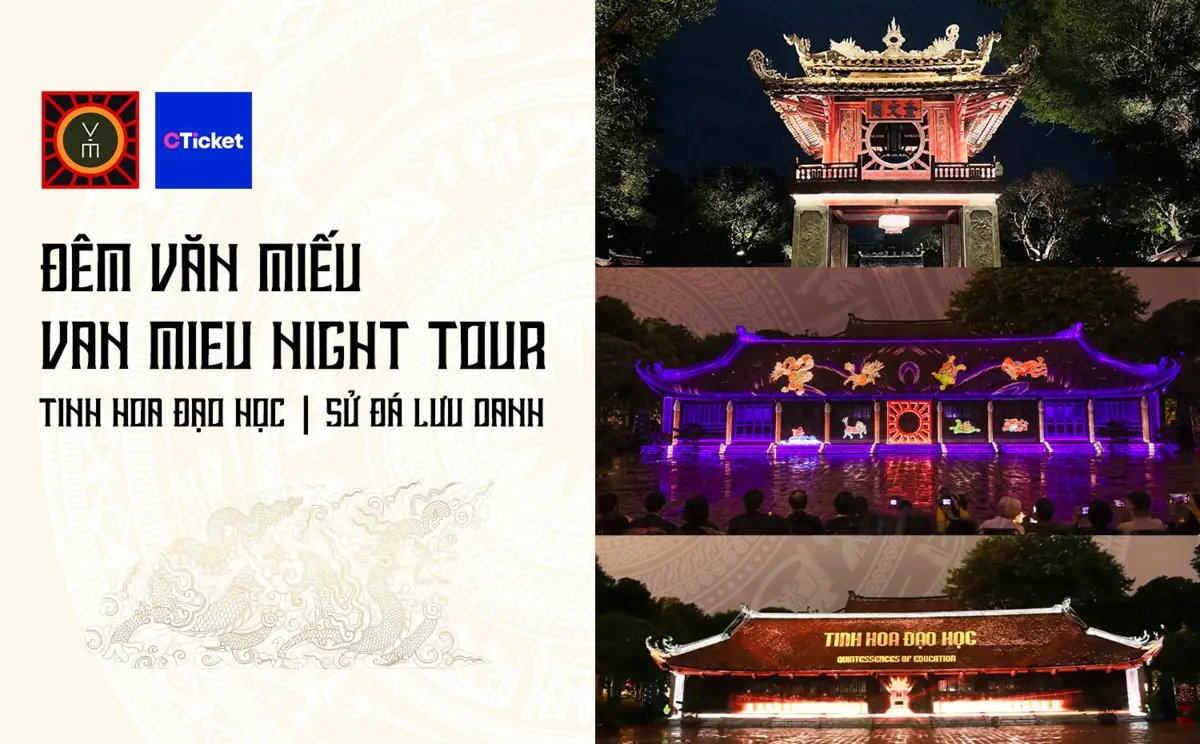
The night tour "The Essence of Education" ("Tinh hoa đạo học")
The night tour "The Essence of Education" ("Tinh hoa đạo học") — the English name used by the monument's own website — has been running since November 1, 2023, on Wednesday, Saturday and Sunday evenings. According to the official page, it was created "trong bối cảnh Hà Nội đẩy mạnh phát triển kinh tế ban đêm" — "at a time when Hanoi was actively developing its night-time economy." Its centerpiece is 3D projection mapping on the facade of the Thái Học front hall: the founding of the temple and the academy, the 82 stelae, the old examinations with their "lều chõng" (the tent and bamboo cot that every candidate brought along), the history of Vietnamese education.
But the tour is more than a show. Along the path from the Văn Miếu Môn gate to the Đại Trung gate, four characters — "Tinh Hoa Đạo Học" — light up on the walkway; at the first stele, the one of 1484, visitors are greeted by a "wise turtle" (cụ rùa thông thái), an animated character with which, according to the website, you can "talk"; in the "teacher's house" (Ngôi nhà thầy đồ), visitors are shown the "four treasures of the study" (brush, inkstone, paper and ink) and can try their hand at calligraphy; and every guest takes home a woodblock print of Khuê Văn Các on dó paper — traditional handmade paper from the bark of the dó tree. There are also creative tasks in virtual reality.
Evening tickets are sold separately; the daytime ticket is not valid. The monument's website lists two packages — "1 show" and "2 shows" — each with separate prices for adults and children; an adult is a visitor taller than 1.30 m (about 4 ft 3 in), a child is between 1 m and 1.30 m, and children under a meter (about 3 ft 3 in) go free. The price changes (it has already changed since the tour was launched in 2023) — check on vanmieu.gov.vn. Bookings: 033 644 1838 and 033 644 1839.
We cover these events on separate pages — check the Hanoi events listings to catch them in person.
Quốc Tử Giám at 950: the anniversary year of 2026
The academy was founded in 1076, and 2026 became the monument's jubilee year — 950 years of "Quốc Tử Giám – Quốc học Việt Nam," "Quốc Tử Giám — Vietnam's national learning." The program stretched over almost the whole year.
The opening. On December 30, 2025, the exhibition "Đạo học ngàn năm" ("A Thousand Years of Learning") opened — for the 955th anniversary of Văn Miếu (1070–2025) and the 950th anniversary of the academy. On January 1, 2026, there was a night program, "Âm sắc Việt" ("Vietnamese Timbres"), and on January 9 a procession of 950 primary school pupils from the ward, "Gieo mầm Đạo học" ("Sowing the Seeds of Learning"). On February 6, in time for Tết, the permanent exhibition on the stelae, "Stone Steles of Achievement" ("Sử đá lưu danh"), opened (more on it under "Three exhibitions") (Báo Văn hóa, 2026).
November: anniversary week. At a press conference on November 2, 2026, the Hanoi Department of Culture, Sports and Tourism announced 11 events; the anniversary week ran from November 5 to 15. The programs included a participant's "passport," "Hành trình Quốc học – Dấu ấn tri thức" ("The Journey of National Learning — Imprints of Knowledge"); a photo spot, "Gặp gỡ hiền tài" ("Meeting the Talents"); and the program "Ánh sao Khuê Minh Triết" ("The Light of the Wise Khuê Star"), in which, according to VietnamPlus, 950 schoolchildren took part on November 11. Earlier, on October 28, a scholarly conference marked the 280th birth anniversary of the scholar Ngô Thì Nhậm, whose name is carved on the stele for the 1775 examination, and on November 12 a national scholarly conference was held, "950 năm Quốc Tử Giám: Di sản đạo học, hiền tài và khát vọng phát triển đất nước" ("950 Years of Quốc Tử Giám: The Heritage of Learning, Talent and the Aspiration for National Development").
November 8. By Hồ Văn, an arts program was staged: "950 năm Quốc Tử Giám – Minh triết khai văn, mở trí, hội tụ hiền tài" — "950 Years of Quốc Tử Giám: Wisdom That Opens the Way to Letters, Enlightens the Mind and Gathers Talent." It had three chapters: "Khởi nguồn đạo học" ("The Origins of Learning"), "Hiền tài đất Việt" ("Talents of the Vietnamese Land") and "Sao Khuê minh triết" ("The Wise Khuê Star").
November 13, 19:30–21:30, Thái Học courtyard. The state ceremony "950 năm Quốc Tử Giám – Quốc học Việt Nam" ("950 Years of Quốc Tử Giám — Vietnam's National Learning") was held under the theme "Tinh hoa đạo học" ("The Essence of Education"). It was attended by General Secretary and State President Tô Lâm and by the head of the UNESCO Office in Vietnam, Jonathan Wallace Baker. The arts program, directed by Phạm Hoàng Giang, was in two parts — "Mạch nguồn đạo học" ("The Wellspring of Learning") and "Hiền tài là nguyên khí quốc gia" ("Talent Is the Vital Force of the State"). The organizers were the Hanoi Department of Culture, Sports and Tourism, the Văn Miếu center and the company VietNamshow, under the direction of the city People's Committee. During the ceremony, the General Secretary was told in particular about the stele for the 1592 examination, which records a father and his son (see "Names in stone"). The monument's website quoted Tô Lâm's words as follows:
"Muốn đất nước trường tồn, tự chủ và vươn tầm thế giới, cội gốc muôn đời vẫn là vun bồi sự học, nuôi dưỡng hiền tài." "For the country to endure, to stand on its own and to rise to the world stage, the root for all time remains the cultivation of learning and the nurturing of talent." Tô Lâm, General Secretary and State President, at the state ceremony on November 13, 2026; as quoted on the monument's website
There is a small discrepancy over the date of the ceremony: at the press conference on November 2 it was announced for 19:30 on November 14, but the report on the monument's website is dated November 13. We follow the date of the report — November 13.
Exhibitions on the road. The anniversary went beyond the temple walls: traveling exhibitions, "Quốc Tử Giám Thăng Long…" ("The Quốc Tử Giám of Thăng Long…"), were shown in Nghệ An province (October 6 – November 6, 2026) and at the Temple of Literature of Sơn Tây (from November 7, 2026).
Temporary exhibitions, 2025–2026
Besides its permanent exhibitions (described under "Three exhibitions"), the monument is always showing something new. Here is what was on in 2025–2026.
"Bia đá kể chuyện" ("The Stelae Tell Stories"). The first exhibition under this title was held in 2022; the second opened on January 16, 2025, right in the stele garden. It had four themes: "Chiêu mộ hiền tài" ("Recruiting Talent"), "Con đường khoa cử" ("The Road of the Examinations"), "Gương sáng tiền nhân" ("Shining Examples of Our Forebears") and "Tài hoa nghệ thuật" ("The Artistry of the Craftsmen") — about the dragons on the crowns of the stelae, the ornament on their edges and how the turtle bases changed from one period to the next. Trương Quốc Toàn — a staff member of PRX-Vietnam, the Paris Region's agency for international cooperation in Vietnam, and an adviser to the monument on visitor programs — explained the idea to Nhân Dân like this: the stelae are a "pho sử đá," a "chronicle in stone," but a "đóng" — "closed" — chronicle, and it needs to be "opened."
"Vườn Ánh sáng" ("Garden of Light"). From April 10 to 19, 2026, a free light exhibition devoted to craft villages ran in the Vườn Giám garden, from 8:00 to 21:00 (Báo Đầu tư).
"Tổ nghề và danh Nho nước Việt" ("Craft Founders and Famous Confucian Scholars of Vietnam"). From November 9 to December 5, 2026, in the Tiền đường, the front hall of Thái Học — an exhibition held as part of the Hà Nội Creative Design Festival 2026. It tells the story of eight doctors from the stelae who are venerated as founders of crafts, and of Đặng Huy Trứ, who stood at the origins of Vietnamese photography.
"Từ di sản đến ngoại giao văn hóa" ("From Heritage to Cultural Diplomacy"). On November 11, 2026, a VNA photo exhibition opened — more than 60 photographs; in its report on the exhibition, the monument's website lists the visits of heads of state (more under "Guests").
Lessons, workshops and an app
The Temple of Literature long ago became an open-air classroom. The monument's website describes several ongoing programs.
"Giáo dục di sản" ("Heritage Education") — programs for preschoolers and for schoolchildren in grades 1–3, 4–6 and 7–12.
"Lớp học xưa" ("The Old Classroom"). Children are taken to see a village teacher of characters: they grind their own ink and learn to write with a brush on dó paper.
"Đi tìm linh vật trên kiến trúc cổ Văn Miếu" ("Find the Mythical Creatures on the Old Buildings of Văn Miếu") — a hunt for mythical animals on the old buildings; what some of them mean is explained under "Carp, a tiger and the Khuê star."
"Đưa nghề ra phố" ("Taking Crafts to the Street"). Since June 20, 2026, craftspeople have been demonstrating their trades right on the grounds of the monument (monument's website), wood carving among them (Tiền Phong, 2026).
Calligraphy. You can try writing both in the Vietnamese Latin alphabet and in Chinese characters; at the New Year there is "xin chữ," asking a calligrapher for a character; on weekends there are short calligraphy courses, and separate workshops are arranged for groups.
The "Việt Nam diệu sử" ("Vietnam's Wondrous History") app. On November 23, 2025, the center and the company BSM launched a free app using augmented reality and artificial intelligence. At the "Nhà Thầy đồ" ("Teacher's House") there are three AR points with tablets and screens: you can "stand beside" people of the past and follow the path of a Confucian student — from the village teacher to the examination tent and "vinh quy bái tổ," the triumphant return to one's home village to bow before the ancestors (Báo Văn hóa, 2025).
Opening hours, tickets and how to get there
| Hours (daytime) | Daily, 8:00–17:00 |
| Evening — the night tour "The Essence of Education" ("Tinh hoa đạo học") | Wed / Sat / Sun, 18:30–22:00 (when the tour was launched in 2023, the press gave 19:00–22:00) |
| Tết | special hours, announced each year; in 2026, closed from noon on February 16, then open 7:30–18:00 from February 17 |
| Adult ticket | 70,000 ₫ (since January 1, 2024, under Resolution No. 16/2023/NQ-HĐND of the Hanoi People's Council, the city council) |
| Reduced ticket | 35,000 ₫ — Vietnamese citizens aged 60 and over; pupils and students of educational institutions in Vietnam; people with severe disabilities (with documentation); people entitled to cultural benefits (with documentation) |
| Free | children under 16; people with especially severe disabilities |
| November 23 — Vietnam Cultural Heritage Day | free for everyone |
| November 24 — Vietnam Culture Day | in 2026, Văn Miếu is not on the list of sites with free admission |
| Night tour "The Essence of Education" | "1 show" and "2 shows" packages — the price changes, check on vanmieu.gov.vn; children under 1 m go free |
| Audio guide | 12 languages, including Russian; devices are issued at the services desk; the website does not give a price |
Prices and hours change — check before you go. In the evening a separate ticket applies; the daytime ticket is not valid. Phone: 024 3747 2566 (main line) and 0866 663 645; 0986 060 566 — "Khuyến học Văn Miếu" ("Encouragement of Learning, Văn Miếu"); night-tour bookings — 033 644 1838 / 033 644 1839.
How to get there. The entrance is on the south side, at 58 Quốc Tử Giám Street. Distances to the center, the railway station and the airport are given under "Where is the Temple of Literature, and how far is it from the center?" In the center, the easiest options are to walk or to book a car through a ride-hailing app (Grab); from outlying districts, take public transport or use the same app. The monument's website lists the buses: 02, 41, E08 and E09 stop opposite 40 Tôn Đức Thắng Street (by the Vườn Giám garden); the 38 stops by 58 Quốc Tử Giám, right at the entrance. Cars and tour buses park along Văn Miếu Street; motorbikes and bicycles, in Vườn Giám.
When to go. Weekday mornings are best: it is cooler and less crowded. The most atmospheric times are the days before Tết (the calligraphers at Hồ Văn) and exam season, but it is crowded then, too. The evening program is a separate visit on a separate ticket.
Rules. This is a sacred place. Under the visitor rules on the monument's website: buy a ticket and show it at the entrance check; "Không sờ, viết, vẽ lên hiện vật, bia đá, công trình kiến trúc. Không giẫm cỏ, hái hoa, bẻ cành" — "Do not touch, write or draw on artifacts, stone stelae or buildings. Do not walk on the grass, pick flowers or break branches"; no smoking anywhere on the grounds; in places of worship, dress modestly and keep quiet; superstitious practices, gambling and fraud are prohibited; visitors are liable for any damage they cause, and security staff may end the visit of anyone who breaks the rules. Do not touch the stelae or the turtles — they are fenced off.
Facilities. An information desk, free Wi-Fi, an audio guide, QR codes with information at the sights, restrooms, motorbike and bicycle parking, a souvenir shop and guides. On the path west of the Đại Thành area, on the way to Thái Học, there is a book café, "Thư quán" ("The Bookshop"): coffee, juices, books.
Things to know. First, you won't be able to "rub a turtle for luck": that is exactly why the stelae were fenced off. Second, the new ward has the same name as the monument — in an address, don't confuse the ward with Văn Miếu Street. Third, the exit is not where the entrance is. Fourth, don't mix up the two November holidays: the free day here is November 23, Cultural Heritage Day. Since 2026, November 24 has been celebrated as Vietnam Culture Day, and Circular No. 167/2026/TT-BTC of the Ministry of Finance grants free admission that day to the museums and monuments on its list — but Văn Miếu, according to VietnamPlus, is not on it.
CityGuide tip. The complex is compact and "reads" logically, courtyard by courtyard — for places like this we prepare a self-guided walking guide (you can download it to your phone and use it offline, or print it out). And you can find "your" stele in advance: on vanmieu.gov.vn each of the 82 stelae has a 3D model, the year of the examination, the date it was erected, the number of successful candidates and, for many of them, the names of the top three; search by examination year.
What to see nearby
Distances are our own measurements along OpenStreetMap routes (OSRM) from the main gate, on foot; where a measurement comes from another of our articles, we say so.
- Vietnam National Fine Arts Museum (≈610 m / ≈8 min) — the museum stands across Nguyễn Thái Học Street from the temple's rear wall, while the temple's entrance is on the south side.
- Goethe-Institut Hanoi (≈0.6 km / 8 min, from the measurements in our article on the institute) — in January 2024 the President of Germany, after touring the Temple of Literature, also called in at the institute (according to our article on the institute).
- Hàng Đẫy Stadium (≈0.74 km / 10 min, from the measurements in our article on the stadium) — at Tết 2026, visitors to the temple parked their cars free of charge by the stadium, at 9 Trịnh Hoài Đức.
- Hanoi Flag Tower (≈0.92 km / 12 min) — open since January 1, 2025, as part of the citadel.
- Imperial Citadel of Thăng Long (≈0.96 km / 13 min) — a UNESCO World Heritage Site; in 2023 Poetry Day moved here from Văn Miếu for the first time.
- One Pillar Pagoda (≈1.22 km / 16 min) — on the 1962 list of national monuments it is number two, immediately before the Temple of Literature.
- Hồ Chí Minh Mausoleum (≈1.39 km / 19 min) — in 2006 many university applicants, after visiting the stelae, went on here (VnExpress).
- Hỏa Lò Prison (≈1.45 km / 19 min) — at Tết 2026 it received 7,034 visitors, compared with 34,712 at the Temple of Literature (Thời báo Tài chính Việt Nam).
- Vietnam National Academy of Music (≈1.49 km / 20 min) — a conservatory with its own concert hall, on Hào Nam Street.
- Quán Thánh Temple (≈2.03 km / 27 min) — another stop on the applicants' "luck route" of 2006.
- Kim Liên Temple (≈2.7 km / 36 min, from the measurements in our article on the Voi Phục and Kim Liên temples) — the second special national monument in the same Văn Miếu – Quốc Tử Giám ward.
- Trấn Quốc Pagoda (Chùa Trấn Quốc) (≈2.74 km / 37 min on foot; by car, because of one-way streets, 6.66 km) — a chùa (Buddhist pagoda) on West Lake whose history our database entry and the Vietnamese press trace back to the 6th century.
- Hanoi Old Quarter — it begins north of Hoàn Kiếm Lake (for the distance to the lake, see the table under "Where is the Temple of Literature, and how far is it from the center?"); at the entrance to Ngọc Sơn Temple on the lake stands the Pen Tower (Tháp Bút) — the last stop on the same "luck route."
The Temple of Literature is part of our guide to Hanoi.
What to see
A walk through the five courtyards
The temple is built as a path: five courtyards behind brick walls, and every wall is pierced by a main gate and two side gates. Walking through them in order is the heart of the visit; the whole complex is compact, and an unhurried look around takes an hour to an hour and a half. The buildings are of different ages, and the monument's website dates each one: the Đại Trung gate and the Đại Thành hall are in the Later Lê style (15th–17th centuries), the Khuê Văn Các pavilion dates from 1805, the main Văn Miếu Môn gate from the early 20th century, the Thái Học area from 1999–2000 and the pavilion on the island in Hồ Văn from 2022.
First courtyard — through the Văn Miếu Môn gate (the Nhập Đạo zone, "entering the Way"). A shady entrance area with old trees, lawns and two ponds on either side. The central passage was historically reserved for the king alone; the side ones were for officials and scholars. This is the "threshold" where the city stays outside.
Second courtyard — the Đại Trung gate ("Great Middle"), the Thành Đạt zone ("achievement"). A calm transition between the worldly and the sacred. The main path leads to Khuê Văn Các; the side paths lead to the small gates of Bí Văn and Súc Văn.
Third courtyard — the Khuê Văn Các pavilion and the stele garden. The most recognizable view of the complex and the symbol of Hanoi. Beyond the pavilion lie the Thiên Quang well and the 82 stelae on their turtles — this is where people linger longest.
Fourth courtyard — the Đại Thành temple. Past the "Gate of Great Success" lies the most sacred part of the complex: the hall with the altar of Confucius and his four principal disciples (Tứ phối). Red lacquered columns, carvings, muted light, incense. Chu Văn An is venerated in the next courtyard, the fifth.
Fifth courtyard — Thái Học, the academy. A complex rebuilt on the site of the hall destroyed in 1946–1947: front and rear halls, a bell tower and a drum tower, a large bell, a statue of the rector Chu Văn An and museum exhibitions. Here the story of "the first university" comes full circle.
You leave the complex by a different way from the one you came in (the addresses of the exits are under "Where is the Temple of Literature, and how far is it from the center?"). If you have arranged to meet a taxi driver "at the entrance," it is best to make clear right away which one you mean.
What follows goes courtyard by courtyard, with the things that are easy to miss.
In front of the gate, and the Văn Miếu Môn gate
The temple begins out on the street. The monument's website calls the forecourt the Tiền án, the "front court." It opens with the tứ trụ — "four pillars" of brick: the two middle ones are taller, and on their tops, facing each other, sit nghê, the mythical guardian creatures of Vietnamese sanctuaries; on the two outer ones are pairs of phoenixes with outspread wings and joined tails. On either side stand two "Hạ mã" stelae — "Dismount." They reminded everyone who rode past, "dù là bậc công khanh (quan lại) hay dân thường" — "whether a high dignitary (an official) or a commoner" — that here one had to get down from one's horse as a sign of respect.
Văn Miếu Môn, the main gate, was built in the early 20th century. Above it are three large characters, "Văn Miếu Môn," "Gate of the Temple of Literature." From the outside the gate looks like a building in its own right: two tiers, three passageways and eight roof slopes. The doors of the central passage are made of lim, a dense ironwood, and carved with dragons turned toward the moon; on the roof ridge is the same motif, "lưỡng long chầu nguyệt," "two dragons paying homage to the moon." On the outside the gate is guarded by a pair of stylized stone dragons from the Lê period, on the inside by a pair from the Nguyễn period: two styles, centuries apart, at a single threshold.
Inside the gate hangs a bell 2.1 m (about 6.9 ft) tall and 0.99 m (about 3.2 ft) in diameter — it was cast in 2000 for the 990th anniversary of Thăng Long – Hanoi (Thăng Long being the old name of the capital).
The pillars of the gate bear parallel sentences in classical Chinese. The monument's website gives one of them in full:
"Đại quốc bất dịch giáo, bất biến tục, thả tôn sùng chi, diệc tín tư văn nguyên hữu dụng / Ngô Nho yếu thông kinh, yếu thức thời vô câu cố dã, thương tư thánh huấn vĩnh tương đôn." "A great country does not change its teaching or alter its customs, but reveres the way of Confucius and trusts that letters have always been of use. / We Confucians must master the classics and understand our own times, without clinging to pedantry and stubbornness, and remember that the teachings of the sages are forever held in honor." Parallel sentences on the middle pillars on the outside of the Văn Miếu Môn gate; translation based on the Vietnamese interpretation on the monument's website
On either side of the gate are two reliefs: on the left, "Long ngư tụ hội," "dragons and fish come together"; on the right, "Mãnh hổ hạ sơn," "the mighty tiger comes down from the mountain." What they mean is explained under "Carp, a tiger and the Khuê star."
Đại Trung: a gate without doors, and two carp
From the main gate a red-brick path leads to the Đại Trung gate, and two side paths lead to small gates. Their names are a whole educational program in themselves: Thành Đức, "Perfected Virtue," and Đạt Tài, "Attained Talent." According to the monument's website, this reflects one of the old Vietnamese requirements of an educated person: to be both virtuous and talented.
The Đại Trung gate itself is in the Later Lê style (15th–17th centuries). It is a wooden structure of three bays on eight rows of columns lacquered red — and without a single door. The round columns are not sunk into the ground but stand on stone bases: the weight of the roof keeps them steady. The roof is covered with "mũi hài" tiles — "shoe-tip" tiles, also known as "dragon scales"; tiles of this kind, according to the website, were already in use under the Lý. The gate stands on a brick platform edged with stone; three steps lead up to it, and the floor is paved with brick from the pottery village of Bát Tràng.
On the ridge are two carp on either side of a vase, made of fragments of porcelain and ceramics. This is a technique of Nguyễn-dynasty palace decoration, and here the carp carry a meaning of their own: it is explained in the section on symbols.
Beyond Đại Trung begins the second courtyard — Thành Đạt, "Achievement." Three paths run through it as well: the middle one to Khuê Văn Các, the side ones to the small gates of Bí Văn ("Refined Style," meaning clear, carefully polished writing) and Súc Văn ("Concise Style," meaning writing that is compressed and full of meaning).
Khuê Văn Các: the pavilion of the star of letters
In 1805 the governor-general of the Northern Citadel (tổng trấn Bắc Thành), Nguyễn Văn Thành, ordered the Khuê Văn Các — the "Pavilion of the Constellation of Letters" — to be built at the Văn Miếu of Hanoi. The monument's website describes it as symmetrical, simple and elegant; it stands on a high square base faced with Bát Tràng brick. The lower level is formed by four brick pillars, open on all four sides. The upper level is of wood, with a two-tiered roof of tubular tiles; its four corners are decorated with terracotta, and on its sides are a carved wooden frieze and balustrades of turned balusters.
The heart of the pavilion is the four round windows of the upper level. Wooden bars radiate around each of them — these are the rays of the Khuê star. That is the name of one of the 28 lunar mansions, or constellations, of old Chinese astronomy — according to the monument's website, the brightest of them; its sixteen stars, the same website says, are arranged so that they resemble the character 文 — "văn," "writing, letters" — and the ancients regarded Khuê as the star that protects literature. The square base and the round windows read as earth and heaven, with the light of knowledge pouring between them.
Above the pavilion hangs a board with three large characters, "Khuê Văn Các," and on its four sides are parallel sentences in praise of the pavilion and the Khuê star. One of them, on the rear side, begins with the words "Khuê tinh thiên lãng nhân văn xiển" — in the website's interpretation, "the Khuê star shines bright in the sky, and human letters shine forth."
Today Khuê Văn Các is the official symbol of Hanoi under the Law on the Capital (more under "Heritage status"), and it is the pavilion's image that is printed on the 100,000-dong banknote. The pavilion stands before the Thiên Quang well, at the end of the main path through the second courtyard.
The Thiên Quang well and the stele garden
Immediately beyond Khuê Văn Các lies the third courtyard and its heart, "Thiên Quang Tỉnh," the "Well of Heavenly Clarity." It is a square pond 30 by 30 meters (about 98 by 98 feet) with a brick balustrade; on the east and west sides, brick steps lead down to the water, and the water, according to the monument's website, stays full all year round, "xanh trong phẳng lặng" — "clear, green and still."
On both sides of the well, to the east and west, stretch the rows of stelae. Above them are eight low roofed shelters on wooden posts, covered with "mũi hài" tiles, and two stele pavilions in the middle of the rows. The shelters were built in 1994 to protect the stelae, and in the website's words they made the third courtyard a complete architectural ensemble. Exactly a hundred and seven years earlier, in 1887, the French researcher Gustave Dumoutier saw a very different picture here: the earlier shelter "a complètement disparu, et les monuments sont aujourd'hui exposés à toutes les intempéries" — "has completely disappeared, and the monuments are now exposed to every kind of weather" (more under "'The Pagoda of the Crows': Văn Miếu in 1887").
The stelae stand behind a barrier, but there are walkways between the rows — you can get close to the stone without touching it. How the barrier has changed is told under "Stelae behind a fence."
How to see the stele garden. Walk along the rows slowly: stelae from different centuries are easy to tell apart by their crowns, their ornament and their turtles (what exactly to look for is in the next section). The very first one, for the 1442 examination, is the one inscribed with "Hiền tài là nguyên khí quốc gia." If you have found "your" stele on vanmieu.gov.vn in advance by examination year, look at its 3D model there as well: that makes it easier to recognize in the row.
How to read a stele
Every stele is a document in several layers, and even without knowing the characters you can tell them apart.
The crown. At the top are the stele's title and carved dragons. With its theme "Tài hoa nghệ thuật" ("The Artistry of the Craftsmen"), the 2025 exhibition "The Stelae Tell Stories" set out to teach visitors exactly this: to look at the dragons on the crowns, the ornament on the edges and the turtle bases, all of which changed from period to period (Nhân Dân, 2025).
The "ký" text. The main field is taken up not by a list but by an essay on the meaning of the examination. According to the "Stone Steles of Achievement" exhibition, these texts have four constant themes: to glorify outstanding scholars and encourage learning; to affirm the role of talent for the country; to instruct the "kẻ sĩ" — the men of learning — in their duty; and to encourage good and restrain evil (Tuổi Trẻ, 2026). It is this text, according to Trịnh Khắc Mạnh, director of the Institute of Hán-Nôm Studies, that sets the Hanoi stelae apart from the Chinese ones.
The list of doctors. Below come the names of those who passed the examination and their home villages (on the classes of doctors, see "Three levels of the imperial examinations").
The signatures. UNESCO notes that each stele bears the date and the names and posts of the compiler of the text, the revisers, the calligrapher and the engravers. Every stele is also a model of calligraphy: the texts are written in different hands (Nhân Dân, 2025).
The turtle. The base, too, dates a stele: the turtles of different periods look different. According to UNESCO, the differences in design, ornament, turtle base and type of characters both preserve the stelae's authenticity and frustrate attempts to make copies.
The scars. On some stelae you can see lines that have been chiseled away. This is not damage done by time but the trace of an order issued in 1840 (details under "1840: the chiseled-off lines").
Record-holding stelae
In 2026 the monument posted a database of all 82 stelae on its website: the year of the examination, the date of erection by the lunar calendar, the number of successful candidates and — for many — the number admitted to the examination and the names of the top three. From this database we worked out the "records" of the stone archive. This is our own count from the official data, not an official ranking.
| Record | Stele | Figures |
|---|---|---|
| Most doctors | 1478 examination (Mậu Tuất) | 62 |
| Second place | 1502 examination | 61 out of 5,000 admitted |
| Fewest doctors | 1592 and 1667 examinations | 3 each |
| Most candidates admitted | 1640 examination | "more than 6,000"; 22 passed — under 0.4% |
| Runner-up | 1514 examination | 5,700 admitted, 43 passed — about 0.75% |
| Toughest selection | 1673 examination | 5 out of "more than 3,000" — under 0.17% |
| The only stele of the Mạc dynasty | 1529 examination | 27 out of 4,000 |
| The very first | 1442 examination | 33 out of 450 |
| The latest | 1778 and 1779 examinations | stelae erected in 1780 |
The first stele is the "easiest." At the 1442 examination roughly one candidate in fourteen passed — 33 out of 450; on no other stele with a known number of candidates is the pass rate higher. Later the competition grew tens of times over: in 1514 there were more than a hundred and thirty candidates for each doctor's place, in 1640 more than two hundred and seventy, and in 1673 more than six hundred.
When no top three were named. On several 18th-century stelae — for the examinations of 1731, 1736, 1754, 1757, 1763, 1766, 1769 and 1772 — the tam khôi ("top three") entry reads "không có," "none": nobody reached the titles of trạng nguyên, bảng nhãn and thám hoa — the first, second and third laureates of the examination (in 1731 and 1736, partly). An examination could give the country doctors without giving it a first scholar.
Three special examinations. Three stelae record "Chế khoa," special examinations held outside the regular schedule in 1554, 1565 and 1577. The other 79 are for the regular examinations for the degree of tiến sĩ (doctor).
By period. Of the 82 stelae, 13 belong to the Early Lê (Lê sơ), one to the Mạc dynasty and 68 to the Revival Lê (Lê trung hưng, the "restored Lê").
Names in stone
Among the 1,304 doctors are people whose names every Vietnamese schoolchild knows. The official stele database and the monument's exhibitions help you find them on the stone.
The 1442 stele. The top three of the first examination were the trạng nguyên (first laureate) Nguyễn Trực (1417–1474) from Thanh Oai district, the bảng nhãn (second laureate) Nguyễn Như Đổ from Thanh Trì district — both places are within Hanoi today — and the thám hoa (third laureate) Lương Như Hộc from Trường Tân district, now part of Hải Phòng. Among those who passed that year was Ngô Sĩ Liên, the future author of the Complete Annals of Đại Việt, the country's principal chronicle, and among the four high officials who examined the candidates at the palace examination was Nguyễn Trãi (Tuổi Trẻ, 2026, drawing on the "Stone Steles of Achievement" exhibition).
The 1463 stele. The trạng nguyên was Lương Thế Vinh (born 1441, year of death unknown) from Thiên Bản district, now in Ninh Bình province; the thám hoa was Quách Đình Bảo (born 1440, year of death unknown). About Lương Thế Vinh — Báo Pháp luật Việt Nam writes that he laid the foundations of Vietnamese mathematics — and his rival an anecdote was told, which you will find under "Lương Thế Vinh and the kite."
The 1529 stele. The only surviving stele of the Mạc dynasty: the examination was held less than two years after Mạc Đăng Dung took the throne of the Lê. The trạng nguyên was Đỗ Tổng.
The 1592 stele: father and son. This stele bears only three names, and two of them belong to a father and his son: Ngô Trí Tri and Ngô Trí Hòa passed the highest examination in the same year. At the state ceremony for the academy's 950th anniversary their story was told with particular emphasis: "một trường hợp hiếm có trong lịch sử khoa cử Việt Nam" — "a rare case in the history of Vietnam's examinations."
The 1628 stele. The thám hoa was Giang Văn Minh (1573–1638). No trạng nguyên or bảng nhãn was named that year, so he was the best candidate at his examination. His embassy to Beijing became the subject of a famous historical anecdote (see "'The Bạch Đằng still runs red': the envoy from the 1628 stele"). On this stele, too, you can see a chiseled-off line — a trace of 1840.
17th–18th centuries. The 1659 stele — trạng nguyên Nguyễn Quốc Trinh; 1661 — trạng nguyên Đặng Công Chất; 1743 — thám hoa Phan Kính; 1748 — thám hoa Nguyễn Huy Oánh. On the 1752 stele is the bảng nhãn Lê Quý Đôn (1726–1784). On the 1775 stele is Ngô Thì Nhậm: in October 2026 a scholarly conference was held for his 280th birth anniversary.
Ten video stories. For ten stelae, the monument's website shows videos from the series "Câu chuyện danh nhân" ("Stories of Famous People"): 1463 (Lương Thế Vinh), 1466 (Đàm Văn Lễ), 1475 (Thái Thuận), 1511 (Trần Doãn Minh and Nguyễn Bạt Tụy), 1554 (Nguyễn Sằn), 1580 (Phùng Khắc Khoan), 1715 (Bùi Sĩ Tiêm), 1733 (Trần Hiền), 1752 (Lê Quý Đôn) and 1775 (Ngô Thì Nhậm).
Đại Thành: the hall of Confucius
The Đại Thành gate (the "Gate of Great Success") leads into the fourth courtyard. It too is in the Later Lê style: three bays, each with a double door lacquered red and carved with "Long vân khánh hội," "dragons and clouds in joyful meeting" — according to the monument's website, an image of the prosperity of a country that honors learning. The gate's name is taken from Mencius's words about Confucius: "Khổng Tử là Tập Đại Thành" — "Confucius gathered together the great perfection," meaning that he absorbed the learning and virtue of all the sages before him.
Above the central bay hangs a board reading "Đại Thành môn." On the right, in small characters, is written: "Lý Thánh Tông Thần Vũ nhị niên Canh Tuất thu bát nguyệt phụng kiến" — "Built by royal command in autumn, in the eighth month of the Canh Tuất year, the second year of Thần Vũ, under Lý Thánh Tông," that is, in 1070. On the left: "Đồng Khánh tam niên Mậu Tý trọng đông đại tu" — "Thoroughly restored in midwinter [the eleventh month] of the Mậu Tý year, the third year of Đồng Khánh" (1888). The monument's website calls the board an important historical document confirming that the temple was built in 1070; judging by its inscription, the board itself was made during the restoration of 1888. And it names the month of the founding — the eighth, not the tenth, as many books have it (the question is examined under "What holds up, and what doesn't").
On either side of the gate are the small gates of Kim Thanh and Ngọc Chấn. Their names, according to the website, come from the language of music: "the sound of metal" — the bell with which music begins — and "the sound of jade" — the stone chime with which it ends.
The Đại Bái courtyard ("Great Worship") is enclosed by two long galleries, to the east and to the west. Directly ahead is the Bái đường, the hall of worship, where the rite in honor of Confucius was once performed. Nine bays without doors, forty columns of lim ironwood, stone steps, a brick floor, a roof of "mũi hài" tiles with "lưỡng long chầu nhật nguyệt" on the ridge — "two dragons paying homage to the sun and the moon." At the ends of the hall are windows with turned bars, and beneath them, wooden reliefs from the Early Lê period with dragons among clouds.
In the center of the hall is an altar table, flanked by a pair of bronze cranes standing on turtles (the crane and the turtle are a pair of symbols of longevity). Above the altar hangs the board "Vạn thế sư biểu," "Model Teacher for Ten Thousand Generations" — the title by which Confucius is honored here. On the east side hang the board "Cổ kim nhật nguyệt" ("Sun and Moon of Past and Present") and the Bích Ung bell, cast in the Cảnh Hưng era. Students and teachers of the academy once made offerings here; today, according to the monument's website, schools and family clans come to perform the rite in support of learning and talent.
The Đại Thành sanctuary stands behind the Bái đường, parallel to it, and is linked to it by a small pavilion. Nine bays, solid walls on three sides; the seven middle bays are closed with solid panel doors, and the two end bays have fixed windows with turned bars, in the Later Lê style. The columns are lacquered red and gilded. Here Confucius is venerated, together with the Tứ phối — his four closest followers — and the Thập triết — the ten wise men. In the center stands a statue of Confucius, facing south, and behind it a shrine cabinet holding a memorial tablet.
Thái Học: the academy, the bell and the "Thunder Drum"
The fifth courtyard is Thái Học. Under the Lê, in the 15th century, the Quốc Tử Giám was also called the Thái Học viện, the "School of Higher Learning," and here, according to the monument's website, there were lecture halls, the Minh Luân hall, student dormitories and a storehouse of wooden blocks for printing books. The present ensemble was built in 1999–2000 on the academy's old foundations, modeled on traditional architecture: a front hall, the Tiền đường; a rear hall, the Hậu đường; the side galleries, Tả Vu and Hữu Vu (the left and right galleries); and a bell tower and a drum tower.
The Tiền đường serves as a hall for exhibitions, scholarly conferences and commemorative ceremonies. Since 2025 it has been home to the carved panel "Vinh quy bái tổ" ("Triumphant Return and Homage to the Ancestors"), made of precious cẩm wood (a tropical hardwood) and measuring 8.33 × 1.70 × 0.16 meters (about 27.3 × 5.6 × 0.5 feet). It shows the scholar's whole journey: the village teacher, the tent at the provincial examination, the metropolitan and palace examinations, the golden list of laureates and the festive return to the home village; among the scenes are Văn Miếu with Khuê Văn Các, and the procession curves like a dragon. According to Nhân Dân, the panel has received two Vietnamese records — as the largest carved picture made on a single piece of wood and as the picture with the greatest number of figures.
The Hậu đường has two stories. On the ground floor stands a bronze statue of Chu Văn An — the academy's rector, the "teacher of teachers"; it was cast in 2003 and, together with its throne, weighs about three tonnes (about 6,600 pounds). Here, too, is the exhibition "The Origins of Confucian Learning" ("Khơi nguồn đạo học"). On the upper floor three kings are venerated whom the monument regards as its founders: Lý Thánh Tông (1023–1072), who built the temple; Lý Nhân Tông (1066–1128), who opened the academy; and Lê Thánh Tông (1442–1497), who erected the first stelae. Their statues were cast in 2003 by craftsmen from Ngũ Xã, the Hanoi bronze-casting village: each is 1.4 meters (about 4.6 feet) tall and weighs about a tonne (about 2,200 pounds).
The bell tower and the drum tower stand symmetrically on either side. They were built in 1999 along with the whole area, on the old foundations, and the monument's website frankly warns that they were made in the spirit of traditional architecture but "không hoàn toàn sao chép nguyên mẫu cổ" — "do not entirely copy the ancient prototype." The bronze bell is 2.34 meters (about 7.7 feet) tall and weighs about 700 kg (about 1,540 pounds). In the drum tower is the "Trống Sấm," the "Thunder Drum": 2.65 meters (about 8.7 feet) high, with a drumhead 2.01 meters (about 6.6 feet) across. It was made by craftsmen from the drum-making village of Đọi Tam (in Hà Nam province, part of Ninh Bình since 2025) for the 990th anniversary of Thăng Long – Hanoi; the drumhead is of buffalo hide, and the drum got its name from its rolling, thunderous sound.
Of the old academy, destroyed in 1946–1947, there remain, according to our database entry, the foundations, two stone columns and four stone inkstones.
Three exhibitions
In the Thái Học area and next to it there are three permanent exhibitions, and together they tell a story that the stelae alone cannot.
"The Origins of Confucian Learning" ("Khơi nguồn đạo học") — on the ground floor of the Hậu đường. More than 300 documents, photographs and objects in four parts — on the kings Lý Thánh Tông, Lý Nhân Tông and Lê Thánh Tông, on the teacher Chu Văn An and on other people who shaped Vietnamese education, among them the royal consort (Nguyên phi) Ỷ Lan and the "danh nhân khoa bảng" — a celebrated scholar made famous by the examinations — Lê Văn Thịnh. The design uses bamboo and wood, with colors chosen to echo the dynasties.
"Quốc Tử Giám – The First National University" ("Quốc Tử Giám – Trường Quốc học đầu tiên") — a "wall of time" running from the Lý to the present day. At the end is the "Bảng magic," the "magic board": you write on it with a brush, and the characters vanish after a few minutes. There is also a "binocular" viewer with a three-dimensional image of a stele.
"Stone Steles of Achievement" ("Sử đá lưu danh," literally "stone history that preserves names") — the newest, opened on February 6, 2026, for Tết and the academy's 950th anniversary. It has four themes: education and examinations; the selection and employment of talent; the system of examinations and academic degrees (khoa bảng) — scholarly clans and villages; and portraits of famous people. The materials are "paper and stone," and old rubbings of the stelae are "brought to life" by projection; on interactive screens you can search for doctors and for the texts of the stelae. The exhibition was created by the center's staff together with Vietnamese and French specialists (in the words of director Lê Xuân Kiêu, Báo Văn hóa, 2026). It was this exhibition's material that formed the basis of Tuổi Trẻ's story about the chiseled-off lines and the first stele.
Hồ Văn, Phương Đình and Vườn Giám
Two parts of the monument lie outside its walls, and many visitors miss them.
Hồ Văn — the "Pond of Letters" — is right across the street from the entrance and covers 12,297 m² (about 3 acres). The monument's website explains why it is there: in traditional Vietnamese architecture a temple, a communal house or a pagoda is usually low and hidden among greenery, with a pond in front of the gate. In the middle of the pond is the islet of Kim Châu ("Golden Pearl"). Since 2022 it has been the site of Phương Đình — a two-tiered pavilion with eight roof slopes on sixteen wooden columns; it stands on the sacred axis of the whole complex and faces the same way as the main buildings. A five-span stone bridge on four rows of piers, carved with folk scenes, leads to the island from the northwest. Two old cây si trees (a kind of fig) on the island were preserved, and two old stelae were moved to a flowerbed south of the islet. How the pond came back to the temple and what used to stand on the island is told under "How the temple got its pond back: 1939–1942" and "The 1860s: a pavilion for the stelae and a pavilion on the island."
Vườn Giám — the "Academy Garden" — stretches along the west side of the complex. Here, among the greenery, stands Nhà Bát Giác, the "Octagonal House," a pavilion built around 2000: a multi-tiered roof with eight upturned corners, red tiles, a wooden frame and openings on four sides. According to the monument's website, it is a place for rest and cultural programs. One of the exits runs through Vườn Giám — onto Tôn Đức Thắng Street — and the motorbike and bicycle parking is here too.
Legends and lore
The lucky turtle: a custom and a ban
The stone turtle beneath a stele is a symbol of longevity and eternity: on its back, knowledge was meant to stand for centuries. But for Vietnamese exam candidates the turtle long ago became something else as well — a talisman.
What that looked like comes across clearly in a VnExpress report of July 2, 2006, "Sĩ tử đổ xô đi cầu may" ("Exam Candidates Flock to Pray for Luck"). Before the university entrance exams, thousands of high school graduates made their way to Văn Miếu. The newspaper describes the custom like this: "Sờ đầu rùa, sờ bia tiến sĩ rồi xoa lên trán lấy may" — "they touch the turtle's head and the doctor's stele, then rub their foreheads for luck." One girl went round all 82 stelae in turn. A young man asked the volunteers to find a doctor from his home province and prayed at "his" stele: "Là đồng hương, chắc tiến sĩ sẽ phù hộ cho mình nhiều hơn" — "since we come from the same place, the doctor will surely look after me more." The candidates' motorbikes — "nearly ten thousand" of them — were parked in the Vườn Giám garden. After the stelae they went on to Đại Thành Hall, then to the statue of Chu Văn An in Thái Học, and many then rode on to the mausoleum, to Quán Thánh Temple and to the Pen Tower (Tháp Bút) by Hoàn Kiếm Lake. A ticket cost 5,000 dong at the time.
Already in 2006, according to the same newspaper, the management "dán nhiều tấm biển cảnh báo không được sờ lên đầu rùa, lên bia tiến sĩ, đồng thời tăng số lượng tình nguyện viên túc trực tại 2 dãy bia" — "put up many signs warning people not to touch the turtles' heads or the doctoral stelae, and increased the number of volunteers on duty by the two rows of stelae." The volunteers patrolled with megaphones. Where the custom itself came from, the press does not explain.
Today the question has been settled by the rules: touching the stelae and buildings is forbidden, and the rows are fenced off (how the barrier has changed is told under "Stelae behind a fence"). Too many hands have already worn the stone away — that is precisely why you can no longer "stroke the turtle." Luck is sought differently here now: with a bow in Đại Thành Hall and before the statue of Chu Văn An, and at Tết a calligrapher writes you a character that carries a wish.
The pupil who was the Water King's son
Vietnam's most revered teacher, Chu Văn An, has a legend of his own, connected with his school in the village of Huỳnh Cung. Báo Pháp luật Việt Nam retold it in 2021 and itself cautioned that the story "chỉ mang tính truyền thuyết" — "is no more than a legend."
According to the legend, the son of the Water King (vua Thủy Tề) came to study with the teacher in the guise of a boy. His tracks always ended at Đại pond, between the villages of Đại Từ, Tứ Kỳ and Huỳnh Cung. Then came a drought, and the teacher asked his pupils whether any of them could bring rain. The boy answered:
"Con vâng lời thầy là trái mệnh Thiên đình nhưng con cứ làm để giúp dân." "To obey you, master, is to defy the command of the Heavenly Court, but I will do it all the same to help the people." Legend of Chu Văn An; as told by Báo Pháp luật Việt Nam, August 29, 2021
He ground ink, sprinkled it over the surrounding land, and tossed his inkstone and brush into the sky — and the rain poured down. The next morning the body of a water serpent (thuồng luồng) was found in the pond: it was the pupil, and the teacher had him buried. The inkstone fell to earth and became đầm Mực, the "Ink Pond," whose water, the legend says, is always dark. The brush fell in the village of Tả Thanh Oai, which became a "land of scholars": it was the home of Ngô Thì Sĩ and Ngô Thì Nhậm — the latter's name is carved on the stele for the 1775 examination at Văn Miếu. In 1990 a film was made from the legend, "Học trò thủy thần" ("The Water Spirit Pupil").
The legend explains well who Chu Văn An was in popular memory: a teacher for whose sake even the son of the Water King was willing to defy the will of Heaven. What the chronicles confirm about his life is told under "Chu Văn An: the 'teacher of teachers.'"
"The Bạch Đằng still runs red": the envoy from the 1628 stele
On the stele for the 1628 examination is carved the name of Giang Văn Minh (1573–1638) — the thám hoa, the best candidate at that examination. In Vietnam a famous historical anecdote (giai thoại) is told about him. Znews retold it in 2016, drawing on the book "Các sứ thần Việt Nam" ("Vietnam's Envoys"). It is a story about an embassy, not an official record, and we present it as a story.
According to the tale, in 1637–1638 Giang Văn Minh led an embassy to Beijing. The envoy, the anecdote goes, staged a ritual lament on the death anniversary of a distant ancestor and in this way forced the Ming emperor to concede that what lies far in the past needs no commemoration — and then promptly asked him to abolish the centuries-old tribute of "golden statues."
The best-known part of the anecdote is a verbal duel. To the Ming line "Đồng trụ chí kim đài dĩ lục" — "The bronze pillar is green with moss to this day," an allusion to the bronze pillar of the Chinese general Ma Yuan (Mã Viện in Vietnamese) — Giang Văn Minh replied:
"Đằng Giang tự cổ huyết do hồng." "The Bạch Đằng River, since ancient times, still runs red with blood." Giang Văn Minh's reply in the historical anecdote; as told by Znews, November 6, 2016, citing the book "Các sứ thần Việt Nam"
It was a reminder of the three victories on the Bạch Đằng River. According to the story, the envoy paid for his audacity with his life: he died on the 2nd day of the sixth lunar month of 1638. King Lê Thần Tông honored him with the inscription "Sứ bất nhục quân mệnh, khả vi thiên cổ anh hùng" — "The envoy did not disgrace his sovereign's command; he is worthy to be called a hero for a thousand ages."
The official stele database confirms little, but what it confirms matters: Giang Văn Minh, who lived from 1573 to 1638, was the thám hoa of the 1628 examination, and no trạng nguyên or bảng nhãn was named that year, so he really was the top candidate at his examination. The rest is what the anecdote has added to his biography.
Lương Thế Vinh and the kite
The stele for the 1463 examination preserves the names of two rivals about whom an anecdote grew up: the trạng nguyên Lương Thế Vinh and the thám hoa Quách Đình Bảo. Báo Pháp luật Việt Nam retold it in 2020.
According to the tale, Quách Đình Bảo had heard a great deal about a child prodigy from the village of Cao Hương and went to take a look at him. He expected to find his rival poring over his books, but found him flying a kite — and admitted that he would never catch up with him. At the 1463 examination that is exactly how it turned out: Lương Thế Vinh came first and Quách Đình Bảo third.
Among the people, Lương Thế Vinh is known as "Trạng Lường," the "Measuring Laureate" (lường means "to measure"; trạng comes from trạng nguyên, "first laureate"), and the newspaper writes that he "đặt nền móng cho Toán học nước nhà" — "laid the foundations of our country's mathematics." The newspaper gives his year of birth as 1411, but that is a misprint: the official stele database gives 1441, and the newspaper itself says a little further on that he was twenty-two in 1463.
Carp, a tiger and the Khuê star: the language of symbols
The Temple of Literature speaks to its visitors in the language of symbols, and each has a meaning of its own, which the monument's website explains.
The carp on Đại Trung. The two carp on the ridge of the second gate face a vase. According to the website, they are a metaphor and a lesson for the student: to succeed, you have to work hard at the classics and at history — and then the day will come when you pass the examination and return to your home village in glory (vinh quy bái tổ). Behind this lies the old East Asian image of the carp that leaps the Dragon Gate and turns into a dragon.
Dragons and fish; the tiger. The relief "Long ngư tụ hội" by the main gate — fish and dragons appearing and vanishing among clouds — is likened, according to the website, to "thanh vân đắc lộ," "a road through the blue clouds" for a successful scholar, that is, a swift career. The relief to the right of the gate, "Mãnh hổ hạ sơn" — a tiger coming down from the mountain amid forests, clouds and waters — represents people of learning stepping forcefully into life.
Dragons with the moon and the sun. On the ridges of the main gate there are "two dragons paying homage to the moon"; on the Bái đường and the Đại Thành sanctuary, "two dragons paying homage to the sun and the moon"; and on the doors of the Đại Thành gate, dragons and clouds, "Long vân khánh hội," a sign of the prosperity of a country that honors learning.
The crane on the turtle. The bronze cranes standing on turtles by the altar of Confucius join two symbols of longevity. The same turtle carries every stele on its back.
The Khuê star. One of the 28 lunar mansions of old Chinese astronomy and the patron star of letters: its sixteen stars, according to the monument's website, form a likeness of the character 文, "văn." The rays of this star are the wooden bars around the round windows of Khuê Văn Các.
Nghê and phoenixes. On the pillars in front of the entrance sit nghê, mythical guardians; according to the monument's website, at Văn Miếu there are nghê on these pillars, on the doctoral stelae, by the Đại Thành gate and even on the robes of Confucius, and in each place they have their own look and meaning — a children's program, "Ơ kìa con nghê!" ("Oh look, a nghê!"), is devoted to them. Beside them on the pillars are phoenixes.
The names of the gates. The names themselves add up to an educational program: virtue and talent (Thành Đức and Đạt Tài), refined and concise style (Bí Văn and Súc Văn), the beginning and the end of music (Kim Thanh and Ngọc Chấn), and the "great success" of Confucius (Đại Thành).
What holds up, and what doesn't
Plenty of convenient formulas get repeated about the Temple of Literature. Here is which of them the sources support and which they do not.
"The temple was founded in the tenth month of 1070." Not confirmed. That is what Vietnamese Wikipedia says, quoting a 1993 translation of the Complete Annals of Đại Việt ("Mùa thu tháng 10, làm Văn Miếu" — "In autumn, in the tenth month, the Văn Miếu was made"), and that is what we ourselves used to write. But the classical Chinese text of the chronicle reads "秋八月" — "in autumn, in the eighth month." The eighth month is also given by the monument's website and by the inscription on the board of the Đại Thành gate: "thu bát nguyệt," "in autumn, in the eighth month." The tenth month is an error in the translation.
"In 1076 the academy was opened for princes and the nobility." Not quite. The chronicle says of 1076: "選文職官員識字者入國子監" — "literate civil officials were selected and sent into the Quốc Tử Giám." "Princes and nobility" is the traditional reading of the name itself: "Quốc tử" means "sons of the state."
"In 1156 the king made the temple a place of worship for Confucius alone." This is Vietnamese Wikipedia's interpretation ("cho sửa lại Văn Miếu và chỉ thờ Khổng Tử" — "had the Văn Miếu repaired and worshipped only Confucius there"). Under that year the chronicle says more briefly: "建孔子廟" — "a temple of Confucius was built."
"In 1253 the academy was opened to commoners." The chronicle does not say so directly. Under 1253 it reports that the Quốc Học viện (National Institute) was established, statues of Confucius, the Duke of Zhou and Mencius were made, the 72 worthies were painted, and an edict summoned Confucian scholars from the whole country to come and expound the classics. "A social ladder for commoners" is an interpretation, not the text of the chronicle.
"The temple was founded in 1074." That is what the French researcher Gustave Dumoutier wrote in 1887. It is the author's mistake: the chronicle, the board on the Đại Thành gate and the monument's website all give 1070.
"The stelae bear 1,307 doctors." Yes and no: 1,307 is the number of successful passes, while the number of people is 1,304, because three men passed the highest examination twice.
"Nearly all the buildings date from the late Lê period." Too sweeping — and we used to write it too. The buildings are of different ages: Đại Trung and Đại Thành are in the Later Lê style, Khuê Văn Các dates from 1805, the main gate from the early 20th century, and Thái Học from 1999–2000.
"There have always been 82 stelae." Dumoutier already recorded the figure 82 in 1887: "leur nombre total est de quatre-vingt deux" — "their total number is eighty-two." But stelae have not survived from every examination: from the Mạc dynasty, for example, a single one remains — for the 1529 examination (Tuổi Trẻ, 2026); the chronicle mentions stelae for the examinations of 1505 and 1508 that are not in the rows — and exactly how many stones have been lost in all is not known.
"The symbol of Hanoi since 2012." More precisely, since 1997: that was when the city People's Committee chose it, and in 2012 a law enshrined the symbol.
"The turtle brings good luck." This is a custom, not a legend with a source behind it: the press does not explain where it came from. What is confirmed is something else — that touching the stelae and turtles is forbidden.
History
1070: "in autumn, in the eighth month"
1070. The country is called Đại Việt, "Great Viet," and it is ruled by the Lý dynasty. Vietnam's principal chronicle, the Complete Annals of Đại Việt (Đại Việt sử ký toàn thư), records under the second year of the Thần Vũ era, the year Canh Tuất:
"秋八月,脩文廟,塑孔子、周公及四配像,畫七十二賢像,四時享祀。皇太子臨學焉。" "In autumn, in the eighth month, the Temple of Literature was built; statues were made of Confucius, the Duke of Zhou and the Four Correlates, images of the seventy-two worthies were painted, and sacrifices were offered to them in all four seasons. The crown prince came there to study." "Đại Việt sử ký toàn thư," Bản kỷ (Basic Annals), book 3 (classical Chinese text from zh.wikisource)
The character 脩 in the first sentence means both "to put in order" and "to build"; Vietnamese translations render it as "làm" or "dựng" — "made," "built." The month in the original is the eighth; the monument's website quotes the chronicle the same way ("Mùa thu tháng 8 dựng Văn Miếu…" — "in autumn, in the eighth month, the Văn Miếu was built…"). Why many books say "the tenth" is explained under "What holds up, and what doesn't."
Behind the dry line lies a scene rare for the Middle Ages. The Văn Miếu ("temple of literature," the classical name for a temple of Confucius, the Chinese sage whose teaching shaped government and education throughout East Asia) was built by King Lý Thánh Tông (1023–1072). And its first pupil was his own son, the crown prince Lý Càn Đức: he had been born in 1066, so he was in his fifth year. The boy's mother was the king's consort Ỷ Lan; today she is one of the heroines of the exhibition "The Origins of Confucian Learning," and the monument's website says of her that she rose from a village girl to become the king's consort, then the queen mother, and "hai lần thay vua điều hành đất nước" — "twice governed the country in the king's place."
The statues in the temple of 1070 were not of Confucius alone. The Duke of Zhou was an ancient Chinese ruler and lawgiver whom the Confucians revered as a model; the "Four Correlates" (Tứ phối) were the four principal followers of Confucius; the "seventy-two worthies" were his disciples. This pantheon would later change (see "From the Lý to the Trần").
1075–1076: the examination before the academy
1075. The history of Vietnamese education usually starts with the academy, but the chronicle puts the examination first. Under the year Ất Mão it reports:
"春二月,詔選明經博學及試儒學三場。" "In spring, in the second month, an edict ordered the selection of men versed in the classics and of broad learning, and an examination in Confucian learning in three sessions." "Đại Việt sử ký toàn thư," Bản kỷ, book 3 (zh.wikisource)
The official website calls this the first examination in the history of Vietnamese examinations: "Minh kinh bác học" ("versed in the classics and broadly learned") and "Nho học tam trường" — "Confucian learning in three sessions." It was held three years after the accession of King Lý Nhân Tông — the very crown prince who had come to study at the temple in 1070.
1076. That same Lý Càn Đức — now King Lý Nhân Tông — takes the next step: beside the temple he opens the Quốc Tử Giám, the Imperial Academy. In summer, in the fourth month of the Bính Thìn year, the chronicle records: "選文職官員識字者入國子監" — "literate civil officials were selected and sent into the Quốc Tử Giám." In other words, its first students were not children but men serving in the civil administration; the academy is called "a school for the sons of the king and the nobility" on the strength of the traditional reading of its name — "Quốc tử," "sons of the state."
The king had been on the throne since 1072, when he succeeded at the age of six, and he ruled under a regency — first of the senior empress Thượng Dương, then of the queen mother Ỷ Lan and the general Lý Thường Kiệt. In the year the academy was founded the king was ten; the decision was, of course, made by the court, but it went down in history under the name of the boy who had himself been the temple's first pupil.
Lý Nhân Tông reigned for a long time — until 1128 — and the Vietnamese historical tradition holds him in high regard. The monument's website quotes the verdict of the 19th-century historian Phan Huy Chú:
"Bấy giờ nước lớn phải sợ, nước nhỏ kính mến, thần giúp người theo, dân thì đông giàu, mình thì thái bình, thực là một ông vua giỏi triều Lý." "In those days great countries had to fear him and small ones respected and loved him; the spirits helped him and people followed him; the population was numerous and wealthy, and he himself reigned in peace — truly a fine king of the Lý dynasty." Phan Huy Chú on Lý Nhân Tông; as quoted on the monument's website
From the Lý to the Trần: the temple, the institute and scholars from the whole country
1156. King Lý Anh Tông, according to Vietnamese Wikipedia, "cho sửa lại Văn Miếu và chỉ thờ Khổng Tử" — "had the Văn Miếu repaired and dedicated to the worship of Confucius alone." In the chronicle itself, under that year (Bính Tý), the entry is shorter: "建孔子廟" — "a temple of Confucius was built." Whether the pantheon was narrowed at the time the text does not say, so "a cult of Confucius alone" is an interpretation.
1236. Under the new Trần dynasty the chronicle names the man in charge of the academy: "以范應臣為尚書知國子院,提調文臣從臣子弟入學" — "Phạm Ứng Thần was appointed thượng thư [a high-ranking minister] and administrator of the Quốc Tử viện (the academy, here styled an "institute"), charged with overseeing the admission to study of the sons and younger kinsmen of civil officials and courtiers."
1243. "重修國子監" — "the Quốc Tử Giám was rebuilt." This milestone also appears in the monument's official timeline: King Trần Thái Tông repairs the academy.
1253. In summer, in the sixth month — "立國學院,塑孔子、周公、亞聖,畫七十二賢像奉事" — "the Quốc Học viện [National Institute] was established; statues were made of Confucius, the Duke of Zhou and the Á thánh [the "Second Sage," Mencius], and images of the seventy-two worthies were painted for veneration." And in the ninth month came an edict: "詔天下儒士詣國子院,講四書六經" — "Confucian scholars of the whole realm are to come to the Quốc Tử viện and expound the Four Books and the Six Classics." The academy thus opened its doors to scholars from all over the country. The popular formula "from 1253 it began to admit able children of commoners" is an interpretation of this edict, not its text.
1272. In winter, in the tenth month, an edict is issued: "詔求賢良明經者為國子監司業,能講諭四書五經之義,入侍經幄" — "seek out the 'hiền lương minh kinh' [the virtuous and good, versed in the classics] to be Quốc Tử Giám Tư nghiệp [rector of the academy], and let those able to expound the meaning of the Four Books and the Five Classics enter to serve at the imperial readings of the classics." A few decades later this post would be held by the most famous teacher in Vietnamese history.
Chu Văn An: the "teacher of teachers"
14th century. The post of Tư nghiệp — rector of the academy — is held by Chu Văn An (1292–1370), the "teacher of teachers" and the central figure of Vietnamese pedagogy. According to the official timeline, he was invited to the capital to take up the post by King Trần Minh Tông (reigned 1314–1329).
The monument's website tells his story in detail. The teacher's courtesy name (tự) was Linh Triệt, his pen name (hiệu) Tiều Ẩn, his posthumous name Khang Tiết. He came from Quang Liệt — today Thanh Liệt ward in Hanoi. Before the academy he ran a school of his own in the village of Huỳnh Cung; among his pupils were the future high officials Phạm Sư Mạnh and Lê Quát, and any pupil who, after becoming an official, behaved dishonestly was, according to the website, no longer received by him. At the academy he taught the heirs to the throne — Trần Vượng and Trần Hạo, the future kings Trần Hiến Tông and Trần Dụ Tông — and wrote a textbook on the Four Books, "Tứ thư thuyết ước" ("A Concise Exposition of the Four Books").
Upright and incorruptible, he submitted to the king his famous "Thất trảm sớ" ("Memorial on the Seven Beheadings"), demanding the execution of seven flattering courtiers. The king did not listen; Chu Văn An "hung up his official's hat" — he resigned. According to the monument's website, this was under Trần Dụ Tông, and the teacher withdrew to Phượng Hoàng mountain in Chí Linh. He died in 1370, and King Trần Nghệ Tông granted him the posthumous name Khang Tiết and ordered that he be venerated at the Văn Miếu, beside Confucius.
How his contemporaries and later generations judged him, the website shows through the words of Ngô Sĩ Liên, the author of the Complete Annals of Đại Việt:
"…đào tạo nhân tài thì công khanh đều ở cửa ông mà ra… Ông thực đáng được coi là ông tổ của các nhà Nho nước Việt ta mà thờ vào Văn Miếu." "…he trained men of talent, and high officials all came out from his door… He truly deserves to be regarded as the forefather of the Confucian scholars of our Viet land and to be venerated at the Văn Miếu." Ngô Sĩ Liên, "Đại Việt sử ký toàn thư"; as quoted on the monument's website
In 2019 UNESCO included the 650th anniversary of Chu Văn An's death (1370–2020) in its list of commemorative anniversaries, calling him, in the website's Vietnamese, a "nhà giáo dục tiêu biểu" — an "outstanding educator" (monument's website). Today his bronze statue stands on the ground floor of the Hậu đường, and the folk legend about him is told under "The pupil who was the Water King's son."
Lê Thánh Tông: the rebuilding of 1483 and the first stelae
Lê Thánh Tông (1442–1497) came to the throne in 1460 at the age of eighteen and reigned for 38 years, under the era names Quang Thuận and Hồng Đức. Under him, according to the monument's website, the Hồng Đức Code, the Hồng Đức-era maps and the Complete Annals of Đại Việt were compiled. He held 12 examinations and selected 502 doctors.
1483. The king repairs the Văn Miếu and enlarges the Quốc Tử Giám. What exactly was built then is described under "The academy through the eyes of the chronicle."
1484. The king introduces the custom thanks to which the whole world knows this place: the names of the doctors — those who passed the highest level of the examinations — begin to be carved on stone stelae, one stele per examination, and each stele is set on the back of a stone turtle. The count begins with the examination of 1442. The monument's website states the purpose like this: "nhằm mục đích biểu dương những người hiền tài, qua đó khuyến khích dân chúng học tập" — "to honor talented people and thereby encourage the people to study."
Why stone? The "Stone Steles of Achievement" exhibition explains: before 1484, the names of successful candidates were recorded in a book, the "Đăng khoa lục" ("Register of Examination Graduates"), and paper perishes easily; carved in stone, the record became "eternal." The website calls the 1484 decision a "sáng kiến vượt tầm thời đại" — "an initiative ahead of its time." Each stele also reminded a doctor of his duty to serve the country.
The sources disagree on how many stelae were put up the first time. Tuổi Trẻ (2026), drawing on the exhibition, writes of "đợt khởi dựng 10 bia đầu tiên vào năm 1484" — "the first batch of 10 stelae, erected in 1484." In the official database, seven surviving stelae are dated 1484 — those for the examinations of 1442, 1448, 1463, 1466, 1475, 1478 and 1481 — and all of them share one date of erection: the 15th day of the eighth month of the 15th year of Hồng Đức. Probably seven of the first batch survive, but no source says so in so many words.
The stele for the 1442 examination is, according to the database, "truy dựng sau 42 năm" — "erected retrospectively, 42 years later." Its text was composed by Thân Nhân Trung, a doctor of the 1469 examination — so the famous line about talent appeared in stone four decades after the examination it commemorates.
The academy through the eyes of the chronicle
The monument's website gives a general picture of the academy in its heyday: under the Lê, in the 15th century, it had lecture halls, the Minh Luân hall, student dormitories and a storehouse of printing blocks. The chronicle adds the details of two great building campaigns.
1483. In spring, in the first month of the Quý Mão year (the 14th year of Hồng Đức), the chronicle records: "作文廟大成殿幷東西廡及更服殿,書板庫,祭器庫,明倫東西堂" — "at the Temple of Literature were built the Đại Thành hall with its east and west galleries, and the Canh Phục hall [where participants changed their robes for the rite], a storehouse for printing blocks, a storehouse for ritual vessels, and the east and west Minh Luân halls" (Đại Việt sử ký toàn thư, Bản kỷ, book 13, classical Chinese text from zh.wikisource).
1511. At the end of the Tân Mùi year, the 3rd year of Hồng Thuận, King Lê Tương Dực, according to the same chronicle, commissioned Nguyễn Văn Lang to repair the Sùng Nho hall at the Quốc Tử Giám, its two galleries, the six Minh Luân halls, the kitchen and the storehouse — and to build anew the eastern and western stele pavilions, "one stele to each bay." In the same year the stelae for the examinations of 1505 and 1508 were erected. They are not in the rows today: these two stones have not come down to us.
1536. According to the official timeline, the Mạc king Mạc Đăng Doanh rebuilds the Quốc Tử Giám.
1762. King Lê Hiển Tông restores the Quốc Tử Giám. In the same Cảnh Hưng era the great bell Bích Ung is cast for the temple — named after the ancient term for an imperial academy. It still hangs in the Bái đường.
Stelae in "batches": how and when they were erected
The first stelae, in 1484, were put up all at once to cover forty years of examinations. After that, according to the official database, the pattern was for a long time as follows: in 1487 and 1496, one stele each in the year of the examination, then the stelae of 1513 and 1521.
The Mạc dynasty. The 1529 examination was held less than two years after Mạc Đăng Dung took the throne of the Lê, and it became the only Mạc examination from which a stele has survived: it was erected in the 11th month of the 3rd year of Minh Đức, the year of the examination. And in 1536, the 7th year of Đại Chính, two more stelae were erected under the Mạc — on the 5th day of the first month and the 15th day of the ninth — both for examinations of the Early Lê, those of 1502 and 1518. So under a new dynasty, stelae were put up to honor the doctors of the one before.
The Revival Lê. The biggest "batches" came in the 17th and 18th centuries. On the 16th day of the 11th month of the 1st year of Thịnh Đức, in 1653, 25 stelae were erected in a single day — for the examinations from 1554 to 1652. On the 2nd day of the 3rd month of the 13th year of Vĩnh Thịnh, in 1717, another 21 followed — for the examinations of 1656–1715. After that, stelae were erected one or two at a time — in the year of the examination or one to six years later; the last two, for the examinations of 1778 and 1779, in 1780.
Why the delays. "Rất ít bia tiến sĩ được dựng ngay trong năm tổ chức khoa thi" — "very few doctoral stelae were erected in the very year the examination was held," writes Tuổi Trẻ, drawing on the "Stone Steles of Achievement" exhibition: most went up several years or decades later, "thậm chí gần một thế kỷ" — "sometimes even almost a century" later. By our count from the database, the stele for the special examination of 1554 went up in 1653 — 99 years later. The exhibition explains the delay this way: the author of the text had time to assess the careers and merits of the doctors. The texts were composed and checked by senior officials, nearly all of them doctors themselves.
How a stele was made. In 2009 Nhân Dân described the procedure. The king entrusted the work to the Ministry of Works (Bộ Công). The officials appointed for the task wrote the text and checked the names, and the king approved the text. Craftsmen selected the stone, a calligrapher wrote the text directly on it, and a carver cut it under the supervision of an official. When the work was finished it was reported to the king, and a rite was performed to consecrate the stele.
Three levels of the imperial examinations
To understand this place, you need to understand what it was all for. The path of an official and scholar in old Vietnam ran through three levels of examinations — and these "three levels" are reflected in the architecture itself: in the multi-tiered roofs of the gates and pavilions, and in the five courtyards laid out like "layers," each symbolizing a student's ascent to a new level.
- Thi Hương — the provincial level. Held once every three years, at provincial examination camps. Those who passed received the first scholarly titles — under the Lê dynasty, hương cống (the senior title) and sinh đồ (the junior one); under the Nguyễn, cử nhân ("recommended man") and tú tài ("flourishing talent") — and the right to serve as minor officials or to teach.
- Thi Hội — the metropolitan level. Only the best from the provincial stage were admitted; the examination was held in the capital under the Ministry of Rites (bộ Lễ).
- Thi Đình — the palace level. The final round, held in the imperial palace, with questions often set by the ruler himself. It did not weed candidates out but ranked them: the top three, tam khôi (trạng nguyên — first, bảng nhãn — second, thám hoa — third), followed by hoàng giáp (doctors of the second class) and tiến sĩ (of the third). This ranking decided who would form the country's future elite. The names of those who passed the highest level — the doctors, tiến sĩ — were the ones immortalized on the stone stelae.
How these classes look on the stone was calculated by Nhân Dân in 2009. Of the 1,307 passes recorded on the 82 stelae, 85 belong to the first class (Đệ nhất giáp: trạng nguyên, bảng nhãn, thám hoa), 283 to the second (Đệ nhị giáp, hoàng giáp) and 939 to the third (Đệ tam giáp, đồng tiến sĩ — "associate doctors"). More than two-thirds of the doctors in stone belong to the third class.
The examinations were sat in conditions that are hard to imagine: a candidate arrived with his own "lều chõng" — a light tent and a bamboo cot (chõng) — and spent day after day in it, writing out his answers with a brush. That image — hundreds of tents in a field — still turns up in the night show at the temple.
How those who passed were honored is told by the text of the first stele itself — in a French translation of 1887: on the 3rd day of the third month the names of the laureates were posted, the king received them in the palace and presented them with the caps and robes of their degree, and after a banquet had each of them escorted home on horseback. The triumphant return to one's home village to bow before the ancestors, "vinh quy bái tổ," is the subject of today's carved panel in the Tiền đường.
Not everyone could take this path. The French historian Emmanuel Poisson points out that women were not admitted to the examinations at all, and people in "lowly" occupations sometimes not until the third generation.
So the temple, the examinations and the stelae add up to a single story: you study, you climb the levels, you end up in stone.
1840: the chiseled-off lines
On the stele for the Mậu Thìn examination of 1628, one line has been chiseled away. The puzzle was solved by Trương Quốc Toàn, who put together the "Stone Steles of Achievement" exhibition — Tuổi Trẻ published his explanation in February 2026.
In 1840 the Nguyễn court ordered that every expression of homage to the Trịnh family be chiseled off stelae and wooden boards throughout the North. The Trịnh lords (chúa Trịnh) ruled the North in the name of the Lê kings from the 16th to the 18th century and waged war on the Nguyễn lords, the ancestors of the new dynasty. The stelae of Văn Miếu fell under the order as well.
"Lý do duy nhất cho việc một số bia tiến sĩ ở Văn Miếu - Quốc Tử Giám bị đục bỏ một số chữ chính là mệnh lệnh của nhà Nguyễn năm 1840." "The only reason why some characters were chiseled off certain doctoral stelae at Văn Miếu – Quốc Tử Giám is the order of the Nguyễn dynasty in 1840." Trương Quốc Toàn; Tuổi Trẻ, February 11, 2026
What exactly was removed has been established. The texts of the stelae survive on wooden printing blocks (mộc bản) kept at the Institute of Hán-Nôm Studies. A comparison showed that the lines removed were those praising the particular Trịnh lord who had gone to war against the Nguyễn lords; lines about other Trịnh lords were left untouched. So the order was targeted — aimed not at the memory of the family as a whole but at the memory of an enemy.
Gustave Dumoutier had already seen the traces of this editing in 1887: he noted chiseled-off lines on the stelae that had praised the Trịnh (more under "'The Pagoda of the Crows': Văn Miếu in 1887").
The Nguyễn: the academy leaves, the pavilion stays
1802–1805. The new Nguyễn dynasty moves the capital to Huế, and the academy goes with it: according to the official timeline, in 1802 Gia Long transfers the Quốc Tử Giám to Huế. The Hanoi temple does not lose its standing: Gia Long leaves it the title Văn Miếu Bắc Thành, "Temple of Literature of the Northern Citadel." In 1805 the former academy of Thăng Long becomes the "Học đường phủ Hoài Đức," the school of Hoài Đức prefecture (phủ). Later, according to the monument's website, the Nguyễn pulled down the old school building and put up in its place the Khải Thánh temple, in honor of the parents of Confucius. In that same year, 1805, the governor-general Nguyễn Văn Thành builds the Khuê Văn Các pavilion beside the square well — today the symbol of Hanoi.
1831. "Văn Miếu Bắc Thành" is renamed "Văn Miếu Hà Nội," "Temple of Literature of Hanoi" (official timeline).
1888. The Đại Thành gate is thoroughly restored; the reminder of this is the "Đại Thành môn" board with its inscription "Đồng Khánh tam niên Mậu Tý trọng đông đại tu" ("thoroughly restored in midwinter of the Mậu Tý year, the third year of Đồng Khánh"; see "Đại Thành: the hall of Confucius").
The 1860s: a pavilion for the stelae and a pavilion on the island
How the stele garden and the pond were laid out under the Nguyễn is told by a stele of 1865 (the 18th year of Tự Đức). It stands on the islet of Kim Châu in the middle of Hồ Văn; it was found during repairs to the Văn Miếu and the dredging of the pond. Its text was composed by Lê Hữu Thanh, a hoàng giáp (doctor of the second class) of the 1851 examination. According to the monument's website, it tells of the building of a pavilion for the doctoral stelae, of the dredging and improvement of Hồ Văn, and of how in 1865 "Đặng sứ quân" — "His Honor Đặng" (sứ quân being a respectful way of addressing an official) — built a pavilion on the island and named it "Văn hồ đình," the "Pavilion of the Pond of Letters." Before that, according to the website, the Phán Thủy đường had stood here, where the scholars of the capital read and discussed poetry.
A little over twenty years later, in 1887, Dumoutier found no shelter over the stelae.
"The Pagoda of the Crows": Văn Miếu in 1887
In 1887 Gustave Dumoutier's book "Les pagodes de Hanoi" ("The Pagodas of Hanoi") was published in Hanoi. Its chapter on our temple is titled "Van Miêu (le temple royal confucéen de Hanoï)" — "Văn Miếu (the royal Confucian temple of Hanoi)" — and it begins with a name that nobody remembers today:
"Ce monument est connu des Européens sous le nom de pagode des Corbeaux, à cause des innombrables corbeaux qui se retirent dans les manguiers archi-séculaires qui entourent et ombragent l'édifice." "This monument is known to Europeans as the Pagoda of the Crows, because of the countless crows that roost in the centuries-old mango trees that surround and shade the building." Gustave Dumoutier, "Les pagodes de Hanoi," 1887
In another chapter of the same book he calls the temple "Van-miêu (pagode des Lettrés plus connue sous le nom de pagode des Corbeaux)" — "Văn Miếu (the Pagoda of the Scholars, better known as the Pagoda of the Crows)." We have found no other explanation of the name than the crows in the mango trees.
Dumoutier went through the temple courtyard by courtyard, and his description is a snapshot of the monument as it was almost a century and a half ago. The main entrance then faced the road to Chợ Dừa. At the gate stood two "ha-ma" ("dismount") stelae under little domes. In the first courtyard, on the left, was a small temple to the spirit of the earth (Thổ địa). The first two courtyards were "aujourd'hui dénudés et envahis par l'herbe" — "now bare and overgrown with grass" — but had once, according to him, been covered with students' huts: "c'était là le quartier latin de Hanoi" — "this was the Latin Quarter of Hanoi." That is the author's own interpretation.
By the pool stood 41 stelae in two rows on each side: "leur nombre total est de quatre-vingt deux" — "their total number is eighty-two." The shelter over them "a complètement disparu, et les monuments sont aujourd'hui exposés à toutes les intempéries" — "has completely disappeared, and the monuments are now exposed to every kind of weather." On the stelae he noticed chiseled-off lines that had praised the Trịnh. In the first hall of the temple were 40 columns of red lacquer with gilding, and by the altar two cranes on turtles (they still stand there today). In the garden of the shrine to Confucius's ancestors there was, in 1887, a small shrine to the goddess Liễu Hạnh, a deity of Vietnamese folk religion, and four caretakers lived at the temple.
Dumoutier also translated the text of the first stele, for the 1442 examination. He read the signature as "Trần-nhơn-trung" (that is, Thân Nhân Trung) and the date as "le 15e jour du 8e mois de la 15e année de Hồng-đức," "the 15th day of the 8th month of the 15th year of Hồng Đức": this matches the date in today's official stele database. He rendered the famous line like this:
"Les sages et les savants sont les racines de l'État; quand ces racines sont nombreuses et puissantes, l'État est inébranlable." "The wise and the learned are the roots of the State; when these roots are numerous and strong, the State is unshakable." The first stele of Văn Miếu in Gustave Dumoutier's French translation, 1887
The translation is a free one — Thân Nhân Trung speaks of "vital force," not of "roots" — but it is an early French rendering of the formula "Hiền tài là nguyên khí quốc gia."
Barracks, quarantine and protection lists: 1900–1927
1900–1903. The monument's official timeline records a grim episode: "Quốc Tử Giám bị người Pháp chiếm dụng làm trại lính và nơi cách ly bệnh dịch" — "the Quốc Tử Giám was taken over by the French and used as a barracks and as a place to isolate the sick during an epidemic."
1906. The Văn Miếu of Hanoi is added to the list of historic monuments of Indochina, and in 1925 to the list of protected historic monuments of Tonkin (Bắc Kỳ). In those decades the French School of the Far East (École française d'Extrême-Orient, EFEO) was also involved in protecting the monument. The EFEO assistant Trần Hàm Tấn, in his article "Étude sur le Vǎn-miêu de Hanoi" ("A Study of the Văn Miếu of Hanoi," published in BEFEO, the EFEO's bulletin, in 1951), names his predecessors: the temple had been described by Gustave Dumoutier (1887) and L. Aurousseau (1913, in the journal "Revue Indochinoise," "The Indochinese Review"). He also notes a curious detail: in the EFEO's "Répertoire des monuments historiques" ("Register of Historic Monuments") of 1927, the Văn Miếu was listed under the village of Thịnh Hào, An Hạ canton, Hoàn Long district — in Hà Đông province, not in the city of Hanoi. This bears out the monument website's account that the temple's land once belonged to the neighboring province (see the next section).
In 2023, at the EFEO photo exhibition "Văn Miếu 1898–1954," Đỗ Đình Hồng, director of the Hanoi Department of Culture and Sports, spoke of the close cooperation between the monument's staff and the EFEO during those years. And in its own report on the exhibition, SGGP English wrote: "EFEO made efforts to help turn it from an abandoned ruin into one of the first-rate heritage venues in the capital." Major restorations, according to the same report, took place in 1920, 1954 and 2000.
How the temple got its pond back: 1939–1942
Hồ Văn pond and a strip of land running the whole length of the west side of the Văn Miếu, according to the monument's website, had always belonged to the temple. But in the late 18th and early 19th centuries, because of the way administrative boundaries were drawn, the temple ended up in Hà Đông province, and when the land of Văn Miếu – Quốc Tử Giám was handed back to Hanoi, the pond was left out. The website's dating is probably inaccurate: according to Vietnamese Wikipedia, a province named Hà Đông appeared only in 1904, and Hoàn Long district — the one under which the temple is listed in the EFEO register of 1927 — belonged to it from late 1914 to 1942.
In 1939 the Confucian scholars of Hanoi petitioned the mayor of Hanoi to ask the colonial administration to return Hồ Văn to the temple. In 1940 the Résident supérieur of Tonkin (thống sứ Bắc Kỳ) approved the transfer, and the Hanoi municipal council signed the act returning the pond. The event was commemorated on a stele, "Hoàn Văn hồ bi" — the "Stele of the Return of the Văn Pond" — whose text was composed in 1942. The stele itself was found only on February 12, 1998, when the pond was being dredged.
The rest of the land by the pond was also returned to the temple in 1940 — under the name Vườn Giám, the "Academy Garden," after the Quốc Tử Giám. The director of the EFEO formally requested that the garden and the pond be landscaped so that the park would be in harmony with the wells of the Quốc Tử Giám, but the colonial authorities permitted only repairs to Hồ Văn — at the EFEO's own expense.
Modern history
1946–1947: the destruction of the academy
1946–1947. During the Resistance War against the French (kháng chiến chống Pháp), French troops destroy Thái Học — the area of the former academy, where the Khải Thánh temple had stood under the Nguyễn. The dates differ: according to the monument's website it was 1946; according to Vietnamese Wikipedia, artillery fire in early 1947 (although another section of the same article, on Khải Thánh, also gives 1946). The monument's website writes: "Năm 1946 toàn bộ khu Quốc Tử Giám xưa đã bị giặc Pháp đốt phá" — "In 1946 the entire area of the old Quốc Tử Giám was burned and wrecked by the French invaders." What remained were the foundations, two stone columns and four stone inkstones.
The other courtyards — with the gates, Khuê Văn Các, the stelae and Đại Thành Hall — survived. The fifth courtyard was rebuilt only half a century later: in 1999, construction of today's Thái Học began on the old foundations.
1954–1998: repairs, status and discoveries
1954. The state repairs the monument (official timeline). This is one of the three major restorations named by the 2023 EFEO exhibition (1920, 1954, 2000).
1962. The Temple of Literature is included in the first list of national monuments of the North (details under "Heritage status").
Until 1980 the Vườn Giám garden, according to the monument's website, was used for purposes it was never meant for — "thậm chí trở thành nơi họp chợ," "it even became a place where a market was held."
1994. According to the monument's website, eight shelters — the ones that stand today — are built over the stelae, and in the same year the monument is ranked together with Hồ Văn pond and the Vườn Giám garden.
1996–2004. Work to restore and landscape Vườn Giám (monument's website); around 2000 the octagonal pavilion, Nhà Bát Giác, appears here.
1998. On February 12, during the dredging of Hồ Văn, the "Hoàn Văn hồ bi" stele of 1942 is found — the one about the pond's return to the temple (see "How the temple got its pond back: 1939–1942").
Thái Học, 1999–2000: an academy built anew
Today's Thái Học is a reconstruction modeled on traditional architecture: 1,530 m² (about 16,500 square feet) of buildings on a 6,150 m² (about 1.5-acre) site, with the Tiền đường (front hall), the Hậu đường (rear hall), side galleries, a bell tower and a drum tower. Construction began in 1999 and was completed in 2000, for the 990th anniversary of Thăng Long – Hanoi (according to the monument's website). The new area was given, in the website's words, "chức năng nhiệm vụ mới" — "new functions and tasks": it is not an educational institution but a space for remembrance, exhibitions and ceremonies.
For the same anniversary, in 2000, the bell for the Văn Miếu Môn gate was cast, and the craftsmen of Đọi Tam village made the "Thunder Drum." In 2003 bronze statues of Chu Văn An and of the three founding kings were installed in the Hậu đường. Where each of them stands is described under "Thái Học: the academy, the bell and the 'Thunder Drum.'"
Stelae behind a fence: signs, silk, steel, wood
How to protect stelae that everybody wants to touch is a question the monument has answered several times.
2006. There is no fence yet: according to VnExpress, the stelae are protected by signs asking people not to touch the turtles and by volunteers with megaphones (details under "The lucky turtle: a custom and a ban").
Until 2014. The rows are cordoned off by a soft barrier of red silk. The press does not say since when it had been in place.
2014. In time for the exams, the Văn Miếu center puts up a sturdy stainless steel fence. On June 23, 2014, Tuổi Trẻ wrote: "trung tâm đã hoàn thành dựng hàng rào bảo vệ hệ thống bia tiến sĩ bằng inox, thay cho hàng rào mềm bằng lụa đỏ trước kia" — "the center has finished putting up a stainless steel fence to protect the doctoral stelae, replacing the soft barrier of red silk used before."
2025. On January 16, 2025, Nhân Dân reported that the center "đã cải tạo lại không gian vườn bia, thay hệ thống rào chắn mới bằng gỗ… tạo không gian đi lại giữa các hàng bia, giúp khách du lịch tiếp cận các bia đá dễ dàng hơn" — "has renovated the stele garden and replaced the barriers with new wooden ones… creating space to walk between the rows of stelae and making it easier for visitors to get close to the stone stelae." The newspaper does not give the year of the replacement. And that is how the stelae are seen today: up close, but without touching.
New in the old: a pavilion, a panel and digital stelae
Over the past ten years the monument has not only been repaired but also added to — following old models and using new technology.
2017–2022: Phương Đình. In 2017 the city approved the restoration of a pavilion on the islet of Kim Châu in the middle of Hồ Văn, where the Phán Thủy đường and the "Văn hồ đình" of 1865 once stood. In 2022 the new Phương Đình pavilion was completed, together with a stone bridge to the island, embankments and a stone balustrade around the island (monument's website; what the pavilion looks like is described under "Hồ Văn, Phương Đình and Vườn Giám").
2019: a conservation plan. The Prime Minister approved the brief for drawing up a plan for the conservation, restoration and rehabilitation of the special national monument. According to Báo Văn hóa, the plan includes a digital database and the regulation of visitor flows.
2023. From February 14 to April 30, the EFEO photo exhibition "Văn Miếu 1898–1954" was held at Văn Miếu — for the 50th anniversary of diplomatic relations between Vietnam and France (1973–2023). On November 1 of the same year the night tour "The Essence of Education" was launched.
2025. On October 10, the 71st anniversary of the liberation of the capital (giải phóng Thủ đô, October 10, 1954), the city presented the monument with the carved panel "Vinh quy bái tổ" (Nhân Dân). On November 23 the center launched the "Việt Nam diệu sử" app, and by that year the stelae had a new wooden barrier.
2026. The monument's website posted a database of all 82 stelae with 3D models, and on February 6 the "Stone Steles of Achievement" exhibition opened.
Guests: from Clinton to the President of Chile
The Temple of Literature has long been Hanoi's main "calling card" for distinguished guests. In November 2026, at the VNA photo exhibition "From Heritage to Cultural Diplomacy" ("Từ di sản đến ngoại giao văn hóa"), the monument's website listed the best-known visits, and VietnamPlus devoted an article to them, "950 năm Quốc Tử Giám: Điểm hẹn của ngoại giao văn hóa Việt Nam" ("950 Years of Quốc Tử Giám: A Meeting Place for Vietnam's Cultural Diplomacy").
| Year | Guest |
|---|---|
| 2000 | U.S. President Bill Clinton |
| 2001 | Russian President Vladimir Putin |
| 2005 | Hu Jintao, General Secretary of the Communist Party of China and President of China |
| 2017 | Emperor Akihito and Empress Michiko of Japan |
| 2024 | German President Frank-Walter Steinmeier and his wife |
| 2025 | General Secretary Tô Lâm and his wife, and French President Emmanuel Macron and his wife |
| 2026 | President of Panama José Raúl Mulino (October 6), Prime Minister of Liechtenstein Brigitte Haas (October 19), President of Chile José Antonio Kast (November 16) |
Steinmeier, January 2024. A state visit. According to VietnamPlus, the German president — a doctor of law and political science — took a particular interest in the stelae: he learned about the history of the examinations for the tiến sĩ degree.
Macron, May 26, 2025. The guests were welcomed at the gate with Huế royal court music (nhã nhạc). Their route, according to VietnamPlus, led through Văn Miếu Môn, Đại Trung Môn, Khuê Văn Các, the Thiên Quang well and the stele garden — the same path that every visitor takes.
Mulino, October 6, 2026. The President of Panama looked at the carved panel "Vinh quy bái tổ" in the Tiền đường and left an entry in the book of honored guests. The monument's website gave it in Vietnamese: "Tôi vô cùng tự hào, trên cương vị Tổng thống Panama, khi có dịp đến thăm di tích lịch sử này, nơi được hun đúc từ những giá trị văn hóa và giáo dục của nhân dân đất nước Việt Nam vĩ đại." — "I am immensely proud, in my capacity as President of Panama, to have had the opportunity to visit this historic site, a place forged by the cultural and educational values of the people of the great country of Vietnam."
Kast, the evening of November 16, 2026. The President of Chile, according to the monument's website, gave the Chilean press his concluding interview on his visit to Vietnam beside the Thiên Quang well.
A ward named after the temple
2025. The administrative reform gives a new phường, an urban ward, the name of the monument itself: Văn Miếu – Quốc Tử Giám. That is now how the museum itself writes its address — a rare case of a neighborhood named after a temple rather than the other way around. Kim Liên Temple also became part of the same ward — so, as our article on the Voi Phục and Kim Liên temples relates, the ward now has two special national monuments. And in January 2026, 950 of the ward's primary school pupils marched in the "Gieo mầm Đạo học" ("Sowing the Seeds of Learning") procession — one of the first events of the anniversary year.
Reference
What we don't know
An honest list of what we looked for and did not find, or found only in conflicting versions.
- How many people come each year. Only the holiday peaks of 2024–2026 are available.
- The date of Decision 548/QĐ-TTg on the special national monument — Báo Văn hóa printed "10.2.2012," while SGGP reported the decision as just signed on May 11, 2012; we have not seen the full text of the decision. Nor did we find the numbers of the 2015 decision on the national treasure and of the 1994 decision on the status together with Hồ Văn and Vườn Giám, or the text of the French act of 1906.
- The symbol in the new law. The 2012 Law on the Capital has been replaced by a new one, of 2024 (39/2024/QH15); we have not checked whether it keeps the article on Khuê Văn Các.
- How many stelae have been lost. The chronicle names at least two stelae that are not in the rows — those for the examinations of 1505 and 1508. Vietnamese Wikipedia reckons that under the Lê regulations there should have been 117 stelae, but we found no scholarly basis for this figure.
- How many stelae were erected in 1484 — ten (Tuổi Trẻ, drawing on the exhibition) or seven (the number that survive with that date in the official database).
- The turtle without a stele. According to Vietnamese Wikipedia, in April 1976 a stone turtle base without its slab was raised from the pond by Khuê Văn Các, "bringing the number of stelae to 83." There is no second source.
- The statue of Confucius. Vietnamese Wikipedia dates the statue in Đại Thành to 1729; we found no confirmation.
- 1946 or early 1947 — when exactly the academy area was destroyed: the official website says 1946, and Vietnamese Wikipedia contradicts itself.
- The Hội chữ Xuân by Hồ Văn — held there since 2015 (Thanh Niên), or a novelty of 2024 (as the center's director called it in SGGP)? Perhaps in 2024 he meant the festival's new design, but nobody says so directly.
- The "2 shows" package of the night tour — a second screening of the 3D mapping, or a second part of the program? The website does not explain.
- The prices of the audio guide and of a guide are not given on the website.
- Where the custom of touching the turtle's head came from — the press does not explain.
- Sources from the colonial era. The full text of Trần Hàm Tấn's article (BEFEO, 1951) is not freely available; we have read only its first page. We did not find L. Aurousseau's article (1913).
- What is known only from Wikipedia. Lê Quý Đôn's description of the academy (1777), a stele of 1863 about shelters for the stelae, and the exact dates of the repairs of 1988–2000 we found only in Vietnamese Wikipedia; there is no second source, so they have been left out of our story.
We have added all these questions to our list for further checking.