Most visitors walk straight past. Coming out of the Temple of Literature they head for the citadel or the mausoleum — while directly across Nguyễn Thái Học Street, behind the temple's blank rear wall, stands a yellow building with a startling roof: a French structure fitted in the 1960s with the roof of a Vietnamese village temple. Inside is the Vietnam National Fine Arts Museum, the country's principal art collection: three thousand square meters of galleries, Buddhist sculpture from the Lý dynasty to the Nguyễn, and nine objects carrying the status of national treasure.
The museum is best understood as a continuation of the Temple of Literature, about something else: there, examinations and stone; here, brush, lacquer and silk. And as in the temple, what matters is not the architecture but what people in this country judged worth keeping.
And also what that cost. Almost every one of the museum's nine principal objects has a rescue story attached, and none of them is about budgets and display cases. The three-meter statue of the thousand-armed Quan Âm (the bodhisattva of compassion, Guanyin in Chinese) was found in 1965 in a pagoda the local cooperative was about to demolish for a warehouse — found by a 25-year-old art historian who had stopped by for a drink of water. Nguyễn Gia Trí's lacquer screen was collected in 1978 from Bảo Đại's palace in Đà Lạt with a bullet hole through it. The original carved doors from Keo pagoda are here, and a replica hangs at the pagoda itself. The statue of a queen who became a nun was collected from a ruined pagoda in Thanh Hóa; according to a local-history source, it has stood in a glass case at the museum since 1992.
At a glance
Nine national treasures
Bảo vật quốc gia, national treasure, is the highest protective status an individual object can hold; it is conferred by the government through a decision of the prime minister. This museum holds nine of them: six made with a brush, three with a chisel. They were recognized in two rounds:
- Decision No. 2599/QĐ-TTg of December 30, 2013 (QĐ-TTg marks a prime minister's decision) — five objects;
- Decision No. 2089/QĐ-TTg of December 25, 2017, signed by Deputy Prime Minister Vũ Đức Đam — four objects.
| Object | Author | Year or century | Material | Size | Status |
|---|---|---|---|---|---|
| Statue of Phật bà Quan Âm (the bodhisattva Quan Âm) from Hội Hạ pagoda (chùa) (Vĩnh Phúc) | — | 16th century | wood, lacquer | 314×215×157 cm | 2013 |
| Statue of Queen Trịnh Thị Ngọc Trúc from Mật pagoda (Thanh Hóa) | — | early 17th century | wood, lacquer | height 111 or 122 cm | 2013 |
| "Kết nạp Đảng ở Điện Biên Phủ" ("Admission to the Party at Điện Biên Phủ") | Nguyễn Sáng | 1963 | lacquer | 122.3×180 cm | 2013 |
| "Em Thúy" ("Little Thúy") | Trần Văn Cẩn | 1943 | oil | 60.5×45.5 cm | 2013 |
| "Hai thiếu nữ và em bé" ("Two Young Women and a Child") | Tô Ngọc Vân | 1944 | oil | 100.2×75 cm | 2013 |
| Carved dragon door (Cánh cửa chạm rồng) from Keo pagoda (Thái Bình) | — | 17th century | wood | 226×244×7 cm | 2017 |
| "Bác Hồ ở chiến khu Việt Bắc" ("Uncle Hồ in the Việt Bắc War Zone") | Dương Bích Liên | 1980 | lacquer | 100×180 cm | 2017 |
| "Bình phong" ("Screen") | Nguyễn Gia Trí | 1939 | lacquer, eight panels | 155.5×400 cm | 2017 |
| "Gióng" (the legendary hero Gióng) | Nguyễn Tư Nghiêm | 1990 | lacquer | 90×120.3 cm | 2017 |
The dimensions in the table are those given by the Vietnam Cultural Heritage Association. For three of the pieces, other sources give different figures. The official register of the Department of Cultural Heritage (Cục Di sản văn hóa) and Báo Pháp luật Việt Nam (2020) give the queen's statue a height of 111 cm, while the association and Báo Pháp luật Việt Nam (2023) give 122 cm. For "Bác Hồ ở chiến khu Việt Bắc," Tiền Phong gives 99.8×180 cm rather than 100×180, and for the "Bình phong" screen, 159×400 cm rather than 155.5×400 (as does luxlifestyle.vn).
One more detail for lovers of Vietnamese painting. "Nghiêm — Liên — Sáng — Phái" is how Vietnam refers to the four great masters of its modern painting: Nguyễn Tư Nghiêm, Dương Bích Liên, Nguyễn Sáng, Bùi Xuân Phái. Three of the four are represented here by national treasures. Which means that two galleries in Building B hold very nearly everything the Vietnamese tradition regards as the summit of its 20th-century painting.
The objects with a story are covered one by one under What to see. It is probably the best way to walk this museum: not by chronology but by story.
Plan your visit
A working museum
Sixty years. In 2026 the museum turns sixty: it opened on June 24, 1966. For the anniversary, from June 24 to July 19, 2026, the courtyard and the ground floor of Building B held the exhibition "Tác phẩm mới trong sưu tập" ("New Works in the Collection") — sixty works bought by or donated to the museum over the past ten years. In 2017 the museum revised its acquisition criteria, and this exhibition is the report on what the new rules brought in.
A century of the school. The same year, 2026, marks the centenary of the École des Beaux-Arts de l'Indochine: the exhibition "100 năm mỹ thuật hiện đại" — "A Hundred Years of Modern Art" — has opened. For the museum this is its own anniversary too: almost its entire 20th-century collection is the work of that school's graduates and teachers.
A phone as your guide. On April 22, 2021 the museum released the audio-guide app iMuseum VFA, a joint project with the company VINMAS. It runs on Android and iOS, recognizes objects by QR code and iBeacon markers, shows high-resolution photographs, locates you in the building and marks in color the galleries you have already walked. It carries nine languages: Vietnamese, English, French, Korean, Japanese, Chinese, Spanish, Italian and German (the first announcements listed eight, with German added later). The hundred principal objects in the app are linked to a 3D tour, an online walk through the galleries. Using the app costs 50,000 ₫ per use, for up to 8 hours; the QR code for it is on the back of the admission ticket.
Temporary exhibitions run here continuously, and the schedule is worth checking on the website before you go: some of Building B's galleries close while exhibitions are installed.
Individual exhibitions and events we cover as separate pages — see the Hanoi events calendar.
Hours, tickets and how to get there
Hours and tickets
| Hours | Tuesday–Sunday, 8:30–17:00 |
| Monday | closed |
| Adult ticket | 40,000 ₫ |
| Pupils and students | 20,000 ₫ |
| Children 6–16 | 10,000 ₫ |
| Guide | 150,000 ₫ for a group of up to 25 |
| iMuseum VFA audio guide | 50,000 ₫ per use, up to 8 hours (the QR code is on the back of the admission ticket); 30,000 ₫ for pupils and students (museum website) |
Prices and hours change — check vnfam.vn. Telephones: (024) 3823 3084 and 032 666 5664; email [email protected]. Note: the museum's website is built so that it serves search robots an empty page — the prices are visible only when you open it in an ordinary browser.
Where it is. 66 Nguyễn Thái Học. The museum stands across the street from the rear wall of the Temple of Literature — which matters for planning: as the crow flies they are a little over two hundred meters apart, but the temple's entrance is on the south side, on Quốc Tử Giám Street, and its exits are onto Văn Miếu Street and Tôn Đức Thắng. From the temple gate to the museum door is about 610 meters, some eight minutes on foot.
Getting there. From the Old Quarter it is 2 km, about 27 minutes on foot or five minutes by ride-hailing car. From Hanoi railway station, 1.1 km, a quarter of an hour on foot. From the Hồ Chí Minh Mausoleum, 1.2 km, sixteen minutes.
How long you need. Two buildings and three thousand square meters make an hour and a half to two hours at an unhurried pace. If you are short of time, go to the second floor of Building B: lacquer and 20th-century painting, most of the treasures, and gallery nine with Tô Ngọc Vân.
A route by story. If you would rather see the best of it with the stories than walk every room: Building A for the thousand-armed Quan Âm and the statue of Trịnh Thị Ngọc Trúc, then the doors from Keo pagoda; Building B, second floor, for "Em Thúy," gallery nine with Tô Ngọc Vân, the three lacquer treasures and Nguyễn Gia Trí's screen. That is about an hour and almost every story in this article.
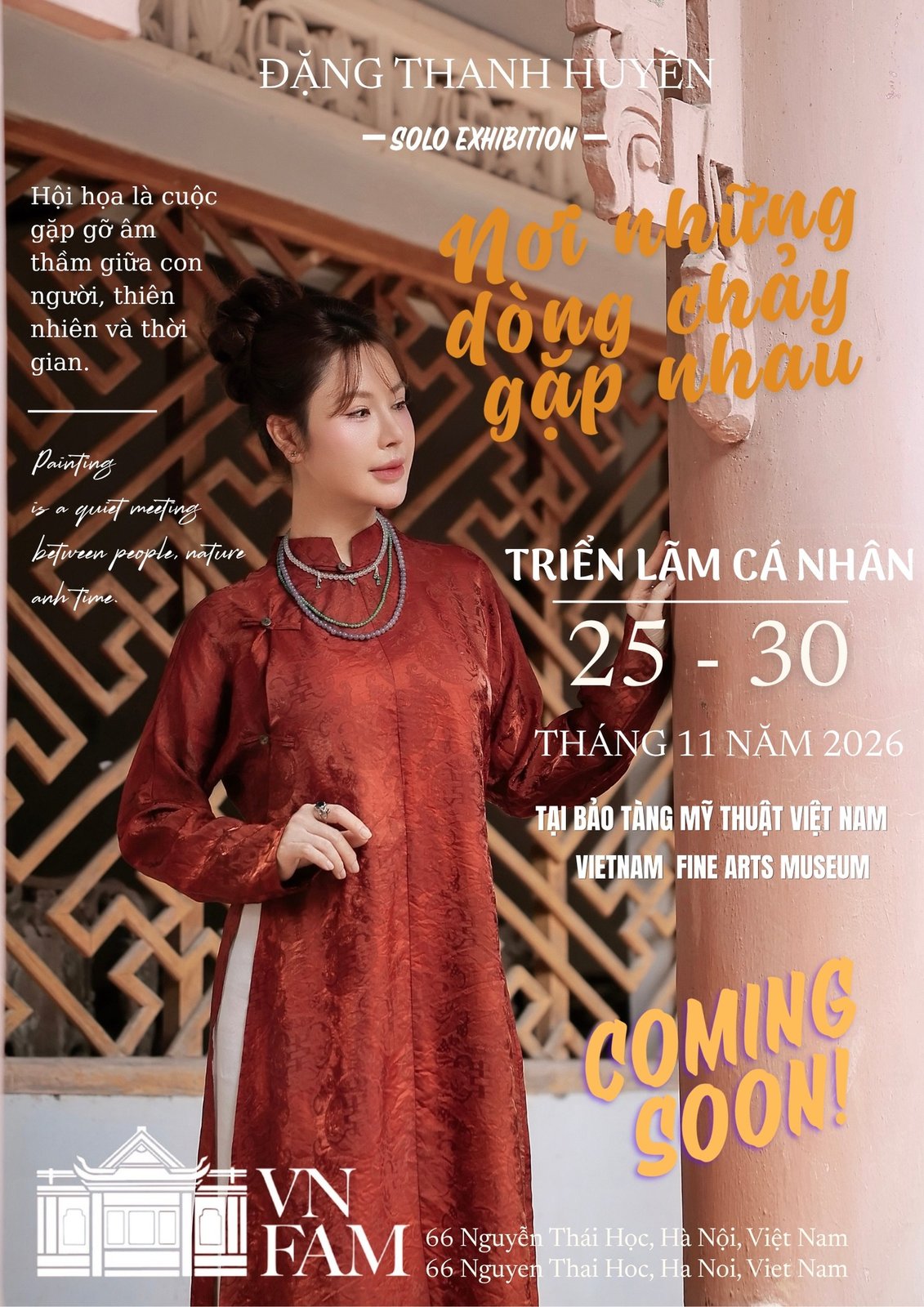
Things to know. First, Monday is the closing day, and that is the main trap: the Temple of Literature opposite is open daily, the museum is not. Second, no flash photography. Third, the address: the museum itself writes it as "66 Nguyễn Thái Học, Ba Đình, Hà Nội" and does not name the phường (urban ward) after the 2025 reform. Other sources disagree here: our database card and Vietnamese Wikipedia put the building in Ba Đình Ward, while OpenStreetMap puts it in Văn Miếu – Quốc Tử Giám Ward. Ba Đình Ward is also what the newspaper Thanh Niên gives: in an exhibition notice of November 10, 2026, it writes the museum's address as "66 Nguyễn Thái Học, P.Ba Đình, Hà Nội" ("P." standing for phường, ward). The former Điện Biên Ward, where the museum stood before the reform, was split by Resolution No. 1656/NQ-UBTVQH15 of the National Assembly Standing Committee (June 16, 2025) among four new wards — Hoàn Kiếm, Ba Đình, Văn Miếu – Quốc Tử Giám and Ô Chợ Dừa — and the resolution does not say which one No. 66 fell into. The house number and street are enough for a taxi or a map app.
CityGuide tip. A logical pair for one morning: the Temple of Literature, then the museum — across the street, but not opposite the entrance; you walk around the block. And if you have half a day, add Trấn Quốc Pagoda: the Trịnh lord who repaired it in 1639 was the father of the queen whose statue stands here. For routes like this we prepare a self-guided walking guide: you can download it to your phone and use it offline, or print it out.
What to see nearby
Distances and times are from OpenStreetMap (OSRM); taxi fares are approximate.
- Temple of Literature (Văn Miếu – Quốc Tử Giám) (≈610 m) — about 8 minutes on foot: the museum stands across Nguyễn Thái Học Street from the temple's rear wall, while the temple entrance is on the south side.
- Hanoi Flag Tower (≈540 m) — about 7 minutes on foot; open as part of the citadel since January 1, 2025.
- Imperial Citadel of Thăng Long (≈990 m) — about 13 minutes on foot; a UNESCO World Heritage site.
- Hanoi Railway Station (Ga Hà Nội) (≈1.1 km) — about 15 minutes on foot.
- Hồ Chí Minh Mausoleum (≈1.2 km) — about 16 minutes on foot; taxi ≈25,000–35,000 ₫.
- Vietnam National Academy of Music (≈1.85 km) — about 25 minutes on foot; a conservatory with its own concert hall.
- The Old Quarter (≈2 km) — about 27 minutes on foot; taxi ≈30,000–45,000 ₫.
- Hoàn Kiếm Lake (≈2.3 km) — about 30 minutes on foot; taxi ≈35,000–50,000 ₫.
- Trấn Quốc Pagoda (≈2.5 km) — the city's oldest pagoda, on West Lake; repaired by the father of the queen whose statue stands in this museum; taxi ≈35,000–50,000 ₫.
The Fine Arts Museum is part of our Hanoi city guide.
What to see
A bicycle, 1965: how the thousand-armed Quan Âm was saved
The largest object in the museum arrived here almost by accident, and in Vietnam the story is told like a parable.
Summer 1965. A member of the museum's staff, the art historian Nguyễn Đỗ Bảo, 25 years old, was cycling the dirt roads of Vĩnh Phúc province. He turned into the yard of the Hợp Thịnh cooperative's grain store in Tam Dương district for a drink of water. Beside it stood a half-ruined pagoda.
What he saw there. The roof leaked, the tiles sagged, the walls were mould and moss, there were no monks. Inside stood a three-meter statue of the thousand-armed Quan Âm, under dust and cobwebs; several arms and the figure of Ngọc Nữ (the Jade Maiden, the bodhisattva's attendant) had fallen off, and the villagers had stacked them at the lotus base. A local farmer explained the situation to the visitor: the statue was to be removed and the cooperative wanted to pull the pagoda down for a warehouse. And he added the crucial thing — nobody dared burn the statue.
Nguyễn Đỗ Bảo photographed the find on a black-and-white camera so that he would have something to show in Hanoi, and got the statue transferred to the museum.
The terms of the deal. The director, Nguyễn Đỗ Cung, negotiated with the commune himself, and the terms were these: the museum paid for a new pagoda to be built and gave the villagers a copy of the statue. The village was not deprived of its holy image — it got a new temple and a copy, while the original went into a state collection. A copy as a legitimate way of leaving an object in place has been Vietnamese museum practice since the 1960s.
What happened next. Specialists from the fine arts department took the statue apart into three sections, moved it and restored it — all in 1965, in time for the museum's opening on June 24, 1966. And twice more, in 1975 and 1979, the statue was taken away for safekeeping — to Tuyên Quang and to Đà Lạt.
What the statue is. Its full name is Quan Âm Thiên Thủ Thiên Nhãn, "thousand arms, thousand eyes." It has 42 arms — so say both Báo Pháp luật Việt Nam and the Vietnam Cultural Heritage Association. The two main hands are joined in front of the chest, two more rest in the lap forming a ritual gesture, and nineteen fan out from each shoulder, every one of them holding a ritual object. Beneath the lotus is the demon Ô Ba Na Đà from the legend of the Quan Âm of the Southern Sea; the small figures of Kim Đồng (the Golden Boy) and Ngọc Nữ stand alongside. The statue is dated to the Mạc dynasty (1527–1592), which makes it about five hundred years old.
The researcher Nguyễn Hải Yến puts it this way: "chúng tôi chắc chắn tác phẩm này ra đời trong thời kỳ phục hưng Phật giáo thế kỷ 16" — "we are certain this work was made during the Buddhist revival of the 16th century." And Vũ Thị Hằng describes its face as round and kindly, "like that of a typical Vietnamese woman," drawing attention to the soft, rounded arms. The maker is unknown; specialists assume a workshop of village craftsmen.
Don't confuse them. The famous Quan Âm nghìn mắt nghìn tay ("Quan Âm of a Thousand Eyes and a Thousand Arms") from Bút Tháp pagoda in Bắc Ninh is also thousand-armed and also a national treasure (2012), but it stayed in the pagoda. The one in the museum is a different statue, from chùa Hội Hạ. Guidebooks mix the two up constantly.
The queen who became a nun
The second sculptural treasure is a portrait of a specific woman, and her biography is worth a paragraph of its own.
Trịnh Thị Ngọc Trúc (1595–1660) was the daughter of Lord Trịnh Tráng — the same man who in 1639 repaired Trấn Quốc Pagoda and planted the lotuses there. She became the wife of King Lê Thần Tông and empress from 1630 to 1642, with the title Diệu Viên Hoàng hậu (Empress Diệu Viên). And then she took monastic vows — in the sources she also appears as Diệu Viên Ni sư, the nun Diệu Viên.
A separate thread is the dictionary Chỉ nam ngọc âm giải nghĩa ("A Guide to the Precious Sounds, with Explanations of Meaning"). The Institute of Hán-Nôm Studies' journal Tạp chí Hán Nôm ("Hán-Nôm Journal," 2013) calls it the earliest Vietnamese Hán–Nôm dictionary, that is, a glossary of Chinese characters in Vietnamese words. Some researchers used to credit the queen with compiling it, on the strength of her religious name, Pháp Tính (Người Hà Nội, "The Hanoian," magazine). But the same journal names the compiler as an elderly monk, Hương Chân Pháp Tính, who reworked an older book, and Ngô Đức Thọ of the same institute dated the edition to 1401, under the Hồ dynasty, and wrote that the book has nothing to do with the queen (2005).
The statue. It was collected from Mật Sơn pagoda (also Đại Bi tự) in Bố Vệ, Đông Sơn district, Thanh Hóa province. According to the newspaper Báo Pháp luật Việt Nam (2020), it is carved from a single block of mít — jackfruit wood — and finished in lacquer and gold (sơn son thếp vàng; the local-history site nguoihanoi.vn also mentions the lacquer and gilding). The paper does not say where its information comes from; the heritage register describes the material more briefly — "gỗ phủ sơn," "lacquered wood" — which does not contradict it. Vietnamese researchers call it the summit of 17th-century Vietnamese portrait sculpture: not an idealized bodhisattva but the likeness of a living person in monastic dress. When it reached the museum, the sources do not say outright. According to Báo Pháp luật Việt Nam, the statue was first taken to the French School of the Far East (Viện Viễn Đông Bác Cổ) and only later went on display at the Fine Arts Museum; according to a local-history source, it has stood here in a glass case since 1992 (the heritage register gives no year); it was recognized as a national treasure in 2013.
Who built that pagoda, the sources disagree. According to the Đại Nam nhất thống chí ("Comprehensive Gazetteer of Đại Nam," the state geography of the Nguyễn dynasty), Mật pagoda was built under King Lê Thánh Tông (1460–1497); according to a rubbing of the pagoda's own stele, it was built by King Lê Huyền Tông (1663–1671) to honor his father, Lê Thần Tông, his mother and his father's consorts (Báo Pháp luật Việt Nam, 2020).
If you come to this museum after Trấn Quốc Pagoda — and that is a logical route — note what you have done: you saw the lotuses planted by the father and the portrait of the daughter.
The doors from Keo pagoda: the original here, the copy on site
The third sculptural object is not a statue but a piece of architecture.
The Cánh cửa chạm rồng from Keo pagoda in Thái Bình is a panel 226 by 244 centimeters and just seven centimeters thick, carved over its whole surface. The motif is "lưỡng long chầu nhật," "two dragons facing the sun," a classic composition of Vietnamese temple carving. It is 17th century, so about four hundred years old; the Vietnamese press calls these the most beautiful carved doors in the country.
And here is an important detail: the original stands in the museum, while the inner triple gate (Tam quan nội) of Keo pagoda itself carries a copy, carved exactly to the original.
The arrangement is the same as with the Quan Âm statue in 1965: the original to the state collection, the copy to the site. It is a decision taken for the object's preservation, and both sides know about it.
"Em Thúy": the sitter, the minuet and the restoration
The museum's best-known painting is a portrait of a girl, painted in 1943.
"Em Thúy" by Trần Văn Cẩn: sixty by forty-five centimeters, oil, and nothing else — a seated girl, hands in her lap, her gaze straight at the viewer. It is the best-known child portrait in Vietnamese painting.
Who is in the picture. Nguyễn Minh Thúy, born in 1935, the painter's niece — she called him bác, "uncle." She is about eight in the picture. She grew up to be a teacher. She died on July 9, 2024; reports of her death give her age as 89 or 90. The person you see on the canvas lived another eighty years after sitting for it — and lived to see the portrait recognized as a national treasure.
How the painting reached the museum. The museum bought it in 1964 from the family of the photographer Đỗ Huân.
The minuet. In 2003 the English musician Paul Zetter, having looked at the painting, wrote a piece called "Little Thuy Minuet." Some Vietnamese papers write that he also helped bring in the conservator; the sources do not agree on that detail and we do not assert it.
The restoration of 2004. The episode is instructive in itself. In 2003 a proposal to restore the painting abroad was not approved by Vietnam's Ministry of Culture. In 2004 the work was done on the spot: the restoration was carried out by the Australian specialist Caroline Fry of the University of Melbourne, funded by the Australia Council for the Arts and the ASIALINK organization. The paint layer was consolidated, the surface cleaned and the frame replaced.
Set that against the story of "Vườn xuân Trung Nam Bắc" ("Spring Garden of the Center, South and North") in Hồ Chí Minh City (see the box in the section on the screen below) and it becomes clear why Vietnamese museum practice treats "Em Thúy" as the example of how it should be done.
The screen from Bảo Đại's palace, with a bullet mark
Nguyễn Gia Trí's lacquer screen of 1939 has the most cinematic biography in the collection.
What it is. An eight-panel lacquer screen, and double-sided. On one side "Thiếu nữ trong vườn," "Girls in the Garden": seven female figures of different ages, which researchers read as a metaphor for a woman's life. On the reverse, "Phong cảnh," "Landscape" (the title "Dọc mùng" also appears — the Vietnamese name of a large-leaved plant related to taro). The technique: the painter built the surface up in relief — banana leaves, hibiscus flowers, clouds and the folds of the áo dài, the Vietnamese long dress, stand out from the plane, so the lacquer works not as a colored film but as volume.
Where it had been. The museum collected it in 1978 — in Bảo Đại's palace in Đà Lạt. Vietnam's last emperor had kept a lacquer screen by the first master of Vietnamese lacquer in his summer residence in the hills; three years after the war ended the screen went to Hanoi.
The bullet mark. When the screen reached the museum there was a hole through it from a shot, and bullet marks on the "Girls in the Garden" side that were later filled. The source does not say when or in what circumstances the screen was shot at.
It was recognized as a treasure in 2017; researchers note in it a successful fusion of Eastern and Western image-making, and the museum notes that it is a major lacquer work from Nguyễn Gia Trí's early period, when he painted landscapes and young women.
Don't confuse them. The famous lacquer "Vườn xuân Trung Nam Bắc" by the same Nguyễn Gia Trí, twenty years in the making, is not here: it belongs to the Fine Arts Museum of Hồ Chí Minh City. That is where it was damaged during a "cleaning" — the affair was taken up at ministerial level in April 2019, and according to the head of the fine arts department, Vi Kiến Thành, restoring the work to its original state is unlikely to be possible. Our own database card wrongly assigned the painting to the Hanoi museum; we have passed on the correction.
Three lacquers: a trench, a river crossing and Thánh Gióng
The three lacquer treasures are worth looking at together: they show how Vietnamese lacquer moved in thirty years from the history painting to something close to abstraction.
"Kết nạp Đảng ở Điện Biên Phủ," 1963
"Admission to the Party at Điện Biên Phủ" by Nguyễn Sáng — lacquer, nearly two meters along its long side. The painter carried the work for nine years after the victory of 1954.
The scene: a cramped corner of a trench between two attacks. Three soldiers at the center, one with a bandaged head and a rifle in his hand; a handshake links the central group to two soldiers on the right; in the left corner a soldier is helping a wounded man, and behind them another is already hurrying into the fight. The whole palette is three principal lacquer tones: son (cinnabar), vàng bạc (gold and silver), then (black).
The researcher Nguyễn Hải Yến calls it "một bức tranh sơn mài độc đáo vào bậc nhất của nền mỹ thuật cách mạng Việt Nam về cả nội dung tư tưởng và bút pháp nghệ thuật" — one of the most singular lacquer paintings of Vietnamese revolutionary art, in both content and handling.
In 1996 the painter was posthumously awarded the Hồ Chí Minh Prize in its first round — according to Nhân Dân, for a group of six works: "Giặc đốt làng tôi" ("The Enemy Burned My Village"), "Kết nạp Đảng ở Điện Biên Phủ," "Thanh niên Thành đồng" ("Youth of the Bronze Citadel"), "Nghỉ trưa" ("Midday Rest"), "Trú mưa" ("Sheltering from the Rain") and "Gặp nhau" ("The Meeting"). Nguyễn Sáng is one of two Vietnamese painters with two national treasures: the other, "Thanh niên Thành đồng," is in the Fine Arts Museum of Hồ Chí Minh City.
"Bác Hồ ở chiến khu Việt Bắc," 1980
Between conception and execution this work has a gap of almost thirty years. Dương Bích Liên (1924–1988) was in the final intake of the École des Beaux-Arts de l'Indochine, that of 1944–1945, and was one of the first painters admitted to the Party on the battlefield. In 1952 he was sent to Việt Bắc to paint Hồ Chí Minh, living and working beside him. He finished the painting from the sketches of that trip only in 1980.
The subject: Hồ Chí Minh with a mountain horse before fording a torrent. The horse is saddled, the man is in a brown shirt with a canvas bag, calmly preparing to cross. The palette is restrained — greens and yellows, but with fine transitions that open several planes. Vietnamese critics note its modern sense of composition and, more importantly, the absence of any deification of the leader: this is a man at the water's edge, not an icon.
It took the top prize at the 1980 national fine arts exhibition; the museum bought it on January 14, 1981.
"Gióng," 1990
Nguyễn Tư Nghiêm took a traditional subject — the legend of Thánh Gióng, the boy hero who straightened up from infant to warrior and threw back the Ân invasion — and rendered it in almost cubist masses: an angular composition, forms gathered into blocks. According to the Institute of Fine Arts, the work is the product of some twenty-five years in which the painter kept returning to the same image.
It won the gold medal at the 1990 national fine arts exhibition (some sources call it that exhibition's first prize). It became a national treasure on December 25, 2017 — the same day as Nguyễn Gia Trí's screen.
Tô Ngọc Vân: the last major work and the last drawing
A word apart about the fifth treasure — and about the man behind it.
"Hai thiếu nữ và em bé," "Two Young Women and a Child," oil, 1944. The painter Lê Anh Vân describes it like this: a typical urban scene, two young women in áo dài sitting and talking, a child playing beside them, the overall mood one of calm. It is treasure number 35 on the national list.
The calm deserves a closer look, because the painting's context is hard.
Tô Ngọc Vân (his birth year is given as 1906 or 1908 depending on the source) was one of the first graduates of the 1925 school and one of the most influential Vietnamese painters of his generation. In April 1954 he was ordered to Điện Biên Phủ to make front-line sketches. On June 15, 1954 he drew the Lũng Lô pass; that drawing is held to be his last work. On June 17, 1954 he was killed at Ba Khe, beyond the same pass, by a French air strike — another source locates it differently, at "cây số 14 Bà Khẽ" — "Kilometer 14, Bà Khẽ." The war had weeks to run: the Geneva Accords were signed in July.
He was recognized as liệt sĩ, fallen for his country, and buried at the Mai Dịch cemetery in Hanoi, where the country's statesmen and cultural figures lie.
The museum holds 59 of his works; "Hai thiếu nữ và em bé" hangs in gallery nine on the second floor. Between that painting of 1944 and the pencil pass of 1954 lie ten years that changed everything: the same hand, the same man, but in the first case a peaceful city drawing room, and in the last a road to the front.
In the galleries: from prehistory to lacquer
The collection held more than 18,000 objects according to 2011 figures, and local-heritage press in 2022 put it at 20,000; for the museum's sixtieth anniversary in 2026, Báo Văn Hóa gave "hơn 21.000 hiện vật, tác phẩm nghệ thuật" — more than 21,000 objects and works of art. On permanent display are some 2,000–2,200 — roughly one object in ten.
How the holdings break down:
| Section | Objects |
|---|---|
| Painting | 6,310 |
| Ceramics | 6,455 |
| Traditional art | 2,012 |
| Sculpture | 993 |
| Foreign art | over 400 |
The display is arranged chronologically. Prehistoric art opens the route. Then the 11th to 19th centuries: the Lý and Trần, the Lê and Mạc, the Tây Sơn and the Nguyễn — mostly Buddhist sculpture and temple carving taken off buildings that could not be preserved in place. Then the 20th century: work before 1945, art of the resistance years 1945–1954, and after that by material — lacquer, silk, paper, oil. Separately there are applied arts, folk prints (the celebrated Đông Hồ and Hàng Trống) and ceramics of the 11th to 20th centuries.
Among the 20th-century sculpture, look for "Ôm bom ba càng" ("Holding the Three-Pronged Mine") by Trần Văn Hòe — a soldier holding the "three-pronged bomb," a weapon detonated against a tank at the cost of the man carrying it.
A curious link: enlarged copies of "Thiếu nữ trong vườn" by Nguyễn Gia Trí and "Chùa Thầy" ("Thầy Pagoda") by Hoàng Tích Chù hang in Hanoi's National Convention Center — while the originals are kept here.
For Nguyễn Tư Nghiêm, the Vietnamese press gives the dates 1922–2016 (Thanh Niên in 2016, Tuổi Trẻ; the Vietnam Cultural Heritage Association agrees); Vietnamese Wikipedia adds that 1922 is the year on his birth certificate, while he was actually born in 1918. Znews makes the same caveat in its 2016 obituary: "một số tư liệu cho rằng ông sinh năm 1918" — "some records say he was born in 1918."
History
The school of 1925: where the 20th-century collection comes from
To make sense of half the galleries here, you need to know about one school.
The exact dates. On October 27, 1924 the Governor-General of Indochina, Martial Merlin, signed the decision establishing the Trường Cao đẳng Mỹ thuật Đông Dương — the École des Beaux-Arts de l'Indochine, or Indochina School of Fine Arts — under the University of Indochina. It was the first professional art school in all of French Indochina. Its first director was the French painter Victor Tardieu (1870–1937), who led it from 1924 to 1937; after him, from 1938 to 1945, came Évariste Jonchère. The date it actually opened differs between sources: some write of November 24, 1924 at 42 Yết Kiêu Street, others of a first intake in 1925. Tardieu built the curriculum on the model of the École des Beaux-Arts in Paris.
How he came to be there. Tardieu arrived in Indochina on a fellowship awarded for the Grand Prix de l'Indochine (the Indochina Grand Prize) of 1922 (by another account he sailed from Marseille as early as January 1921 and first went south). What kept him was a commission: a large mural for the university's assembly hall, some 78 m² in area, which he finished only in 1928. The mural was in the assembly hall of the main building of the University of Indochina, at 19 Lê Thánh Tông Street — so says the bulletin of Vietnam National University, Hanoi (Đại học Quốc gia Hà Nội, 2021); the version placing it in the hall of the Hanoi Medical University is not borne out. The original has not survived — a whitewashed wall took its place — and in 2006 the university decided to re-create the mural from the original. Nam Sơn, by the same source's account, put a great deal into it.
The co-founder was Vietnamese. This was not an obvious decision for 1925: as co-founder Tardieu chose not a Western colleague but his own Vietnamese student Nam Sơn — Nguyễn Vạn Thọ (1890–1973), who had studied in Paris. As early as 1923 Nam Sơn handed Tardieu his "Đề cương Mỹ thuật Việt Nam," an outline for a Vietnamese fine-arts program that Vietnamese sources call one of the first bricks in the school's foundation. He was formally appointed Tardieu's assistant on February 18, 1925. The relationship went both ways: Nam Sơn took Tardieu round Vietnamese temples and explained the ornament of the communal houses (đình) and the pagodas (chùa), while Tardieu taught him Western technique.
Who came out of it. The first generation of Vietnamese painters, whose work forms the core of this museum: Nguyễn Phan Chánh, Tô Ngọc Vân, Lê Phổ, Nguyễn Gia Trí, Trần Văn Cẩn, Nguyễn Tư Nghiêm, Lương Xuân Nhị, Lê Thị Lựu. Half the names on that list hang in Building B. The last intakes are already of the 1940s: Dương Bích Liên was in the class of 1944–1945, the final one.
The school's chief achievement. It brought back into art two techniques previously treated as craft: painting on silk (tranh lụa) and lacquer (sơn mài).
How lacquer made its way into the curriculum is traced by the art historian Lisa Bixenstine Safford (Hiram College) in an article for Heidelberg University's The Journal of Transcultural Studies (2015). The painting students were steered toward lacquer by Professor Joseph Inguimberty — purportedly, Safford writes, after a visit to the Temple of Literature in 1927, the very temple whose back wall the museum now faces across the street — and he invited the master artisan Đinh Văn Thành to teach lacquer technique at the school. The school's lacquer studio was taking shape in the early 1930s, and by 1938 the study of lacquer technique was compulsory for all students, painters and sculptors alike. Among those who encouraged experiments with lacquer, Safford also names the school's second director, Évariste Jonchère.
The result is visible in the galleries: 20th-century Vietnamese lacquer painting is not souvenir boxes but large easel work, four pieces of which are recognized as national treasures.
Silk in Paris: "Chơi ô ăn quan" and its travels
One painting that may not even be in the museum still has to be described: without it you cannot understand what the school was for.
What the painting is. "Chơi ô ăn quan" — "Playing Ô Ăn Quan," a children's game of pebbles and pits — by Nguyễn Phan Chánh, 1931, silk, 62×85 cm. It is the best-known Vietnamese painting on silk, and the work with which Vietnamese painting first reached a world stage: the silk the school had raised from craft to art proved itself with this picture.
Paris, 1931. Nguyễn Phan Chánh sent four silk paintings to the International Colonial Exposition in Paris: "Chơi ô ăn quan," "Lên đồng" ("Spirit Possession Ritual"), "Rửa rau cầu ao" ("Washing Greens on the Pond Jetty") and "Em cho chim ăn" ("Girl Feeding Birds"). All four were quickly bought by foreign collectors — and vanished from Vietnam.
Paris, before 1954. The Vietnamese collector Đức Minh, finding himself in Paris, walked into a second-hand shop and saw a painting labelled as coming from Vietnam. It was "Chơi ô ăn quan." More than twenty years after it left, the painting came back to Hanoi.
And then it left again. After the deaths of Đức Minh and his wife, Thanh Niên writes, the paintings passed to their children: some were kept, others had to be sold, and "Chơi ô ăn quan" went to a foreign collector. The paper ends the story by saying that the painting was off on its travels again, and no one knows when it will come back. The American TIME wrote in 2009, citing Nora Taylor, that the works regarded as the originals of "Chơi ô ăn quan," which used to hang in this museum, are now in galleries in Singapore and Japan.
What it is worth today. For scale: another work by Nguyễn Phan Chánh, "Em bé bên chú chim" ("Child with a Bird," 65×50 cm), sold at Christie's in Hong Kong (China) on May 27, 2018 for 6.7 million Hong Kong dollars, about 20 billion ₫. Another, "Người bán gạo" ("The Rice Seller"), is with the Hong Kong collector Pascal de Sarthe. The first generation of the 1925 school is now a market in which a single canvas fetches more than the museum cost to build in its first year.
Hence the central point: half of what the school of 1925 produced scattered around the world — bought up in the 1930s, resurfacing at auction in the 1990s and 2000s. The museum built its collection in a country those works were being taken out of, and in years when the country was being bombed. Keep that in mind and the sections on the museum's treasures (under What to see) read differently.
Modern history
A boarding house for officials' daughters
The building was put up by the French in the 1930s, for one narrow purpose: a boarding school for the daughters of French officials, brought to Hanoi to study from across what are now Vietnam, Laos and Cambodia. The colonial capital gathered the administration's children in one place, and they needed a house with dormitories and classrooms.
1962. The state hands the building to the Ministry of Culture to be a museum. And here comes the architecturally interesting part: the Western façade is "Vietnamized." The building is given the features of a village đình, the communal house — the characteristic roof with upturned eaves, and its ornament. The result is a hybrid that today reads as a sign of its era: a country that has just driven out its colonizers converts a colonial house into a national museum and literally puts a Vietnamese roof on it.
June 24, 1966 — the opening. A site of 4,200 m², with 1,200 m² of galleries. The date speaks for itself: the museum opened when the American bombing of the North had already been running for a year and a half.
1997–1999. Expansion: the site grows to 4,737 m² and the galleries to 3,000 m² — two and a half times over. Since then the museum has occupied two buildings: A for ancient and folk art, B for the 20th century and temporary exhibitions.
Nguyễn Đỗ Cung: the man who assembled this museum
This museum has an author, and it is not an architect.
Nguyễn Đỗ Cung — painter and art researcher, the first director of the Vietnam National Fine Arts Museum. It was he who in 1962 was charged with creating the Viện Bảo tàng Mỹ thuật, the museum-institute; he oversaw the building work and became its director. According to the museum's website, the state handed the building to the Ministry of Culture in 1962, and the museum opened to visitors in 1966; Báo Văn Hóa's anniversary article of 2026 states plainly that in 1966 the museum "chính thức được thành lập," was officially established.
The main thing to know about Cung is this: the museum you walk into is largely what he managed to collect. In the 1960s museum staff travelled the villages looking for Buddhist sculpture and temple carving in buildings that could no longer be saved in place, and brought them to Hanoi. The story of the thousand-armed Quan Âm in the section A bicycle, 1965 is exactly that: a young member of staff made the find, and the director himself negotiated with the commune and paid for a new pagoda.
Cung knew how to look. In that same Quan Âm story he noticed what others had not: the statue's torso is square, and its shoulders are unlike those of later thousand-armed Quan Âm statues — and he said that was what made it singular.
On February 13, 2025 the story acquired a frame. The museum took into its collection a sculpted portrait, "Chân dung họa sĩ Nguyễn Đỗ Cung" ("Portrait of the Painter Nguyễn Đỗ Cung"), the work of the sculptor Trần Tuy (1942–2019), made in 2003: plaster finished in dark yellow lacquer, 61×34×26 cm. Trần Tuy worked at the museum from 1963 to 1972, served under Cung and regarded him as his teacher — "người thầy có ảnh hưởng sâu sắc," a mentor of profound influence. The sculptor's family donated the portrait; the certificate went to his widow, An Thị Lộc, and his son, Trần Nhất Hoàng, deputy head of the Ministry of Culture's international cooperation department, said at the ceremony: "Gia đình vô cùng vui mừng, vinh dự và trân trọng khi được trao tặng tác phẩm" — "The family is overjoyed; it is an honor, and we hand over the work with respect." The museum's director, Nguyễn Anh Minh, said at the same ceremony that Cung "có công rất lớn trong việc xây dựng nền móng cho Bảo tàng Mỹ thuật Việt Nam" — made a very great contribution to laying the museum's foundations.
So the first director's portrait now stands in the museum he built, made by a man who worked for him.