
Hanoi: 10 places to start with
Hoàn Kiếm Lake, Old Quarter, Temple of Literature, the Citadel…
Read the guide →Culture and history of Hanoi: temples, museums, the old quarter
53 places where Hanoi tells its story. Each with opening hours, tickets and how to get there.
Phu Dong Temple and Giong Festival
Đền Phù Đổng và Hội Gióng
Two temples some forty kilometers (about 25 miles) apart. At Phù Đổng, according to legend, Thánh Gióng — Saint Gióng — was born: a three-year-old who could not speak, yet grew into a giant and routed a foreign army. On Mount Sóc he took off his armor and rode up into the sky. Every spring the villages re-enact his war, with a flag in place of a sword and little girls playing the enemy generals; since 2010 the festival has been on UNESCO's list of the intangible cultural heritage of humanity.
Vietnam Museum of Ethnology (VME)
Bảo tàng Dân tộc học Việt Nam
A museum conceived by ethnologists in the 1970s, fought for through the hungry 1980s and opened in 1997 by Jacques Chirac and Nguyễn Thị Bình: a building shaped like a "bronze drum" with Vietnam's 54 ethnic groups inside, an Architectural Garden where craftsmen from the villages put up and repair their own houses, and a "Kite" building devoted to the cultures of Southeast Asia and the rest of the world.
Perfume Pagoda (Huong Son) — Perfume Pagoda Festival
Chùa Hương (Hương Sơn, Mỹ Đức) — Lễ hội chùa Hương
Pagodas, temples and cave sanctuaries in the limestone mountains of Hương Sơn, about 65 kilometers (40 miles) by road south of central Hanoi. According to legend, this is where Princess Diệu Thiện spent nine years in ascetic practice before becoming the bodhisattva Quan Âm. Every spring, from roughly the second day of Tết (the Lunar New Year) to the end of the third lunar month, hundreds of thousands of pilgrims come here by rowboat; the festival is one of the longest and largest in Vietnam.
Hanoi Opera House
Nhà hát Lớn Hà Nội
The French spent 10 years building it on a filled-in pond, taking the Opéra Garnier in Paris as their model. Then it became a stage for Vietnamese history: the future national anthem was first performed in public on its square, and the country’s first constitution was adopted in its auditorium.
Hoa Lo Prison Relic
Di tích Nhà tù Hỏa Lò
In 1896, on the site of a village of potters, the French built one of the largest and most heavily fortified prisons in Indochina — the Maison Centrale ("Central House"). It stood for almost a century. A whole generation of the Vietnamese revolution passed through its punishment cells; prisoners twice escaped from it through the sewers; a future United States senator was held inside; and in 1993 four-fifths of its grounds were given over to an office tower. Today it is a museum that received nearly 800,000 visitors in 2024, and tickets for its evening programs sell out weeks in advance.
Hoan Kiem Lake (Sword Lake)
Hồ Hoàn Kiếm (Hồ Gươm)
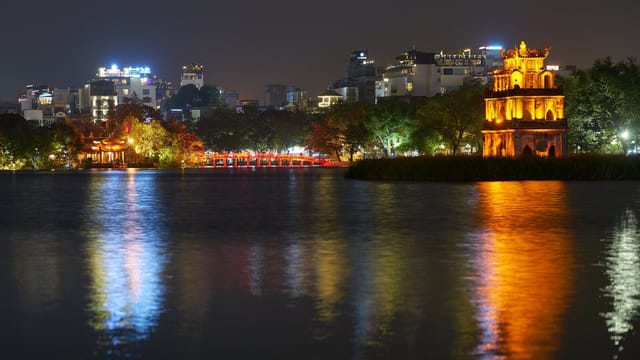
A small lake in the very center of the city where everything comes together: the legend of a magic sword, a red bridge leading to a temple on an island, the Turtle Tower, once topped by a copy of the Statue of Liberty, and a giant turtle — the last one in the lake, which died in 2016. For a hundred years the island temple was a workshop where printing blocks were carved and books were printed, and on the lake's shores the French built their first quarter in Hanoi.
Hanoi Train Street (Railway Cafés)
Phố cà phê đường tàu (Phùng Hưng – Trần Phú – Khâm Thiên)
Two stretches of working railroad, a meter from the coffee tables: how the line reached the heart of Hanoi in 1902, who has lived beside the rails since 1956, why the street was shut down in 2019, 2022 and 2025 — and what the law says you may not do here.
St. Joseph's Cathedral, Hanoi
Nhà thờ Lớn Hà Nội (Nhà thờ chính tòa Thánh Giuse)
The cathedral of the Archdiocese of Hanoi stands where, almost a thousand years ago, King Lý Thánh Tông built Báo Thiên Pagoda and its twelve-tiered tower. The present church, from the 1880s, was raised in Tonkinese brick and lime on the model of a cathedral drawn up by a bishop who had never studied architecture. Today it is a working cathedral, with Mass every day, five bells, a Japanese organ, and a square where Hanoi comes out to welcome Christmas.
Bach Ma Temple (White Horse Temple)
Đền Bạch Mã
A small temple on Hàng Buồm, a shopping street in Hanoi's Old Quarter, is called the oldest of the "four guardians" of Thăng Long, and its god the city god of the old capital. Over a thousand years that god has answered to several names: Chinese merchants took him for a Han general, a French orientalist for a Tang governor, and the legend of a white horse that traced the city walls picked up new details century after century. We went through the texts to see what was actually written about the temple, and when.
Vietnam Military History Museum
Bảo tàng Lịch sử Quân sự Việt Nam
For more than half a century this museum stood at the foot of the Hanoi Flag Tower, in office buildings left behind by the French army. In November 2024 it moved to 38 hectares beside Thăng Long Avenue — into a bow-shaped building designed by a Japanese firm, with a 45-meter Victory Tower in place of the old tower, four national treasures, and four million visitors in its first twenty months.
Presidential Palace relic site — Ho Chi Minh's Stilt House
Khu di tích Chủ tịch Hồ Chí Minh tại Phủ Chủ tịch (nhà sàn Bác Hồ)
A yellow palace for the Governor-General of Indochina, built in 1901–1907 on the edge of the Botanical Garden — and beside it the former house of the palace electrician, a wooden stilt house of 1958 and the concrete House 67, where President Hồ Chí Minh spent the last fifteen years of his life and died on September 2, 1969. Since 2009 it has been one of Vietnam's first ten special national monuments; over half a century, some ninety million people have come here.
Quan Thanh Temple
Đền Quán Thánh (Trấn Vũ Quán)
A Taoist temple that tradition dates to the 11th century, on a corner of West Lake, home to a bronze statue cast in 1677 — one of the 14 national treasures named in the fifth round of designations. The gate bears one name and the hall inside another, and the temple's bell found its way into a four-line verse that every schoolchild in Vietnam knows.
About this section
Culture & history of Hanoi on CityGuide.vn: temples and pagodas, museums, the old quarter, monuments and historic theatres. Each guide tells the story of the place, what to see, the Vietnamese address, opening hours, tickets and how to get there — from official sources, with sources listed.