A lake where, legend says, a magic sword was given back; an academy called the country’s first university, with 82 stelae standing on stone turtles; a citadel that was a seat of power for almost thirteen centuries; a lotus pagoda on a single pillar; and an opera house from whose balcony the flag with the yellow star was unfurled. Ten addresses that explain the city best on a first visit.
How did we choose these places? This is not a ranking, and not a list of the “most beautiful” sights. These are the city’s symbols: the places in which you can read the story of Thăng Long, today Hanoi, from the capital of the Lý dynasty, moved here in 1010, through the French city of the late 19th century, to the square where independence was proclaimed in 1945. Almost all of them fall into two clusters — one around Hoàn Kiếm Lake, the other around Ba Đình Square — and within each cluster you can get around on foot. West Lake lies a little farther north, and we describe it together with Trấn Quốc Pagoda at its edge. Each place has a full-length article on our site, with its history, its legends, a close look at where the sources disagree, and practical information. Here you will find the essentials: what the place is, why it is worth your time and what to know before you go. The link at the end of each section leads to the details.
1. Hoan Kiem Lake and Ngoc Son Temple (Hồ Hoàn Kiếm, đền Ngọc Sơn)
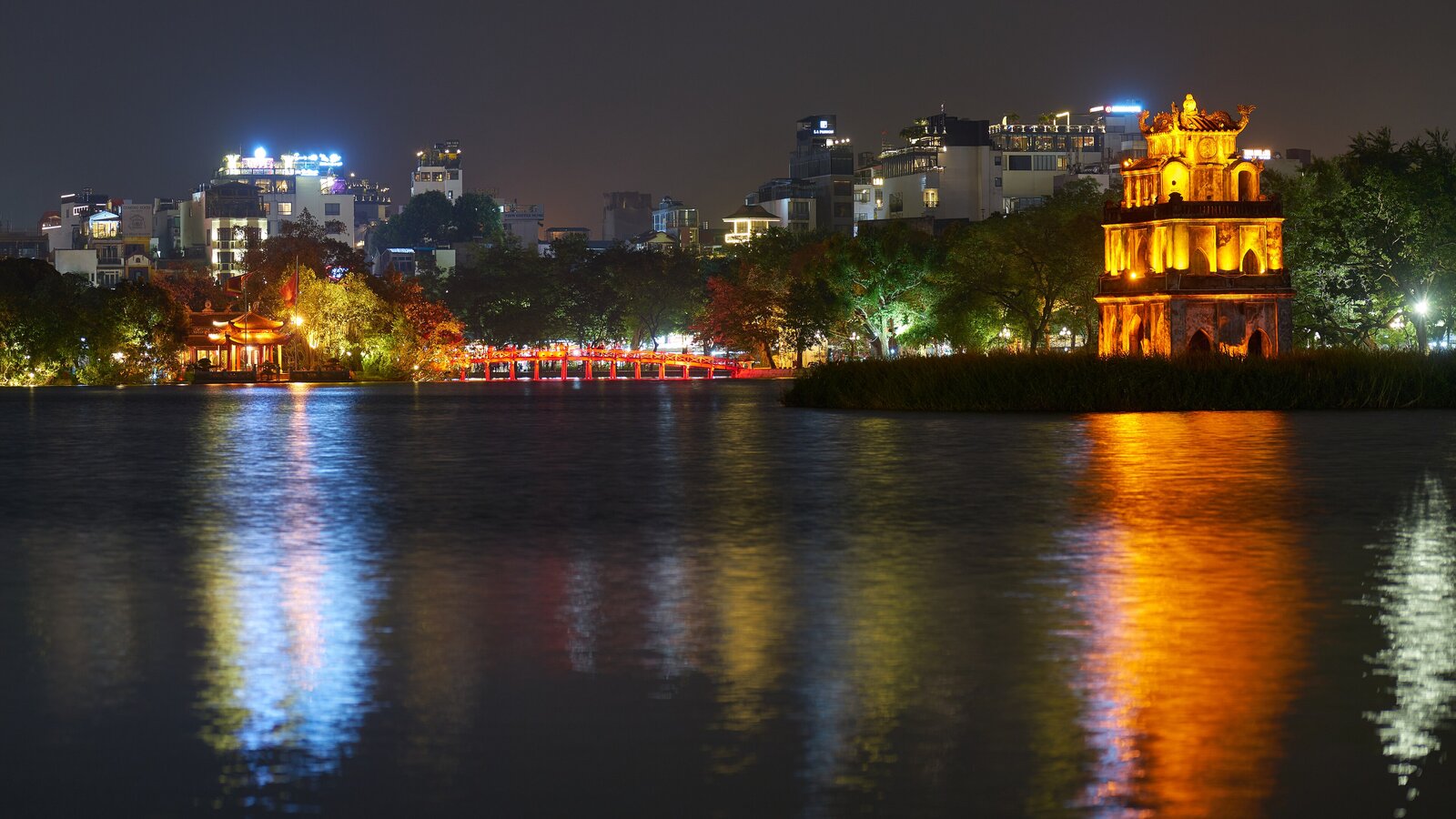
About 12 hectares (some 30 acres) of water in the very center of Hanoi, between the Old Quarter and the French city. The official name means “Lake of the Returned Sword”; in everyday speech it is Hồ Gươm, “Sword Lake.” Since 2013 the lake and Ngọc Sơn Temple on its island — a đền, that is, a temple dedicated to a deity or a national hero — have been protected together as a single special national monument (di tích quốc gia đặc biệt), the country’s highest heritage rank.
A legend that grew over the centuries. In the version taught in Vietnamese schools, King Lê Lợi, having defeated the Ming army in 1428, gave his magic sword back to the Golden Turtle, which asked him: “Xin bệ hạ hoàn gươm lại cho Long Quân!” — “Your Majesty, please return the sword to Long Quân [the Dragon Lord of the waters]!” But the chronicle of the uprising, written in 1431, tells only how the sword was found, and in an 18th-century account the king hurls the sword into the lake in anger. According to the researcher Trần Quang Đức, it was only at the end of the 19th century that these episodes were strung together into the familiar story of the returned sword.
The red bridge and the Pen Tower. Thê Húc Bridge — the name means “where the morning light lingers” — was built in 1865, when the scholar Nguyễn Văn Siêu was rebuilding the temple. At the entrance he put up the Pen Tower (Tháp Bút), inscribed with the characters “Tả thanh thiên” — “writing on the blue sky” — and the stone Ink Slab (Đài Nghiên). From 1845 to 1945 the temple was also a printing house: according to the researcher Vương Thị Hường, writing in the journal Hán Nôm in 2023, it was the largest woodblock-printing center in Hanoi.
The last turtle. The lake’s last giant turtle, “Cụ Rùa” (“the Venerable Turtle”), was found dead on January 19, 2016; its age was estimated at about 200 years. Today the turtle, preserved by taxidermists, stands behind glass in the rear hall of the temple. And in the 1890s, for several years, the Turtle Tower (Tháp Rùa) in the middle of the lake was topped by a bronze copy of the Statue of Liberty, which Bartholdi had sent to the Hanoi Exhibition of 1887.
Visiting: the lake is open around the clock, free of charge; the temple is open Mon–Thu 7:00–19:00 and Fri–Sun and public holidays 7:00–22:00; tickets cost 50,000 ₫, and children under 16 get in free. From Friday evening until midnight on Sunday, the area around the lake becomes a pedestrian zone. Prices and hours change — check before you go.
Read more: Hoàn Kiếm Lake and Ngọc Sơn Temple — every version of the sword legend, the lake’s last turtle from 1991 to 2016, the fire at the palace of the Trịnh lords and the fate of Hanoi’s Statue of Liberty.
2. Hanoi Old Quarter (Khu Phố cổ Hà Nội)
About 80 hectares (roughly 200 acres) of tightly packed buildings between Hoàn Kiếm Lake, the Red River and the former imperial citadel. Written sources mention the merchant town beneath the citadel walls from the 15th century on, and since 2004 the quarter has been a national historical monument.
“Thirty-six streets” is a name, not a count. Almost every story about the quarter begins with a folk song: “Rủ nhau chơi khắp Long Thành, / Ba mươi sáu phố rành rành chẳng sai” — “Come, let’s wander all through Long Thành [Thăng Long, old Hanoi]: thirty-six streets, each one accounted for, not one amiss.” Today the quarter has 76 streets, and the city’s 2013 regulations list 79. More than fifty of them begin with the word “Hàng,” meaning “goods”: Hàng Bạc is Silver Street, Hàng Mã the street of votive paper offerings. Silver is still sold on Hàng Bạc: under King Lê Thánh Tông, Dân trí writes, citing historical documents, craftsmen from the village of Châu Khê were brought here to cast silver ingots.
The tube house. The typical house of the quarter is the nhà ống, the “tube house”: 3–4 meters (10–13 feet) wide and 40–50 meters (130–165 feet) deep, sometimes as much as 60 (about 200 feet). Why so narrow? Scholars disagree. Was land divided among sons in equal strips, or were merchants taxed on the width of their storefront? The architect Nguyễn Quang Minh considers the second hypothesis the more plausible. To see a tube house from the inside, visit Heritage House 87 Mã Mây.
A gate, a temple and the house of the Declaration. Ô Quan Chưởng, built in 1749, is the only gate of old Hanoi still standing. The White Horse Temple (Đền Bạch Mã) is tied to a legend of 1010: a white horse is said to have shown King Lý Thái Tổ where to raise the walls of his new capital. And at 48 Hàng Ngang, above a silk shop, Hồ Chí Minh wrote the Declaration of Independence on a typewriter from August 28 to 30, 1945; the house has been a national monument since 1979.
Visiting: the quarter is open around the clock; the pedestrian zone runs from 19:00 on Friday until 24:00 on Sunday; the quarter’s temples and 87 Mã Mây charge 20,000 ₫, and children under 16 get in free. Prices and hours change — check before you go.
Read more: Hanoi Old Quarter — how the streets of the trade guilds work, what the writer Thạch Lam had to say about phở and street food, a 3.3 km (2-mile) walk through the quarter and the Gold Week (Tuần lễ Vàng) of 1945.
3. Temple of Literature (Văn Miếu – Quốc Tử Giám)
A temple of Confucius founded in 1070, and the Quốc Tử Giám academy, opened beside it in 1076. The academy is called Vietnam’s first university — that is how both the monument itself and the state news agency, the Vietnam News Agency (VNA, Thông tấn xã Việt Nam), describe it — and on November 13, 2026, its 950th anniversary was celebrated here. The entrance is at 58 Quốc Tử Giám Street.
82 stelae on turtles. The heart of the complex is a set of 82 stone slabs dating from 1484 to 1780, each one standing on the back of a stone turtle, beside the square Thiên Quang pond (the “Well of Heavenly Clarity”). Carved on them are the names of 1,304 doctors who passed 82 examinations held between 1442 and 1779. Since 2011 the stelae have been on UNESCO’s Memory of the World register, and since 2015 they have been a national treasure. The very first of them, for the examination of 1442, bears a line that Vietnamese people know by heart: “Hiền tài là nguyên khí của quốc gia” — “Talented and virtuous people are the vital force of the nation.”
Three centuries of selection. By our own count, based on the official stele database, about one candidate in fourteen passed the first examination — 33 out of 450. In 1640 more than 6,000 people were admitted to the examination, and 22 passed: under 0.4%.
A symbol on a banknote. In 1997 Hanoi chose as its symbol the Khuê Văn Các, the “Pavilion of the Constellation of Letters,” built in 1805. Wooden bars radiate around each of its four round windows: these are the rays of the Khuê star, the patron of literature. In 2012 the Law on the Capital made the choice official, and the pavilion’s image is printed on the 100,000-dong banknote.
No more stroking the turtles. As recently as 2006, thousands of high school graduates came here before their university entrance exams to touch the heads of the stone turtles and the stelae for luck. Too many hands wore the stone away, and today the rows of stelae are fenced off: touching them is not allowed.
Visiting: open daily 8:00–17:00; tickets cost 70,000 ₫, and children under 16 get in free; an unhurried visit takes an hour to an hour and a half. On Wednesday, Saturday and Sunday evenings there is a night tour, “The Essence of Education” (“Tinh hoa đạo học”), with a separate ticket. Check before you go.
Read more: Temple of Literature — the five courtyards step by step, the record-holding stelae, the teacher Chu Văn An and the legend of his pupil, the son of the Water King.
4. Imperial Citadel of Thang Long (Hoàng thành Thăng Long)
A green island in the heart of Hanoi, with gates, towers, stone dragons and a vast excavation site across the street. The visitor entrance is at 19C Hoàng Diệu, opposite the National Assembly building. Since 2010 the citadel has been a UNESCO World Heritage Site — the first in Hanoi.
Thirteen centuries of power. ICOMOS, the experts who assessed the nomination for UNESCO, called the site “the centre of regional political power for almost thirteen centuries without interruption”: the fortress of the Tang-dynasty governors, the palaces of the Lý, Trần and Lê dynasties, the Nguyễn citadel, a French headquarters. Beneath the platform of Kính Thiên, the throne hall, archaeologists counted six meters (about 20 feet) of occupation layers in 2026. And the excavations at 18 Hoàng Diệu, begun in December 2002, are described by the newspaper Nhân Dân as the largest in Vietnam’s history.
A city named for a dragon. The chronicle records that in the fall of 1010, as Lý Thái Tổ was moving his capital here, “a yellow dragon appeared above the imperial boat” — and the city was named Thăng Long, “Rising Dragon.” In 1805 Emperor Gia Long let the city keep the name but replaced the character for “dragon” (龍) with a homophone meaning “prosperity” (隆): the king no longer lived here, and the dragon was the symbol of the monarch.
What to see. The Flag Tower of 1812, 33.4 meters (about 110 feet) high, 41.4 meters (about 136 feet) with the flagpole; the Đoan Môn Gate with its five arches, the central one reserved for the king alone; the Kính Thiên staircase with its stone dragons, which led up to the throne; and the North Gate (Cửa Bắc), still marked by French cannonballs from 1882. Beneath House D67, on the central axis, is a bunker nine meters (about 30 feet) underground, where the Supreme Command worked from 1968 to 1975.
Visiting: open daily 8:00–17:00; tickets cost 100,000 ₫, and children under 16 get in free; a night tour runs on Fridays and Saturdays at 19:00 and must be booked in advance. The Heritage Conservation Center suggests setting aside a morning or an afternoon for the visit. Since the fall of 2026, work to restore the hall has been under way on the Kính Thiên axis — check what is open before you go.
Read more: Imperial Citadel of Thăng Long — ten names for one city, the tigers and elephants of the Forbidden City, the finds from the dig, and the palace discovered in 2025 beneath the French headquarters.
5. Ho Chi Minh Mausoleum (Lăng Chủ tịch Hồ Chí Minh)
Vietnam’s foremost memorial stands on Ba Đình Square, where Hồ Chí Minh read the Declaration of Independence on September 2, 1945. The building took the place of the old reviewing stand: construction began on September 2, 1973, and it opened on August 29, 1975. It is 21.6 meters (about 71 feet) high; for its width, the official portal hochiminh.vn gives 31 meters (about 102 feet) across the front, while other sources give 41.2 meters (about 135 feet).
A design shown to the whole country. A call for proposals in 1970 brought in more than 200 designs. The 24 best sketches were taken on tour and exhibited in Hanoi, Hải Phòng, Thái Nguyên, Sơn La and Nghệ An; 745,487 people came to see them, and 34,022 left written comments. To make room for this public discussion, the Politburo postponed approval of the design by four to five months.
The whole country in one building. The sand came from Kim Bôi (Hòa Bình), the pebbles from Tuyên Quang, sixteen kinds of precious wood from the Trường Sơn range, and two hundred sets of doors were carved by craftsmen from three provinces. In front of the entrance and behind the building grow 79 cycads — one for each year of Hồ Chí Minh’s life. In the vestibule, inlaid in gold, is his phrase from the appeal of July 17, 1966: “Không có gì quý hơn Độc lập Tự do” — “Nothing is more precious than independence and freedom.”
The flag and the thirty-four. Every morning — at 6:00 in summer and 6:30 in winter — the flag on the square is raised by 34 servicemen: that is how many fighters there were in the Vietnam Propaganda Liberation Army unit (Đội Việt Nam Tuyên truyền Giải phóng quân) of 1944, from which the army grew. At that hour the square is almost empty. In all, according to the Mausoleum Command’s report as of August 2025, the mausoleum has received more than 70 million visitors since it opened, more than 10 million of them from abroad.
Visiting: admission is free; on Tuesday, Wednesday, Thursday, Saturday and Sunday, mornings only: in winter (November 1 – March 31) 8:00–11:00, until 11:30 on weekends and public holidays; in summer 7:30–10:30, until 11:00 on weekends and public holidays. There are no visits on Mondays and Fridays (unless the first day of Tết, the Lunar New Year, April 30, May 19 or September 2 falls on one of those days), and once a year the mausoleum closes for maintenance (in 2026, from September 4 to November 2). Shoulders and knees must be covered, and photography inside is not allowed; on an ordinary day the line takes 30–60 minutes. Check before you go.
Read more: Hồ Chí Minh Mausoleum — six years in the hills before the opening, who designed and built it, and how the guard, the garden and the square work.
6. One Pillar Pagoda (Chùa Một Cột)
A small wooden pavilion on a stone pillar in the middle of a square pond, 260 meters (about 280 yards) on foot from the mausoleum. It is the heart of the Diên Hựu temple, which King Lý Thái Tông built in the winter of 1049.
The king’s dream. The chronicle tells how the king dreamed that the Buddha Quan Âm (the bodhisattva of compassion, Avalokiteśvara) was seated on a lotus throne and led him up onto it. Some of the courtiers took the dream for an ill omen, but a monk named Thiền Tuệ advised him to raise a stone pillar in the middle of the ground and to build a lotus throne on top of it, just as in the dream. (The characters of that name, though, can also be read as praise: “full of meditation and wisdom.”) The monks walked around the throne, praying for the sovereign’s long life — hence the name Diên Hựu, “extended blessing.” The popular story of a son whom Quan Âm supposedly granted the king comes from a stele of 1665, and it is about a different king.
The bell that never rang. In 1080 a great bell was cast for the temple, but when it was struck, it made no sound. Destroying a finished object would not do, so the bell was left lying in the damp “turtle field” beside the temple — hence its name, Quy Điền (“turtle field”). In 1426 the Ming troops, left with almost no weapons, broke it up to make cannon.
An explosion and 62 days. During the Mid-Autumn Festival of 1954 the pavilion was blown up. Work began on January 1, 1955, and 62 days later the architect Nguyễn Bá Lăng had put the pagoda back together from a late-19th-century photograph belonging to the École française d’Extrême-Orient (EFEO), the French School of the Far East. Behind the pavilion grows a bodhi tree descended from the tree under which the Buddha attained enlightenment: India’s president, Rajendra Prasad, gave the sapling to Hồ Chí Minh in February 1958. The pagoda has appeared on the 5,000 ₫ coin, and in 2012 the Asia Book of Records, a non-governmental records organization, named it the pagoda with the most distinctive architecture in Asia.
Visiting: according to the newspaper Báo Lâm Đồng (2025), the pagoda is open daily 7:00–18:00, free for Vietnamese citizens and 25,000 ₫ for foreign visitors; there are no official hours or admission rates, so check on the spot. The pavilion is tiny: 13 steps lead up to the platform, and inside there is room for only a few people.
Read more: One Pillar Pagoda — the chronicle entry for 1049 word for word, where the “bell of twelve thousand cân” (catties) came from, and where copies of the pagoda stand, from Ho Chi Minh City to Moscow.
7. Hoa Lo Prison (Nhà tù Hỏa Lò)
A museum in a former colonial prison at 1 Hỏa Lò Street, on the corner of Hai Bà Trưng: a blank yellow-gray wall with “MAISON CENTRALE” lettered above the gate.
The village of stoves. The name is older than the prison. Until 1896 this was the village of Phụ Khánh, which by the 19th century was the only place in the capital that made household earthenware, portable clay stoves (bếp lò) among them. In everyday speech it was “làng Hỏa Lò,” “the village of stoves.” The French resettled the villagers and built a central prison, the Maison Centrale (“Central House”), but Hanoians went on calling it after the vanished village.
One-fifth of a prison. Together with its access roads, the prison covered 12,908 m² (about 3.2 acres). In 1993 four-fifths of the site was given over to the construction of the Hanoi Towers, and the remaining fifth was preserved as a memorial; it opened to visitors on October 20, 1997. A whole generation of the Vietnamese revolution passed through these cells. In March 1945 more than a hundred prisoners escaped through a sewer manhole — the newspaper Hà Nội Mới calls it the largest escape in the prison’s history. In the courtyard grows a bàng, an Indian almond tree, whose root the political prisoners turned into a secret “mailbox.”
The “Hanoi Hilton.” From 1964 to 1973 American airmen were held here, and the nickname “Hanoi Hilton” was their own invention, after the hotel chain. Among them was the future U.S. senator John McCain.
More and more visitors. In 2019 the museum received 456,710 visitors, and in 2024, 790,416; in the first ten months of 2024 almost half of them were foreigners. Tickets for the theatrical evening programs “Đêm thiêng liêng” (“Sacred Night”) sell out weeks ahead.
Visiting: open daily 8:00–17:00, including public holidays and Tết; tickets cost 50,000 ₫, and children under 16 get in free; a visit takes an hour to an hour and a half, or closer to two with the 35-story audio guide. The exhibition is harrowing; the museum recommends the evening programs for visitors aged 16 and over, and they must be booked in advance. Check before you go.
Read more: Hỏa Lò Prison — how the Maison Centrale was built, two escapes through the sewers, the life of the political prisoners and the six “jobs” of the bàng tree.
8. Hanoi Opera House (Nhà hát Lớn Hà Nội)
The theater stands on August Revolution Square (Quảng trường Cách mạng Tháng Tám), at the end of Tràng Tiền Street, which leads here from Hoàn Kiếm Lake. Hanoians simply call it Nhà hát Lớn, the “Big Theater.” Since 2011 the building and the square together have been a national historical and architectural monument.
Hanoi’s “Garnier.” The French spent ten years, from 1901 to 1911, building the theater on a filled-in pond, taking the Opéra Garnier in Paris as their model — for a city where, around 1900, just over a thousand Europeans and other non-Asians lived. It is 87 meters (about 285 feet) long and 34 meters (about 112 feet) to the top of the roof. It opened on December 9, 1911, with a charity gala that featured Eugène Labiche and Édouard Martin’s comedy Le Voyage de Monsieur Perrichon (Monsieur Perrichon’s Journey), and the stage curtain was painted by Monsieur Pradet, a veterinarian and a painter in his spare time.
A stage for history. On August 17, 1945, a red banner with a yellow star, six meters by four (roughly 20 by 13 feet), was unfurled from the theater’s balcony, and on the square “Tiến quân ca” (“Song of the Marching Troops”), the future national anthem, was performed in public for the first time. On March 2, 1946, the first session of the National Assembly opened in the auditorium, and at its second session, that fall, the country’s first constitution was adopted here. On November 24, 1946, at the First National Cultural Conference, Hồ Chí Minh said here: “Văn hóa phải soi đường cho quốc dân đi” — “Culture must light the way for the nation.”
The Mirror Hall. Guests in the Mirror Hall (Phòng Gương) on the second floor have included U.S. President Bill Clinton (2000) and Russian President Vladimir Putin (2001). During the 1995–1997 restoration almost 400 metric tons of equipment were quietly built into the building, and in January 2026 the UK-based magazine Time Out named the theater one of Asia’s six architectural gems.
Visiting: after January 31, 2026, the theater closed for restoration for about two years; there are no performances or tours. The square and the facade are open to everyone, and concerts are held as scheduled in the Vườn âm nhạc (Music Garden) beside the theater. Check before you go.
Read more: Hanoi Opera House — the design competition and ten years of construction, who unfurled the flag in August 1945 and how, the first Vietnamese opera, and what the restoration of the 1990s changed.
9. St. Joseph’s Cathedral (Nhà thờ Lớn Hà Nội)
The cathedral of the Archdiocese of Hanoi, at 40 Nhà Chung Street, is about 900 meters (just over half a mile) on foot from Thê Húc Bridge on Hoàn Kiếm Lake. Hanoians call it “the Great Church” (Nhà thờ Lớn).
A tower that came before the cathedral. In 1057 King Lý Thánh Tông raised a twelve-tiered tower on this spot, at Báo Thiên Pagoda — a chùa, that is, a Buddhist pagoda. It stood for 490 years: “報天塔崩” — “the Báo Thiên tower collapsed,” the chronicle records under the year 1547.
A self-taught bishop. The present cathedral was built of Tonkinese brick and lime in 1884–1888, on the model of the church at Kẻ Sở designed by Bishop Paul-François Puginier — who, as a French army doctor remarked in astonishment, had never studied architecture. The money was raised by lotteries, and the prizes were works by Vietnamese craftsmen. The cathedral opened at Christmas 1887 (the parish website gives December 24, 1886), but received its full liturgical dedication only on May 1, 1999. Its bell towers are 31.5 meters (about 103 feet) high, and the church is 64.5 meters (about 212 feet) long — almost exactly half the length of Notre-Dame de Paris, with which it is often compared.
Bells and an organ. There are five bells. The largest rings only about six times a year: five adults can fit inside it, and it takes more than ten people to swing it. Since 2022 the choir loft has held an organ that the Belgian organ builder Guido Schumacher built for a center for the elderly in the Japanese city of Itami; a Japanese piano repair specialist searched for a new home for the instrument by email and on Google Maps. And the cathedral’s dark walls are the patina of old lime plaster, darkened by damp and moss; when the facade was replastered in 2020–2022, this color of “time” was painted back on.
Visiting: admission is free; sightseeing Mon–Sat 8:00–11:00 and 14:00–17:00; on Sundays and during Mass, tourists are not admitted. Shoulders and knees must be covered. Mass in English is held on Sundays at 11:30; the biggest celebration of the year on the square in front of the cathedral is Christmas. Check before you go.
Read more: St. Joseph’s Cathedral — the almost five centuries of the Báo Thiên tower, the full Mass schedule, the Christmas program and the cathedral’s last bell ringer.
10. West Lake and Tran Quoc Pagoda (Hồ Tây, chùa Trấn Quốc)
Hanoi’s largest natural lake lies northwest of the historic center. A causeway, Thanh Niên Road, separates it from the smaller Trúc Bạch Lake, and on an islet beside the causeway stands Trấn Quốc Pagoda. Under a 2026 city decision, the lake covers 527.5 hectares (about 1,300 acres).
An old riverbed and six names. West Lake is a horseshoe-shaped oxbow of the Red River, left behind when the river changed course. The lake has had six names in its history. Đầm Xác Cáo is “the marsh of the fox’s corpse”: according to legend, Lạc Long Quân, the forefather of the Việt, drowned a nine-tailed fox here. Hồ Kim Ngưu is the “Lake of the Golden Buffalo”: a buffalo took the sound of a bronze bell for its mother’s call and trampled the forest, and the ground sank and was swallowed by the water. The present name dates from 1573: the personal name of King Lê Thế Tông, Duy Đàm, was taboo, so the earlier name, Dâm Đàm (“the misty pool”), was replaced with Tây Hồ, “West Lake.”
Lotus and tea. In June and July the ponds around the lake bloom with the local Bách Diệp (“hundred-petal”) lotus, which has 100–120 petals. Since 2024 the Quảng An craft of scenting tea with lotus has been part of Vietnam’s national intangible cultural heritage: the traditional method takes 1,000–1,400 flowers for every kilogram of tea. On a peninsula of the eastern shore stands Phủ Tây Hồ — a phủ, a shrine of the Mother Goddess religion (Đạo Mẫu), and the principal one in Hanoi. In 2016 UNESCO inscribed the practices of the Mother Goddess cult on its list, although the shrine itself is not named in the nomination file.
Trấn Quốc Pagoda. According to VnExpress, it is considered the oldest pagoda in Hanoi: tradition has it founded in the 6th century, and in 1615, to save it from the river, it was moved to the islet of Kim Ngư, the “Golden Fish.” It was here, in 1096, that the dowager empress Ỷ Lan questioned the monks about where Buddhism in Vietnam had come from. The red eleven-tier tower, 15 meters (about 49 feet) high, with 66 statues of the Buddha Amitābha, opened in 2003, and the bodhi tree in the courtyard was given to the pagoda in 1959 by India’s president, Rajendra Prasad. According to VietNamNet, National Geographic ranked Trấn Quốc ninth among the twenty most beautiful Buddhist temples in the world.
Visiting: the lakeside promenades are open around the clock, free of charge; swimming and fishing are prohibited, and there are no pleasure boats. The pagoda is open every day of the year; twenty minutes is enough for the pagoda itself, about an hour with a walk by the water; the best times to come are early morning and toward sunset. There is no official information on an admission fee — ask on site.
Read more: West Lake — nine figures for its area, the legend of Phùng Khắc Khoan and the heavenly maiden, the seaplane station, and what is being done about the water today.
Read more: Trấn Quốc Pagoda — the pagoda’s four names, the monk who became the first head of Vietnam’s Buddhist community, the sangha, fourteen stelae and the tears of the physician Hải Thượng Lãn Ông.
Short on time?
The distances below are our own measurements along OpenStreetMap routes, taken from our articles on each place. The first cluster is around Hoàn Kiếm Lake: from Thê Húc Bridge it is about 600 meters (some 650 yards) to 48 Hàng Ngang in the Old Quarter and about 900 meters, or 12 minutes on foot, to St. Joseph’s Cathedral; from the cathedral to Hỏa Lò Prison is another 600 meters or so, and the Opera House is 1.3 km (about 0.8 mile) from the lake along Tràng Tiền Street. The second cluster is around Ba Đình Square: One Pillar Pagoda stands 260 meters from the mausoleum, the citadel entrance is about 910 meters (just over half a mile) from the mausoleum, and from the gate of the Temple of Literature to the citadel is about 960 meters (0.6 mile). The mausoleum admits visitors only in the morning, so a day around Ba Đình is best started there; from the mausoleum it is about 1.5 km (roughly a mile), some twenty minutes on foot, to Trấn Quốc Pagoda on West Lake. The two clusters are about 2.6 km (1.6 miles) apart — the distance from Thê Húc Bridge to the Temple of Literature.
Sources
The facts come from our articles on each place; the primary sources are listed in the “Sources” section of each article.
- Hoàn Kiếm Lake and Ngọc Sơn Temple
- Hanoi Old Quarter
- Temple of Literature
- Imperial Citadel of Thăng Long
- Hồ Chí Minh Mausoleum
- One Pillar Pagoda
- Hỏa Lò Prison
- Hanoi Opera House
- St. Joseph’s Cathedral
- West Lake
- Trấn Quốc Pagoda
Cover photo: Radek Kucharski / Flickr, CC BY 2.0