
Festival «Bốc Fest»
Nha may xe lua Gia Lam (Ha Noi)
999,000 ₫ – 1,399,000 ₫



 Culture and Arts
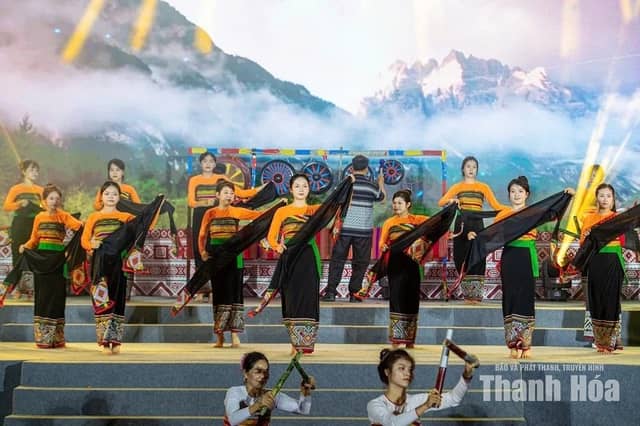
Seven ethnic communities of a single province step onto one open-air stage: trống hội drums, cồng chiêng gongs, laser graphics stretched across the width of the square, and dances and songs that normally live in the mountain villages of western Thanh Hóa. Three evenings in a row in the provincial centre, and what you get is not a museum case but a culture still carried by the people who own it.
The core of the festival is a 90-minute stage programme, «Sắc màu văn hóa Xứ Thanh», «The Colours of Xứ Thanh Culture», where «Xứ Thanh» is the old, still widely used name for this land. It is built in three chapters.
This is a province-scale event: people of the Kinh, Mường, Thái, Dao, Thổ, Mông and Khơ Mú communities from all 166 communes and wards of Thanh Hóa take part. The opening ceremony is broadcast live by the provincial outlet Báo và Phát thanh, Truyền hình Thanh Hóa.
Around the main stage there is a hands-on space where the crafts and rituals of each community are demonstrated, a traditional culture display titled «Thanh Hóa - Những sắc màu văn hóa», and performances by amateur ensembles from across the province. A detailed day-by-day schedule has not been published yet.
The province has the history to justify a festival this size. The village of Đông Sơn on the Mã river gave its name to an entire Bronze Age culture of Southeast Asia: the first bronze objects were found there in 1924, and the Đông Sơn drums have been a symbol of early Vietnam ever since. In 1397 Ho Quy Ly (Hồ Quý Ly) had a stone citadel built here, Thành Nhà Hồ, inscribed on the UNESCO World Heritage List on 27 June 2011. And it was from this land that Le Loi (Lê Lợi) launched the Lam Sơn uprising in 1418; Lam Kinh, the ancestral seat of the Later Lê dynasty, still stands nearby.
Thanh Hóa sits roughly 150 km south of Hanoi, on the road most travellers use without stopping. These three evenings are a reason to stop: you see in one place what would otherwise take a week of driving through the western highlands. The organisers have not announced any separate admission conditions.
Come early and stay past the stage programme, because at festivals like this the best part often happens around the square rather than on it.
Quảng trường Lam Sơn
Quảng trường Lam Sơn, phường Hạc Thành, tỉnh Thanh Hóa
Nha may xe lua Gia Lam (Ha Noi)
999,000 ₫ – 1,399,000 ₫

Nhà thi đấu Cầu Giấy
2,150,000 ₫ – 3,990,000 ₫

Phòng hòa nhạc Lớn, Học viện Âm nhạc Quốc gia Việt Nam
500,000 ₫ – 800,000 ₫

Hanoi
Contact organizers

Bảo tàng Vũ Dân Tân (Vu Dan Tan Museum)
Free

West Lake & Trinh Cong Son Walking Street
159,000 ₫

Phố đi bộ Trần Nhân Tông
420,000 ₫ – 780,000 ₫

National Convention Center
1,310,000 ₫ – 11,770,000 ₫
Nha may xe lua Gia Lam (Ha Noi)
999,000 ₫ – 1,399,000 ₫
Nhà thi đấu Cầu Giấy
2,150,000 ₫ – 3,990,000 ₫
Phòng hòa nhạc Lớn, Học viện Âm nhạc Quốc gia Việt Nam
500,000 ₫ – 800,000 ₫
Hanoi
Contact organizers
Bảo tàng Vũ Dân Tân (Vu Dan Tan Museum)
Free
West Lake & Trinh Cong Son Walking Street
159,000 ₫