
A palace whose gates the tanks came through on April 30, 1975; a cathedral whose spires were built by the creator of the Michelin Guide; a market that Eiffel did not build; and an underground world dug with a hoe. Ten addresses that explain the city best on a first visit.
How did we choose these places? This is not a ranking, and not a list of the “most beautiful” sights. These are the city’s symbols: the buildings and streets in which you can read the story of Saigon, today Ho Chi Minh City, from the colonial center of the 19th century to the celebrations of 2026. Eight of the ten stand in the old center, within walking distance of one another. Bình Tây Market and Thiên Hậu Temple are in Chợ Lớn, the old Chinese city to the west. The Củ Chi Tunnels lie outside the city and make a trip of their own. Each place has a full-length article on our site, with its history, its legends, a close look at where the sources disagree, and practical information. Here you will find the essentials: what the place is, why it is worth your time and what to know before you go. The link at the end of each section leads to the details.
1. Independence Palace (Dinh Độc Lập)
A modernist palace at the head of Lê Duẩn Boulevard, which runs straight up to its gates; the main entrance and the ticket office are at 135 Nam Kỳ Khởi Nghĩa. Since 2009 it has been a special national monument — one of the first ten in Vietnam, and the only one in Ho Chi Minh City among them. It is run by Hội trường Thống Nhất (Reunification Hall), and heads of state are still received here.
April 30, 1975. According to the official chronicle, at 10:45 tank No. 843 struck the palace’s left side gate, tank No. 390 flattened the main gates, and at 11:30 the flag of the National Liberation Front of South Vietnam rose above the roof. In Vietnam the day is a public holiday: the Day of the Liberation of the South and the Reunification of the Country (Ngày Giải phóng miền Nam, thống nhất đất nước). General Dương Văn Minh’s address announcing the surrender was recorded on the pocket dictaphone of a journalist from the West German magazine Der Spiegel: no other tape recorder could be found, and it took three takes.
The tanks on the lawn are not the originals. Both of the real ones, Nos. 843 and 390, were recognized as national treasures in 2012, and both are in Hanoi. The tanks in the forecourt are machines of the same types and the same period.
A palace written in characters. The French Norodom Palace was begun on this site in 1868, and a magazine of 1872 compared it to the Tuileries in Paris. The present building is the work of Ngô Viết Thụ, the first Vietnamese to win the Grand Prix de Rome in architecture: construction began on July 1, 1962, and the palace was inaugurated on October 31, 1966. As the museum describes it, the plan forms the Chinese character 吉 (“good fortune”), the façade reads as 興 (“prosperity”), and the stone “bamboo” screen around the second floor was the idea of the sculptor Nguyễn Văn Thế. On the roof, two red circles mark the spots where bombs from an F-5E fighter struck on April 8, 1975. Beneath the building is a bunker 72.5 meters (about 238 feet) long.
Visiting: open daily 7:00–18:00; the palace and the exhibition together cost 80,000 ₫ (ages 18–59), the palace alone 40,000 ₫; no shorts or sleeveless tops. On public holidays it is best to arrive at opening time. Prices and hours change — check before you go.
Read more: Independence Palace — the whole of April 30, 1975, minute by minute, how to read the façade written in characters, and what the bunker has to show.
2. Notre-Dame Cathedral Basilica of Saigon (Nhà thờ Đức Bà)
The red-brick cathedral of the Archdiocese of Ho Chi Minh City stands on Paris Commune Square (Công xã Paris), facing the post office across the square. Pope John XXIII made it a minor basilica in an apostolic letter dated November 13, 1962.
The church the termites ate. Saigon’s first cathedral, a wooden one, “was devoured in less than 10 years by termites,” as the historian Alfred Schreiner put it (in Tim Doling’s English rendering). The first stone of the present cathedral, designed by the Paris architect Jules Bourard, was laid on October 7, 1877, and the cathedral opened in April 1880.
Michelin’s spires. When it opened, the cathedral had no spires. They were put up in 1894–1895 by the engineer André Michelin — the same man who would go on to create Bibendum, the Michelin Man (1898), and the red Michelin Guide (1900). Because of the termites, the spires contain not a single piece of wood. Bishop Colombert, who had dreamed of them, died five days after their erection began. With their crosses, the towers rose to about 60.5 meters (almost 200 feet), and on March 19, 2026, they were crowned with new gilded crosses 3.73 meters (about 12 feet) tall.
Silent bells. The six bells were cast in France and brought to Saigon in 1879. They have been silent since January 18, 2020: termites had eaten away the wooden frame they hang from, from the inside. A temporary carillon plays in their place.
The legend of the Marseille brick. Almost everyone writes that the brick was shipped from Marseille. Only the roof tiles, stamped Guichard Carvin, are documented as coming from Marseille. The white marble statue of Our Lady of Peace, 4.6 meters (about 15 feet) tall, was set up in front of the façade in 1959; according to the Saigon local historian Trần Nhật Vy, it was this statue that gave the cathedral its popular name, Nhà thờ Đức Bà — the “Church of Our Lady.”
Visiting: the restoration has been under way since July 2017, and tourists are not allowed inside — you can enter only to attend Mass (on weekdays at 5:30 and 17:30; on Sundays there are six services). The façade and the square are open around the clock, free of charge. Check the Mass schedule before you go.
Read more: Notre-Dame Cathedral Basilica of Saigon — what is inside, who is buried beneath the floor, who really designed the spires, and why the restoration is now in its tenth year.
3. Saigon Central Post Office (Bưu điện Trung tâm Sài Gòn)
The yellow building at 2 Công xã Paris (Paris Commune Square), across from the cathedral. It was completed in 1891 — the plaque above the entrance reads “1886 – 1891” — and it still works as a post office.
The house of steel wire. Old Saigonese called the post office “nhà dây thép,” the “house of steel wire”: the building was put up for a service in which mail and telegraph were one and the same.
Eiffel had nothing to do with it. Guides often name Gustave Eiffel as its author, but the documents of the period — the newspaper Le Temps in 1888 and a Paris architecture journal in 1891 — name the colony’s chief architect, Marie-Alfred Foulhoux. The building’s frame really was made in France, but the document that says so does not name the firm. According to the historian Tim Doling, the myth is believed to have started with a 1990 booklet for travel agencies, in which Eiffel’s name is spelled out by ear in Vietnamese: “Guy-xta-vơ Ép-phen.” The post office was supposed to open on July 14, 1891, but the ceremony was put off “until the return of the governor general,” and on January 20, 1892, Foulhoux died. The post office turned out to be his last work.
What to look for. On either side of the entrance arch, according to an essay in the newspaper Báo Phụ Nữ, are the names of Volta, Ampère, Franklin and Faraday. Inside is a hall under steel vaults with two large maps: “Saigon et ses environs” (“Saigon and Its Surroundings”), dated 1892, and the telegraph lines of South Vietnam and Cambodia, dated 1936. For about thirty years, until November 2020, Dương Văn Ngộ, Saigon’s last hired letter writer, sat at a wooden table in the hall writing and translating other people’s letters; in 2009 the Vietnam Book of Records recognized him as the country’s longest-serving hired letter writer. And in 2023 Architectural Digest ranked the post office second, after the one in Algiers, in its gallery of the most beautiful post offices in the world.
Visiting: admission is free; the post office publishes no official opening hours, so check by phone with the branch. Before Tết, the Lunar New Year, people sit here writing greeting cards, and in early December a street art festival takes over the square.
Read more: Saigon Central Post Office — where the second version of the architect’s name comes from, who Foulhoux was, and the stories of the last letter writer.
4. Ben Thanh Market (Chợ Bến Thành)
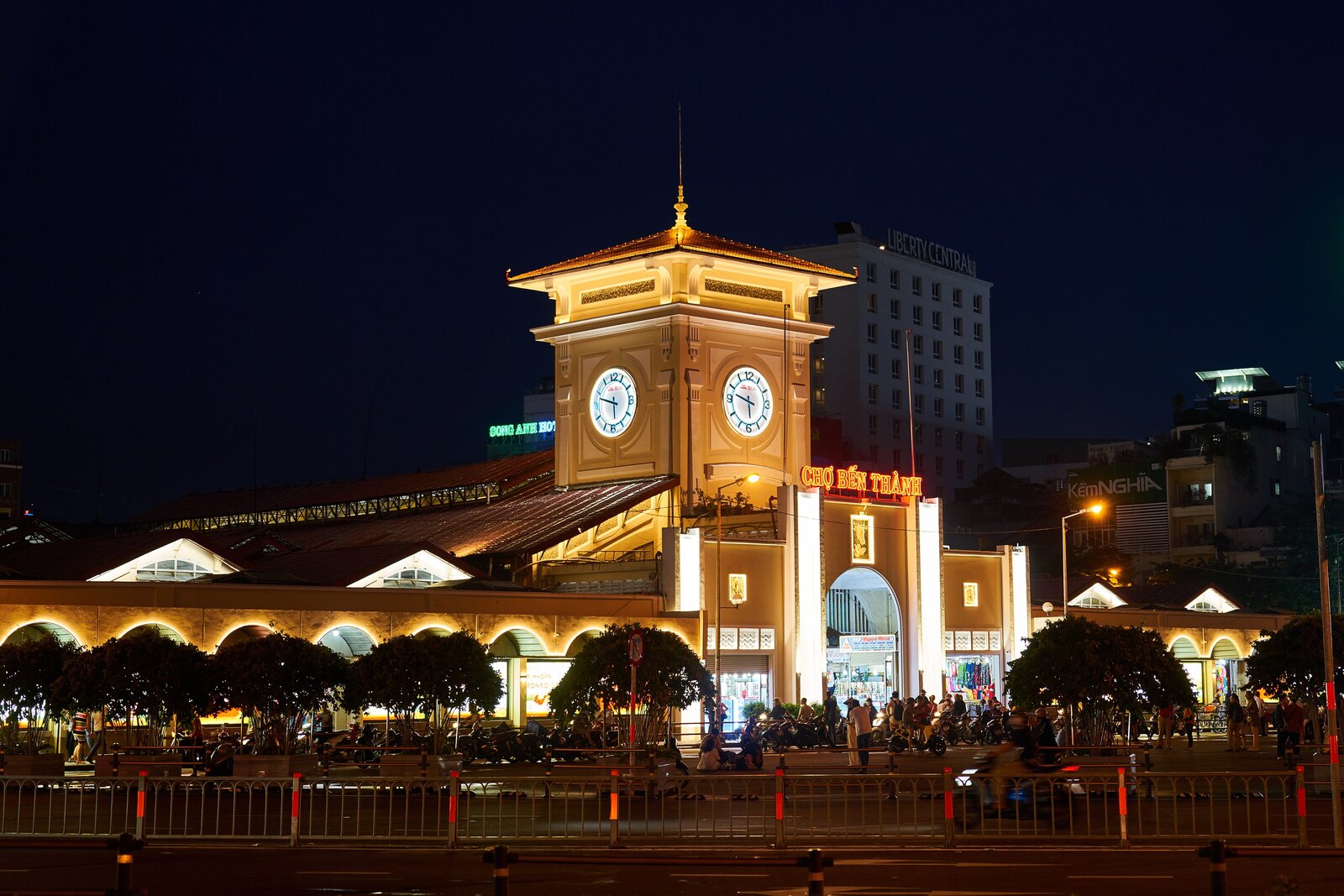
Saigon’s central market, at the head of Lê Lợi Boulevard on Quách Thị Trang Square; the main entrance is the southern one, under the clock tower.
A name older than the building. Bến Thành, according to the market’s official history, means “the landing in front of the citadel gate”: that was the name of the landing stage on the Bến Nghé river beside the octagonal citadel built in 1789–1790 by the future Emperor Gia Long. The present market went up on a drained swamp that the French called Lieutenant Boresse’s swamp and the Vietnamese ao Bồ Rệt, the Bồ Rệt pond.
Eiffel lost the tender. In the 1912 tender, Eiffel’s construction company (the Société de Levallois-Perret) came away with nothing but a consolation prize of 4,000 francs. The market was built by the firm of Brossard et Mopin. The first stone was laid on January 29, 1913, and on March 28, 1914, the market opened with three days of festivities, a cavalcade of floats and half-price “pleasure trains.” The famous fight between a girl and a tiger at those festivities, however, is not borne out by any document.
The tower and the reliefs. The clock tower, more than 18 meters (about 59 feet) high, with faces on three of its sides, is the unofficial emblem of the city: Vietnamese communities have built copies of it in shopping malls in the United States, Australia and Canada. The clock strikes at 6:00, 12:00 and 18:00. At the very top sits a finial in the shape of a wine gourd (bầu rượu), a sign of abundance. Above the main entrances are twelve ceramic panels from 1952, designed by the artist Lê Văn Mậu: oxen, fish, rays, ducks and bunches of bananas — the things the market sells.
Today. There are about 1,500 stalls, and more than 80% of the visitors are foreigners. Since November 2024 the market has been an architectural and artistic monument of city-level significance.
Visiting: under the market’s rules it is open 7:00–22:00, with the fresh-produce aisles opening at 4:00, though most stalls close by 19:00–20:00; admission is free. Metro: Bến Thành station, exit 1. Look for price tags and note the stall number: complaints are handled by stall number. From the second half of October 2026, a construction fence for metro line 2 is due to close off part of the square in front of the market. Check before you go.
Read more: Bến Thành Market — the three days of festivities in 1914, the market before the market, with its crocodiles, and a walk through the aisles.
5. Saigon Opera House, the Municipal Theater (Nhà hát Thành phố)
The theater stands on Lam Sơn Square (Công trường Lam Sơn), by the intersection of Đồng Khởi and Lê Lợi, between the Continental and Caravelle hotels. It has been a national monument since 2012. It was the first of the three great municipal theaters of French Indochina: according to the historian J. Kleinen, Saigon’s opened in 1900, Hải Phòng’s in 1904 and Hanoi’s in 1911.
A competition with a price cap. In 1895 the city announced a design competition with one condition: no design costing more than 700,000 francs would be accepted. The winner was Eugène Ferret, but according to Doling the theater ended up costing more than 2.5 million francs. The most popular opening date, January 1, 1900, is not confirmed by any document found so far; most likely the theater opened in January 1900, during the visit of Prince Valdemar of Denmark.
The Petit Palais myth. The façade is said to have been copied from the Petit Palais in Paris. But Ferret’s design was approved in November 1895, while the drawing of the Petit Palais dates only from the summer of 1896. On the façade are two caryatids about 4.5 meters (about 15 feet) tall, “theo phong cách Erechtheyon Hy Lạp” — “in the style of the Greek Erechtheion” — along with angels holding a lyre and the head of Pan. The inscription “Nhà hát thành phố” (“Municipal Theater”) replaced the French “Théatre Municipal.”
Several lives. From the mid-1950s until 1975 the building housed the parliament of the Saigon government (chính quyền Sài Gòn), and from 1967 its Lower House; for Saigon’s 300th anniversary the theater was restored. The auditorium seats 468; the figure of “1,800 seats” found on Wikipedia is not supported by any document of the period. Beneath the square there is a metro station: according to the operator, it is the only one of the line’s three underground stations where the two tracks run side by side, so as not to affect the building above. Today the stage belongs to HBSO — the city’s symphony orchestra, opera and ballet — and to À Ố Show, a bamboo circus born on this stage in 2013.
Visiting: you can get inside only with a ticket to a performance; the façade and the square are open to everyone. HBSO performances in the 2026 calendar begin at 20:00; ticket prices vary — check at the box office.
Read more: Saigon Opera House — five opening dates, three architects, tenors at three or four thousand francs a month, and how to get a seat at a performance.
6. Nguyen Hue Walking Street (Phố đi bộ Nguyễn Huệ)
A granite plaza that runs from the former city hall, now the City People’s Committee building, to the riverside at Bạch Đằng Wharf (Bến Bạch Đằng): about 880 meters (just over half a mile), a 12-minute walk. It became a pedestrian street on April 29, 2015.
A canal beneath the granite. This was the route of the Grand Canal, which ran from the river to the gates of the Gia Định citadel. The French filled it in two stages — the upper part in the 1860s, the lower end in the late 1880s, by 1890 — and named the boulevard after Admiral Charner, who in 1840 had carried Napoleon’s ashes back to France. For a long time afterward Saigon residents still called it “đường Kinh Lấp,” “Filled Canal Street.” In 1955–1956 it was given the name of Nguyễn Huệ — Emperor Quang Trung, the chief rival of Gia Long. The newspaper Pháp Luật TP.HCM explains the logic: “Nếu có đường Gia Long thì cũng có đường Nguyễn Huệ” — “If there is a Gia Long Street, there will also be a Nguyễn Huệ Street.”
The city hall and the monument. At the upper end stands the former city hall, the Hôtel de Ville (1898–1909), a national monument since 2020. In front of it, since May 17, 2015, has stood a statue of Hồ Chí Minh by the sculptor Lâm Quang Nới, 7.2 meters (about 24 feet) tall.
The city’s main stage. From 1960 flowers were brought here by boat for Tết, and since 2004 the street has hosted Đường hoa, the Tết flower street — every year except 2015, when it moved to Hàm Nghi Street. In 2024 two dragons, each more than 100 meters (over 328 feet) long, stretched along it, and in 2026 the flower street drew more than 1.8 million visits in eight days. This is also where the city welcomes the New Year and celebrates April 30 and September 2, National Day, and the façade of the city hall serves as the screen for 3D-mapping light shows.
Visiting: the plaza has no opening hours, and entry is free. Evening is the best time to come: by day there is little shade, and on weekends from 19:00 to 23:00 the side carriageways are closed to traffic. Check the current rules.
Read more: Nguyễn Huệ Walking Street — all 23 flower streets, four dates for the filling of the canal, the “horn basin” roundabout of Bồn Kèn, and the house where the patriot and reformer Phan Châu Trinh died.
7. War Remnants Museum (Bảo tàng Chứng tích Chiến tranh)
The museum at 28 Võ Văn Tần is 650 meters — about nine minutes on foot — from the Independence Palace. Its exhibition house opened on September 4, 1975, four months after the Liberation of the South and the reunification of the country; the present building has been open since 2010.
Ground with a long history. In 1791, in the Khải Tường pagoda that once stood on this spot, Prince Nguyễn Phúc Đảm was born — the future Emperor Minh Mạng. Later the site was taken up by a French military post, a clinic and a medical school, and from 1965 by American offices.
“Requiem.” The second hall on the route is “Hồi niệm” (“Remembrance”), home to the “Requiem” collection. According to the museum, it holds 275 photographs by 134 photojournalists of eleven nationalities who were killed in the wars in Indochina. The collection was assembled by the British photographer Tim Page and the German Horst Faas, and the money for it was raised by American war veterans from Kentucky; it is a gift from the people of Kentucky to Vietnam, and it has stayed here for good. The emblem of the hall is a photograph of the bullet-pierced camera of the Japanese reporter Taizo Ichinose.
A museum for peace. Since 1998 the museum has belonged to the International Network of Museums for Peace — the only one in Vietnam, as it says itself — and it signs itself “Bảo tàng vì Hòa bình,” “a museum for peace.” Over half a century, by the museum’s count, it has received more than 25 million visits, more than 1.4 million of them in 2025 alone. In Tripadvisor’s 2026 “Best of the Best” ranking, the museum is fifth among the attractions of Asia.
How to see it. The route runs from the top down: start on the third floor, in the “Historical Truths” hall (Những sự thật lịch sử), and leave for last the courtyard, with its planes, helicopters and tanks, and the separate prison building, with its reconstruction of the “tiger cages” of the Côn Đảo island prison.
Visiting: open daily 7:30–17:30, with the ticket office open until 17:00; tickets cost 60,000 ₫ (since October 1, 2026), and an online ticket for a time of your choice spares you the line. The content is harrowing: children under 10 must be accompanied by an adult. Check before you go.
Read more: War Remnants Museum — how “Requiem” made its way from Kentucky, the twelve zones of the route, and the stories behind objects donated to the museum.
8. Cu Chi Tunnels (Địa đạo Củ Chi)
An underground network in the former district of Củ Chi, with two memorial sites on the bank of the Saigon River: Bến Đình (about 44 km, or 27 miles, by road from Bến Thành Market) and Bến Dược (about 58 km, or 36 miles), 12 km (about 7.5 miles) apart. The tunnels have been a special national monument since 2015, and since July 15, 2026, they have been on UNESCO’s Tentative List of World Heritage.
From a pit to an underground city. It all began in 1946 with secret shelter pits in the villages. A pit, once found, became a trap, so people lengthened the pits into passages with several exits. Official Vietnamese sources put the network at “more than 200” or “almost 250” kilometers; Vietnam’s UNESCO submission says “several hundred.” About 4 km (about 2.5 miles) survive. According to the same submission, in 2012 the Asia Book of Records recognized them as the longest tunnel system in Asia.
A hoe and a basket. The tunnels were dug with a cuốc ngao, a hoe with a handle only 30–40 centimeters (about 12–16 inches) long, and a ky chệt, a bamboo basket that held about 10 kilograms (22 pounds) of earth. They ran on two or three levels. A genuine passage is about 62 centimeters wide and 104 high (roughly 24 by 41 inches), and at its tightest, 40 by 73 (about 16 by 29 inches). And the Hoàng Cầm stove — invented by an army cook of that name — hid its own smoke: the smoke traveled along winding channels through damp earth, and what was left “bò lan trông như làn sương mỏng” — “creeps along looking like a thin mist.”
What to see. At Bến Dược: the command bunkers, an operating room, and the memorial temple bearing 45,666 names of the fallen of the Saigon – Chợ Lớn – Gia Định region. At Bến Đình: the wreck of an American M41 tank and craters left by B-52 bombs; this is where most group tours go.
Visiting: open daily 7:00–17:00; the admission fee is 35,000 ₫, and foreign visitors pay another 100,000 ₫ for “service and guide.” The passages are cramped: people with claustrophobia, asthma or heart conditions are advised not to go down. The drive from the center takes 45–55 minutes without traffic, or an hour and a half to two hours, according to the press. Check before you go.
Read more: Củ Chi Tunnels — how to choose between Bến Dược and Bến Đình, how to get there by bus, and how the war was fought underground.
9. Binh Tay Market and Thien Hau Temple in Cho Lon (Chợ Bình Tây, chùa Bà Thiên Hậu)
Chợ Lớn, the “Big Market,” is the old Chinese city on the western side of Ho Chi Minh City. Its heart is Bình Tây Market (57A Tháp Mười, 8.4 km, or about 5.2 miles, by road from Bến Thành Market) and the temple of the sea goddess Thiên Hậu (710 Nguyễn Trãi); the two are about 1.7 km (about 1.1 miles) apart, some 23 minutes on foot.
A market opened on the night of the Moon. On September 28, 1928, the city deliberately opened the market at the Mid-Autumn Festival (Trung thu), and the dragon floats of the seven Chinese communities paraded through the streets. The city built the market, while the land and 242,000 piasters came from the merchant Quách Đàm, the “king of rice,” who had started out buying up empty bottles — but he did not live to see the opening: he died sixteen months before it. The market has tier upon tier of tiled roofs and a tower with clocks on all four sides; at the opening, the governor of Cochinchina called it the most beautiful market in the Far East. Since 2017 it has been a monument of city-level significance.
The Lady’s temple (chùa Bà). Officially the temple is Hội quán Tuệ Thành, the assembly hall (hội quán) of the Chinese community from Guangzhou; it has been a national monument since 1993. Coils of incense hang beneath the roof: a visitor writes down a wish, and a temple keeper hangs the coil up high. The roof ridges are lined with ceramic friezes from 1908, up to 16 meters (about 52 feet) long. According to tradition, the temple was founded around 1760; according to the documents, it was standing no later than 1795 — the year marked on the bell in the main hall.
The goddess’s seal. On the 28th day of the 12th lunar month (in 2026, February 15), at 9:00, the temple keepers stamp towels with a seal bearing the words “Bảo hộ an khang” — “Protection, peace and good health.” People start lining up at 4:00, and each person may bring no more than five new towels.
Visiting: admission is free. Bình Tây is a wholesale market; the night market (since December 2025) runs 18:00–24:00. The temple is a working sanctuary; in January 2024 photography was allowed only in the courtyard — check on site. Bus 39 runs here from Bến Thành Market.
Read more: Bình Tây Market and Thiên Hậu Temple — the “king of rice,” the Nguyên Tiêu Lantern Festival of the first full moon of the lunar year, the lantern street and the medicine street.
10. Saigon Zoo and Botanical Gardens (Thảo Cầm Viên Sài Gòn)
A garden of about 17 hectares (about 42 acres) at the end of Lê Duẩn Boulevard; the gates are at 2 Nguyễn Bỉnh Khiêm. Its name means “garden of plants and birds,” but Saigon people call it something simpler: Sở Thú, “the Menagerie.”
A garden from 1864. Admiral de La Grandière signed the decree establishing the garden on March 23, 1864, and it opened to the public on July 14, 1869. From 1865 it was run by the botanist Jean-Baptiste Louis Pierre. Even at seventy, according to a colleague, he would answer advice to take a rest with: “Je n'ai pas le temps de me reposer : la vie est si courte” — “I have no time to rest: life is so short.” The garden describes itself as the eighth-oldest zoo in the world; our own count does not bear that out, but it is certainly among the oldest zoos still operating, and it is the same age as the Moscow Zoo.
Animals and trees. As of March 2026, 1,919 animals of 119 species lived here. The elephant Chuông, according to the garden, was born in 1960, and as a calf she was walked for many days all the way from Cambodia. Burmese padauk No. 1302 is more than two hundred years old: according to the garden, the tree was growing on this spot before the garden was founded in 1864.
A museum and a temple inside the same wall. The History Museum opened on January 1, 1929; it describes itself as the first museum in southern Vietnam. In 1927 a public subscription bought the collector Holbé’s collection for the museum for 45,000 piasters, and the governor promised a building — a “jewel box” for the jewels. The museum holds twelve national treasures from the ancient Óc Eo and Champa cultures. The Hùng Kings Temple, which honors the legendary first kings of Vietnam, was built as a “Temple of Remembrance” for Vietnamese who died in the First World War; beside it stands a bronze elephant, a gift from King Rama VII of Siam.
Visiting: the garden is open daily 7:00–18:30 (one page of its website says until 18:00); tickets cost 60,000 ₫ for visitors 1.3 meters (about 4 feet 3 inches) tall and over, and 40,000 ₫ for children between 1 and 1.3 meters. The museum is open Tuesday to Sunday, 8:00–11:30 and 13:00–17:00; tickets cost 60,000 ₫. The garden and the museum sell separate tickets. Check before you go.
Read more: Saigon Zoo and Botanical Gardens — the feeding schedule, the heritage trees, the treasures of Óc Eo, and why “the eighth-oldest” is not quite right.
Short on time?
Distances and walking times in this article are our own measurements along OpenStreetMap routes, taken from our articles on each place. The cathedral and the post office face each other across the square, about 200 meters (some 220 yards) apart, and Nguyễn Văn Bình Book Street starts on the same square, beside the post office. From the cathedral to the gates of the Independence Palace is about 350 meters, and from the palace to the War Remnants Museum about 650, so these four places fit into a single walk. The Opera House is 350 meters from the upper end of Nguyễn Huệ Walking Street, and from the theater it is about 860 meters (about half a mile) along Lê Lợi Boulevard to Bến Thành Market; the zoo is about 1.2 km (three-quarters of a mile) from the cathedral. Bình Tây Market in Chợ Lớn is 8.4 km by road from Bến Thành Market — go by taxi or on bus 39 — while the Củ Chi Tunnels take half a day: a group tour lasts about five hours, including the drive.
Sources
The facts come from our articles on each place; the primary sources are listed in the “Sources” section of each article.
- Independence Palace
- Notre-Dame Cathedral Basilica of Saigon
- Saigon Central Post Office
- Bến Thành Market
- Saigon Opera House
- Nguyễn Huệ Walking Street
- War Remnants Museum
- Củ Chi Tunnels
- Bình Tây Market and Thiên Hậu Temple
- Saigon Zoo and Botanical Gardens
Cover photo: Radek Kucharski / Flickr, CC BY 2.0