Trail race «Vung Tau City Trail 2026»
Vung Tau Revolutionary Traditional House
550,000 ₫ – 1,150,000 ₫

 Culture and Arts
Long before sunrise the fishing boats of Vung Tau head out to sea to meet the Whale. For coastal fishermen the whale is a guardian who carries people in distress back to shore, and once a year the whole community rows out to receive him. Fishermen here have kept the rite for more than a century.
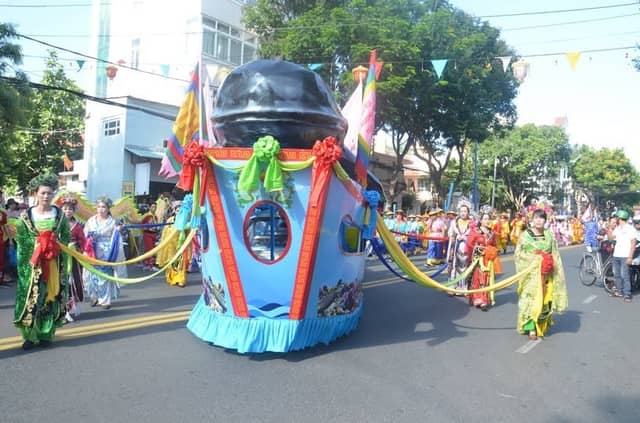
The festival spreads across several points of Vũng Tàu ward: Bãi Trước with Quang Trung Park and Cầu Đá pier, Miếu Hòn Bà, the Đình thần Thắng Tam heritage site and the central procession streets. Its ritual core opens on the water — a convoy of flower-decked boats brings the spirit tablet of Cá Ông ashore, and the official opening follows at the triangle park on Bãi Trước.
The ritual part opens out at sea on the morning of 26 September, between 5:30 and 7:15:
lễ Nghinh Ông trên biển, the sea rite that opens the festival
lễ rước Ông, the palanquin procession from the shore to the temple
lễ cúng tế Ông Nam Hải, the offering to the sea deity honoured as Nam Hải Đại tướng quân
lễ thỉnh Sắc Thần, the rite of the imperial decree that confirmed the deity's title
lễ Xây chầu đại bội, followed by classical tuồng cổ theatre
The festive half opens on 25 September, a day before the rites, and runs to the close of the festival: the Đua thuyền buồm Vũng Tàu mở rộng 2026 sailing regatta, folk games on the water, a sea-creature drawing contest for teenagers called «Sắc màu Lễ hội biển Vũng Tàu 2026», the «Rung chuông vàng» quiz on the history of the festival, and an online contest about the heritage site itself.
Bring the children or a camera: this is a living rite the community runs for itself, not a reconstruction staged for visitors, and you can follow the procession from the waterline to the temple yard.
The temple complex was begun in 1820, the year Canh Thìn, early in the reign of Emperor Minh Mạng. It takes its name from Thắng Tam, one of three fishing villages founded on the peninsula then. Lăng Ông Nam Hải was added in 1824 and Miếu Bà Ngũ Hành in 1832; since 1991 the complex has been a national historical and cultural monument.
Lăng Ông Nam Hải holds 180 sets of whale bones, the largest skeleton measuring 18 metres — village records say that whale died in 1831 in the waters off Bãi Sau. Emperors Thiệu Trị and Tự Đức granted the Nam Hải deity three imperial decrees, in 1845, 1846 and 1850.
Since 2000 the General Department of Tourism has listed the festival among the 15 largest festivals in the country, and in 2023 the Ministry of Culture, Sports and Tourism entered it into the National List of Intangible Cultural Heritage.
Another point on the festival map is Hòn Bà, a rocky islet a little over two hundred metres off Núi Nhỏ hill, carrying Miếu Hòn Bà — a shrine built around 1881 for Ngũ Đức Thánh Phi. Around the middle of each lunar month the water draws back and uncovers a stone path that people walk out to the shrine.
Come down while the sea is still dark, and you will see the boats leave the shore to meet the Whale.
Thang Tam Communal House and Bai Truoc (Quang Trung Park)
77A Hoàng Hoa Thám, phường Vũng Tàu, TP. Hồ Chí Minh
Copying and use of these materials is permitted only with the written permission of the site owners.