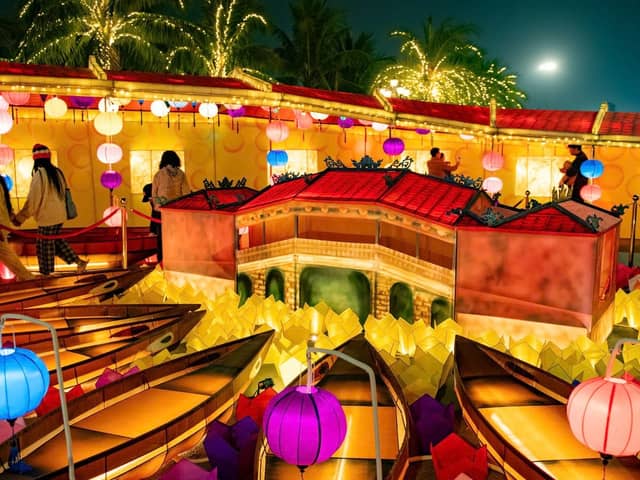
Festival «Đèn lồng quốc tế Hội An 2026» (Hoi An International Lantern Festival)
Song Hoai Square
Contact organizers

 Culture and Arts
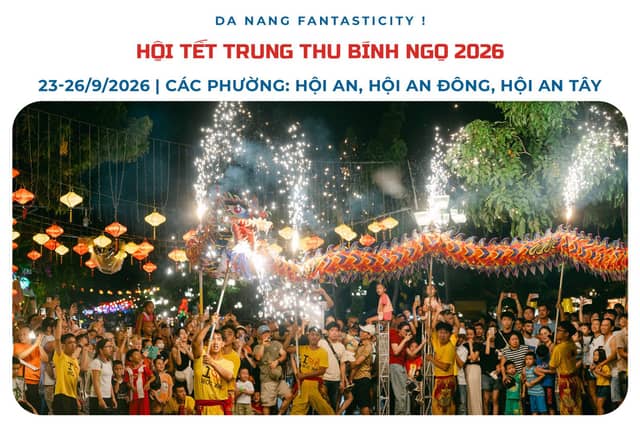
Four nights of the eighth-moon full moon in an old town that already turns off its electric lights for lanterns — and at the centre of it, a creature found nowhere else in Vietnam: the Thiên cẩu, the «heavenly dog». If you have seen lion dancing anywhere else in the country, what happens here is a different animal entirely.
This year's announced programme covers a Thiên cẩu and lion dance competition with accompanying performances, a display of traditional Mid-Autumn offering trays, a lantern procession, and the lantern-lit ancient town night.
How the Thiên cẩu differs from a lion. Its head is built from rattan, bamboo and papier-mâché, with a flat rather than rounded forehead, a sharp horn on the nape curving forward, pig-like ears, bulging eyes with moving lids, a large three-tiered nose, a bearded lower jaw that opens and closes on the beat, and «gills» shaped like a pair of carp on either side. The body is a long cloth, usually red and furless; the tail is a bunch of leaves. The crucial difference: a lion is always exactly two dancers, whereas the Thiên cẩu has one person carrying the head and one, two or many more under the body — producing a many-legged creature closer to a children's chain game. A comic Ông Địa with a fan always accompanies it.
In legend the heavenly dog swallows the sun and the moon, causing eclipses; people banged barrels, clappers and gongs to drive it off. If the creature swallowed a light and then spat it back out, the year would bring a good harvest. In Hội An the dance also carries the job of driving off malign spirits, warding off epidemics and fires, and calling in trade — which is why merchants once invited troupes to dance at their shopfronts.
The dance has been in Hội An for more than 100 years; before 1945 each Chinese congregation kept its own Thiên cẩu head for performances in its assembly hall. Around 1995–1997 it all but vanished from the streets, displaced by the Saigon-style lion dance, and recent years have revived it largely through competitions like this one.
In 2023 the Mid-Autumn festival traditions of Hội An entered Vietnam's national register of intangible cultural heritage, with the certificate presented on the evening of 28 September 2023 in Hội An Park.
The day-by-day schedule is usually released by the organisers only shortly before the festival opens, so check announcements from the Hội An World Cultural Heritage Conservation Centre before travelling.
Good for families with children, for photographers, and for anyone who wants a festival that is still a living practice rather than a performance staged for visitors.
The full moon itself falls on the Friday, which is the night the streets are busiest — worth knowing whether you want the crowd or the quieter evenings around it.
Hội An Ancient Town and the wards of Hội An, Hội An Đông and Hội An Tây
Các phường Hội An, Hội An Đông, Hội An Tây, thành phố Đà Nẵng
Copying and use of these materials is permitted only with the written permission of the site owners.