In 1904 Henri Parmentier, an architect with the French School of the Far East, finished his description of the valley's principal tower. "La tour principale A1, conçue dans des proportions grandioses, est d'une exécution remarquable et d'une conservation extraordinaire; de telle sorte que le plus vieux peut-être des sanctuaires chams paraît en être également le mieux conservé" — "The principal tower, A1, conceived on a grand scale, is remarkably executed and extraordinarily well preserved, so that what is perhaps the oldest of the Cham sanctuaries appears to be the best preserved as well." Sixty-five years later, in August 1969, American B52 bombers dropped their bombs on the sanctuary, and nothing was left of A1 but its base.
Fifteen hundred years before that, the king who founded the sanctuary had left a request in stone for those who would come after him: "Par pitié pour moi, ne détruisez pas ce que j'ai donné" — "Out of pity for me, do not destroy what I have given." The stele bearing these words was found in 1899 in front of that very tower.
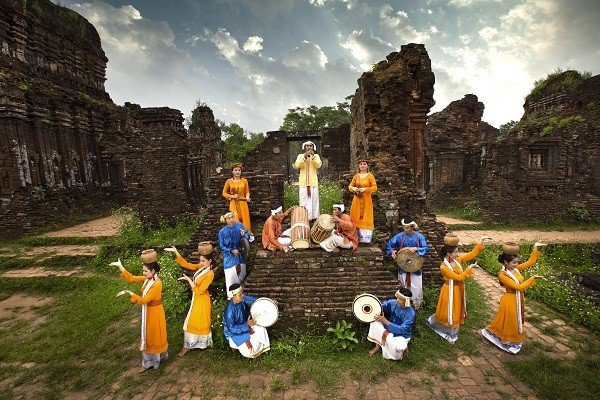
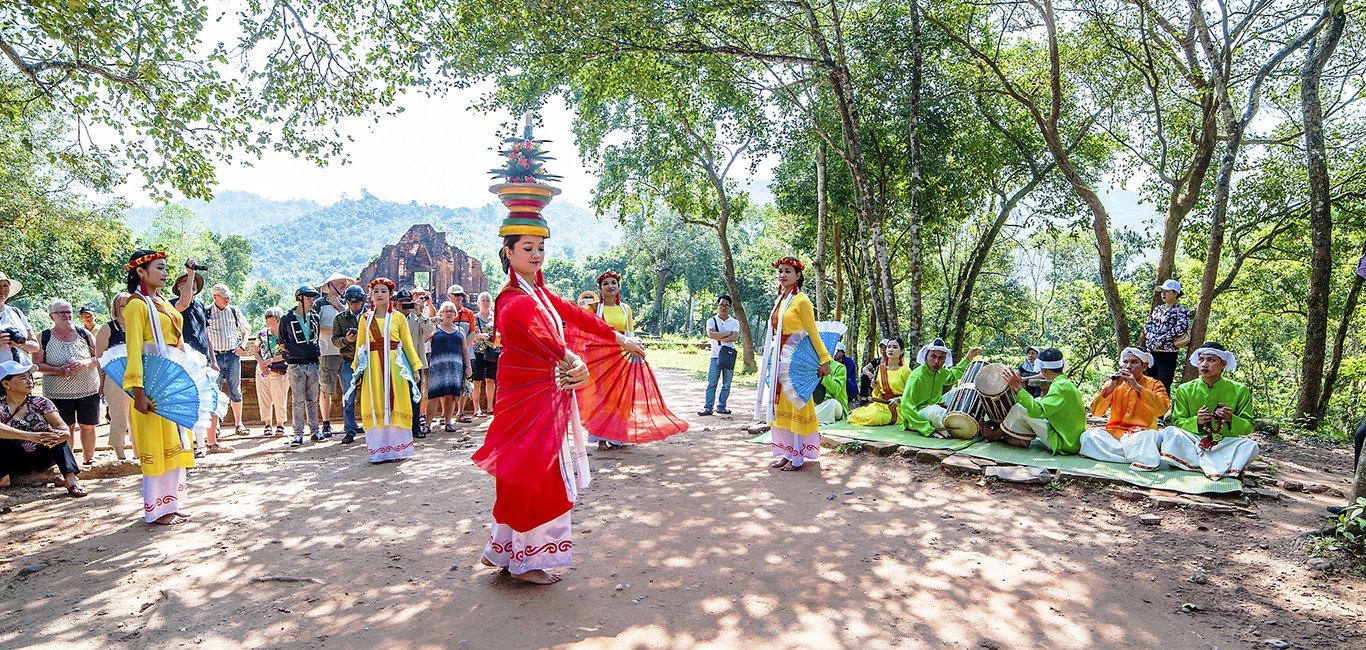
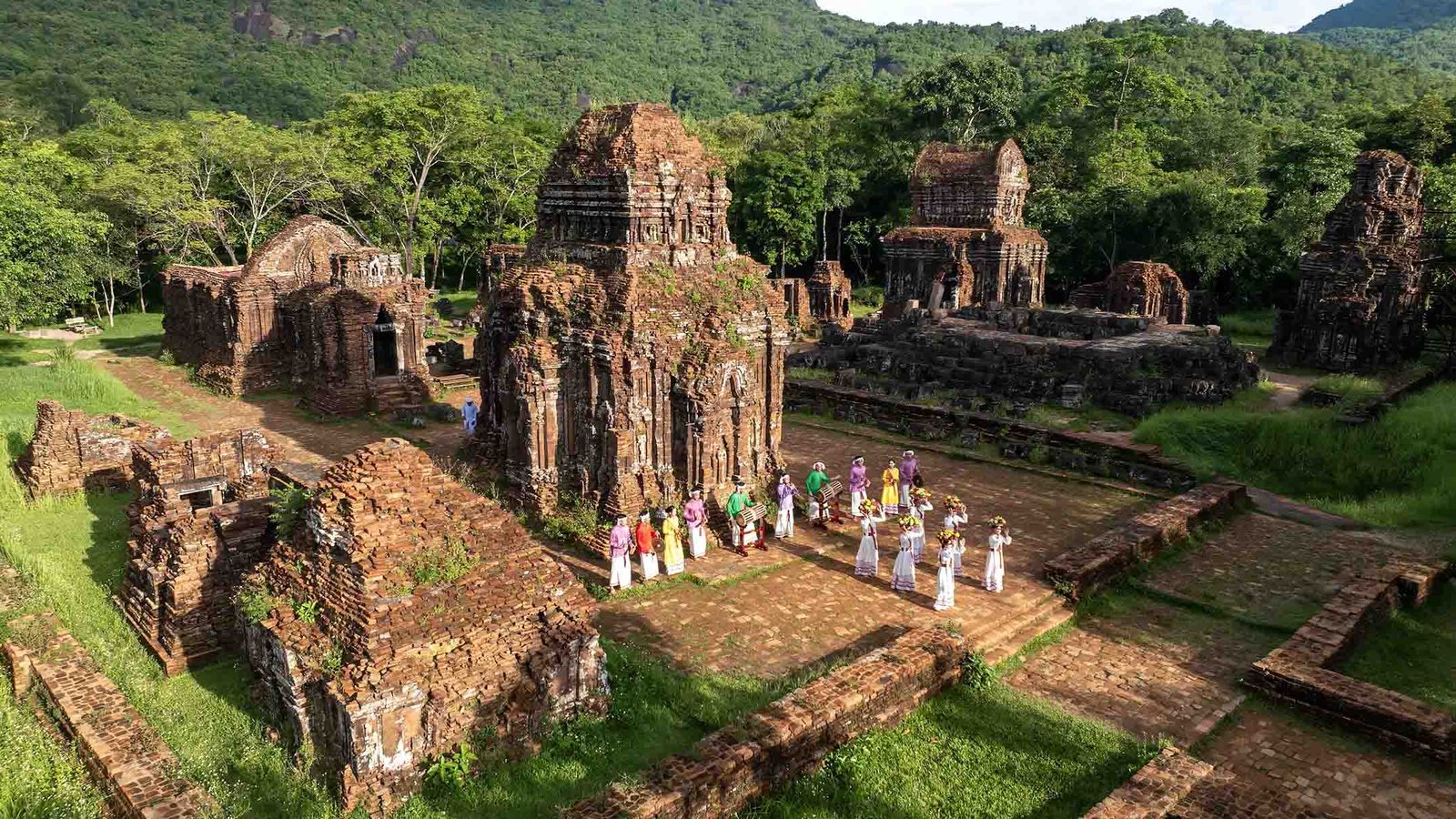
Mỹ Sơn is a small, round basin in the foothills in the western part of the former Duy Xuyên district of Quảng Nam province, which since 2025 has been part of the city of Đà Nẵng. The kings of Champa — the Hindu kingdom of the Cham people on the coast of what is now central Vietnam — built temples to Shiva here from the 7th to the 13th century, and the first one, apparently of wood, went up as early as the turn of the 4th and 5th centuries. The Champa scholar Trần Kỳ Phương writes that among the Hindu monuments of Southeast Asia, Mỹ Sơn stands out for the longest continuous sequence of development: nine centuries. The valley has lived through oblivion, fires, floods and war. It has been cleared of mines and saved from a dam; it has been restored by Poles, Italians and Indians; and the museum at its entrance was built with Japanese funding. In 1999 the UNESCO World Heritage Committee inscribed "My Son Sanctuary" on its list as "an exceptional example of cultural interchange." Today more than 400,000 people a year come here, nine in ten of them from abroad, and every day, beneath the towers, musicians play the kèn saranai, a Cham reed instrument, and dancers perform with clay jars balanced on their heads.
At a glance
The basin, the "former lake" and the Great Mountain
The first scholarly description of the valley was a few lines written by Louis Finot, director of the French School of the Far East (École française d'Extrême-Orient, EFEO), in the School's bulletin for 1902:
"A une heure de marche du village est un vallon d'un accès difficile, clos de toutes parts d'une ceinture de collines rocheuses et envahi par une brousse épaisse. Ce cirque solitaire recèle le plus magnifique ensemble de monuments qui nous soit resté de l'ancien Champa". "An hour's walk from the village lies a valley difficult of access, closed in on every side by a belt of rocky hills and overgrown with thick brush. This solitary cirque conceals the most magnificent ensemble of monuments that has come down to us from ancient Champa." Louis Finot, "Notes d'épigraphie" ("Epigraphic Notes"), BEFEO (the EFEO bulletin), vol. 2, 1902
Hence the French name "cirque de Mi-sơn" — the "cirque," or basin, of Mỹ Sơn. Two years later Parmentier described it with a surveyor's eye: an almost circular valley 1.5 to 1.8 km (roughly a mile) across "from crest to crest," wedged between the spurs of the Đèo Lê pass and a double chain of hills. The main peaks above it are Hòn Chúa and Răng Mèo, whose "characteristic silhouettes can be seen from Tourane and farther away." "Le cirque de Mĩ-sơn a tous les caractères d'un ancien lac" — "the cirque of Mỹ Sơn has all the characteristics of an ancient lake": it opens onto the Quảng Nam plain only through a narrow gorge to the north. All the water in the valley gathers into a stream that barely flows in the dry season but in the rains becomes "a torrent with extraordinary floods." "Nous l'avons vu, d'un cours moyen de 0 m 50, s'élever en trois heures à 3 m 50," Parmentier wrote — "We have seen it rise in three hours from an average depth of 0.50 m to 3.50 m": while he was there, the stream went from half a meter to three and a half meters (from about 1.6 to 11.5 feet) in three hours and flooded the valley floor across a width of 100–200 meters (330–660 feet). Its bed has cut down to almost three meters (about 10 feet) below the foundations of the temples; the water carried away part of hall A9 and possibly one of the towers of group A'.
Why did the kings choose this spot? Parmentier linked the choice to the neighborhood: at the mouth of the Thu Bồn lay the Cham port the French knew as Faifo (today's Hội An); on the plain stood the citadel of Trà Kiệu; and by the river were the rock of Hòn Cục, with an inscription by the sanctuary's founder, and the quarries. The ICOMOS experts in 1999 offered another explanation: the small valley among high mountains was also "an easily defensible stronghold."
The mountain that mattered most to the builders themselves is the one named in the inscriptions. The founder's stele grants the god the land "between the mountains," and one of them it calls Mahāparvata, "the Great Mountain." In 1904 Finot identified it with the highest peak to the south of the basin, and in 2011 Trần Kỳ Phương wrote that local people today call the holy mountain south of the valley Răng Mèo — "Cat Tooth" — or Hòn Quắp. In the text of his chapter the mountain is named "Mahendraparvata/Great God of the Mountain," while the caption to his photograph calls it the "Holy Mountain of Mahaparvata." The stream that flows north from it runs, according to the inscription on the Hòn Cục rock, into the "Holy River of Mahanadi," which is the Thu Bồn. There is a third name as well, Hòn Đền mountain: it appears in the name of the protected zone set up by the province in 1989 ("Hòn Đền — Mỹ Sơn"), and in the village at the foot of the hills people tell a legend about Hòn Đền (see "A village festival at the foot of the hills"). Which of these peaks is the Mahāparvata of the inscriptions cannot be settled from the sources we have read.
The name "Mỹ Sơn," on the other hand, is not Cham. It belongs to a Vietnamese village: in Finot's 1902 article the village of My-sơn lies in Duy Xuyên district, about 8 km (5 miles) southwest of the Hòn Cục rock, and the valley is "an hour's walk from the village." ICOMOS translates it: "the name in Vietnamese means 'Beautiful Mountain'" — mỹ, "beautiful," and sơn, "mountain." What the Cham called the valley themselves is unknown; the inscriptions name gods and mountains, and the country is called "Campādeśa," "the land of Champa."
UNESCO, Marrakesh, 1999
Vietnam submitted nomination No. 949, "My Son Sanctuary," on July 28, 1998. The Bureau of the World Heritage Committee at first referred the dossier back: it asked for a management plan for the site and assurances of funding and — a curious detail — invited the State Party to reflect "upon the natural and historical links between this property and Hoi An, reflected in the close association of both with the same river." In January 1999 an ICOMOS mission visited the valley. Vietnam had proposed inscribing the sanctuary under criteria ii and v; ICOMOS recommended ii and iii.
The decision was taken at the Committee's 23rd session in Marrakesh, Morocco, which ran from November 29 to December 4, 1999:
"The Committee inscribed this property on the World Heritage List on the basis of criteria (ii) and (iii): Criterion (ii): The My Son Sanctuary is an exceptional example of cultural interchange, with an indigenous society adapting to external cultural influences, notably the Hindu art and architecture of the Indian sub-continent. Criterion (iii): The Champa Kingdom was an important phenomenon in the political and cultural history of South-East Asia, vividly illustrated by the ruins of My Son." Decision 23 COM VIII.C.1, UNESCO World Heritage Committee, 1999
The text of the decision also records the statements made. The Delegate of China, speaking on behalf of all the Asian and Pacific members of the Committee, supported the nomination and expressed satisfaction that the extraordinary session of the Bureau had respected "the wish of the State Party with regard to the name and size of the property" — Vietnam's wishes concerning the site's name and boundaries; the Observer of Vietnam thanked the Committee for its decision. Hội An was inscribed at the same session, so the sanctuary and the old port on the same river joined the UNESCO list together.
The sources disagree on the exact day. In 2022 VietnamPlus (Vietnam News Agency) gave December 1, 1999. Nhân Dân and Tuổi Trẻ in 2025 give December 4 — the same day as for Hội An; December 4 is also the anniversary marked by the management board itself, which offers discounts in the souvenir shops that day. On the UNESCO website the session's decisions are not dated by day, and Trần Kỳ Phương simply writes "in December 1999." One thing is certain: December 1999, the 23rd session, in Marrakesh.
What the ICOMOS experts saw
The ICOMOS evaluation, drawn up in September 1999, is one of the most sober texts about Mỹ Sơn. "The My Son Sanctuary is a remarkable architectural ensemble that developed over a period of ten centuries. It presents a vivid picture of spiritual and political life in an important phase of the history of South-East Asia," the experts write. On authenticity, the evaluation says: "The authenticity of My Son in terms of design, materials, workmanship, and setting is high."
The most precise passage in the evaluation is the one comparing Mỹ Sơn with its neighbors:
"Comparisons may be made with more spectacular sites, such as Angkor (Cambodia), Pagan (Myanmar), or Sukhothai (Thailand), but these represent cultures that are complementary to that of My Son rather than competitive in cultural and spiritual terms." ICOMOS, Advisory Body Evaluation No 949, 1999
The evaluation is not celebratory in tone. "Despite the wholly admirable efforts of the State Party, the state of conservation of many of the individual monuments is very poor, and there is a need for urgent action," the experts write. By then the Poles had finished their work; after 1999 the Italians, the Institute for Monument Conservation and the Indians came to the valley (see "The museum at the entrance and the 'four restorations'").
The evaluation also gives the figures of the day. There were 3,570 visitors in 1990 and 12,500 in 1997, and the national tourism plan foresaw "very substantial increases" over the coming decade. The site's staff consisted of six graduate conservators and administrators, two students, an accountant and eight guards. Nobody lived in the protected area or in the buffer zone around it. The historical part of the evaluation also contains claims without a source (for example, that B1 was built in 1275); we cite them with a caveat.
Protection status: 1979, 1989, 2009 and 1,158 hectares
The sanctuary is protected by several documents, and each one widened the protection.
- April 29, 1979 — by decision No. 54VH/QĐ the Ministry of Culture and Information recognized Mỹ Sơn as a monument of architecture and art (di tích kiến trúc nghệ thuật), according to VietnamPlus. According to ICOMOS, 310 ha (about 770 acres) were placed under protection at that time.
- 1989 — decision No. 1484/QĐ-UB of the People's Committee of Quảng Nam – Đà Nẵng province on the restricted protection zone "Hòn Đền — Mỹ Sơn": 1,062 ha (about 2,620 acres), in which, according to ICOMOS, settlement, grazing, logging and other activities harmful to the monument are prohibited.
- January 15, 1995 — the site's management board, the Ban Quản lý Di sản Văn hóa Mỹ Sơn, was set up; it turned thirty in 2025.
- December 1999 — UNESCO World Heritage status.
- August 12, 2009 — by Prime Minister's Decision No. 1272/QĐ-TTg Mỹ Sơn became a special national monument (di tích quốc gia đặc biệt). The protection zones, according to the fact sheet of the Department of Cultural Heritage: zone I, 324,600 m² (about 80 acres); zone II, 11,255,400 m² (about 2,780 acres).
- 2025 — Prime Minister's Decision No. 1404/QĐ-TTg of June 28 concerns the brief for a master plan for the conservation and restoration of the special national monument up to 2035, with a vision to 2050. According to the board's plans (January 2026), the brief is to be completed by the end of 2026 and the plan itself submitted to the Prime Minister for approval in 2027.
Today, according to the board's director, Nguyễn Công Khiết, 1,158 ha (about 2,860 acres) are allocated to the heritage zone, and the board, he says, has managed to preserve the same area of forest. The core with the ancient buildings covers 32 ha (about 79 acres) — the "khu vực đỏ," the "red zone," where any construction or intervention is forbidden; around it lie a transition zone and a buffer zone. More than ten families whose houses and fields lay deep inside the zone were resettled, and the state planted forest on the cleared land. Once, Nguyễn Công Khiết says, the forest around the temples was a source of income for the surrounding villages: people felled trees, burned charcoal, gathered honey and hunted there. They were persuaded to give this up and were hired as restorers and guards; today twenty local residents are paid to patrol the forest every day (Tuổi Trẻ, 2025).
The forest around the sanctuary is a special-use forest (rừng đặc dụng). In 2017 SGGP wrote that its 1,158 ha "được Thủ tướng Chính phủ ký quyết định khoanh vùng bảo vệ," "were placed under protection by a decision signed by the Prime Minister" (the paper gives no number or date), and lie mainly in the communes of Duy Sơn, Duy Hòa and Duy Phú in Duy Xuyên district and Sơn Viên and Quế Trung in Nông Sơn district, as they were divided at the time; the project "Bảo vệ rừng cảnh quan Mỹ Sơn" ("Protecting the Mỹ Sơn Landscape Forest") was then still in preparation.
Since July 1, 2025, the monument has been managed by the city of Đà Nẵng. On December 29, 2025, as the Đà Nẵng Department of Culture, Sports and Tourism announced, Nguyễn Công Khiết was appointed director of the Ban Quản lý Di sản văn hóa thế giới Mỹ Sơn, the Mỹ Sơn World Cultural Heritage Management Board. Before that, from July, he had led the board as deputy director, and before the reform he was director of the board under Duy Xuyên district. He has said that he began at Mỹ Sơn as an employee in charge of ticket sales.
Six national treasures and where they are
In Vietnam the status of national treasure (bảo vật quốc gia) is given to authentic objects of exceptional value. Mỹ Sơn has six, but only two of them are in the valley itself. The other four went long ago to Đà Nẵng, to the Museum of Cham Sculpture. In 2025 the management board confirmed this distribution: four in the Museum of Cham Sculpture, one in the Mỹ Sơn museum, and the A10 altar in its place in the temple.
| Treasure | Date | Recognized | Where it is kept |
|---|---|---|---|
| The Mỹ Sơn E1 altar (Đài thờ Mỹ Sơn E1) | 7th–8th centuries | October 1, 2012, Decision No. 1426/QĐ-TTg, first group | Museum of Cham Sculpture, Đà Nẵng |
| Mukhalinga | 7th–8th centuries; found in November 2012 | January 14, 2015, Decision No. 53/QĐ-TTg | Mỹ Sơn museum at the entrance |
| Ganesha from E5 (Tượng thần Ganesha Mỹ Sơn E5) | 7th century | December 31, 2020, Decision No. 2283/QĐ-TTg, ninth group | Museum of Cham Sculpture, Đà Nẵng |
| The Mỹ Sơn A10 altar with linga-yoni | 9th–10th centuries | December 25, 2021, Decision No. 2198/QĐ-TTg, tenth group | Temple A10, on site |
| Relief "The Birth of Brahma" from E1 (Phù điêu Đản sinh Brahma Mỹ Sơn E1) | 7th–8th centuries | January 18, 2024, Decision No. 73/QĐ-TTg, twelfth group | Museum of Cham Sculpture, Đà Nẵng |
| Shiva from C1 (Tượng thần Shiva Mỹ Sơn C1) | 8th century | January 18, 2024, Decision No. 73/QĐ-TTg | Museum of Cham Sculpture, Đà Nẵng |
Decision No. 73/QĐ-TTg was signed by Deputy Prime Minister Trần Hồng Hà. Our database card and Thanh Niên (2026) stated that groups E–F hold "four national treasures": the mukhalinga, the Brahma relief, the E1 altar and the Ganesha from E5. Their origin is right, but three of the four are not at Mỹ Sơn but in Đà Nẵng. Thanh Niên, moreover, names temple E1 as the place where the mukhalinga was found, whereas Báo Văn hóa and VietNamNet say it was near E4; it is connected with E1 only as a hypothesis (see the section on the mukhalinga). And the card calls the A10 altar a "2022 treasure," although the decision was signed on December 25, 2021. The decision numbers in the table follow the national treasure register of the Department of Cultural Heritage; the register dates Decision No. 1426/QĐ-TTg to December 1, 2012, but the text of the decision itself is dated October 1, 2012.
Plan your visit
Where Mỹ Sơn is and how far it is from Đà Nẵng
The sanctuary lies in the hills south-southwest of central Đà Nẵng, in the valley of the Khe Thẻ stream, which flows into the Thu Bồn River. Administratively it belongs to xã Thu Bồn, TP Đà Nẵng — Thu Bồn commune, Đà Nẵng City. That is how the site's management board and the press have written it since August 2025, and the board's official website gives the address as "Thôn Mỹ Sơn - xã Thu Bồn - Thành phố Đà Nẵng" — "Mỹ Sơn village (thôn), Thu Bồn commune, Đà Nẵng City." The legal basis is Resolution No. 1659/NQ-UBTVQH15 of the Standing Committee of the National Assembly, dated June 16, 2025: its item 63 merges the former communes (xã) of Duy Châu, Duy Hòa, Duy Phú and Duy Tân into the new xã Thu Bồn. Before the reform of July 1, 2025, the address read xã Duy Phú, huyện Duy Xuyên, tỉnh Quảng Nam — Duy Phú commune, Duy Xuyên district, Quảng Nam province — and on that same day the province of Quảng Nam became part of the city of Đà Nẵng.
How far away it is depends on the source. The official fact sheet of the Department of Cultural Heritage (Cục Di sản văn hóa) gives "khoảng 70 km" — about 70 km (some 43 miles) — from Đà Nẵng, and so did VnExpress in 2022 and Tiền Phong in 2026; our database card also says about 70 km from central Đà Nẵng and about 40 km from Hội An. We measured along OpenStreetMap routes (OSRM) from the ticket office by the Khe Thẻ bridge (15.77364, 108.10923). The Hội An figure matched, but the distance to central Đà Nẵng came out much shorter:
| From | By car | In a straight line |
|---|---|---|
| City center — Dragon Bridge (Cầu Rồng) | ≈41.5 km (about 26 mi), about 39 min | ≈34.4 km (about 21 mi) |
| Đà Nẵng railway station | ≈41.8 km (about 26 mi), about 40 min | ≈34.8 km (about 22 mi) |
| Airport, Terminal T1 (domestic flights) | ≈40.7 km (about 25 mi), about 39 min | ≈32.6 km (about 20 mi) |
| Airport, Terminal T2 (international flights) | ≈40.8 km (about 25 mi), about 39 min | ≈33.0 km (about 20.5 mi) |
| Hội An — Japanese Covered Bridge (Chùa Cầu) | ≈37.6 km (about 23 mi), about 38 min | ≈25.9 km (about 16 mi) |
The times assume no traffic; on rural roads and in the rainy season the drive will take longer. The sources do not say from which point the "70 km" is measured; our road measurement is 41.5 km. In 1904 Parmentier gave a straight-line figure close to ours: "33 kilomètres S. S. E. [so in Parmentier] à vol d'oiseau de Tourane" — 33 km (about 20.5 miles) as the crow flies from Tourane, as the French called Đà Nẵng. His bearing is wrong: by our measurements, Mỹ Sơn lies south-southwest of Đà Nẵng (the bearing from the ticket office to Cầu Rồng is 22°). The main road to the sanctuary is provincial road ĐT610 from Nam Phước, about 27 km (17 miles) long; it was rebuilt in 2007 for 169 billion ₫ (Phan Hộ, director of the site's management board, 2019).
Visitors are taken to the towers by the board's electric shuttle. The ticket office, the parking lot, the museum and the lower shuttle stop are all by the Khe Thẻ bridge; from there the shuttle runs along a forest road to the upper stop — by our measurements, about 1.7 km (about a mile) by road and 1.2 km in a straight line. From the upper stop to the center of groups B–C–D it is another 790 m (about half a mile) as the crow flies, and you cover that on foot. In 2015 the board's director explained that without the shuttle the walk from the ticket office to the towers is about 2 km (1.2 miles). Distances to the neighboring places in our database are given in "What to see nearby."
Music brought from Ninh Thuận
No Cham have lived in the Mỹ Sơn valley for a long time. As Tuổi Trẻ reported Nguyễn Công Khiết's words in 2025, time and change ("sự bào mòn của thời gian và thiên biến," "the erosion of time and change") have meant that most Cham no longer live around the temples or anywhere nearby. How to bring the sanctuary to life for visitors without disturbing it was, the paper says, a long-standing puzzle. The idea came after the head of culture of Ninh Thuận province, where Cham villages still exist, visited Mỹ Sơn. The main question was where to find musicians, directors and choreographers who knew Cham culture, and the director of Ninh Thuận's Department of Culture agreed to help.
At the beginning of 2002, on his recommendation, Mỹ Sơn invited a group of Cham artists from Ninh Thuận. "Đa phần những người này đều là nghệ nhân có tên tuổi, sinh sống ở các làng Chăm lâu đời, thường thực hành các nghi lễ truyền thống của cộng đồng," Tuổi Trẻ writes — "Most of them were well-known artisans who lived in long-established Cham villages and regularly performed the community's traditional rituals." By day they performed at the Duy Xuyên district House of Culture and at Mỹ Sơn; at night they slept in staff housing at the entrance to the valley. According to the architect Đặng Khánh Ngọc of the Institute for Monument Conservation, Mỹ Sơn's dance company took shape in 2003; apparently the artists arrived in 2002 and became a permanent troupe a year later.
The company has grown since then. The kèn saranai master, from Phước Hữu commune in the former Ninh Phước district, arrived at the beginning of 2004. His family had kept Cham traditions for generations, and his uncle was a saranai player well known in the province; he himself learned as a child to make paranưng and ginăng drums and took part in rituals back home. At Mỹ Sơn he lives with three people from his home area, among them ginăng drummers and a choreographer. To keep the artists for the long term, the authorities sold them land for houses at a discount and helped them build; the saranai master married a woman from his home region, and the board took her on as a weaver who demonstrates Cham thổ cẩm brocade weaving to visitors. They are now, the paper writes, residents of Đà Nẵng. Between performances he makes instruments to order on site.
"Ở đây ngoài biểu diễn nghệ thuật Chăm, tôi còn tranh thủ chế tác nhạc cụ. Khách đến tham quan có thể đặt hàng và mua về để làm quà, không gì hạnh phúc bằng việc được sống với văn hóa, trái tim của mình bên di sản của tiền nhân đã để lại tới hôm nay". "Besides performing Cham art here, I also find time to make instruments. Visitors can order them and take them home as gifts. There is no greater happiness than to live with one's own culture and one's own heart beside the heritage our forebears have left us to this day." The kèn saranai master of the Mỹ Sơn troupe, Tuổi Trẻ, August 13, 2025
Nguyễn Công Khiết calls the troupe "một phần của linh hồn di sản sống động," "a part of the soul of a living heritage."
Seven performances a day
"Hoạt động múa Chăm được đưa vào biểu diễn phục vụ du khách hơn 10 năm qua, trở thành "thương hiệu" của du lịch Mỹ Sơn với 7 suất diễn/ngày," Báo Văn hóa wrote in November 2025, citing the board: Cham dance has been performed for visitors for more than ten years and has become the "brand" of Mỹ Sơn tourism, with seven performances a day. Ten years ago, Nguyễn Công Khiết recalled, there were three.
The 2026 schedule is posted on the board's official pages:
| Where | When | Good to know |
|---|---|---|
| At the foot of group G | 9:00 and 14:45 | the performance at G is suspended in bad weather |
| Performance hall (nhà biểu diễn) | 9:45, 10:30, 11:15, 14:00, 16:00 | daily, "trừ trường hợp đặc biệt," "except in special cases," which the board announces |
| Slope up to group H (dốc tháp H), "Hát Dân ca Chăm" — Cham folk songs | Monday, Wednesday, Friday, 9:00 and 14:45 | the schedule says nothing about suspension in bad weather |
| Groups B–C–D, "Âm vang Mỹ Sơn" | the 15th of every month, 9:00 and 14:45 | the venue has varied — in April 2026 the show was held at group G |
Prices and hours change — check before you go.
The performances are included in the ticket. The schedule has changed more than once: in 2020, according to the performance hall's rules, there were four 15-minute shows (9:15, 10:45, 14:00, 15:30), and they went ahead only if at least twenty spectators had gathered; from February 1, 2023, the times of the three morning shows were changed — one, at 9:15, moved to group G, while two stayed in the performance hall (10:00 and 10:45) — and the afternoon shows stayed as they were (14:00 and 15:30 in the hall, 14:15 at group G); and from March 1, 2024, the 10:00 show was moved to 9:45. That is why different figures turn up in the papers: a Tuổi Trẻ report in 2025 counted four shows in the performance hall, a board report at the end of September 2025 nine "suất diễn," and the official schedule seven.
What is performed? According to the management board (2023), the program includes "điệu múa nổi tiếng "Apsara vũ nữ Chăm"," "the famous 'Apsara vũ nữ Chăm' dance" (the dance of the Cham apsara dancers), the kèn saranai, múa đội lu — the dance with a jar on the head — the drums of a Cham village festival, "múa tượng tháp Shiva" ("the dance of the Shiva tower statues") and Cham songs. A Tuổi Trẻ reporter described an ordinary show like this: on a small stage behind a velvet curtain, the paranưng drum begins to beat and falls silent, the saranai comes in, and girls in Cham costume walk out onto the stage with clay jars on their heads. "Dù tiết mục khá đơn giản, không quá hoành tráng như ở các nhà hát lớn nhưng được diễn xướng ngay trên thánh địa khiến du khách trải qua những cung bậc cảm xúc," the paper writes — the number is fairly simple and not as grand as in the big theaters, but performed right in the sanctuary, it takes visitors through a whole range of emotions.
From September 2, 2023, the "đội Ciet" dance was added to the program. A Ciet is an object in which the garments of the gods (or of deified kings) are kept. The girls carry the Ciet on their heads, with jnam scarves over their shoulders and fans in their hands; the dance shows the Cham receiving the god's garments, brought from the Raglai people, carrying them to the temple in the tower, bathing the statue and dressing it. Báo Văn hóa calls "đội Ciet" the most beautiful of the temple dances: "Múa "đội Ciet" là một điệu múa truyền thống của người Chăm vừa mang yếu tố tâm linh vừa mang yếu tố cổ truyền" — "The 'đội Ciet' dance is a traditional dance of the Cham people that carries both spiritual and ancient elements."
The performance hall has its own rules: phones on silent, no climbing onto the stage, no filming during a number.
"Âm vang Mỹ Sơn" ("Echoes of Mỹ Sơn") and the songs on the slope to group H
In 2025–2026 the management board added two regular programs to the daily shows. It named the aim plainly: to make Mỹ Sơn an "điểm du lịch văn hóa lễ hội," a destination for cultural and festival tourism (Báo Văn hóa, January 2026).
"Âm vang Mỹ Sơn" ("Echoes of Mỹ Sơn") was described in November 2025 as a "chương trình nghệ thuật thực cảnh," an open-air show staged in the real setting, held "vào các dịp lễ, Tết và ngày cố định trong tháng," "on holidays, at Tết and on fixed days of the month." Under the 2026 schedule it takes place on the 15th of every month by the solar calendar at groups B–C–D, at 9:00 and 14:45. The most detailed program the newspapers published was for Giỗ Tổ Hùng Vương, the commemoration day of the Hùng Kings, on April 26, 2026: two shows, at 9:00 and 14:45, at group G, in three chapters. The first, "Dòng chảy thời gian" ("The Flow of Time"), traced Mỹ Sơn's culture through history; the second, "Dân ca Chăm Po-Nai," offered Cham songs of good harvests and plenty; the third, "Lên tháp" ("Up to the Tower"), recreated the Katê festival, a major annual Cham festival, with traditional dances, the ginăng drum and the kèn saranai. We were unable to establish whether the program was also held on the 15th of other months.
"Hát Dân ca Chăm," Cham folk songs, are sung on the slope up to group H. In the board's results for 2025 they were named one of three new products, along with a local food corner and Cham pottery. The plans said different things — "2 suất diễn/ngày," "two performances a day" to begin with; "hằng tuần," "weekly"; "hằng ngày," "daily" — and under the 2026 schedule it is Monday, Wednesday and Friday, at 9:00 and 14:45.
Mỹ Sơn has a Vietnamese voice as well. At Tết 2025, bài chòi — a Vietnamese folk singing game — was performed by the Khe Thẻ stream for the first time, and by the end of 2025 the board planned to stage the local community's bài chòi regularly, up to six times a day. The newspapers do not say whether this went to plan.
Festivals in 2026: "Sắc màu di sản" ("Colors of Heritage") and áo dài days
Mỹ Sơn's busiest festival calendar is in spring. In 2026 it looked like this (Báo Văn hóa and Tuổi Trẻ, April 23, 2026):
- April 23–26 — free admission for women wearing the áo dài, the Vietnamese long dress: this was Mỹ Sơn's way of supporting Đà Nẵng's first city áo dài festival. The condition was to take a photo at the sanctuary and post it with the festival hashtag.
- April 26, Giỗ Tổ Hùng Vương — "Âm vang Mỹ Sơn" at group G (see the previous section).
- April 30 and May 1 — the program "Sắc màu di sản" ("Colors of Heritage") in three parts. From 8:30 to 9:00, in the lobby of the "nhà chuyên gia," the experts' house, "khúc gọi mùa lễ hội Kate," "a call to the Katê festival season." From 9:00 to 9:30, at the foot of the slope to group H, a crafts demonstration: women weaving and shaping pottery by hand. At 14:45, at group A, "về miền tháp cổ," "to the land of the ancient towers": a talk on Cham culture and the beliefs bound up in the Rija Harei ritual, with dances, the kèn saranai and bright costumes.
- April 26 – May 3 — for Vietnamese visitors, a sixth ticket free with every five purchased. The board expected the number of Vietnamese visitors over the holidays to rise by 15–20%.
In winter the main festival is Tết. From the second to the ninth day of Tết 2025 (the Year of the Snake, Ất Tỵ), Mỹ Sơn ran a local food corner — bánh ít lá gai (sticky-rice cakes made with ramie leaves), bánh chưng (the square sticky-rice cake of Tết), mì Quảng (Quảng-style noodles) and bánh căn (small rice-flour pancakes) — and all the regular services (shuttles, guides, Cham performances, weaving, the bike path) ran without a break. In spring 2026 the board announced the program "Mùa Xuân hành hương thánh địa Mỹ Sơn," "A Spring Pilgrimage to the Mỹ Sơn Sanctuary."
The board's calendar also marks Giỗ Tổ, April 30 and May 1, November 23 (Vietnam Cultural Heritage Day), December 4 (the UNESCO anniversary) and New Year's Day; on these days, according to an announcement in October 2025, the souvenir shops offer discounts.
The night show that never caught on
Mỹ Sơn has no evening life, and the management board makes no secret of it. The story of the night program "Đêm Mỹ Sơn huyền thoại" ("Legendary Mỹ Sơn Night") is an honest account of how hard it is to turn a sanctuary into a stage.
It was conceived in the autumn of 2021, when Mỹ Sơn reopened to tourists after its COVID-19 closure (October 5, 2021). The board, then headed by Phan Hộ, together with a local company, planned a program from 16:00 to 20:30 on the 16th day of every lunar month. The first part was to be music and crafts along the stretch from "Nhà Đôi" to the slope up to group H: a mini-concert on folk instruments, Cham songs, an excerpt from the Rija Nưgar festival, Quảng Nam and Cham food, pottery, weaving, Cham earrings, trying on costumes, folk games. The second was an hour-long show in three chapters in the temple zone (Báo Văn hóa, 2021).
The premiere took place on the evening of March 24, 2022, as part of the National Tourism Year "Quảng Nam — Điểm đến du lịch xanh" ("Quảng Nam: A Green Tourism Destination"). More than 200 performers appeared beneath the towers for the first time, watched by "hàng nghìn," "thousands," of spectators. The three chapters ran for 60 minutes: "Thung lũng — câu chuyện thời gian" ("The Valley: A Tale of Time"), "Đêm Mỹ Sơn huyền thoại" and "Ánh sáng giao hòa" ("The Light of Harmony"). The stage, according to the board, was formed by the paths leading to the groups of towers, "không đụng vào bất cứ công trình nào," "without touching any structure," and the audience was seated away from the towers. Phan Hộ said at the time: "Dự kiến chương trình đưa vào phục vụ du khách từ tháng 5 tới. Trước mắt sẽ tổ chức mỗi tháng một lần vào ngày 16 Âm lịch. Sau đó tùy vào thực tế, nhu cầu của khán giả, chương trình sẽ tăng buổi biểu diễn và tiến tới phục vụ hàng đêm cho du khách" — "We plan to put the program on for visitors from this coming May. For now it will be held once a month, on the 16th day of the lunar month. After that, depending on how things go and on audience demand, the program will add performances and move toward being staged every night" (VnExpress, 2022).
Nightly performances never came. From May 2022 the program ran once a month, and then, as the magazine Thương hiệu & Công luận wrote in 2025, it "đã phải bị buộc dừng vì không đủ chi phí để duy trì" — "had to be stopped because there was not enough money to keep it going." In some newspapers and documents it is called "Đêm Mỹ Sơn huyền ảo" ("Magical Mỹ Sơn Night"); it is the same program. In August 2025 the director of the city's Department of Culture, Trương Thị Hồng Hạnh, gave instructions to study an annual Mỹ Sơn festival with this night program as its centerpiece.
On the evening of November 21, 2025, a revamped, shortened version was shown to delegates from Vietnam's ten World Heritage sites, for the twentieth anniversary of Vietnam Cultural Heritage Day. The third chapter was now called "Ánh sáng chan hòa" ("Light Poured All Around"). Nguyễn Công Khiết admitted: "Chương trình đầu tư lớn nhưng lịch diễn chưa cố định mà phải theo từng thời điểm có các đoàn khách lớn" — "A lot has been invested in the program, but its schedule is not yet fixed; it has to follow the times when large groups of visitors come" (Tuổi Trẻ, 2025). In January 2026, as Tuổi Trẻ reported, he told travel companies that despite all the effort Mỹ Sơn still had no product to keep visitors there in the evening, and that "Đêm Mỹ Sơn huyền thoại" was not delivering results. In the plan for 2026 the program was listed for the 16th day of the lunar month, marked "dự kiến," "tentative"; it does not appear in the official 2026 schedule. If you are hoping to see Mỹ Sơn by night, do not count on it.
This story has a second side. Mỹ Sơn is a sanctuary, and the province's leaders have said as much: in 2024 the secretary of the Quảng Nam provincial Party committee, Lương Nguyễn Minh Triết (appointed secretary of the Đà Nẵng city Party committee in September 2025), said, as Nguyễn Công Khiết recounted, that "Mỹ Sơn phải tạo ra các dịch vụ có chất lượng, giữ gìn cảnh quan không gian, tuyệt đối không phát triển dịch vụ ồ ạt" — "Mỹ Sơn must create quality services and preserve its landscape and space, and must absolutely not develop services en masse."
Anniversaries and festivals: 2009, 2019, 2024
Mỹ Sơn marks its UNESCO dates every five years; according to Nhân Dân, the board staged programs for the fifth, tenth, fifteenth, twentieth and twenty-fifth anniversaries, as well as three editions of "Hành trình Di sản" ("The Heritage Journey"), "Lễ hội mùa Xuân bên tháp cổ" ("Spring Festival by the Ancient Towers"), "Festival di sản" ("Heritage Festival") and "Đêm Mỹ Sơn huyền ảo" ("Magical Mỹ Sơn Night").
2009, ten years. The fourth provincial festival, "Lễ hội Quảng Nam — Hành trình Di sản" ("The Heritage Journey," June 4–7, 2009), opened on the evening of June 4 at Mỹ Sơn with the program "Ấn tượng một chặng đường" ("Impressions of a Journey") on a "stage without a stage" set into the monument; there was also a cultural exchange between Mỹ Sơn and the Lao temple of Vat Phu (Báo Pháp luật). The "Hành trình di sản" festival, according to the board's website, was held "định kỳ năm chẵn," "regularly in even-numbered years" (although the fourth, as we see, fell in 2009), at two World Heritage sites, Hội An and Mỹ Sơn; at Mỹ Sơn, according to the board's website, its ritual part included "lễ dâng nước, lễ mở cửa đền, lễ tắm tượng" — the offering of water, the opening of the temple doors and the bathing of the statues. The festival later became the "Festival Di sản Quảng Nam"; the sixth festival opened on June 9, 2017, in Tam Kỳ.
2019, twenty years. The celebrations opened on the evening of September 8, 2019, at 20:00, right in the temple zone; for the anniversary the Ministry of Culture, the province and UNESCO held an international conference on the role of communities in heritage conservation. On the same day a 179 km (111-mile) stage of the VTV Cup Tôn Hoa Sen cycle race, "Hành trình di sản," passed through Mỹ Sơn.
2022. Besides the premiere of the night program, the temple zone hosted International Day of Yoga on June 30, 2022: the Indian embassy, the Ministry of Culture and the province staged a demonstration attended by India's ambassador, Pranay Verma, and the vice chairman of the provincial committee, Trần Anh Tuấn, in which a hundred members of Quảng Nam yoga clubs took part. It was one of the events marking the fiftieth anniversary of diplomatic relations between Vietnam and India. We were unable to establish whether the yoga day was held at Mỹ Sơn in 2025–2026.
2024, twenty-five years. On November 22 the heritage staff of Mỹ Sơn and Hội An held a cultural and sports exchange. On November 29 a scientific conference took place in the temple zone, "Khu đền tháp Mỹ Sơn và các Di sản Văn hóa Thế giới ở miền Trung: Trữ lượng và viễn cảnh" ("The Mỹ Sơn Temple Complex and the World Cultural Heritage Sites of Central Vietnam: Reserves and Prospects"), organized by the Institute of Social Sciences of the Central Region and the Duy Xuyên district committee; it was accompanied by the volume "Di sản Văn hóa Mỹ Sơn 25 năm nhìn lại" ("The Cultural Heritage of Mỹ Sơn: Looking Back over 25 Years"). On the morning of December 3 a formal celebration was held in the temple zone, with awards for individuals and teams; on the same day the sanctuary was visited by the vice chairman of the National Assembly, Nguyễn Đức Hải, together with deputies from Quảng Nam. According to press reports, he called for Mỹ Sơn to attract not only tourists but also researchers and people passionate about history. Nguyễn Công Khiết summed up the quarter-century like this: "Từ một vùng đất hoang vắng, một di tích bị bỏ quên trong suốt thời gian dài đổ nát của những bom đạn chiến tranh tàn phá, Mỹ Sơn đã bừng tỉnh, trở thành điểm sáng của công tác trùng tu, tôn tạo và thu hút khách du lịch" — "From a desolate land, a monument long forgotten in the ruins left by the bombs and shells of war, Mỹ Sơn has woken up and become a bright spot in restoration, embellishment and attracting tourists" (Báo Văn hóa, December 3, 2024).
2025. Mỹ Sơn marked the twentieth anniversary of Vietnam Cultural Heritage Day (November 23) by bringing back the night program for delegates from the country's ten World Heritage sites (see "The night show that never caught on").
No community rituals here
For readers who come to Mỹ Sơn looking for living Cham rituals, the main point has to be made plainly: in the sources we have read there is not a single case of the Cham community holding a real Katê festival or Rija Nagar ritual here. The Cham have long since ceased to live in the valley, and their community's rituals take place where the Cham live today — for example, in the old Cham villages of the former Ninh Thuận province, where the troupe's artists come from: there they performed the traditional rituals themselves.
At Mỹ Sơn, Katê and Rija exist only as stage re-creations: "Lên tháp" in the "Âm vang Mỹ Sơn" program (April 2026); the "call to the Katê season" and the talk about the Rija Harei ritual in "Sắc màu di sản" (April 30 – May 1, 2026); and an excerpt from Rija Nưgar in the original concept for the night program in 2021. The 2026 plan also lists an excerpt from the "Cầu an — Tông ôn" ritual of the Cham people (cầu an means a prayer for peace and well-being). In 2025 the board promised to prepare programs for the annual Katê season in October; whether they were held, we were unable to establish.
Mỹ Sơn nevertheless remains a sanctuary. Nguyễn Công Khiết said in 2025 that "giữa tháng 6 đến tháng 8 hằng năm vẫn có người dân địa phương ở các nơi tìm về Mỹ Sơn để thực hiện nghi thức tín ngưỡng tâm linh" — every year, from mid-June to August, local people from various places still come to Mỹ Sơn to perform rites of their faith; he did not specify who they are or what the rites are. And he added: "Tôi cho rằng ứng xử với Mỹ Sơn phải đặc biệt cẩn trọng, phải coi đây là không gian thiêng liêng" — "I believe that Mỹ Sơn must be treated with particular care and regarded as a sacred space." That is why the visitor rules ask you to dress "lịch sự, kín đáo," "decently and modestly," "để tôn trọng văn hóa và tín ngưỡng nơi đây," "out of respect for the culture and beliefs of this place."
A village festival at the foot of the hills
Mỹ Sơn's oldest living festival is not Cham but Vietnamese, and it takes place not in the temple zone but in the village at the entrance. Every year on the tenth day of the first lunar month, the people of thôn Bàn Sơn (in the former xã Duy Phú) hold a ceremony at the communal house (đình) of Mỹ Sơn village, together with the Khai Truông festival, "the opening of the forest trails." According to material from the management board, the village of Mỹ Sơn was once divided into Mỹ Sơn hạ and Mỹ Sơn thượng, Lower and Upper Mỹ Sơn — today's thôn Bàn Sơn, Chánh Sơn, Trung Sơn and Mỹ Sơn. According to local history, the đình was built in 1746; it was destroyed in the war and the rituals lapsed, and from 2011 the villagers, raising money with help from natives of the village who had gone away to work, rebuilt it — across a field from the old site, where the shrine of Bà, the Lady, of Mỹ Sơn thượng used to stand. Today the đình has two parts: one for Bà and the other for the village's tutelary spirit (thần hoàng).
There used to be four ceremonies a year: the commemoration of the souls of the dead on the 21st day of the twelfth month, Khai Truông on the 7th day of the first month, the veneration of Bà Thu Bồn from afar ("thờ vọng" — from the villagers' own village) on the 22nd day of the second month and the "cúng Tán Khách" offering on the 15th day of the first month (the source does not explain what "Tán Khách" refers to). Now they have been combined into a single day. Khai Truông is an offering to the spirit of the mountains at the start of the year: the villagers "report" to the master of the forest and ask permission to go back into the forest to work. According to a resident of thôn Bàn Sơn, the custom is very old, because the village lived off the forest, and in the forest grew that same dầu rái tree, "vàng nước," with whose resin, people here believe, the Cham bound the towers. In the past the ceremony included a buffalo sacrifice and a procession to fetch water (rước nước).
The festival has a legend of its own. On the eve of the main festival of Bà Thu Bồn — held not at Mỹ Sơn but in the village of Thu Bồn Tây (in the former xã Duy Tân), on the 12th day of the second lunar month, and a different event from the village's veneration from afar on the 22nd — the people of Mỹ Sơn, according to legend, saw a red silk ribbon fly out of Hòn Đền mountain above the sanctuary. They decided that Bà was setting off for her festival. The ribbon came down in the village — a sign that Bà had stopped to rest — and on that spot they built a shrine. Cham bricks remain from it, along with a big tree that grows in front of the đình. In this festival, the management board writes, one can clearly see the "giao thoa văn hóa Chăm — Việt," the interweaving of Cham and Vietnamese cultures. Other legends are told in the area too — of "Ao vuông — Đá dựng," "the square pond and the standing stone," and of a stone in the shape of a fairy's footprint.
Smaller events: lanterns on the Khe Thẻ and the troupe on tour
The life of the management board also includes events that are not aimed at tourists. On the evening of August 27, 2026, the board's young staff floated lanterns (hoa đăng) on the Khe Thẻ stream for the first time, in memory of the fallen, for the 81st anniversary of the August Revolution and Independence Day.
The troupe also performs outside the valley. On July 30, 2026, Mỹ Sơn and the Cổng Trời Đông Giang eco-tourism area in the Đông Giang mountains staged their first joint program, "Vũ điệu đại ngàn — Âm vang tháp cổ" ("Dance of the Great Forest, Echoes of the Ancient Towers"): about 45 performers from the two companies, a saranai solo, a fragment of "Đêm Mỹ Sơn huyền thoại" and the dance "Tung tung da dá," performed together with the Cơ Tu (Katu) people. Nguyễn Công Khiết admitted that Mỹ Sơn's part was shorter than its usual program at the monument and promised regular exchanges and evening programs on the Hội An – Mỹ Sơn – Cổng Trời Đông Giang route (Việt Báo, 2026).
Visitors: from three thousand to four hundred and fifty thousand
In thirty years Mỹ Sơn has gone from an almost empty valley to a place that hundreds of thousands of people visit every year — and nearly all of them are foreigners.
| Year | Visitors | Of whom foreign | Source |
|---|---|---|---|
| 1990 | 3,570 | — | ICOMOS, 1999 |
| 1997 | 12,500 | — | ICOMOS, 1999 |
| 1999 | about 3,000 | — | Phan Hộ, 2019 (board website) |
| 2018 | almost 400,000 | — | Phan Hộ, 2019 |
| 2022 | 110,366 | 66,879 | Thương hiệu & Công luận, 2025 |
| 2023 | 378,778 | 334,416 | same |
| 2024 | 457,378 | 416,908 | same; Nhân Dân: "more than 450,000" |
| 2025 | 431,538 | 392,461 | Tuổi Trẻ, January 30, 2026 |
| First half of 2026 | 223,558 | 204,023 | Tạp chí Tòa án nhân dân, June 24, 2026 |
| Target for 2026 | about 490,000 | — | Tiền Phong, February 10, 2026 |
Phan Hộ's figure for 1999 does not square with the ICOMOS figure for 1997: he may have meant a different count, but the source offers no explanation. For 2024, an estimate was given in November of that year — 445,949 people, 17.7% more than in 2023; the final figure for the year was 457,378. For 2025 Tiền Phong wrote that the site "ước đón hơn 438.000 lượt khách," "was estimated to have received more than 438,000 visits"; the board's final figure, announced at its meeting on January 30, 2026, was 431,538 people, of whom 39,077 were Vietnamese.
These rows show several things. First, foreigners account for about nine visitors in ten: in 2025, by our calculation, 91%. Over the holidays of April 30 – May 1, 2024, Vietnamese visitors came, according to Tuổi Trẻ, at "chừng 100 lượt mỗi ngày," "around 100 a day," even though overall the sanctuary received 1,793 people on April 27 and 1,440 on April 28. Second, 2025 was the first year of decline since the post-COVID recovery: by our calculation, 5.6% fewer than in 2024. Over the first nine months of 2025 the flow was still growing (353,072 people, up 4.2%), so the decline came in the last quarter; in late October and early November 2025 the region went through floods, after which the board checked the condition of the monument (Báo Văn hóa), but the sources draw no direct link between this and the figures. Revenue for 2025 was "gần 70 tỉ đồng," almost 70 billion ₫, of which almost 63 billion ₫ came from tickets — 94.3% of the previous year's.
On an ordinary day, according to the board's deputy director Văn Thị Cẩm Tú (September 2025), about 1,500 people come. The target for 2026 is to receive 5% of all of Đà Nẵng's visitors; the board names Malaysia and India as new markets. It does not hide the problems either: the flow depends on tour operators' itineraries, and visitors from Korea, China and Taiwan (China), in the board's assessment, tend to choose entertainment attractions and spend little. Visits have grown longer: ten years ago people spent about an hour at Mỹ Sơn, and now "trên 2 tiếng," "more than two hours" (Nguyễn Công Khiết, 2025); by September 2025 the shuttle fleet had been increased to 15 vehicles.
The ticket that did not go up for ten years
The price of a ticket to Mỹ Sơn is a story in itself, and in 2026 it still had no ending.
From July 1, 2015, by decision of the Duy Xuyên district committee, the ticket for Vietnamese visitors went up from 60,000 to 100,000 ₫, and for foreigners from 100,000 to 150,000 ₫. The admission fee itself (phí tham quan) stayed the same, 40,000 ₫; only the service charge rose — for foreigners from 60,000 to 110,000 ₫, for Vietnamese from 20,000 to 60,000 ₫. For that, visitors got order and cleanliness, the Cham dance shows and the electric shuttle from the Khe Thẻ bridge to the towers. Anyone who paid only the fee walked about 2 km to the towers. The head of the board at the time, Phan Hộ, explained: "Chúng tôi không thay đổi phí tham quan vì cái này thuộc thẩm quyền UBND tỉnh, huyện chỉ có thẩm quyền nâng phí dịch vụ" — "We are not changing the admission fee because that is within the authority of the provincial People's Committee; the district only has the authority to raise the service charge" (Báo Đà Nẵng, 2015). The tour operators were divided: a representative of Saigontourist likened the increase to pressure on business, while Vietravel thought a rise from $5 to $7 was nothing to be afraid of.
Those 100,000 and 150,000 ₫ held for ten years and "chưa tăng lần nào," "were not raised a single time," as Nguyễn Công Khiết said in January 2026. The exception was the COVID months: on March 16, 2020, ticket sales were halted, on April 28 they resumed at the old price, and in summer 2020 groups were given discounts and children under 16 got in free (VnExpress). From November 26, 2020, to June 30, 2021, the board halved the fee included in the ticket, from 40,000 to 20,000 ₫, and the ticket cost 80,000 ₫ for Vietnamese visitors and 130,000 ₫ for foreigners (board announcement).
In September 2025 an audit demanded that the price be made the same for Vietnamese and foreign visitors — as a "yêu cầu bắt buộc," a "mandatory requirement." At a round table on September 26, 2025, attended by about 50 tour operators, the board explained how the ticket is made up: a 40,000 ₫ fee for everyone, plus a service charge of 60,000 ₫ for Vietnamese and 110,000 ₫ for foreigners. On January 30, 2026, the board announced that, with upgraded services, the ticket would become a single 250,000 ₫ price for all, and that the proposal would go to the Đà Nẵng city People's Council in the first quarter, "chậm nhất là đầu quý 2-2026," "at the latest at the beginning of the second quarter of 2026." The tour operators responded: "Chúng tôi ủng hộ việc tăng giá vé, nhưng mong Mỹ Sơn sẽ có nhiều dịch vụ hấp dẫn và phù hợp cho du khách" — "We support raising the ticket price, but we hope Mỹ Sơn will have more services that are attractive and suited to visitors" (Tuổi Trẻ).
The city People's Council, meanwhile, passed two resolutions — but on the fee, not on the ticket. Resolution No. 02/2026/NQ-HĐND of February 11, 2026, set Mỹ Sơn's fee at 40,000 ₫ per person, the same for Vietnamese and foreigners. Exempt from it are Vietnamese citizens with disabilities, beneficiaries of the policy on access to culture, children under 16 and schoolchildren, Vietnamese citizens aged 60 and over, and diplomats. Mỹ Sơn keeps half of the fee for restoration, festivals and promotion, under a special mechanism for Đà Nẵng (National Assembly Resolution No. 259/2025/QH15). Resolution No. 98/2026/NQ-HĐND, in force from August 10, 2026, kept the same 40,000 ₫ for the "Khu đền tháp Mỹ Sơn" and set 20,000 ₫ each for the city's other Cham towers — Bằng An, Chiên Đàn and Khương Mỹ — and for the Sa Huỳnh – Chămpa museum. The documents we read do not say whether these exemptions apply to the whole ticket price or only to the fee.
As of October 14, 2026, the board's official online ticket office sells a ticket to a foreign visitor for 148,000 ₫, to a Vietnamese citizen for 99,000 ₫, and a child's ticket for 30,000 ₫. The information page of the same site and the board's own website give 150,000, 100,000 and 30,000 ₫ — "giá bán cuối cùng đã bao gồm thuế Giá trị gia tăng (VAT)," "the final selling price, value added tax (VAT) included." The site does not explain why the online price is 1,000–2,000 ₫ lower; its information page only cautions that the price "có thể thay đổi tùy thời điểm," "may change from time to time," and that the exact figure is shown on the purchase page. So the single 250,000 ₫ ticket had not been introduced by mid-October 2026, and we were unable to find any decision of the city People's Council on it. Check the price before you go.
Mỹ Sơn today: management plans and the forest
For 2026 the management board drew up a long list of new offerings (Báo Văn hóa, January 31, 2026). Part of it concerns the forest: a 4 km (2.5-mile) bike path to the Mỹ Sơn hydropower plant, planting trees and medicinal plants under the forest canopy, walking trails, a lookout on a former fire watchtower (chòi canh cháy) and "night-walking" — walks after dark to watch wildlife. Part concerns crafts: Cham thổ cẩm weaving with a bracelet-making workshop, Cham pottery, Vietnamese nón lá conical hats and Đông Hồ woodblock prints. And there is more: food, and a "bảo tàng số," a "digital museum," with 3D projection mapping, virtual reality and an AI-based guide. Which of these are already running is hard to say from the sources we read: in February 2026 Báo Văn hóa wrote that most of the new products were being offered to visitors for the first time.
Science is in the plan too. The board intended to continue excavating the sacred road; to agree with Japan on a stratigraphic survey, with Poland on laser scanning (LiDAR) and with Italy on excavating and conserving group L; it proposed holding an international conference on "giao thoa văn hóa Ấn Độ — Champa — Đại Việt," the interaction of the cultures of India, Champa and Đại Việt; and it planned a "giáo dục di sản," heritage education, program with schools in the neighboring communes. On September 25, 2026, a round table, "Mỹ Sơn xanh" ("Green Mỹ Sơn"), was held on preserving the towers, the ecosystem and the community; we have not seen a detailed report on it.
Mỹ Sơn's multimedia audio guide was launched on July 19, 2023, together with the company VIETSOFTPRO; about two thousand people used it in its first month, and by October 2025 the site had 40 QR codes and a 360° virtual tour.
Transport, on the other hand, is still at the planning stage. In February 2025 Quảng Nam province approved a 98 km (61-mile) tourist bus route, Hội An – Mỹ Sơn – Cổng Trời Đông Giang, with at least four runs a day, from the Hai Bà Trưng parking lot in Hội An to the parking lot at the sanctuary; an operator was sought for 7–10 years. On March 7, 2025, the route "Cung đường di sản Hội An - Mỹ Sơn - Cổng Trời Đông Giang" ("Heritage Road Hội An – Mỹ Sơn – Cổng Trời Đông Giang") was officially announced, together with a decision approving a transport route along it, but the report names neither the type of transport nor the operator, the number of runs or the fare; the only boat trip in the program is a sunset cruise on the Thu Bồn (Báo Văn hóa). We were unable to establish whether the bus has been launched. In August 2025 the city Department of Culture backed the idea of a river route to Mỹ Sơn along the Hàn, Vĩnh Điện and Thu Bồn rivers, as part of Đà Nẵng's plan for tourism development to 2030 with a vision to 2045; there is no regular river service to the sanctuary as of 2026.
Opening hours, tickets and how to get there
| Address | thôn Mỹ Sơn, xã Thu Bồn, TP Đà Nẵng — Mỹ Sơn village, Thu Bồn commune, Đà Nẵng City (before July 1, 2025: xã Duy Phú, huyện Duy Xuyên, Quảng Nam) |
| Coordinates | ticket office by the Khe Thẻ bridge — 15.77364, 108.10923; upper shuttle stop — 15.76867, 108.11935; group C — 15.76328, 108.12412 (OpenStreetMap) |
| Hours | daily, including public holidays and Tết; from 6:00; closing at 17:00 (board website, 2019 page) or 18:00 (online ticket office website and the board's 2020 visitor guide); the websites do not settle which applies, so check by phone with the board |
| Ticket office | 6:00 to 17:30 (online ticket office website); the board's 2020 visitor guide gave 17:00 |
| Phones | board hotline — 0235 3731 309; online ticket office — 0963 412 068 |
| Mỹ Sơn museum | 6:00–17:00 |
| Ticket (October 14, 2026) | foreign visitors — 150,000 ₫, Vietnamese citizens — 100,000 ₫ (online ticket office: 148,000 and 99,000 ₫); VAT included |
| Children | ages 5–15 — 30,000 ₫ (shuttle ticket); under 5 — free |
| What the ticket includes | the Mỹ Sơn museum, the electric shuttle, a performance of Cham folk art, the visit to the monument |
| Fee under the 2026 resolution | 40,000 ₫, part of the price; exempt from the fee are Vietnamese citizens aged 60 and over, children under 16 and schoolchildren, people with disabilities and several other categories; whether the exemption covers the whole ticket — check before you go |
| Board guides | from February 1, 2026: 100,000 ₫ per guided-tour ticket — 1–5 people: 1 ticket, 6–15: 2, 16–30: 3; groups of no more than 30; the standard route takes about 60 minutes; book at the shuttle stop |
| Performances | 7 a day — at group G (9:00, 14:45) and in the performance hall (9:45, 10:30, 11:15, 14:00, 16:00); songs on the slope to H — Mon, Wed, Fri; "Âm vang Mỹ Sơn" — on the 15th |
| Dress | decent and covered; no short or revealing clothing |
| Rules | every visitor must carry a ticket; do not touch or climb the ancient structures, and do not write on or scratch anything; no eating or drinking in the monument area; photos without flash; commercial filming only with permission |
Prices and hours change — check before you go.
When to go. The sanctuary is open every day, Tết included. The sources we read give no official recommendation on the best season or time of day to come. In the morning you can catch the first performance at group G, at 9:00; if you want to see "Âm vang Mỹ Sơn," plan your trip for the 15th of the month, and for the songs on the slope to H, a Monday, Wednesday or Friday. In bad weather the performance at group G is suspended. In the season of rains and storms some of the approaches flood (more in "Frequently asked questions").
How to get there. Distances from central Đà Nẵng, the railway station, the airport and Hội An are in the table in "Where Mỹ Sơn is and how far it is from Đà Nẵng" (our measurements). By our calculation at 2026 rates, a taxi from the Dragon Bridge to the sanctuary costs about 525,000–580,000 ₫ and from the Japanese Covered Bridge in Hội An about 480,000–530,000 ₫ (Green SM: 30,500 ₫ for the first 2 km, 15,300 ₫ per km from the 3rd to the 12th, 14,000 ₫ from the 13th to the 25th and 13,000 ₫ from the 26th; Grab: 27,000 ₫ for 2 km, 12,175 ₫ per km and 442 ₫ per minute, plus a platform fee of 3,000–9,000 ₫ depending on distance from November 10, 2026, to February 25, 2027, and 7% of the fare from February 26, 2027). Taxi fares are approximate and vary with the weather, holidays and rush hour. Tolls, if the route uses toll roads, are paid on top (Green SM). For a ride to the airport, the app shows the fare before you book. The sources we read mention no public bus to the sanctuary. The province approved a Hội An – Mỹ Sơn – Cổng Trời Đông Giang tourist bus in 2025, but we have found no reports that it has gone into service (see "Mỹ Sơn today: management plans and the forest"). There is no river route to Mỹ Sơn yet either. There is parking at the ticket office; from there the electric shuttle takes you on to the towers.
Tips.
- Do not touch or climb the ancient structures — the visitor rules forbid it outright.
- Keep food and water packed away in the monument area: the rules forbid eating and drinking by the towers.
- Do not film during performances in the performance hall; switch your phone to silent and do not go up on stage.
- Allow more than two hours for the visit — that is how long a visit now takes, according to the board.
- Online tickets cannot be refunded or transferred (more in "Frequently asked questions").
What to see nearby
Mỹ Sơn lies far from the other places in our database, and what surrounds it is not a city but the mountains and villages of the Thu Bồn valley. Distances are our measurements along OpenStreetMap routes from the ticket office by the Khe Thẻ bridge; driving times assume no traffic.
- Museum of Cham Sculpture — in central Đà Nẵng, by the Dragon Bridge, Cầu Rồng (the distance is the same as to the city center; see "Where Mỹ Sơn is and how far it is from Đà Nẵng"); four of Mỹ Sơn's six national treasures are kept here — the E1 altar, the relief "The Birth of Brahma," the Ganesha from E5 and the Shiva from C1 — as well as the "Dancing Shiva" found by Camille Paris.
- Túy Loan Village (≈29.1 km, about 18 mi, by car / 29 min) — by our measurements, the place in our Đà Nẵng database closest to the sanctuary by road; a village of bánh tráng rice paper where, as in Mỹ Sơn village, a festival at the communal house (đình) is held at the start of the year.
- Phong Nam Ancient Village (≈37.8 km, about 23.5 mi / 35 min) — a village with the Phong Lệ communal house; around 1890, in the Phong Lệ area, Camille Paris found the "Dancing Shiva" relief (the Cham ruins of Phong Lệ, according to Báo Văn hóa, lie in the former phường Hòa Thọ Đông).
- Marble Mountains (≈44.7 km, about 28 mi / 42 min) — another place with a Cham past; Báo Pháp luật (2021) sees Mỹ Sơn's influence in the carving of the Non Nước stonemasons.
Not in our database, but connected with Mỹ Sơn (no measurements):
- Hội An — the old port at the mouth of the same Thu Bồn River, inscribed on the UNESCO list at the same 1999 session; Kazik's park is there, on Trần Phú Street. Distance: see "Where Mỹ Sơn is and how far it is from Đà Nẵng."
- The Đồng Dương monastery — the Buddhist monastery of King Indravarman II (875), 25 km (about 15.5 miles) from Mỹ Sơn as the crow flies (according to Parmentier, 1904); India has promised to help with it as well.
- The Hòn Cục rock — the third inscription of Bhadravarman, at the southern end of the Chiêm Sơn railroad bridge, 11 km from the sanctuary (Trần Kỳ Phương); visible in the dry season.
- Trà Kiệu — the site of the Cham citadel whose proximity Parmentier linked to the choice of place for the sanctuary.
- The Cham towers of Bằng An, Chiên Đàn and Khương Mỹ, and the Sa Huỳnh – Chămpa museum — the city's other Cham monuments; the admission fee for each is 20,000 ₫ (Resolution No. 98/2026).
- Cổng Trời Đông Giang — the mountain eco-tourism area with which Mỹ Sơn began joint programs in 2026.
The Mỹ Sơn Sanctuary is part of our guide to Đà Nẵng.
What to see
Six styles over nine centuries
How do you date temples that have left no inscriptions? The first scheme was proposed by the discoverers themselves. In 1904 Finot, drawing on Parmentier's observations, divided the art of Mỹ Sơn into four periods and named them after kings: the style of Śambhuvarman, the style of Prakāśadharma, the "archaizing" style of Harivarman II and the style of Jaya Harivarman I. He placed tower A1 in the style of Śambhuvarman.
The scale accepted today was built later — by Philippe Stern in his book "L'art du Champa (ancien Annam) et son évolution" ("The Art of Champa (Ancient Annam) and Its Evolution," 1942) and by Jean Boisselier in "La statuaire du Champa" ("The Statuary of Champa," 1963). Two of its styles are named after Mỹ Sơn itself, after temples E1 and A1. The official fact sheet of Vietnam's Department of Cultural Heritage (Cục Di sản văn hóa) assigns the temples as follows:
| Style | Date (per Cục Di sản) | Buildings at Mỹ Sơn |
|---|---|---|
| Ancient, Mỹ Sơn E1 | 7th–8th centuries | E1, F1 |
| Hòa Lai | late 8th – early 9th century | A2, C7, F3 |
| Đồng Dương | mid-9th – early 10th century | A10, A11, A13, B4 |
| Mỹ Sơn A1 | 10th century | A1, B2, B3, B5, B6, B8, C1, C2, C4, C5, C6, D1, D2, D4, E7 |
| Transitional, from A1 to Bình Định | 11th–12th centuries | E4, F2 |
| Bình Định | 13th–14th centuries | B1, tower K, groups G and H |
The English and Vietnamese Wikipedias give the same sequence but with different dates: in them the E1 style belongs to the 8th century and Bình Định to the late 11th–13th century, and tower K is assigned to the transitional style. In 2019 Thanh Niên assigned group H to the Po Klong Garai style of the 13th–14th centuries. We take the Cục Di sản scheme as the official one.
One important correction follows from this scale. Finot and Parmentier believed A1 to be Śambhuvarman's 7th-century temple itself. By its style, however, the A1 that stood in the valley in 1904 was a 10th-century building — a rebuilding on the site of an older temple. Comparing Mỹ Sơn with the other Hindu monuments of Southeast Asia, Trần Kỳ Phương, following Stern, writes that the complex "stands out as exhibiting the longest continuous sequence of development over a period of nine centuries."
How a Cham temple is laid out
A typical temple group at Mỹ Sơn follows a single plan, and once you know it the ruins are easier to read. At the center stands the kalan, the sanctuary tower, with a linga set on a yoni — its pedestal and female counterpart — inside. Opposite it is the gopura, the gate. In front of the gate is the mandapa, a long hall with a tiled roof where, according to Trần Kỳ Phương, "sacred music and dances were performed." To the right of the kalan is the kosagrha; today's Cham call such buildings "fire-towers." The kosagrha has a boat-shaped roof and always faces north, toward Kubera.
Kalans usually face east, but Mỹ Sơn has a special type with doors to both the east and the west, which Trần Kỳ Phương names after the main tower: "kalan Mỹ Sơn A1." Around A1 stood the small towers A2–A7; according to the Vietnamese Wikipedia, they were dedicated to the gods of the directions — Indra, Agni, Yama, Varuṇa, Nirṛti, Vāyu, Kubera and Īśāna.
The second rule is the double cult of the royal Shiva: next to the temple of the linga there might stand a temple with a statue of the god. Trần Kỳ Phương names three such pairs: B1 (the linga) and C1 (the standing Shiva), A1 and A4, E1 and E4. The statue of Shiva from C1 is now a national treasure (see "Ganesha from E5 and Shiva from C1").
Parmentier's letters and the towers' folk names
Parmentier gave the groups of towers Latin letters, and these are still in use today: A, A', B, C, D, E, F, G, H and the separate towers K, L, M and N. Within each group the buildings are numbered: A1, B5, E7. But the people of the surrounding villages had names of their own, and the official fact sheet of the Department of Cultural Heritage preserves them: groups A and A' are "tháp Chùa" ("the pagoda towers"), B, C and D "khu tháp Chợ" ("the market towers"), E and F "khu tháp Hố Khế" ("the Hố Khế towers"; hố means "pit"), and G and H "khu tháp Bàn Cờ" ("the chessboard towers"). The fact sheet does not explain why they are called this.
According to the same fact sheet, group A had 13 buildings (A1–A13) and A' had 4, all four with their doors facing west, toward the center of the valley. Group B has 14 buildings, and the fact sheet calls B5 "tháp còn lại đẹp nhất," "the most beautiful of the surviving towers." Group C has 7, D has 6 (D1 and D2 are not towers but long halls with doors to the east and west), E has 9, F has 3 (temple F1 and gates F2 and F3), G has 5 and H has 4.
The sources disagree on how many buildings Mỹ Sơn has in all; the reason is probably different arithmetic (this is our explanation; the sources do not offer one):
- 68 — Parmentier in 1904: "68 édifices ont subsisté; encore ce chiffre est-il loin de représenter la totalité des monuments" — "68 buildings have survived, and even this figure is far from representing all the monuments": light wooden structures disappeared without a trace;
- "more than thirty" — Finot on his first visit, in 1899, before the clearing;
- about 70 — Trần Kỳ Phương and ICOMOS ("nearly seventy monuments"); more than 70 — the Department of Cultural Heritage; 71 — the English Wikipedia; 72 — Thanh Niên (2020): these counts apparently include the foundations found during excavation;
- 32 — the number of buildings left by 1975, of which only about twenty kept their original appearance (VietnamPlus, 2022);
- 40 — the number of temples and towers, not counting enclosure walls, given by the management board in 2025; the board also holds 1,803 objects of sandstone, terracotta and ceramics, of which 708 are displayed in the temple area, 93 in the museum at the entrance, and the rest are in storage (Tuổi Trẻ, 2025).
Bricks "without mortar": the argument over the masonry
Mỹ Sơn's towers are often said to be built of bricks laid with no mortar at all, and the secret of the masonry to be lost. How exactly the bricks are bonded is something the sources disagree on; but the secret of the brick itself really has not been cracked.
The site's management board, describing groups E–F in 2025, writes that the bricks there are "xếp chồng lên nhau, không có vết mạch vữa" — "stacked one on another, with no trace of mortar joints" — and that the same principle is followed in restoration (Báo Văn hóa, June 30, 2025). Researchers, however, speak of a very thin mortar, and what it consisted of has been debated for a long time. The English Wikipedia sets out two hypotheses: a resin from local trees, or an adhesive mortar made of the same clay as the bricks. The second, according to Wikipedia, is supported by chemical analyses that found no organic matter between the bricks but did find minerals similar to the brick itself. Trần Kỳ Phương, citing Italian researchers (Binda and colleagues, 2009), leans toward the first: the binder may have been dầu rái, the resin of the dipterocarp Dipterocarpus alatus Roxb., mixed with dry clay or brick powder, and the finished walls may also have been coated with a layer of the same resin. People in central Vietnam, he writes, still mix it with powdered shells to caulk their boats, and a mortar of dầu rái with powdered shell has been identified at the Cham temple of Po Rame, from the 17th–18th centuries. In the village at the foot of Mỹ Sơn this tree is called "vàng nước," "water gold," and people say it was with its resin that the Cham built the towers (according to material from the management board).
Italian specialists (Ballino and colleagues, 2001, as cited by Trần Kỳ Phương) explained why a thin joint is better than a thick one. The bricks were fired at below 850 °C (about 1,560 °F); there was no lime in the mortar; the joints are so thin that moisture cannot get into them; contact between the bricks is improved by a natural glue or resin; thin joints make even masonry of soft brick strong; and the original thin joints carry less biological growth than cement ones. Two other questions remain open. Were the bricks fired before they were laid, or was the whole tower fired at once? In favor of the second are traces of high temperature in the mortar; against it, the absence of any traces of gigantic fires. And the carving, it seems, was done on the finished wall: the lines of the ornament run across the joints between bricks without a break (English Wikipedia).
Indian restorers in 2017–2022 used two binders: dầu rái with brick dust, and clam-shell lime (vôi nghêu) with brick dust. But in 2025 the management board still writes that "chất liệu, vật liệu, kỹ thuật xây dựng còn là những bí ẩn chưa giải mã" — "the materials and building techniques remain mysteries that have not been solved." So the position is this: the management board writes that there are no traces of mortar in the masonry; researchers say there is a joint, but a very thin one, made with dầu rái resin or with a mortar of the same clay; the question remains open.
The story of the brick itself is just as telling. The first batch for hall G3, ordered from a local craftsman in the village (thôn) of La Tháp Tây (in the former xã Duy Hòa), "đã bị nát dần" — "gradually crumbled." Zolese and her colleagues sent samples abroad for analysis time after time and compared them with ancient brick, and in the end the same workshop began firing to a strict recipe with a cycle lasting a whole month. That brick went into group G, then into E7, and the Indians, according to VnExpress, used for groups K, H and A the same kind of brick that UNESCO had bought for group G. In 2025 the head of the management board, Nguyễn Công Khiết, told Tuổi Trẻ that the recipe for the ancient brick has still not been found: scientists make brick that looks identical, but its quality falls short, while the ancient brick from the ground that was long used to patch the towers "vữa nhão dần" — is gradually going soft. That same craftsman, who lives at the edge of the temple zone, learned to make brick that "đáp ứng cơ bản các tiêu chuẩn," "basically meets the standards," but in 2024 his coal-fired kiln was shut down because of its emissions. The board persuaded the authorities to allow the kiln to be moved away from homes, and it is now the only place in Quảng Nam that makes material for restoring Cham towers.
A linga-yoni from twenty fragments
On May 28, 2020, the site's management board announced a find no one at Mỹ Sơn had expected. Clearing temple A10, Indian and Vietnamese specialists found a sandstone altar with a linga and a yoni carved from a single stone. It was reassembled from more than twenty fragments. In the judgment of the ASI team leader, Jalihal Ranganath, it is the largest monolithic linga-yoni found to date at Mỹ Sơn, and in Cham sculpture as a whole (as reported by Báo Văn hóa, May 29, 2020).
Its dimensions, according to VnExpress: an altar of 17 sandstone blocks in five tiers, 226 cm (about 7.4 feet) high and 258 by 258 cm (about 8.5 by 8.5 feet) in plan; the linga is 55 cm (about 22 inches) in diameter and 57 cm high, smoothly polished, with a band around it; the yoni measures 225 by 169 cm (about 7.4 by 5.5 feet) and is 31 cm (about a foot) thick. Tuổi Trẻ in 2025 gives the altar's length as 269 cm. Carved on the altar's four sides are priests standing with folded hands, as though a rite were under way. The blocks are joined by dovetail clamps of lead ("mộng đuôi cá bằng chì"), a way of joining stone that is rare in Cham architecture (VietNamNet, 2026).
Why had the French not found it? By 1903–1904 temple A10 had already been dug over by treasure hunters, and the altar had fallen "xuống dưới đáy hố thiêng," "to the bottom of the sacred pit" beneath the temple; the technology of the day could not raise it. Later A10 was cleared and repaired more than once — in 1936–1942 and after 1975 — but, as Tuổi Trẻ writes (2025), "không ai biết rằng trong đền này chứa một báu vật vô giá…" — "no one knew that this temple held a priceless treasure…"
A10 was built in the 9th century under King Indravarman II, who in 875 founded the Buddhist monastery of Đồng Dương. Together with B4, write Báo Văn hóa and Nhân Dân (2020), A10 is "một trong hai ngôi đền tiêu biểu mang phong cách Đồng Dương tại thung lũng Mỹ Sơn" — one of the two most representative temples of that style at Mỹ Sơn; on the official scale, four buildings in all belong to the Đồng Dương style: A10, A11, A13 and B4. Trần Kỳ Phương sees in the altars of A10 and A1 the influence of the E1 altar, in simpler form: they mark the transition from the "open" temple to the "closed" one (8th century to the second half of the 9th). VietNamNet calls the altar "tiêu biểu và duy nhất còn lại của không gian thờ tự Hindu giáo dưới vương triều Indrapura (875 – 915)" — "the representative and only surviving example of a Hindu place of worship under the Indrapura dynasty (875–915)": in an age when Buddhism was flourishing in Champa, it shows that Shiva was still worshipped.
By Prime Minister's Decision No. 2198/QĐ-TTg of December 25, 2021, the altar was included in the tenth group of national treasures (23 objects). Newspapers in 2022–2026 often say "2022," but the document is dated December 25, 2021. The altar is kept where it was found, in temple A10.
The E1 altar and "The Birth of Brahma"
Temple E1 gave its name to the earliest style of Cham art, and its two treasures show why.
The E1 altar was assembled from 16 sandstone blocks; 14 remain, two having gone missing after the excavation. On top there probably stood a sandstone linga-yoni, but it is gone. In Hindu belief the altar is an image of Mount Meru, the abode of the gods, on whose summit Shiva reigns (Báo Văn hóa, 2025). The same paper calls it "đài thờ duy nhất được tìm thấy hiện nay mô phỏng các chi tiết trang trí kiến trúc của một ngôi tháp" — "the only altar found so far that reproduces the architectural decoration of a tower": steps, arches, door columns, animals and plant motifs. Carved on the steps are six dancers with scarves; on the sides, hermits in a forest and a musician playing the flute.
The tympanum "The Birth of Brahma" hung over the door of temple E1. Báo Văn hóa dates its move to the museum to 1935, while the EFEO chronicle for 1936 records that "a large lintel showing the Birth of Brahmā" (un grand linteau figurant la Naissance de Brahmâ) was brought from E1 that year. Báo Văn hóa describes the scene like this: "Bức chạm minh họa thần Visnu nằm trên biển vũ trụ mênh mông đen tối, được nâng đỡ bởi rắn thần Shesha 7 đầu, tay phải thần đỡ dưới đầu, tay trái giữ chặt cuống sen mọc ra từ rốn, trên đài sen thần Brahma ra đời trong tư thế thiền định" — "The carving shows the god Vishnu lying on the vast, dark ocean of the cosmos, borne up by the seven-headed serpent Shesha; his right hand supports his head, his left firmly holds the stem of a lotus growing from his navel, and on the lotus the god Brahma is born in a posture of meditation." At Vishnu's feet sits a hermit giving a blessing, although the Indian canon usually places Lakshmi there. At the edges are two Garudas, "mình người chân chim," "with human bodies and birds' feet" — an image, the paper says, "rất phổ biến trong nghệ thuật Môn — Dvaravati ở Thái Lan," "very common in the Mon–Dvaravati art of Thailand."
The mukhalinga found after a downpour
In November 2012, after a heavy downpour, a sandstone linga 126.5 cm (about 50 inches) tall was found near temple E4. It turned out to be almost intact. Its lower, square part is dedicated to Brahma, creation; the middle, octagonal part to Vishnu, preservation; and the upper, round part to Shiva, destruction. From the upper part projects the head of Shiva, carved from the same stone: 23 cm (9 inches) high and 13.5 cm wide, with a topknot 5.5 cm high (VietNamNet, 2026). A linga bearing the face of the god in this way is called a mukhalinga. On January 14, 2015, by Decision No. 53/QĐ-TTg, it was recognized as a national treasure (according to the register of the Department of Cultural Heritage; the Vietnam News Agency reported January 13), and it now stands in the Mỹ Sơn museum at the entrance, under tempered glass ("kính cường lực," Báo Văn hóa, 2025).
Where it originally stood is not known for certain. It has a chip at the back, and because of its date — around the beginning of the 8th century — many specialists believe it may have been set on the E1 altar (VietNamNet). Hence the confusion in the press: Thanh Niên in 2026 names E1 as the place it was found, although it was found near E4.
VietNamNet calls it "tác phẩm Mukhalinga duy nhất được phát hiện tại Việt Nam cho đến nay" — "the only mukhalinga discovered in Vietnam to date." That is not so. On August 7, 2023, An Giang province received the certificate of a national treasure — its eighth — for another mukhalinga, a 6th-century statue of Shiva 91 cm (36 inches) tall. It was found in 1986 in the commune of Vọng Thê, Thoại Sơn district, and is kept in the provincial museum; Việt Nam News calls it "the earliest known sculpture depicting the mukha (face) symbol in the Óc Eo culture," the ancient culture of southern Vietnam. So Vietnam has at least two mukhalinga national treasures: the Cham one from Mỹ Sơn and the Óc Eo one from An Giang.
Ganesha from E5 and Shiva from C1
Ganesha — son of Shiva and Parvati, the god of good fortune and knowledge — is shown standing, with four arms. The 7th-century statue, measuring 95 by 48 by 34 cm (about 37 by 19 by 13 inches), was found in 1903 in temple E5; it has been in the Museum of Cham Sculpture in Đà Nẵng since 1918, and on December 31, 2020, it was included in the ninth group of national treasures. In 2005–2006 it traveled to Paris for the exhibition "Trésors d'art du Vietnam. La sculpture du Champa" ("Art Treasures of Vietnam: The Sculpture of Champa") at the Musée Guimet: it is No. 11 in the exhibition catalog, an entry cited in a 2009 article by Pierre Baptiste, one of the catalog's two editors; according to Tuổi Trẻ (2019), the Museum of Cham Sculpture sent 48 pieces to that exhibition. In 2014 it was shown at the Metropolitan Museum of Art in New York in the exhibition "Lost Kingdoms" (April 14 – July 27): according to a review in the Journal of the Siam Society (2015), the Museum of Cham Sculpture sent "a superb image of Ganeśa from Temple E5 at My Son."
Shiva from C1 is an 8th-century statue found in 1903 in tower C1 — the very tower where, according to Trần Kỳ Phương, the statue of the god stood as the counterpart to the linga in B1. It was not found whole: the head and the legs below the knees were later attached with cement. The statue's ears are pierced for earrings, which were put on it for rituals. What it represents is disputed. Parmentier saw in it Shiva as a mendicant (Shiva khất thực); other scholars, an image of the "god-king" of Cham religion (Báo Văn hóa, 2025; VietNamNet, 2026). The 1.5 kg set of gold attire found in 1904 in neighboring tower C7 — crown, belt and breastplate — was probably intended for it.
A walk through the sanctuary
Mỹ Sơn is not large, but it is spread out: the groups stand on hills and in hollows on both sides of the stream, and, according to the board, a visit now takes more than two hours. Below is what to look at in each group; the order in which you walk the paths depends on the route suggested at the shuttle stop. We have no exact walking distances inside the valley, only a few straight-line measurements.
The museum by the ticket office. It is worth starting here, by the Khe Thẻ bridge: the Japanese-built museum of 2005 gives an overall picture of the sanctuary, and it holds the mukhalinga, one of the two treasures that have stayed at Mỹ Sơn. The museum is open from 6:00 to 17:00.
Tower K and the sacred road. The gate tower K was restored by the Indians in 2018. East of it, underground, runs the sacred road of the 11th–12th centuries; the board intends eventually to lead visitors along it.
Group H. It is reached by the slope known as "dốc tháp H," where Cham songs are sung on Mondays, Wednesdays and Fridays. This is one of the latest groups (13th–14th centuries); in the war only its main temple, H1, survived, and in 2019 the group was restored by the Indians. From here to group A it is about 300 m (VnExpress).
Groups A and A' — "the heart of Mỹ Sơn." Behind walls more than a meter thick are the base of tower A1, with its two doors; temple A10, with its treasure altar still in place; and A8, A11 and A13, the last with an unusual relief inside. The four towers of group A' face west, toward the center of the valley.
Groups B, C and D. Here you will find the stone, never-finished temple B1; tower B5, which the official fact sheet calls the most beautiful of those still standing; C1, where the statue of Shiva came from; and C7, where the gold attire was found. The long halls D1 and D2 served as sculpture galleries from 1994; somewhere nearby, by D2, stood Kazik's hut. The royal sarcophagus was found between B6 and C3 in 1985. On the 15th of every month "Âm vang Mỹ Sơn" is performed here. 75 m (about 250 feet) to the south, on a hill, is group L, excavated in 2019 and 2025.
Group G. On a low hill between groups A and E stand five buildings in the Bình Định style (13th–14th centuries on the official scale), restored by the Italians by 2013; at the foot of the group the Cham performances begin at 9:00 and 14:45, and in the group's exhibition hall (according to Thanh Niên, 2017) is that inscription thanking the local craftsmen.
Groups E and F. The northeast of the valley, where the Indian restoration is under way until 2029. Large bomb craters from 1969 can still be seen in groups B, E and F. Tower E7 was restored in 2011–2013 (by other accounts, by 2015); the rest are ruins that are now being raised brick by brick; from K to group E, according to Báo Văn hóa, is about 530 m.
You can explore on your own, with the multimedia guide via the QR codes, or with one of the board's guides (see "Opening hours, tickets and how to get there").
Legends and lore
What is said about Mỹ Sơn: how much is true and where it comes from
"The Vietnamese Angkor." Comparisons with Angkor, Borobudur, Pagan and Vat Phu are a guidebook commonplace; there is even one in the exhibition of the museum at the entrance. But specialists stress the difference. Trần Kỳ Phương: "Although the Cham did not build any large monuments resembling those of Angkor, Cambodia or the Hindu-Buddhist stone temples of Central Java (Indonesia), the architectural works of Mỹ Sơn reflect the subtle sense of beauty and exquisite talent of Cham artists." ICOMOS, as we have seen, calls these cultures complementary rather than competing, and VietnamPlus writes that the temples of Mỹ Sơn are "chỉ là những công trình xây dựng có kích thước vừa và nhỏ," "merely structures of medium and small size." In age, Mỹ Sơn comes first: its first stele dates from around 400, while Angkor Wat was built in the 12th century under Suryavarman II (Báo Văn hóa, 2026). We did not come across the phrase "the Vietnamese Angkor" in any of the Vietnamese official or newspaper texts we read.
"The oldest sanctuary in Southeast Asia." What is confirmed is this: the founder's stele dates from the turn of the 4th and 5th centuries; the Śambhuvarman stele was, in 1903, "the oldest dated inscription in Indochina"; and building went on for nine centuries, "the longest continuous sequence of development" among the region's Hindu monuments. The English Wikipedia puts it more strongly — "perhaps the longest inhabited archaeological site in Mainland Southeast Asia" — but without a verifiable reference, and VietNamNet, in a headline, calls Mỹ Sơn "khu thánh địa lâu đời nhất Việt Nam," "the oldest sanctuary in Vietnam." A fair way to put it: one of the oldest Hindu sanctuaries in Southeast Asia, built almost without interruption over nine centuries.
1885 and the French soldiers. This is the version of the official Vietnamese sources: the fact sheet of the Department of Cultural Heritage says the site was found by chance by the French in 1885, and Thanh Niên and Trần Kỳ Phương specify a band of French soldiers. The EFEO researchers, in 1904, named Camille Paris as the first to report the ruins (in 1897 or 1898); other sources give 1889 and 1898 (see "1885, 1889 or 1898").
"The bricks are stuck together without mortar, and the secret is lost." Here the sources disagree: the management board writes that there are no traces of mortar joints in the masonry of groups E–F, while researchers write of a very thin joint of dầu rái resin or of a mortar made from the same clay (see "Bricks 'without mortar'"). The recipe for the ancient brick itself, though, really has not been reproduced to this day.
"A1 is a 7th-century temple." So Finot and Parmentier believed, but by its style the tower they saw belongs to the 10th century (see "Six styles over nine centuries").
"The mukhalinga is the only one in Vietnam." No: in 2023 a 6th-century mukhalinga of the Óc Eo culture from An Giang province also received a national treasure certificate (see the section on the mukhalinga).
"Mỹ Sơn is a Cham name." No, it is the Vietnamese name of a village: "Beautiful Mountain." What the Cham called the valley is unknown.
History
Champa: a kingdom on the Thu Bồn River
Indian influence shows in everything at Mỹ Sơn. For the first centuries the inscriptions here were written only in Sanskrit, the gods were given Indian names, and UNESCO calls the sanctuary itself an example of how a local society adapted the Hindu art and architecture of the Indian subcontinent. The ICOMOS experts made a point of noting that Hinduism here "stubbornly persisted … in the face of Buddhist competition for many centuries." The kings' principal god was Shiva, and his principal sanctuary in the north of the country was Mỹ Sơn.
The sanctuary's founder is known from three inscriptions. He is King Bhadravarman I (Bhadravarman), called Phạm Hồ Đạt in Vietnamese sources, who reigned around 380–413 (so Trần Kỳ Phương, citing the historian Đào Duy Anh, and the English Wikipedia; the Vietnamese Wikipedia gives 381–413). Besides the stele at Mỹ Sơn itself, he left inscriptions on the rocks of Hòn Cục, on the Thu Bồn River, and of Chợ Dinh, in Phú Yên province. The Hòn Cục inscription can be seen in the dry season on a rock at the southern end of the Chiêm Sơn railroad bridge, 11 km (about 7 miles) from the sanctuary (Trần Kỳ Phương). The Chợ Dinh rock lies much farther south. Finot wrote: "Ces deux épigraphes — que sépare une distance de 325 kilomètres à vol d'oiseau — sont tellement semblables de fond et de forme qu'on peut les supposer gravées par ordre du même souverain" — "These two inscriptions, separated by a distance of 325 kilometers as the crow flies, are so alike in substance and in form that one may suppose them engraved by order of the same sovereign." His conclusion: as early as the 5th century the Cham lived in a single state rather than a scatter of small kingdoms, and Champa held the bay of Tourane.
Mỹ Sơn was not the kingdom's only holy place. Trần Kỳ Phương describes a duality in Cham religion: the cult of Shiva at Mỹ Sơn and the cult of the goddess Bhagavati at the Po Nagar temple in Nha Trang — "male-female/father-mother/mountain-sea/areca clan–coconut clan." The clans show up in the inscriptions, too: of King Harivarman, Finot writes that on his father's side he belonged to the Nārikela ("Coconut Palm") lineage and on his mother's to the Krāmuka ("Areca Palm") lineage. ICOMOS calls Mỹ Sơn the sanctuary of the coconut clan (Narikelavansa), which governed Amaravati, the northern region of the kingdom.
The stele of Bhadravarman: a valley given to a god
In December 1899 Louis Finot and Étienne Lunet de Lajonquière came to the basin for the first time. Finot later recalled: "En visitant Mî-sơn au mois de décembre 1899, nous eûmes, M. de Lajonquière et moi, l'heureuse chance de trouver la stèle de fondation du premier temple" — "Visiting Mỹ Sơn in December 1899, M. de Lajonquière and I had the good fortune to find the foundation stele of the first temple." It was a thick stone slab 2 m high and 1 m wide (about 6.5 by 3.3 feet), rectangular at the bottom and rounded at the top, with inscriptions on two faces; the inscribed part measures 1.10 m, and the letters are 3 cm (just over an inch) high.
"C'est devant ce temple que nous avons exhumé une stèle renversée et enfouie en terre, peut-être à l'endroit même où elle fut érigée il y a quinze siècles". "It was in front of this temple that we dug up a stele, overturned and sunk into the ground — perhaps on the very spot where it was erected fifteen centuries ago." Louis Finot, BEFEO, vol. 2, 1902
The stele was taken to the School's museum in Hanoi. In the modern corpus of Cham inscriptions it is numbered C.72, and today it is in the Vietnam National Museum of History in Hanoi, the heir to the School's museum: the inscription database of the DHARMA research project (edition by the epigraphist Arlo Griffiths) lists stele C.72 in that museum under inventory number LSb 21165, with B 2,2 as its former number in the School's museum. The museum displays a "Bia Mỹ Sơn 1" ("Mỹ Sơn Stele 1") of the 5th century from temple Mỹ Sơn A1 in its stone sculpture garden at 1 Tràng Tiền Street, and the museum's English-language page summarizes its inscription: King Bhadravarman gives the god a tract of land among three mountains, where the sanctuary stands (museum website, 2018).
The text opens with homage to Maheśvara and Umā, to Brahma and Vishnu, and then to the elements: to Earth, Wind, Space and, "in the fifth place," Fire. Then King Bhadravarman announces that he grants the god Bhadreśvara "un fonds perpétuel," "a perpetual endowment": the land bounded by the mountains, "avec les habitants," "with its inhabitants." The god's name is formed by a custom that would recur at Mỹ Sơn more than once: Bhadra from the king's name, plus īśvara, "lord" — that is, Shiva. Finot called the stele "en quelque sorte, la charte de fondation de ce grand sanctuaire" — "in a sense, the founding charter of this great sanctuary," which, judging by the number and beauty of its buildings, "dut jouir dans le Champa d'un prestige sans égal," "must have enjoyed unequaled prestige in Champa." He did not admire its style, remarking on "the clumsiness of the style and the incorrectness of the language."
The most powerful passage is the stele's ending. If anyone seizes or ravages this land by force, may the inhabitants be free of blame and the sin fall on him. And then the king addresses a future king "versed in the knowledge of the four Vedas," the royal official and the inhabitants:
"Par pitié pour moi, ne détruisez pas ce que j'ai donné. Si vous le détruisez, que le bien fait par vous d'existence en existence soit pour moi et que le mal fait par moi soit pour vous. Si au contraire vous le maintenez scrupuleusement, que le mérite vous en appartienne aussi". "Out of pity for me, do not destroy what I have given. If you destroy it, may the good done by you from existence to existence be mine, and the evil done by me be yours. If, on the contrary, you maintain it scrupulously, may the merit of it also belong to you." Stele of Bhadravarman I, Mỹ Sơn, around 400; translated from the Sanskrit by Louis Finot, BEFEO, vol. 2, 1902
At first Finot read the list of mountains like this: Sulaha to the south, the Great Mountain to the west, Kucaka to the north. A year later, having checked the text against Mỹ Sơn's second stele, where the same mountains are named again, he corrected himself: the cardinal directions come before the names of the mountains, and the correct reading is "à l'Est le mont Sulaha (ou Sullaha), au Sud le Grand Mont, à l'Ouest le mont Kucaka, au Nord…" — "to the east Mount Sulaha (or Sullaha), to the south the Great Mountain, to the west Mount Kucaka, to the north…" The name of the northern mountain is lost on both steles. It is a rare case of a discrepancy resolved by the primary source itself: in 1904 Finot repeated the corrected reading.
The fire and Śambhuvarman: Indochina's oldest dated inscription
Bhadravarman's temple, Finot supposed, "devait être une construction légère" — "must have been a light structure"; the Vietnamese Wikipedia flatly calls it wooden. Under King Rudravarman (Rudravarman I) it burned down. Mỹ Sơn's second stele records this in two Sanskrit words: "agnīdagdhaṃ devadevālayam" — "burned by fire, the temple of the god of gods." The year on the stone survives only in part, as a figure for the hundreds: "uttareṣu caturṣu varṣaçateṣu çakānāṃ vyatīteṣu" — "when more than four hundred years of the Śaka era had passed." By Finot's reckoning, the fire took place between 479 and 577 CE. The English Wikipedia gives an exact date, "535 or 536 AD," but it is not in the primary source, and Wikipedia does not say where it comes from.
The temple was restored by Rudravarman's successor, and probably his son, Śambhuvarman, called Phạm Phạn Chi in Vietnamese sources. The Vietnamese Wikipedia gives his reign as 577–629, the English one as 572–629. He reinstated the god under a new name, Śambhubhadreśvara, "qui, selon l'usage, rappelle à la fois les deux noms du fondateur et du restaurateur du temple" — "which, by custom, recalls at once the two names of the founder and of the restorer of the temple." The Vietnamese Wikipedia says the new temple was already built of brick; the edition of the stele itself does not name the material.
Śambhuvarman's stele has come down in two fragments: the upper one is at most 0.60 m high and 0.55 m wide (about 24 by 22 inches), the lower one 0.48 m high and 0.70 m wide (about 19 by 28 inches) (Finot, 1903). The stone is a poor sandstone, and the slab is split, besides, by a cleavage plane. It was found not far from the stele of Bhadravarman. It bore three dates — of the fire, of Rudravarman's death and of the temple's restoration — and none of them has survived in full. Even so, in 1903 Finot noted that the stele "a en outre ce privilège d'être la plus ancienne inscription datée de l'Indochine" — "has, moreover, the privilege of being the oldest dated inscription in Indochina." It also contained the earliest mention of the country's name then known — "Campā"; before it, the oldest had been an inscription of 799.
"…lui dont la puissance est inconcevable, qui n'a ni commencement ni fin, puisse-t-il donner le bonheur au pays de Campa, ce Çambhubhadreçvara!" "…he whose power is inconceivable, who has neither beginning nor end — may he grant happiness to the land of Campa, this Śambhubhadreśvara!" Stele of Śambhuvarman, Mỹ Sơn; translated by Louis Finot, BEFEO, vol. 3, 1903
The king himself is praised in the manner customary for Sanskrit panegyrics: "Il est comme un soleil terrestre illuminant la nuit … [sa gloire] se lève comme la lune d'un soir d'automne" — "He is like an earthly sun lighting up the night … [his glory] rises like the moon on an autumn evening."
The grandson of a Cambodian king and a pilgrim to the Ganges
Mỹ Sơn's third great stele was found by temple E6. It was erected by King Prakāśadharma-Vikrāntavarman and records gifts to three gods at once — Īśāneśvara, Śambhubhadreśvara and Prabhāseśvara. Its thirty stanzas of Sanskrit are dated, according to Finot, to the year 579 of the Śaka era, that is, around 657; in the machine-read text of the edition the figure comes out as 570 Śaka and the year 658. The "570" is most likely a recognition error, while 657 and 658 do not contradict each other: the Śaka year begins in spring, so Śaka 579 spans 657–658 CE (our calculation).
The stele's value lies in its genealogy. It names a dynasty unknown until then. Its first king, Gaṅgarāja, gave up the throne and went on pilgrimage to the Ganges. Finot did not hide his surprise: "C'est la première fois que les documents nous montrent un roi indochinois allant se retremper à la source de la civilisation brahmanique" — "This is the first time the documents show us an Indochinese king going to renew his strength at the very source of Brahmanical civilization." Further down the genealogy come Rudravarman, Śambhuvarman, Kandarpadharma and Bhadreśvaravarman, while Prakāśadharma himself is the son of Jagaddharma and of Princess Śarvāṇī, daughter of the Cambodian king Īśānavarman. On the maternal side the family was traced back to the legendary Brahmin Kauṇḍinya and to Somā, daughter of the king of the nāgas — to the "lunar dynasty." Finot compared the stele with Chinese chronicles that mention embassies from Champa in 653 and 669, and with Cambodian inscriptions.
Prakāśadharma left Mỹ Sơn one more innovation. He was the first to present the god with a kośa — a metal sheath, a kind of "mask," fitted over the linga, the aniconic stone emblem of Shiva. In Finot's words, the kośa gave the stone "la forme d'un dieu personnel," "the form of a personal god," with four to six faces turned toward the cardinal points.
Twenty-five stones and seven hundred fragments
By 1904 Finot had published every Mỹ Sơn inscription known at the time. There were 25 inscribed stones — steles, pillars, slabs, pedestals — plus isolated words and fragments. Seven of them had been noted earlier by Camille Paris, who also took squeezes of them; Finot and Lajonquière found the stele of Bhadravarman and the second fragment of the Śambhuvarman stele in 1899; and the excavations of 1903–1904 produced seventeen more. Finot counted some seven hundred fragments of broken steles, about eight broken or effaced steles and about ten effaced inscriptions on temple walls. A later count, cited by the English Wikipedia, is "approximately 32 steles," dated from the 5th to the 12th century.
The language of the inscriptions changes along with the sanctuary. Until the 8th century of the Śaka era, only Sanskrit was written here; then inscriptions in Old Cham appear. The first Cham inscription at Mỹ Sơn — No. XI in Finot's numbering — tells of the restoration of the sanctuary of Īśānabhadreśvara by King Harivarman.
The inscriptions show what the temple lived on. The kings gave it rice fields; slaves of both sexes — dancers, singers, musicians; elephants, oxen and buffalo. Inside the brick towers stood precious shrines: inscription XXIV mentions an "antargṛha," an inner chamber of sandalwood plated with gold and silver, and inscription XXII a silver tower inside the tower — rajata prāsāda dalam prāsāda in the Cham text. One inscription even describes a royal funeral: after the death of King Harivarman, in Finot's translation, "quatorze femmes se brûlèrent sur son bûcher" — "fourteen women burned themselves on his pyre."
The last inscriptions of Mỹ Sơn are dated in different ways. Trần Kỳ Phương mentions an inscription of about 1234/35 near temple B1, left by King Parameśvaravarman II, but does not explicitly call it the last; the English Wikipedia names a pillar of Jaya Indravarman V dated 1243; and in Finot's edition the last king to appear in the Mỹ Sơn inscriptions is Jaya Siṃhavarman II, who came to the throne in the year 1187 of the Śaka era, that is, around 1265 (Finot, BEFEO, 1904, p. 907; the conversion is ours). The discrepancy comes from different counts and different readings of the dates. Finot himself, having finished the corpus, wrote of late Mỹ Sơn: "il est manifeste que la lumière à laquelle s'éclaira pendant des siècles la vie du Champa s'affaiblit graduellement et est à la veille de s'éteindre" — "it is plain that the light by which the life of Champa was lit for centuries is gradually growing dimmer and is on the point of going out."
The builder kings: stone B1, group G and Mount Vugvan
The two buildings that the inscriptions describe in detail are linked to kings of the 11th and 12th centuries. Finot took temple B1 to be the sanctuary of Śrī Īśānabhadreśvara: an ancient temple had stood here; around the year 1030 of the Śaka era (≈1108 CE) Harivarman built a tower in its place; enemies destroyed it, and King Jaya Harivarman I rebuilt it. B1 is the only stone temple in the valley, and, as Finot stressed, "il ne fut jamais achevé" — "it was never finished." According to the Vietnamese Wikipedia, it was last rebuilt in stone in 1234.
In 1903 B1 lay buried under a huge heap of rubble that rose to the level of the neighboring buildings. "Le déblaiement de ce tertre n'a pas demandé moins de deux mois de travail à lui seul," Parmentier wrote: clearing that mound alone took no less than two months' work. And he added: "L'édifice semble avoir voulu rivaliser avec la tour A1" — "the building seems to have wanted to rival tower A1"; along the main axis the two are almost the same size. ICOMOS in 1999 called B1 the largest temple at Mỹ Sơn and dated it to 1275, but gave no source for the date; according to Finot, B1 is connected with inscriptions of the 11th–13th centuries. During the war, in the ICOMOS assessment, B1 was "largely destroyed by bombing."
Group G was built by the same Jaya Harivarman I: according to Finot, it is the temple of Harivarmeśvara, to which the foundation stele found in G belongs. Mount Vugvan is more complicated. The king's inscriptions repeat more than once that he raised a temple "on Mount Vugvan," but in Finot this is said of B1, the temple of Śrī Īśānabhadreśvara — and B1 stands on the floor of the basin. Finot therefore supposed that Vugvan was the name of the whole mountain massif around it. Trần Kỳ Phương places group G itself on Vugvan hill and writes that the king's inscription of about 1157/58 tells of his victories over Cambodia. Group G consists of five structures on a low hill between groups A and E — temple G1, gate G2, hall G3, the southern building G4 and the stele pavilion G5 — in the Bình Định style, which on the official scale of the Department of Cultural Heritage means the 13th–14th centuries (in 2017 Thanh Niên wrote of the 12th–13th centuries). It was this group that the Italians would restore more than eight hundred years later (see "Italy: a map, group G and the 'barefoot specialists'").
A royal necropolis: the sarcophagus of 1985
Mỹ Sơn was apparently not only a temple but also a place of royal burial. In 1985, during the restoration of groups B–C–D, archaeologists found between towers B6 and C3, inside a low wall, a rectangular sarcophagus assembled from several sandstone slabs. It held potsherds and ash from a cremation. "This is believed to be the reburial tomb of a king who ruled around the tenth century," writes Trần Kỳ Phương. According to his 2011 book, the sarcophagus was on display in gallery D1 at the site; in 2019 the management board was planning to move the exhibits from halls D1 and D2 to the museum.
The kings, judging by the inscriptions, were cremated: on Harivarman's funeral pyre and the fourteen women on it, see the section on the inscriptions.
The light fades: the end of the sanctuary
By the end of the 13th century, Trần Kỳ Phương writes, Mỹ Sơn had been left on the sidelines: "At the end of the thirteenth century, Mỹ Sơn was isolated due to the decline of the Amaravati polity. At this time, the state of Vijaya (currently in Bình Định Province) became the political center of Champa." Building in the valley came to a halt; the last structures, on the official scale of styles, are groups G and H, tower K and the stone B1, all in the Bình Định style. Worship at Mỹ Sơn, according to ICOMOS, ceased in the second half of the 15th century.
After that the sanctuary has no written history for several centuries. The wooden halls, the shrines and the roofs vanished, and the brick towers were swallowed by the forest. But the valley was never entirely forgotten. The groups of towers have Vietnamese folk names, which the official fact sheet gives alongside Parmentier's letters (see "Parmentier's letters and the towers' folk names"). The Vietnamese village of Mỹ Sơn, according to local history, built its communal house (đình) in 1746. And by the time the scholars arrived, the temples had already been dug over by treasure hunters. Tuổi Trẻ wrote in 2025 that even before the French School began its work, "những cuộc săn tìm báu vật đã diễn ra gắt gao gây rất nhiều xáo trộn" — "treasure hunts had been carried out relentlessly, causing great disturbance"; many buildings had been toppled and badly disfigured. The clearest trace of this is the altar of temple A10: by 1903 it had already sunk to the bottom of the dug-out "sacred pit," and there was no way to raise it at the time (see "A linga-yoni from twenty fragments").
1885, 1889 or 1898: who "discovered" Mỹ Sơn
Who discovered the sanctuary, and when, is the first big discrepancy in its history. The official Vietnamese version runs: "Khu di tích này được người Pháp tình cờ phát hiện vào năm 1885" — "This site was discovered by chance by the French in 1885" (fact sheet of the Department of Cultural Heritage). Thanh Niên in 2017 is more specific: "một toán lính Pháp đã tình cờ phát hiện khu tháp Chăm Mỹ Sơn giữa rừng cây thâm u" — "a band of French soldiers came by chance upon the Cham towers of Mỹ Sơn in the depths of a dark forest." Trần Kỳ Phương writes the same in English: Mỹ Sơn was "rediscovered in 1885 by a group of French colonial soldiers. Ten years later, Camille Paris cleared the site."
Other sources give other years: VietnamPlus in 2022 and the English Wikipedia say 1898 and Camille Paris; the French Wikipedia says 1889. The EFEO researchers, in their publications of 1902–1904, do not mention soldiers. Here is how Parmentier told the beginning of the story in 1904:
"Les monuments de ce cirque ont été signalés pour la première fois en 1897 ou 98, je crois, par M. C. Paris; il y fit un peu plus tard, de rapides recherches qui amenèrent la découverte d'un certain nombre d'inscriptions. MM. Finot et de Lajonquière visitèrent ces ruines en 1899 et y découvrirent la belle stèle de Bhadravarman". "The monuments of this cirque were first reported in 1897 or '98, I believe, by M. C. Paris; a little later he carried out some rapid investigations there, which led to the discovery of a number of inscriptions. MM. Finot and de Lajonquière visited these ruins in 1899 and discovered there the fine stele of Bhadravarman." Henri Parmentier, "Les monuments du cirque de Mĩ-sơn" ("The Monuments of the Mỹ Sơn Cirque"), BEFEO, vol. 4, 1904
In the same volume Finot added a detail that pushes the date back further still. Paris's report appeared in the "Bulletin de géographie historique et descriptive" ("Bulletin of Historical and Descriptive Geography") in 1902, but "le rapport de M. Paris est antérieur de cinq ou six ans à cette publication" — "M. Paris's report predates this publication by five or six years," which means it was written around 1896–1897.
The EFEO publications of 1902–1904 do not mention 1885. So we give both versions: first, the official Vietnamese one — 1885 and French soldiers; second, according to the EFEO researchers themselves — the first to report the ruins was Camille Paris, in 1897–1898.
Who was Paris? Camille Paris (1856–1908, according to the French Wikipedia) worked on building the telegraph line along the coast of central Vietnam — then Trung Kỳ, which the French called "Annam" — and owned a plantation at Phong Lệ, near Tourane. Around 1890 he found there, along with other objects, the relief known as the "Dancing Shiva" and moved it to the park in Tourane, where the Museum of Cham Sculpture stands today; the relief is now a national treasure (Báo Văn hóa, 2025). Trần Kỳ Phương gives 1898 as the year of Paris's death, but this is plainly a mistake: Paris was still publishing in 1902.
Eleven months in the jungle: the expedition of 1903–1904
The next to come to the basin was the School's architect. Parmentier surveyed it in 1901 and again in 1902, this time together with the photographer Charles Carpeaux. According to Pierre Baptiste's chapter "The Archaeology of Ancient Champa: The French Excavations" in the volume "Champa and the Archaeology of Mỹ Sơn (Vietnam)" (NUS Press, 2009, pp. 14–25), which Thanh Niên cites, on December 22, 1902, in Hanoi, the Governor-General of Indochina signed an order "tạm ứng một số tiền 1.500 đồng, giao cho ông Henri Parmentier, người có trách nhiệm sử dụng nó đúng vào mục đích khai quật khảo cổ học ở miền Trung VN" — to advance the sum of 1,500 đồng to Henri Parmentier, "who is responsible for using it strictly for the purpose of archaeological excavation in central Vietnam."
How the expedition lived is known from Carpeaux's diary and Parmentier's reports, as retold in the same volume and by the newspaper Thanh Niên. They traveled on pack horses and on foot. Harsh weather, snakes and venomous insects undermined the health of both men. For fear of wild animals, the camp was pitched on a high, isolated hill in the middle of the valley. A photograph in the album "Missions Archéologiques" ("Archaeological Missions") shows a wooden house behind a palisade of sharpened tree trunks about 4 m (13 feet) high — "không khác gì một "pháo đài"," "no different from a 'fortress.'" Even so, one night a tiger carried off a worker — an episode we know from a single source. Many of the workers left, and Carpeaux often went to Đà Nẵng to recover. Parmentier stayed on site for almost a year, from March 11, 1903, to February 3, 1904.
He summed it all up in one sentence: "Enfin en 1903 et 1904, nous y exécutâmes en collaboration une campagne de fouilles qui dura onze mois et qui permit de déblayer entièrement tous les monuments" — "Finally, in 1903 and 1904, we carried out there together a campaign of excavations that lasted eleven months and made it possible to clear all the monuments completely." That same year, 1904, the fourth volume of the School's bulletin came out: in it Parmentier published "Les monuments du cirque de Mĩ-sơn," a description, with plans and sections, of every building (pages 805–896), and Finot the texts and translations of twenty-five inscriptions (pages 897–977). These were followed by Parmentier's "Inventaire descriptif des monuments čams de l'Annam" ("A Descriptive Inventory of the Cham Monuments of Annam"; vol. I, 1909; vol. II, 1918) and his book "Les sculptures chames au Musée de Tourane" ("Cham Sculpture in the Tourane Museum," 1922 — though the EFEO chronicle for 1936 dates it to 1923, as the fourth volume of the Ars Asiatica series).
Carpeaux did not live to see those books: in 1904 Finot already calls him "notre regretté collaborateur," "our late colleague." His dates, according to Trần Kỳ Phương, are 1870–1904; we were unable to establish the cause of his death. Parmentier (1870 or 1871 – 1949; Thanh Niên writes that he was born in 1871 in Paris and graduated from the architecture section of the École des Beaux-Arts in Paris) later headed EFEO's archaeological service.
Parmentier's drawings are still kept by the site's management board. Hồ Xuân Tịnh, deputy director of the Quảng Nam Department of Culture, Sports and Tourism, said of them: "Mặc dù trong điều kiện thiếu thốn các phương tiện kỹ thuật, những bản đạc họa của H.Parmentier tại Mỹ Sơn vẫn được thể hiện rất chi tiết và khá chính xác" — "Despite the lack of technical equipment, H. Parmentier's measured drawings at Mỹ Sơn are very detailed and quite accurate"; hundreds of plans, elevations and sections have become "extremely valuable material for researchers and restorers." Trần Kỳ Phương added: "Nếu không có các nghiên cứu của H.Parmentier thì nhiều kiến trúc, mỹ thuật Chăm nói chung và của Mỹ Sơn nói riêng đã biến mất mãi mãi…" — "Without H. Parmentier's research, much of Cham architecture and art in general, and of Mỹ Sơn's in particular, would have vanished forever…" (Thanh Niên, 2017).
Gold from C7 and Ganesha from E5: the finds of 1903–1904
The clearing of 1903–1904 produced more than drawings. In 1903 a standing four-armed Ganesha was found in temple E5, and a statue of Shiva in temple C1. In tower C7, according to the fact sheet of the Department of Cultural Heritage, French archaeologists found in 1904 "một bộ trang phục bằng vàng gắn với một pho tượng thần (có kích thước bằng 1/2 người thường), gồm có mũ, nịt, miếng hộ tâm" — "a set of gold attire fitted to a statue of a god (half the size of an ordinary person), consisting of a crown, a belt and a breastplate." According to Báo Văn hóa (2025), the set weighs 1.5 kg (3.3 pounds) and was probably meant for the statue of Shiva from neighboring C1.
Many of the finds went to Đà Nẵng. According to our database card, the museum of Cham sculpture in Tourane was conceived by Parmentier as early as 1902; construction began in 1915, and it opened in 1919; Thanh Niên writes that Parmentier also sorted the collections himself, arranging them by period and style. The Ganesha from E5 has stood there since 1918, the tympanum with the birth of Brahma from E1 since 1935 (the EFEO chronicle says 1936). Today this is the Museum of Cham Sculpture, and four of Mỹ Sơn's six national treasures are kept there (see "Six national treasures and where they are").
Groups E and F were excavated once more after that, in 2002–2003, by Vietnam's Institute of Archaeology (Nguyễn Văn Thọ, management board, 2025); in 2003 the Institute cleared a heap of broken brick at temple F1.
"Perhaps the oldest": tower A1 in 1904
Finot and Parmentier both regarded A1 as the principal tower of the valley. Finot wrote:
"La grande tour A1, qui par ses majestueuses proportions, l'antiquité de son style et la richesse de sa décoration, tient le premier rang parmi les monuments de Mi-sơn, est presque sûrement ce temple de Çambhubhadreçvara, bâti par Çambhuvarman. La présence des deux plus anciennes stèles à cet endroit vient à l'appui de cette conclusion". "The great tower A1, which by its majestic proportions, the antiquity of its style and the richness of its decoration holds the first rank among the monuments of Mỹ Sơn, is almost certainly that temple of Śambhubhadreśvara built by Śambhuvarman. The presence of the two oldest steles at this spot supports this conclusion." Louis Finot, "Les inscriptions de Mi-sơn" ("The Inscriptions of Mỹ Sơn"), BEFEO, vol. 4, 1904
Parmentier described the tower in detail. It has two doors on the east–west axis, "mais la principale est celle de l'Ouest, qui est munie d'un perron, tandis que celle de l'Est donne seulement sur une terrasse sans communication avec le sol de la cour" — "but the main one is the western door, which has a flight of steps, while the eastern one opens only onto a terrace with no connection to the ground of the courtyard." Inside is a square chamber that "s'élève à une grande hauteur et ne montre aucune trace de plafond," "rises to a great height and shows no trace of a ceiling"; there are six niches for lamps in its walls; the central pedestal, in his view, is younger than the tower itself. He called the group around A1 "l'admirable ensemble que forment la tour A1 et ses annexes, les petits sanctuaires A2–7, réunis sur une terrasse commune" — "the admirable ensemble formed by tower A1 and its annexes, the small sanctuaries A2–7, gathered on a common terrace."
The two doors are what makes A1 special even today. Lê Văn Cường, the management board's specialist in conservation technique, called it in 2020, as Thanh Niên reported, "kiệt tác kiến trúc độc đáo nhất ở châu Á," "the most original architectural masterpiece in Asia," and explained how it differs from the other temples of Mỹ Sơn: it has no fewer than two doors, one to the west and one to the east ("có tới 2 cửa ra vào, 1 ở hướng tây, 1 ở hướng đông"). According to the same Thanh Niên article, the eastern door faces "hướng của thần," "the direction of the god," and the western one faces the temples of groups B, C and D; around the main tower stood seven small ones (Parmentier described six, A2–A7), and inside there was a very large linga-yoni. The neighboring temple A10 is built in the same way, but it has only one door, to the west.
The sources give the tower's height as one of two figures:
- 24 m (about 79 feet) — ICOMOS in 1999 ("A1, is the highest in My Son (24m)"); Thanh Niên in 2020, citing "các chuyên gia khảo cổ người Pháp," "French archaeologists" ("cao 24 m (cao nhất trong tổng thể 72 tháp ở Khu đền tháp Mỹ Sơn)," "24 m high (the tallest of all 72 towers in the Mỹ Sơn temple complex)"); VietnamPlus in 2022; and the Vietnamese Wikipedia;
- 28 m (about 92 feet) — Trần Kỳ Phương in his 2011 book ("with its 28-meter-high tower") and in a 2017 interview with Thanh Niên.
Both figures probably go back to Parmentier's measurements, but the pages of his 1904 article that we read give no final height, and we have not seen the "Inventaire descriptif" of 1909. As for the tower's age, Stern's scale corrected the discoverers: the A1 style belongs to the 10th century, so the tower of 1904 was a rebuilding on the site of Śambhuvarman's temple, not that temple itself.
The first restoration and the "Archaeological Park" of 1942
More than thirty years after the clearing, the School undertook a restoration for the first time. "Restoration work at Mỹ Sơn began in July 1937 under Louis Bezacier and Nguyễn Xuân Đồng; during this time the edifices of groups B and D were consolidated. The following year, the A1 temple (a masterpiece of Cham architecture) and six small towers (A2–A7) were reconstructed," writes Trần Kỳ Phương. As he told Thanh Niên, A1 and the small towers A2–A7 were repaired in 1937–1938, and from 1938 to 1944 Nguyễn Xuân Đồng and his colleagues strengthened the foundations of towers B3, B5, B6, C1, C2, C3, D1 and D4. ICOMOS dates EFEO's work to 1938–1944; the Vietnamese Wikipedia lists B5, B4, C2, C3, D1 and D2 among the buildings repaired in 1939–1943.
At the same time an attempt was made to tame the stream. After a destructive flood, a dam was built in 1939–1941 to divert the water from hall A9, which it was undermining. "Unfortunately, the dam broke during a large flood in 1946," writes Trần Kỳ Phương.
The completion of the work was marked by a ceremony: in August 1942 the Governor-General of Indochina, Admiral Decoux, opened the "Parc Archéologique de Mỹ Sơn," the Mỹ Sơn Archaeological Park ("công viên khảo cổ học Mỹ Sơn" in Trần Kỳ Phương's Vietnamese account).
Nguyễn Xuân Đồng: Mỹ Sơn's first Vietnamese restorer
Beside Bezacier in 1937 stood a Vietnamese, and it was he who would later link the prewar and postwar history of the sanctuary. "Ông Nguyễn Xuân Đồng (1907 – 1986) sinh tại Bắc Ninh, tốt nghiệp Trường Mỹ thuật Đông Dương. Ông làm việc tại Viện Viễn Đông Bác cổ Pháp (EFEO) từ năm 1928," writes Thanh Niên — "Nguyễn Xuân Đồng (1907–1986) was born in Bắc Ninh and graduated from the Indochina College of Fine Arts. He worked at the French School of the Far East (EFEO) from 1928."
He was not only a restorer but also Parmentier's right hand in studying and arranging Cham sculpture, and in 1938 EFEO appointed him curator of the museum of Cham sculpture in Đà Nẵng — the first Vietnamese to hold the post. After he retired, the museum kept him on as a consultant until his death. "Cụ Đồng có kiến thức rộng, sâu sắc về nghệ thuật kiến trúc và điêu khắc Chăm. Cũng nhờ cụ giúp đỡ mà không ít cán bộ nghiên cứu tại Bảo tàng Điêu khắc Chăm thời bấy giờ nâng cao hiểu biết về văn hóa Champa," Hồ Xuân Tịnh recalled — "Old Mr. Đồng had a broad and deep knowledge of Cham architecture and sculpture. Thanks to his help, many of the researchers at the Museum of Cham Sculpture in those days came to understand Champa culture better."
The sources give different dates for his life and his service. Thanh Niên: born in 1907, curator of the museum from 1938 to 1965. Trần Kỳ Phương (2011): "Nguyễn Xuân Đồng (1909–86) curator of the Museum of Champa Sculpture in Danang from 1938 until 1973." Trần Kỳ Phương himself worked alongside him for three years, from 1978 to 1981, and it was from him that he heard the story of the letter Nguyễn Xuân Đồng wrote in 1969 (see "Philippe Stern's letter").
Modern history
A peaceful decade and the war years (1954–1969)
The fullest account of what happened to the sanctuary in the mid-20th century comes from Trần Kỳ Phương. As he told Thanh Niên (2017), in the war era Mỹ Sơn had a peaceful interval of about ten years, from 1954 to 1964. "Sau đó, từ năm 1965 trở đi, chiến tranh lan rộng, Mỹ Sơn dần bị bỏ phế rồi trở thành căn cứ hoạt động của du kích" — "After that, from 1965 on, the war spread; Mỹ Sơn was gradually abandoned and then became a base of operations for the guerrillas." From 1966, he goes on, the Saigon army (quân đội Sài Gòn) shelled the sanctuary continuously, because the Liberation Armed Forces of the South (quân giải phóng miền Nam) were active in the area.
These were the years of the Resistance War against America to save the nation (kháng chiến chống Mỹ cứu nước). The ICOMOS experts described the period briefly in 1999: "With the start of hostilities in 1965 My Son became a guerrilla base and the whole region was the target for American bombing and minelaying." Trần Kỳ Phương adds in his 2011 book that thousands of mines were left on the slopes of the basin, especially on the northern slope, where a path led to the villages.
August 1969
The heaviest blow fell in the summer of 1969. Trần Kỳ Phương:
"Tai họa lớn nhất đã xảy đến cho Mỹ Sơn là vào tháng 8.1969, khi máy bay B52 của Mỹ ném bom xuống khu di tích này. Trận bom này đã làm Mỹ Sơn hoàn toàn biến dạng. Hầu hết đền, tháp quan trọng đều bị sụp đổ, những hố bom lớn hiện còn thấy rải rác ở các nhóm B, E, F. Hai ngôi đền lớn của Mỹ Sơn là A1 (thế kỷ 10) và E4 (thế kỷ 11) bị sập hoàn toàn". "The greatest disaster came to Mỹ Sơn in August 1969, when American B52 aircraft dropped bombs on the site. That bombing completely disfigured Mỹ Sơn. Almost all the important temples and towers collapsed, and large bomb craters can still be seen scattered through groups B, E and F. Mỹ Sơn's two large temples, A1 (10th century) and E4 (11th century), collapsed completely." Trần Kỳ Phương, researcher of Champa culture, Thanh Niên, October 10, 2017
The site's management board sums up the toll for the main group: "Năm 1969, khu A gồm 17 đền tháp, trong đó có tháp A1, bị bom B.52 tàn phá, chỉ còn phần đế tháp" — "In 1969 group A, comprising 17 temples and towers, among them tower A1, was destroyed by B52 bombs; only the bases of the towers remained" (Thanh Niên, 2020). Other groups suffered too. Thanh Niên writes of severe destruction in groups A, B, E, F and G; the five buildings of group G "bị hư hỏng nặng nề," "were badly damaged." According to ICOMOS, only the main temple of group H, H1, survived the bombing, and the stone B1 was "largely destroyed by bombing." Gate F3 vanished altogether: in 2026 Thanh Niên wrote that "công trình F3 đã bị bom phá hủy hoàn toàn, không còn dấu tích" — "structure F3 was completely destroyed by bombs, with no trace left," and Tuổi Trẻ that its location is now known only from a plan. Temple A10, according to Nhân Dân, was damaged "trong năm 1969 và 1972," "in 1969 and 1972."
Most sources, Trần Kỳ Phương and ICOMOS among them, give the same date for the main bombing: August 1969. VietnamPlus wrote in 2022 that A1 "bị bom Mỹ đánh đổ vào cuối năm 1969," "was brought down by American bombs at the end of 1969"; we leave this discrepancy open but take August as the main date.
The stele of Bhadravarman, with its plea "do not destroy what I have given," had long since been taken away to Hanoi. Sixty-five years after Parmentier called A1 the "best preserved" of the Cham temples, nothing was left of the tower but its base. It was not fully rebuilt even in the 21st century: in 2020 the management board and the Indian specialists agreed on "để lại, chưa trùng tu" — to leave A1 as it is and not restore it for now — and by 2026 the tower had been stabilized and some sections of its walls restored (Báo Văn hóa, 2026).
Philippe Stern's letter
Trần Kỳ Phương heard about one episode of 1969 from Nguyễn Xuân Đồng, with whom he worked in 1978–1981. On learning of the bombing, Nguyễn Xuân Đồng wrote to Philippe Stern in France — the same Stern who had built the scale of Cham styles in 1942. "Cụ biên một bức thư báo tin đồng thời tố cáo lính Mỹ phá hoại di tích gửi cho Philippe Stern (quản thủ Bảo tàng Guimet tại Paris)," Trần Kỳ Phương recounted — "The old man wrote a letter to Philippe Stern (curator of the Musée Guimet in Paris), reporting the news and at the same time accusing American soldiers of destroying the monument."
On receiving the letter, Stern wrote to the White House. Trần Kỳ Phương quotes the English text of his letter of December 8, 1969, from a publication by Jarrige (2005):
"Dear Mister President, As former Chief Curator of the French National Museums, in charge of the arts of South East Asia (musée Guimet), in which Vietnam is included, I would like to point out to you, as a personal communication, dear Mister President, the very critic[al] situation in which are the historical monuments in that part of the world…" Philippe Stern to the President of the United States, December 8, 1969 (as quoted by Trần Kỳ Phương, 2011)
In Thanh Niên's Vietnamese retelling, Stern speaks of "tình trạng báo động của những di tích lịch sử Champa như một phần lịch sử thế giới" — "the alarming state of the historical monuments of Champa as part of world history."
A month later, in January 1970, according to Thanh Niên, President Nixon sent the commander of the American forces in the South a message asking that damage to monuments from military operations be avoided as far as possible. Trần Kỳ Phương quotes the text of the message from Heffley (1972): "The White House desires that to the extent possible measures be taken to insure damage to monuments is not caused by military operations." Trần Kỳ Phương himself suggests that by then the president had already read a photo book on the Cham monuments, made by an American official in Đà Nẵng with the help of the same Nguyễn Xuân Đồng.
Philippe Stern (1895–1979) lived another ten years. What became of A1, we already know.
Sixty tons: clearing the mines, 1975–1977
After April 30, 1975 — the day the South was completely liberated and the country reunified — no one could simply walk into the valley. "Mỹ Sơn lúc đó nổi tiếng không phải di sản văn hóa Chăm mà là bom mìn," Huỳnh Tiến Năm recalled later — "In those days Mỹ Sơn was famous not for its Cham heritage but for its bombs and mines" (Tuổi Trẻ, 2017).
It was he, the commander of the Duy Tân commune militia (xã đội trưởng), whom the military command of Quảng Nam – Đà Nẵng province charged with opening a road into the sanctuary. He had twelve men under him. Work began in June 1975. They advanced in a line, keeping about ten meters (33 feet) apart, "để khỏi "chết chùm"" — "so as not to 'die in a bunch,'" so that a single explosion would not kill several of them at once. "Tại hiện trường có đủ tất cả các loại bom nguy hiểm, mìn ríp… mà dụng cụ để "rà phá" chỉ là cây sắt," he said — "There were all kinds of dangerous bombs on the site, tripwire mines… and our only tool for 'sweeping' was an iron rod." His comrades lifted a few dozen pieces of ordnance a day; Năm himself, the most experienced, lifted 300–400. Sometimes they found grenades with their pins pulled, planted under stones; sometimes mines laid out in a pattern — "nếu định hình được thì tôi có thể gỡ cả 100 quả trong vòng vài chục phút," "if I could work out the pattern, I could clear a whole hundred of them in a few dozen minutes."
The first stage was finished in October 1975. Right after Tết 1976 — the Lunar New Year holiday — the team came back with orders to clear a strip several meters wide, and they opened a path about 6 km (nearly 4 miles) long from the main road to the towers. A few days later a group of specialists, many of them foreigners, walked along it; by 1977 many groups were coming in by this road. What the sanctuary looked like in those years can be seen in a photograph Trần Kỳ Phương took in 1978: the valley lying in ruins after the bombs and shells (Thanh Niên).
"Đó là ngày 5.4.1977, khi tôi đang cố gắng vô hiệu 2 quả bom chống tăng ở một vị trí rất khó tại đồi 60 thì một trái mìn ríp phát nổ. Tôi bị thương nặng và hỏng một mắt. Không lâu sau, một đồng chí khác phá 2 trái bom đã hy sinh". "It was April 5, 1977. I was trying to defuse two antitank bombs in a very difficult spot on Hill 60 when a tripwire mine went off. I was badly wounded and lost an eye. Not long afterward, another comrade gave his life defusing two bombs." Huỳnh Tiến Năm, Thanh Niên, October 11, 2017
After that the district decided to halt the demining, but when Năm learned of his comrade's death he went back to the valley. By August 1977 the whole Mỹ Sơn area and the sanctuary had been "hoàn toàn "giải phóng"" — completely "liberated": about 60 metric tons (some 132,000 pounds) of bombs and mines had been removed. In 1988 the state awarded him the title of Hero of the People's Armed Forces (Anh hùng lực lượng vũ trang). And when the Poles came in 1982, he led the local crew on the clearance work and took his instructions from their leader — Kazik, of whom more below — through an interpreter working from Russian.
The sources disagree on how many people died clearing and restoring Mỹ Sơn. The Thanh Niên journalist who recorded Năm's story writes that many "âm thầm nằm xuống," "quietly laid down their lives" here, but gives no number. Trần Kỳ Phương writes that from 1978 on, six people were killed and eleven wounded in the restoration and demining. Newspapers in 2022 wrote that eight people in the architect Kazik's archaeological team died — from leftover wartime ordnance, from disease and from the hardships of life there. Most likely these are different groups and different years.
The dam that could have drowned the sanctuary
Mines were not the only threat. In the late 1970s, when the country was short of food and the slogan of the day was "Thủy lợi là biện pháp hàng đầu" — "Irrigation is the foremost measure" — a plan appeared in Quảng Nam for a dam on the Khe Thẻ stream. Huỳnh Viết Tư, a member of the Đà Nẵng Historical Science Association, describes it in his contribution to the book "Hồ Nghinh — Một đời vì nước vì dân" ("Hồ Nghinh: A Life for the Country and the People," 2017): the stream winds through a valley ringed by the Chúa, Dương Chỉ, Dương Thông and Mỏ Cày mountains, and "chỉ cần đắp một con đập từ núi Mỏ Cày qua Dương Chỉ, Dương Thông ngăn suối là có một hồ chứa nước đủ tưới tiêu cho một vùng rộng lớn" — "all it would take is a dam from Mỏ Cày mountain across to Dương Chỉ and Dương Thông to block the stream, and there would be a reservoir big enough to irrigate a large area" in the west of Duy Xuyên. The temples, in Huỳnh Tiến Năm's words, would have gone under water forever.
The project was opposed by most of the leaders of Duy Xuyên district: they "không muốn xóa đi một chứng tích tội ác chiến tranh" — "did not want to erase a piece of evidence of war crimes" — and proposed raising two old dams, Vĩnh Trinh and Thạch Bàn, instead of building a new one. In 1978 the province of Quảng Nam – Đà Nẵng called a meeting to announce the construction. At that meeting Hồ Duy Diệm, the former head of the provincial planning office, spoke out against the project.
The dispute was settled by the secretary of the provincial Party committee, Hồ Nghinh (who held the post from 1963 to 1982). As Hồ Duy Diệm told it, after the meeting he sent the deputy chairman of the provincial committee to the site and, having heard his report, "đã bác bỏ dự án. Đập Khe Thẻ bị loại khỏi quy hoạch nhờ quyết định của ông" — "rejected the project. The Khe Thẻ dam was removed from the plans thanks to his decision." Huỳnh Viết Tư notes that the same Hồ Nghinh pushed through the construction of the large Phú Ninh dam but firmly rejected the dam by the sanctuary, "bởi ông hiểu được giá trị văn hóa vô giá của Mỹ Sơn" — "because he understood the priceless cultural value of Mỹ Sơn." And during the war, as Võ Công Trí, deputy secretary of the Đà Nẵng city Party committee, remembered, he used to say: "Khi giải phóng Đà Nẵng, phải có kế hoạch bảo vệ Museé Cham" — "When we liberate Đà Nẵng, we must have a plan to protect the Cham museum."
A Polish "knight of monuments": how Kazik came to Mỹ Sơn
The next chapter of the story began in 1980. As Professor Hoàng Đạo Kính, then director of the Ministry of Culture's Central Workshop for the Conservation and Restoration of Monuments, tells it, in the middle of that year Vietnam was visited by Tadeusz Polak, director general of PKZ, the Polish association of conservation workshops. PKZ at that time had, in his words, "hơn 18.000 chuyên gia, kỹ sư đi trùng tu khắp thế giới" — "more than 18,000 specialists and engineers doing restoration all over the world." Polak offered his help and took a block of Cham brickwork back to Poland to study how the bricks in the masonry were bonded together.
Hoàng Đạo Kính and Polak signed a cooperation agreement which, among other things, set up a Polish-Vietnamese subcommission for the restoration of the Cham monuments and the Củ Chi tunnels. Poland paid the salaries and the airfares; the Vietnamese side provided housing and places to work. Polak sent a question around his 18 enterprises: who would lead the team? The one who volunteered was the architect Kazimierz Kwiatkowski, of the workshop in Lublin; he was 37. Phùng Phu, former director of the Huế Monuments Conservation Center, recalled that Kwiatkowski was working on a restoration in France at the time at a salary of almost $3,000 — a very high one in those days. "Tôi cho đó là sự lựa chọn số phận," said Phùng Phu — "I think of it as a choice made by fate."
In Quảng Nam they simply called him Kazik. According to Trần Kỳ Phương, in the 1980s the restoration of the Cham monuments was funded by the Vietnamese government; the Poles came in shifts — from 1981 to 1987, according to Hoàng Đạo Kính, about twenty specialists, some for one or two seasons, some four or five times over. Many could not cope with the conditions at Mỹ Sơn. Kazik stayed for more than ten years.
The hut by D2
Accounts differ on exactly when Kazik first came to the valley: according to Hồ Xuân Tịnh, around June 1981, "để kiểm tra việc phát quang và chuẩn bị kế hoạch trùng tu năm 1982," "to inspect the clearing and prepare the restoration plan for 1982"; according to Tuổi Trẻ, in September 1981. Mỹ Sơn welcomed him, as the paper puts it, with its "đặc sản," its "local specialty": a climate that was stuffy and hot by day and cold at night, with forest downpours that swelled the Khe Thẻ until the valley was cut off from the outside world. The chairman of the provincial committee, Phạm Đức Nam, was pressing hard: Mỹ Sơn had to be saved at any cost, and museum staff and restorers were rushed in to clear the undergrowth.
The artist Nguyễn Thượng Hỷ and the researcher Trần Kỳ Phương were sent to meet the Pole. "Tụi tôi thầm nghĩ ông ấy vào khảo sát, kiểm tra rồi về nghỉ khách sạn sang trọng nhất ở Đà Nẵng chứ. Nào ngờ, ông ấy đề nghị làm lán trại ở lại khu đền tháp cùng công nhân," Nguyễn Thượng Hỷ recalled — "We privately thought he'd come in, survey, inspect, and then go back to rest in the most luxurious hotel in Đà Nẵng. Who would have guessed: he asked for a hut to be built so he could stay at the temples with the workers."
The workers cut wood and bamboo in the forest and knocked together a bed. In the morning, as Hồ Hải Học, former director of the provincial Department of Culture and Information, told it, it turned out that Kazik had not slept all night: the hut was shorter than he was, and his feet stuck out for the mosquitoes to feast on. His hosts were embarrassed, but he waved it away: "Nhờ không ngủ được mà tôi có một đêm trọn vẹn ngắm Mỹ Sơn dưới ánh trăng thật tuyệt" — "Because I couldn't sleep, I had a whole night to gaze at Mỹ Sơn in the moonlight — it was wonderful." "Có thể sau đêm đó, tháp cổ Mỹ Sơn đã chiếm trọn tình yêu ông ấy," Hồ Hải Học added — "Perhaps after that night the ancient towers of Mỹ Sơn won his heart completely."
The little hut by tower D2 became his home, his dining room and his office. By day Kazik worked in shorts and no shirt, forever writing, drawing and measuring alongside the workers; at midday he gathered dry leaves so he could light a fire against the cold at night. "Kazik sống như một người địa phương thực thụ, ngủ giữa lòng tháp biết bao nguy hiểm rình rập…," Nguyễn Thượng Hỷ remembered — "Kazik lived like a true local, sleeping in among the towers with so many dangers lying in wait…" He learned a little Vietnamese, according to Hồ Xuân Tịnh, and the two words he said most often were "cuốc lủi" (rice liquor) and "nước mắm" (fish sauce). On moonlit nights he would sometimes walk alone to tower B1 and look out over the whole valley from there.
To the chairman of the Duy Xuyên district committee, Hoàng Châu Sinh, Kazik said, as Tuổi Trẻ reports:
"Biết ở Mỹ Sơn còn lắm nguy hiểm nhưng chỉ cần chậm một ngày thôi là chúng ta sẽ mất vĩnh viễn những ngôi tháp cổ kính này. Thà chúng ta mất đi để giữ gìn những kho báu vô giá của nhân loại này". "I know there are still many dangers at Mỹ Sơn, but if we are even one day late, we will lose these ancient towers forever. Better that we ourselves be lost, so long as these priceless treasures of humanity are preserved." Kazimierz Kwiatkowski to the chairman of the Duy Xuyên district committee, Hoàng Châu Sinh; Tuổi Trẻ, March 18, 2017
What the Poles did (1981–1994)
The Polish-Vietnamese program at Mỹ Sơn ran from 1982 to 1994 (Hồ Xuân Tịnh). According to Trần Kỳ Phương, in 1981–1985 the Poles carried out a photogrammetric survey of groups B, C and D, and in 1986–1990 they consolidated the towers of group A: "Thousands of square meters of broken bricks were moved and rearranged" (Thanh Niên writes of "hàng ngàn mét khối," "thousands of cubic meters"). Trần Kỳ Phương describes the method as consolidation, anastylosis (putting fallen parts back where they belong) and partial restoration: fallen bricks from the towers themselves were set back in place and bound with modern cement.
How Kazik saved the towers from collapse was described by Hồ Xuân Tịnh: "Đối với các tháp bị cây cối che phủ, rễ cây xuyên qua thân tháp, Kazik cho công nhân dọn dẹp rồi rút hết rễ cây ra. Sau đó, ông dùng phương pháp khoan neo, rồi dùng dây cáp siết thân tháp co ngót lại" — "For towers covered with trees whose roots had pierced the body of the tower, Kazik had the workers clear them and pull out all the roots. Then he used the method of drilling in anchors and tightened cables around the body of the tower to draw it back together." In this way parts that had spread and separated were pressed back against one another. Kazik, Hồ Xuân Tịnh said, was very cautious, because Cham architecture was new to a European restorer, and he always consulted before doing anything. He held to the principle of "archaeological" restoration — preserving the authentic fabric to the greatest possible extent and intervening only to keep the monument in its present state — and for its sake, according to newspapers in 2022, he went to Poland himself to fetch chemicals.
PKZ's last project at Mỹ Sơn was a pair of galleries: in 1990–1994 sculpture collected on the site was put on display in halls D1 and D2. Helping with this, according to Thanh Niên, were the Champa Culture Support Society of Quảng Nam – Đà Nẵng province, the German Society of Friends of Champa Culture and the Polish restoration center. In 2019 the management board planned to move the exhibits to the museum and give the halls back their original function. D1 and D2, explained Lê Văn Minh, head of the board's conservation and museum department, were mandapas — "nơi dành cho các giáo sĩ tĩnh tâm trước khi bước vào những buổi lễ chính," "a place for the priests to compose their minds before the main ceremonies" — while the concrete plinths under the exhibits "khiến du khách ngộ nhận đây là những... cỗ quan tài" — "made visitors mistake them for… coffins" (Thanh Niên, March 5, 2019).
Trần Kỳ Phương, a close friend of Kazik's, said that what he valued most in him was his taste: "Với đầu óc thẩm mỹ rất cao của mình, Kazik đã không làm biến dạng các đền tháp mà còn góp phần làm cho các tháp đẹp lên. Điểm khó nhất là giữ được tính chân xác của di tích mà sau này Mỹ Sơn đã chinh phục được tiêu chí của UNESCO để ghi tên vào danh sách di sản văn hóa của nhân loại" — "With his very refined aesthetic sense, Kazik did not disfigure the temples; he even helped make them more beautiful. The hardest thing was to preserve the authenticity of the monument, and it was by that authenticity that Mỹ Sơn later met UNESCO's criteria for inscription on the list of humanity's cultural heritage."
Death in Huế and a park in Hội An
Kazimierz Kwiatkowski (1944–1997) spent twelve years in Vietnam. Besides Mỹ Sơn, he worked in Hội An, where he was the first to speak of the old town's world value, and in Huế. It was in Huế that he died, on March 19, 1997, in the middle of restoration work. He missed seeing Mỹ Sơn and Hội An inscribed on the UNESCO list by almost three years. The Polish writer Jacek Zygmunt Matuszak, in his book "Kazimierz Kwiatkowski — Hồi ức một con người đặc biệt" ("Memories of an Extraordinary Man"), whose Vietnamese edition came out for the twentieth anniversary of his death, writes: "Ngay từ ngày đầu có mặt ở Mỹ Sơn, ông luôn nói rằng, quần thể này sẽ được đưa vào danh sách di sản thế giới của UNESCO" — "From his very first day at Mỹ Sơn, he always said that this complex would be put on UNESCO's World Heritage List."
Kazik had two nicknames. "Mọi người còn gọi ông là "người từ rừng rậm"," writes Matuszak — "People also called him 'the man from the jungle,'" because at first he lived in a thatched hut in the forest around the temples; and for the way he fought for monuments he was also "hiệp sĩ của di tích," "the knight of monuments." Trần Kỳ Phương remembered: "Không hiểu sao Kazik yêu Mỹ Sơn một cách kỳ lạ. Những năm không có kinh phí đành gián đoạn công tác trùng tu, ông phải về nước. Khi có cơ hội là ông đến Mỹ Sơn liền, ông nói ông nhớ Mỹ Sơn..." — "I don't know why, but Kazik loved Mỹ Sơn in an extraordinary way. In the years when there was no funding and the restoration work had to stop, he had to go home. As soon as he got the chance he came straight back to Mỹ Sơn; he said he had missed Mỹ Sơn..."
The Italian archaeologist Patrizia Zolese, who later worked in the valley, put it briefly, and Hồ Xuân Tịnh recalled her words afterward: "Nếu không có Kazik, chúng ta không còn những ngọn tháp để nghiên cứu và trùng tu" — "If it were not for Kazik, we would have no towers left to study and restore."
In 2007 Hội An opened a small park named after Kazik, with his bust, in the center of the old town on Trần Phú Street. The anniversaries of his death are marked there together with the Polish embassy: in 2017, for the twentieth, Matuszak's book was launched in Hội An along with an exhibition of photographs of his work in Hội An and Mỹ Sơn; in 2022, for the twenty-fifth, the Polish ambassador, Wojciech Gerwel, came to the ceremony.
Italy: a map, group G and the "barefoot specialists"
The Italians were next to come to the valley. In 1998 the Italian Lerici Foundation (Fondazione C. M. Lerici) prepared a project for a computer-based archaeological map of Mỹ Sơn — with satellite and aerial imagery, geophysical prospection, a geographic information system and training courses for Vietnamese specialists — to run for three years. The ICOMOS experts, evaluating the dossier for UNESCO, called it "commendable." According to Trần Kỳ Phương, the foundation's team at the University of Milan, led by the archaeologist Patrizia Zolese, carried out excavation and restoration in group G from 1997 to 2007, and the result was a GIS map of the entire site.
The Italians' main work was group G — the group Jaya Harivarman I had built (on Vugvan hill, according to Trần Kỳ Phương) and that was badly damaged in 1969. According to Thanh Niên, the project to conserve the group began in January 2004 within a three-way program, Vietnam – UNESCO – Italy, and the Italian government allocated $812,000 for it. The Vietnamese Wikipedia gives $800,000, and the archaeologist Lê Đình Phụng of the Institute of Archaeology writes that the work was carried out "dưới sự tài trợ của UNESCO từ năm 2006" — "with UNESCO funding from 2006." In 2019 the director of the management board, Phan Hộ, dated the restoration of group G to 2003–2013 and called it a model for the rest. The restored group was opened on June 22, 2013. The dates differ most likely because some count from the foundation's first work on the map and the survey, and others from the start of the group G project proper.
Hồ Xuân Tịnh remembered Zolese as someone hard to forget: "bà còn được người ta nhớ lâu bởi tính nói nhiều không phải những chuyện linh tinh thường ngày mà là chuyện khảo cổ, trùng tu" — "people also remember her for a long time because she talked a great deal — not about the trivia of daily life, but about archaeology and restoration." Her team achieved what its predecessors had not: according to Thanh Niên, it found a recipe for brick "tương đồng đến 90%," "up to 90 percent similar" to the brick the ancient Cham used, and discovered in the valley itself the resin of the dipterocarp tree (dầu rái), with which the Cham are believed to have bonded their bricks (more on this in "Bricks 'without mortar'").
The people mattered even more. The Italians trained a crew of 50 local farmers, whom the newspaper called "chuyên gia chân đất," "barefoot specialists." "Các chuyên gia nước ngoài và ở Hà Nội rồi cũng sẽ rời Mỹ Sơn về hết. Lúc đó, những công nhân địa phương trở thành đội ngũ bảo tồn kế tiếp," Zolese said — "The foreign experts and the ones from Hanoi will all leave Mỹ Sơn in the end. Then the local workers will become the next generation of conservators." And so it proved: these craftsmen went on to work on tower E7. In the exhibition hall of group G the Italians left an inscription, which Thanh Niên quotes in Vietnamese: "Chúng tôi rất biết ơn những người thợ lành nghề đồng hành cùng chúng tôi trong những năm qua. Nếu không có sự cống hiến tài năng và sức chịu đựng bền bỉ của họ, công việc này sẽ không bao giờ có thể hoàn thành" — "We are deeply grateful to the skilled craftsmen who have worked alongside us over these years. Without the dedication of their talent and their tireless endurance, this work could never have been completed."
The project's results have been published: a guide to the archaeology and restoration of Cham towers was compiled from the work on group G, and in 2009 the book "Champa and the Archaeology of Mỹ Sơn (Vietnam)," edited by Hardy, Cucarzi and Zolese, came out in Singapore (NUS Press). According to Báo Văn hóa (2025), an Italian grant also funded a project for a center to train restorers in Quảng Nam ("Trung tâm đào tạo nghề trùng tu di tích tại Quảng Nam"). Italy is still in the valley today: the Lerici Foundation excavated group L in 2019 and 2025 (see "Group L: where did the priests live?").
The museum at the entrance and the "four restorations"
Japan contributed to Mỹ Sơn in its own way: it built the site a museum. "The Mỹ Sơn site museum was inaugurated on 24 March 2005 after a nine-month construction period," writes Trần Kỳ Phương; it was paid for by a Japanese aid project "as a token of friendship and cooperation." According to the board's website, it was built from June 2004 to March 2005 with non-refundable aid from the government of Japan, beside the Khe Thẻ stream, about 2 km (1.2 miles) northwest of the monument, so that visitors would get an overall picture of Mỹ Sơn before entering the valley. The Vietnamese Wikipedia gives the plot's area as 5,400 m² (about 58,000 square feet), the main hall's as 1,000 m² (about 10,800 square feet), and the distance to the monument as about 1 km; by our measurements, from the ticket office next to the museum to the center of groups B–C–D it is about 2 km in a straight line.
The exhibition, according to Trần Kỳ Phương, has 24 panels, original sculpture, models and a reconstruction of a wooden shrine modeled on 8th-century structures, as well as a comparison of Mỹ Sơn with Prambanan, Borobudur, Pagan, Angkor and Vat Phu. The board's website lists among the exhibits steles, the bull Nandin, tower finials, altars, reliefs and the mukhalinga. Other projects are linked to Japan as well: the exhibition "Di sản chung của chúng ta" ("Our Common Heritage") on Laos, Vietnam and Cambodia, through UNESCO's Japanese Funds-in-Trust, and the film "Mỹ Sơn — Thung lũng thần linh và nghệ thuật" ("Mỹ Sơn: Valley of Gods and Art"), made together with the Mitsubishi Corporation and UNESCO (Báo Văn hóa, 2025). The sources we read do not say how much the Japanese projects cost. By 2025, according to the board's director, the sanctuary had gained themed exhibition rooms and a "phòng quản lý bảo vật quốc gia," a strongroom for the national treasures.
Others worked in the valley in those same years. From 2000 to 2006 Vietnamese and foreign archaeologists funded by the World Monuments Fund carried out several excavations — one of them right in the stream, from which many stone blocks of an ancient structure were raised (Trần Kỳ Phương). In 2002–2004 the Ministry of Culture, according to the Vietnamese Wikipedia, allocated about 7 billion ₫ ($440,000) for emergency conservation. Tower E7 was restored by the Institute for Monument Conservation (Viện Bảo tồn di tích): according to Báo Văn hóa and Tuổi Trẻ, in 2011–2013; according to Thanh Niên, the work was finished in 2015.
In 2019 the archaeologist Lê Đình Phụng summed all this up as Mỹ Sơn's "four restorations": in the 1980s the Poles, who cleared the site, consolidated the towers and gathered up the debris after the "bom rải thảm năm 1969," the "carpet bombing of 1969"; then the Italians in group G; in 2015, E7; and finally the Indians in groups K, H and A. He put the common principle this way: "khảo cổ học đi trước một bước" — "archaeology goes one step ahead."
India, phase one: K, H and "the heart of Mỹ Sơn"
Many centuries after King Gaṅgarāja left Champa on pilgrimage to the Ganges, Indian archaeologists came to the valley. A memorandum between the two governments on conserving the sanctuary was signed on October 28, 2014; before that, in 2011–2014, the Indian embassy and the Archaeological Survey of India (ASI) visited the valley many times. The work went on for six years, from 2017 to 2022, in groups K, H and A.
The first to be restored was tower K, the gateway to the sanctuary, known as "tháp Cổng," "the gate tower." According to VnExpress, the Indians excavated more than 700 m² (about 7,500 square feet) around it: beneath 60–80 cm (about 2 to 2.6 feet) of soil the whole enclosure wall came to light, along with parts of the tower's stone and terracotta decoration. The tower was finished in September 2018. Group H (temples H1–H4 and their enclosure), 300 m (about 1,000 feet) from group A, was finished by July 2019: the tower, which had been leaning and subsiding, was propped up, the enclosure wall repaired, and old brick combined with new. In 2020–2022 the work reached group A. It is surrounded by brick walls more than a meter (over 3 feet) thick that enclose about 3,000 m² (some three-quarters of an acre); inside are A1, A8, A10, A11, A12 and A13. The first to be tackled were A8, A11 and A10. When Mỹ Sơn was closed to tourists on March 16, 2020, because of COVID-19, the work was stepped up: according to Thanh Niên, a hundred people were working on the site.
"Nhóm tháp A là nhóm cực kỳ quan trọng, có giá trị rất lớn về nghệ thuật, kiến trúc, được ví như trái tim của cả Khu đền tháp Mỹ Sơn… Bên dưới các khu đền tháp còn ẩn chứa nhiều bí mật, thậm chí còn nhiều hiện vật bị chôn vùi do bom đạn…". "Group A is an extremely important group, of very great artistic and architectural value; it is likened to the heart of the whole Mỹ Sơn temple complex… Beneath the temples many secrets still lie hidden, and even many objects buried by bombs and shells…" Phan Hộ, director of the site's management board, Thanh Niên, August 12, 2019
Phan Hộ described the method this way: "không làm thay đổi hiện trạng, trùng tu phục hồi một phần di tích, chống đổ vỡ, xuống cấp" — not changing the present state, restoring the monument in part, preventing collapse and decay. The Indian way of working took the Vietnamese colleagues aback at first. According to Phan Hộ, as Thanh Niên reported in 2019, when work began on tower K, many Vietnamese specialists were "sốc," "shocked," by the Indians' speed and methods. "Nhưng bây giờ thì ổn rồi, nhất là khi nhóm tháp H hoàn thành trùng tu, được các chuyên gia trong nước đánh giá rất cao," he added — "But now it's fine, especially since group H was restored and very highly rated by specialists in Vietnam." It was decided not to restore tower A1 at all (see "August 1969").
The formal handover took place on the morning of December 20, 2022, marking the fiftieth anniversary of diplomatic relations between Vietnam and India, in the presence of India's deputy ambassador, Subhash P. Gupta, and the vice chairman of the Quảng Nam provincial committee, Trần Văn Tân. The result, according to the Ministry of Culture's Department of International Cooperation, was 734 objects found, among them "những hiện vật độc đáo," "unique artifacts." As early as 2017 an ancient road and a wall were found by towers K and H; by May 2020 more than 275 objects had been recovered; in group A, a stone statue and an unusual relief inside A13. The main find was made in temple A10 (see "A linga-yoni from twenty fragments").
The sources disagree on how much this phase cost: "50 tỉ đồng," "50 billion đồng," from India and 10 billion ₫ from Vietnam (Thanh Niên, 2020); "hơn 60 tỷ đồng, trong đó Ấn Độ tài trợ 50 tỷ đồng," "more than 60 billion đồng, of which India funded 50 billion" (VnExpress, 2022); 55 billion ₫ from India (Tuổi Trẻ, 2025); "khoảng 2,2 triệu USD," "about $2.2 million" (Báo Văn hóa, 2026); $2.25 million (English Wikipedia). The difference probably comes down to exchange rates and to some quoting the plan and others the actual spending. The years of the phase are also given differently: 2015–2021 in the plan, 2016–2021 or 2016–2022 in some newspapers, and 2017–2022 in material from 2025–2026.
India, phase two: groups E and F until 2029
Preparations for the second round of Indian aid began as early as December 2020: in a "Joint Vision," the prime ministers of the two countries agreed on funding for group F, and the agreement of that year was titled "Dự án bảo tồn, phát huy giá trị khu di tích Phật viện Đồng Dương (Thăng Bình) và nhóm tháp F ở Mỹ Sơn" — "Project to conserve and promote the value of the Đồng Dương Buddhist monastery site (Thăng Bình) and group F at Mỹ Sơn." On August 1, 2024, during Prime Minister Phạm Minh Chính's state visit to India, a letter of intent on group F was signed. Work on groups E and F began in 2025: according to Tuổi Trẻ, "từ đầu tháng 2-2025," "from early February 2025"; according to Báo Văn hóa, officially from May — probably preparations started in February and the restoration itself in May. The deadline is 2029.
This is non-refundable aid worth $4.852 million (Nguyễn Công Khiết, director of the management board), or about 115 billion ₫ (Thanh Niên, 2026). One publication in 2026 gives the sum as "hơn 40,76 triệu Rupee," "more than 40.76 million rupees," which does not square with the other figures and apparently contains a misprint.
The groups were in a grim state when the work began. Group E, according to Tuổi Trẻ, has eight buildings (E1–E8; the Department of Cultural Heritage counts nine), and all of them except the restored E7 were badly damaged. Group F has three buildings, and one of them, F3, no longer exists. Temple F1 — of the 8th–9th centuries according to Báo Văn hóa (2024), though the official style scale of the Department of Cultural Heritage assigns it to the E1 style of the 7th–8th centuries — was excavated in 2003 and had never been restored before the project: its walls were held up by welded iron frames under a corrugated-iron canopy. The F2 gate tower had partly collapsed, "leaving a leaning 3.2m wall riddled with deep cracks" (Việt Nam News). Việt Nam News calls group F "one of the earliest architectural complexes dedicated to Shiva worship, dating back to the 7th to 11th centuries," and E1 "the earliest surviving relic of the area." And four of the six national treasures come from here: the E1 altar, the Brahma tympanum, the mukhalinga found near E4 and the Ganesha from E5.
In 2025, according to Thanh Niên, about 20% of the work was done: gates F2 and E2 and the long hall (mandapa) E3 were restored, along with the western enclosure wall of group F, parts of the E enclosure and the eastern enclosure of F; drainage and a retaining wall against erosion were built by the stream north of group F, and a footpath west of F. More than twenty experienced local workers were on site under Indian direction. India's ambassador, Sandeep Arya, who came on June 22, 2025, singled out the local craftsmen for praise; on July 2 of the same year the deputy ambassador, T. Ajungla Jamir, visited Mỹ Sơn for the first time. On June 10, 2026, the ASI team led by Praveen Kumar Attuluri was received by the vice chairwoman of the Đà Nẵng city committee, Nguyễn Thị Anh Thi. The plan for May 2026 – March 2027 covers temples F1, E5 and E6, the enclosure walls and drainage. In 2026 the board intended to open the western part of groups E–F to visitors and to let schoolchildren and students watch the work in progress; in June 2026, according to Thương hiệu & Công luận, the opening of the western part was still expected "trong năm 2026," "in the course of 2026," with no date given. We were unable to establish whether it has opened.
Nguyễn Công Khiết spoke in 2025 about the years of waiting: "Suốt nhiều năm qua chúng tôi cố gắng bao che, bảo quản tốt nhất có thể các công trình kiến trúc cổ để chờ các dự án trùng tu tái khởi động" — "For many years we tried to shelter and preserve the ancient structures as best we could, waiting for the restoration projects to start up again."
India is not stopping there. By embassy note No. NV/HAN/511/2026 of April 24, 2026, it added to the project a Mỹ Sơn World Heritage Information Center costing more than 120 million rupees, on a low hill opposite the exhibition building; it is to be built in 2027 and completed for the 55th anniversary of diplomatic relations between the two countries (Báo Văn hóa, 2026). The center will tell the story of the work in groups A, K, H, E and F and display the finds of 2017–2029. For 2026 the management board also planned to ask India to restore group A'. Back in 2022 the Indian side had promised to help with the Đồng Dương monastery and with the Nhạn tower in Phú Yên as well.
The sacred road
The most unexpected discovery of recent years was made not in the temples but between them. In June 2023 the management board and the Institute of Archaeology dug a 20 m² (about 215-square-foot) test pit near tower K; in March 2024 they excavated 220 m² to the east of it, and from July to November 2025, under Ministry decision No. 2104/QĐ-BVHTTDL, another 770 m². In three seasons, 1,010 m² (about 10,900 square feet) in all. The results were announced at a scientific seminar on December 12, 2025.
Under the ground between tower K and the central groups lies a road. The head of the excavation, Nguyễn Ngọc Quý of the Institute of Archaeology, described it as follows: a strip 9 m (about 30 feet) wide between its outer edges, with a roadway proper 7.9 m wide, level, made of compacted sand, gravel and broken brick 15–20 cm (6–8 inches) thick. On either side are brick walls: two rows of brick with a fill of rubble and earth, tapering toward the top to a width of about 0.46 m (18 inches); judging by the fallen brick, they rose to about a meter (3 feet) and separated the space of the road from the world outside. The northern wall is continuous; the southern one is lower and pierced by openings with stone thresholds, in which square sockets for stone posts and round ones for the pivot of a wooden door leaf remain. The 2025 season exposed a 75 m (about 250-foot) stretch east of K, running east–west with a 45° deviation to the north; in all, 132 m (about 430 feet) have been exposed from the foot of the tower.
Hence two apparent discrepancies in the newspapers. Length: 132 m is probably the stretch exposed by excavation, and "more than 150 m" the line that the 2023–2024 survey traced as far as a dry stream east of K (this is our explanation of the discrepancy; Báo Văn hóa on December 15, 2025, writes that "một đoạn đường dài 150m," "a 150 m stretch of road," was exposed). On January 7, 2026, the same paper gives a third figure: the 2025 excavation identified "một con đường dài khoảng 170m, kéo dài từ chân phía Đông tháp K đến bờ phía Tây của con suối cạn" — a road about 170 m (some 560 feet) long, running from the eastern foot of K to the western bank of the dry stream — of which 132 m has been clearly exposed. At one of its seminars, meanwhile, the management board suggested that the whole road "kéo dài trên 500m," "extends for more than 500 m" (over 1,600 feet), as far as the open ground in front of group F (Tuổi Trẻ, 2025). Number of openings: Báo Văn hóa explains that four openings were found in 2025 and a fifth had been uncovered by Indian specialists back in 2017, so there are five along the 132 m of road — roughly one every 25–27 m. Sherds of terracotta and glazed ceramics of the 10th–12th centuries turned up only outside the northern wall, beyond the ritual space. The road is dated to the 11th–12th centuries (in some publications, to the 12th).
What kind of road was it? The researchers, Báo Văn hóa wrote on December 12, 2025, identified it as "con đường thiêng - con đường dẫn Thần linh, Vua chúa và Tăng lữ Bà la môn giáo đi vào không gian thiêng Thánh địa Mỹ Sơn" — "a sacred road, the road that led the gods, the kings and the Brahmin priests into the sacred space of the Mỹ Sơn Sanctuary." Initial comparative studies, Báo Văn hóa writes, show that such a road "là duy nhất trong hệ thống di tích văn hóa Champa," "is unique among the cultural monuments of Champa": elsewhere the path runs straight to the central temple, whereas here the road leads into an entire temple zone. Hence a new scholarly conclusion too: Mỹ Sơn remained the religious core of Champa throughout its history, and its sacred space expanded and contracted under different kings.
"Kể từ khi người Pháp phát hiện khu đền tháp Mỹ Sơn vào cuối thế kỷ XIX, việc phát lộ con đường thiêng dẫn vào khu di tích Mỹ Sơn là sự kiện khảo cổ học quan trọng thời hiện đại". "Since the French discovered the Mỹ Sơn temple complex at the end of the 19th century, the uncovering of the sacred road leading into the Mỹ Sơn site has been an important archaeological event of modern times." Ngô Văn Doanh, former deputy director of the Institute for Southeast Asian Studies, seminar of December 12, 2025 (Báo Văn hóa, December 15, 2025)
Nguyễn Ngọc Quý also drew a practical conclusion from the find: the current visitor route through Mỹ Sơn, he said, "đang đi ngược," "runs backward," and the sacred road could show visitors the sanctuary as those who entered it once saw it — from the gate to the place of ritual (Tuổi Trẻ, 2025). The board promises to take tourists "theo đúng con đường di sản người Chăm đã để lại," "along the very heritage road the Cham left behind," and is looking for a memorable name for it. The road has a small mystery of its own: in 2018 a test pit on the open ground in front of "Nhà Đôi" ("the Double House") revealed the ruins of another temple; according to the oral tradition of local guides, a "watchtower" (tháp Canh) once stood there, guarding the approach to the sanctuary.
Group L: where did the priests live?
According to Báo Văn hóa (August 2, 2025), group L is one of the few last groups at Mỹ Sơn that still urgently needed excavating and conserving. It stands on top of a small hill about 75 m (about 250 feet) south of groups B–C–D — as high up as the late groups G and H, with a view over the whole temple zone. At the beginning of the 20th century Parmentier described L as a long tile-roofed hall with two doors facing each other. In 2019 the Lerici Foundation carried out the first excavation and found, west of this hall, the foundation of a second building; the two were named L1 and L2, and both stand on an east–west axis inside a common enclosure.
The second season was authorized by Ministry of Culture decision No. 1263/QĐ-BVHTTDL of May 6, 2025, signed by Deputy Minister Hoàng Đạo Cương. From May 9 to July 30, 2025, the management board, the Institute for Monument Conservation, the Institute of Archaeology and the Lerici Foundation excavated 150 m² (about 1,600 square feet); the work was led by Nguyễn Ngọc Quý. At a seminar on August 2, 2025, a date based on the excavation data was announced for the first time: the buildings of group L are late, from around the 13th century, and may have been in use until the early 14th. Back in June, Nguyễn Văn Thọ, head of the board's conservation and museum department, had said provisionally that L was more likely a residential area than a temple; the newspapers report no final conclusion about what the buildings were for. After the work, the trench and the foundation of L2 were backfilled to protect them. The board wants to make group L a site for "archaeological tourism" and preserve it in the open air.
Walking the circle: the parikrama hypothesis
The sacred road has also prompted some bold hypotheses. In a series of articles in Báo Văn hóa, "Con đường Hoàng gia từ Trà Kiệu đến Mỹ Sơn" ("The Royal Road from Trà Kiệu to Mỹ Sơn," December 2025 – October 2026), the authors propose a reconstruction of a clockwise ritual circuit of the sanctuary, like the Indian parikrama, the ritual walk around a sacred place: from tower K to groups F–E, then G, A, A', B–C–D, H and back to F. They cautiously suggest that crossing the Khe Thẻ stream may have served as a "purification" — something that has yet to be tested.
The authors also compare distances: the stretch from K to group E is about 530 m (about 1,740 feet), almost the same as the two western approaches of Angkor Wat (about 550 m, according to Eleanor Mannikka's book "Angkor Wat: Time, Space, and Kingship," 1996). But they caution at once that this "chỉ mở một câu hỏi đối chiếu; chưa thể dùng nó để xác lập một chuẩn chiều dài chung" — "only opens a question for comparison; it cannot yet be used to establish a common standard of length" — and that the whole route is "một trình tự di chuyển có thể có, chưa phải lộ trình được văn bản ghi chép đầy đủ," "a possible order of movement, not yet a route fully recorded in written sources." That is how we present it: as a hypothesis.
Reference
What we don't know
An honest list of what we were unable to establish, or what the sources give differently:
- Who "discovered" Mỹ Sơn, and when — 1885 and French soldiers, according to the official Vietnamese version, or Camille Paris in 1897–1898, according to EFEO's own testimony; how the two versions fit together could not be established from the sources we read.
- The height of tower A1 — 24 or 28 m; we have not seen Parmentier's final figure.
- Which mountain is the Mahāparvata of the inscriptions: Răng Mèo (Hòn Quắp), Hòn Chúa or Hòn Đền.
- What the Cham called the valley itself.
- Mỹ Sơn's last inscription — around 1234/35, 1243 or around 1265; the reign dates of Bhadravarman and Śambhuvarman, which vary from source to source.
- How many people died clearing and restoring Mỹ Sơn after 1975.
- Dates in the life of Nguyễn Xuân Đồng — born in 1907 or 1909, curator until 1965 or until 1973 — and the cause of Charles Carpeaux's death.
- What the Japanese projects cost, and the exact sums for India's first phase — 50, 55 or 60 billion ₫.
- The length and date of the sacred road — 132 m exposed, "more than 150 m" or about 170 m traced, "more than 500 m" supposed; 11th–12th or 12th century; and the purpose of the buildings of group L.
- The day of inscription on the UNESCO list — December 1 or 4, 1999.
- The ticket price in 2026: whether the single 250,000 ₫ price will be introduced, and whether the exemptions of Resolution No. 02/2026 apply to the whole ticket.
- Closing time — 17:00 or 18:00: both figures appear on the board's official pages.
- The 2026 programs: whether the night program is running and whether "Âm vang Mỹ Sơn" takes place on every 15th; whether the western part of groups E–F has opened; whether the annual Mỹ Sơn festival and the program for the Katê season have been held.
- The Hội An – Mỹ Sơn – Đông Giang bus — whether it has been launched.
- Where the press's "70 km" to Đà Nẵng comes from, when OpenStreetMap roads give about 41.5 km.
We have added all these questions to our list for further checking.