
Culture and history of Da Nang: temples, museums, the old quarter
14 places where Da Nang tells its story. Each with opening hours, tickets and how to get there.
My Son Sanctuary
Khu đền tháp Mỹ Sơn (Thánh địa Mỹ Sơn)
A basin in the wooded hills a little over forty kilometers from Đà Nẵng, where for nine centuries the kings of Champa built temples to Shiva. Here a stele from around the year 400 was found, asking that what was given to the god not be destroyed; here, in 1904, French scholars described a temple that was "perhaps the oldest" of the Cham sanctuaries and had also turned out to be "the best preserved" — and in August 1969 nothing was left of it but its base. A UNESCO World Heritage site since 1999, it has been pieced back together brick by brick for half a century by Poles, Italians, Indians and Vietnamese craftsmen.
Non Nuoc Stone Carving Village
Làng đá mỹ nghệ Non Nước
A village of stone carvers at the foot of the Marble Mountains (Ngũ Hành Sơn) on the southeastern edge of Đà Nẵng: nearly four hundred workshops and showrooms where everything is carved, from a bracelet to a statue more than ten meters (about 33 feet) tall. Its craft, decorative stone carving — “Nghề điêu khắc đá mỹ nghệ Non Nước,” “the Non Nước decorative stone carving craft” — has been national intangible cultural heritage of Vietnam since 2014, and the oldest document about the local carvers is a stele from 1678.
Museum of Cham Sculpture
Bảo tàng Điêu khắc Chăm Đà Nẵng
One of Vietnam’s oldest museums grew out of a garden where, in 1891–1892, a French Resident (the colonial administrator of a province) gathered fifty Cham sculptures. The building, designed by the French School of the Far East, was finished in May 1916; the public was let in from 1919, but the museum was formally opened only in 1936. Today it holds about two thousand works of Champa art — a collection regarded as the largest in Vietnam — and twelve national treasures, more than any other place in Đà Nẵng.
Marble Mountains
Danh thắng Ngũ Hành Sơn
Six limestone-and-marble peaks on the shore of the East Sea, eight kilometers (about 5 miles) from central Đà Nẵng, on the old road to Hội An. Buddhist pagodas have stood here since the 17th century; 78 inscriptions are carved into the walls of the caves, from a list of Japanese donors dated 1640 to poems by the ministers of Emperor Thành Thái; every spring the mountains host the city's largest Buddhist festival; and at their foot the carvers of Non Nước village have been cutting stone for more than three hundred years.
Da Nang Museum
Bảo tàng Đà Nẵng (42 Bạch Đằng)
Since March 2025, Đà Nẵng’s city museum has occupied a building of 1898–1900 on the Hàn River: the former French municipal office (Tòa Đốc lý), later City Hall, on whose roof the flag of the city’s liberation was raised on March 29, 1975. Inside are about three thousand documents and objects on the history, nature and culture of Đà Nẵng, 3D mapping films, a robot assistant and a hall devoted to the history of the building itself.
Han Market & Con Market
Chợ Hàn và chợ Cồn
Two old city markets in central Đà Nẵng, a kilometer apart. Hàn Market by the river is mentioned as early as the 17th century, and a French guidebook of 1926 traced the city’s European name, Tourane, back to it; Cồn Market grew up on a sandy hill in the 1940s and by 1966 had outgrown Hàn Market. Today they are two of Đà Nẵng’s four first-class markets: at Hàn, tailors make an áo dài (the Vietnamese national dress) in half an hour to an hour, and visitors buy dried squid to take home as gifts; at Cồn, people come for mì Quảng (Quảng-style noodles), bánh bèo (little steamed rice “saucers” with a topping) and avocado ice cream.
Nguyen Hien Dinh Tuong Theatre (Nguyen Hien Dinh Tuong Troupe, Da Nang Art Theatre)
Nhà hát Tuồng Nguyễn Hiển Dĩnh (Đoàn Tuồng Nguyễn Hiển Dĩnh — Nhà hát Nghệ thuật Đà Nẵng)
A stage for tuồng, Vietnam’s classical music drama of painted mask-like faces, war drums and heroes from old stories. The troupe is almost 60 years old; for visitors it stages programs that combine tuồng with folk music and dance, and in 2025 it performed for free on Sundays on the bank of the Hàn River.
APEC Park & Da Nang International Fireworks Festival (DIFF) on the Han River
Công viên APEC và Lễ hội pháo hoa quốc tế Đà Nẵng (DIFF) trên sông Hàn
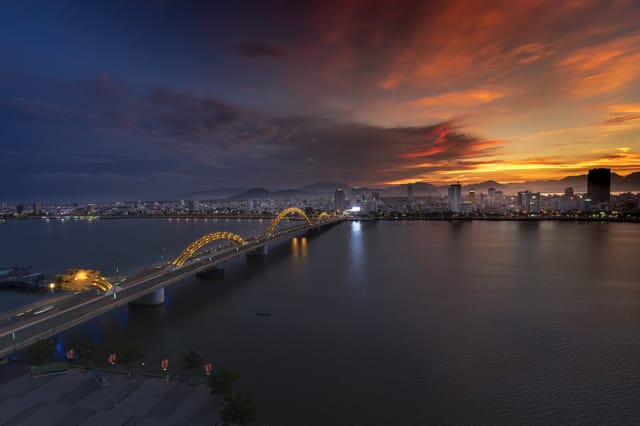
A small city park on the west bank of the Hàn River, a few hundred meters from the Dragon Bridge: a sculpture garden commemorating the 2017 APEC leaders’ meeting and a pavilion under a steel dome shaped like a kite. And from late May through July, the Đà Nẵng International Fireworks Festival (DIFF) fills the sky over the same river: people watch the fireworks from grandstands on the east bank — or for free, from the riverside promenades.
Da Nang Fine Arts Museum
Bảo tàng Mỹ thuật Đà Nẵng
Đà Nẵng’s art museum opened in December 2016 in the building of the former city history museum; according to Tuổi Trẻ, it was the country’s third art museum, after those in Hanoi and Ho Chi Minh City. Its three floors hold contemporary painting from Central Vietnam, “Houei,” a Japanese gift of works by graduates of the Indochina College of Fine Arts, Lê Bá Đảng’s printing stones and matrices, folk painting, masks of tuồng (Vietnam’s classical musical drama) and the crafts of the Quảng region, as the land of Quảng Nam and Đà Nẵng is known.
Hai Van Gate (Hai Van Pass)
Hải Vân Quan
A Nguyễn-dynasty gate fort at the very top of the Hải Vân Pass, 490 m (about 1,610 ft) above the sea: two gates, walls with cannon embrasures, a barracks and an arsenal. The old state road from Đà Nẵng to the imperial capital ran through it, by the only convenient route across the mountains on the border between the lands of Huế and Quảng Nam; in 2021–2024 Huế and Đà Nẵng restored the fort together.
Han River Bridge
Cầu Sông Hàn (cầu quay Sông Hàn)
The Sông Hàn Bridge, opened on March 29, 2000, linked downtown Đà Nẵng with the east bank of the Hàn River, which until then had lived by the ferry and small boats. The money for it was raised by the whole city, from a day’s pay given by civil servants to breakfast money saved by schoolchildren. Its cable-stayed central span turns 90° to lie along the river: once in the dead of night to let ships through, now for the crowds who come to watch.
Trung Vuong Theatre ('Tien Sa' musical, 'Han River Story')
Nhà hát Trưng Vương (vũ nhạc kịch «Tiên Sa», «Chuyện sông Hàn»)
A concert theater in central Đà Nẵng with a 1,203-seat hall, where the city celebrates its anniversaries, opens its festivals and hosts touring companies. In 2025 its stage saw the premiere of “Tiên Sa,” a wordless dance show about a fairy and a young man, and in 2026 the program “Hàn River Story” (“Chuyện sông Hàn”); since November 1, 2026, the building has been run by the new Đà Nẵng Art Theatre.
About this section
Culture & history of Da Nang on CityGuide.vn: temples and pagodas, museums, the old quarter, monuments and historic theatres. Each guide tells the story of the place, what to see, the Vietnamese address, opening hours, tickets and how to get there — from official sources, with sources listed.