
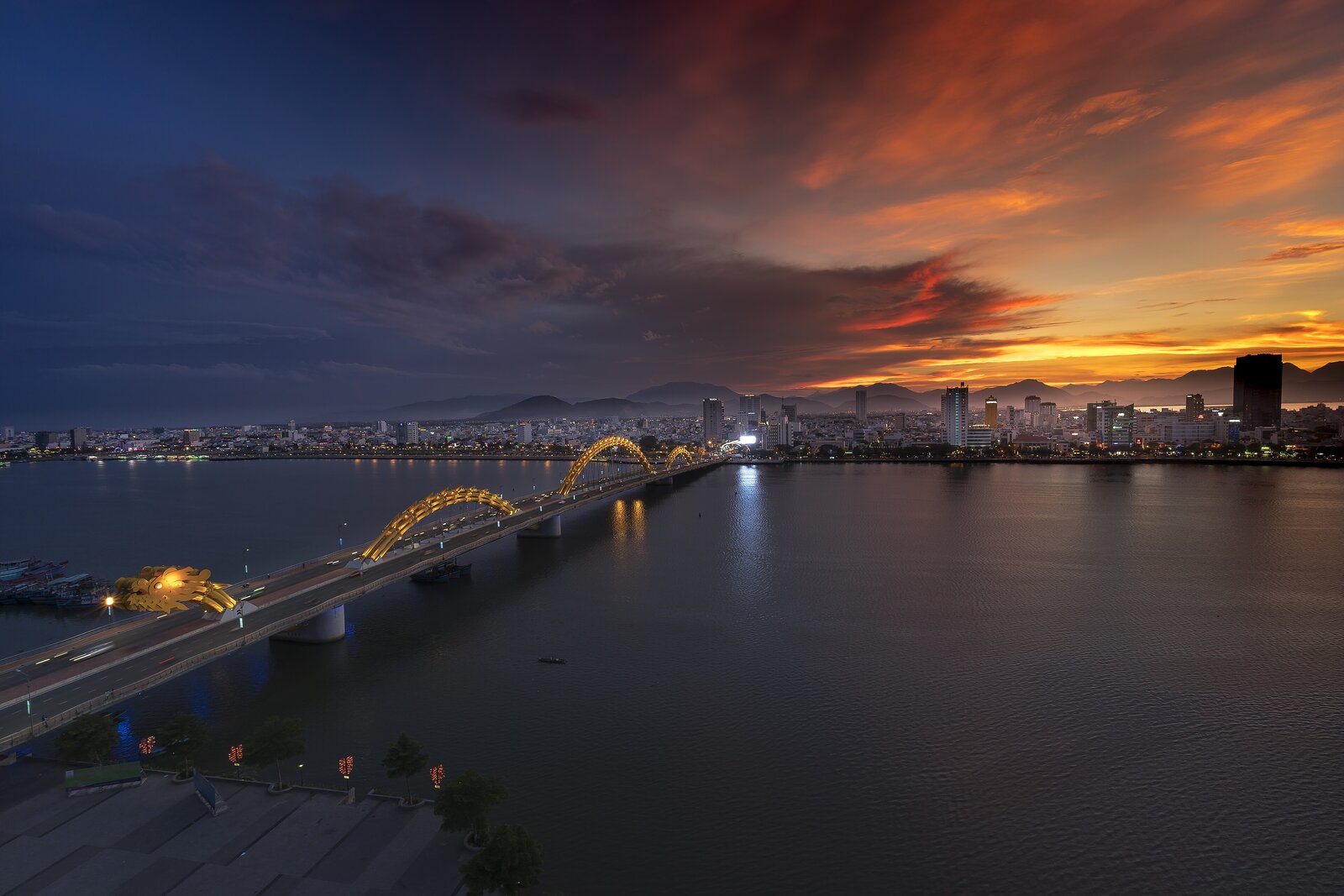
A steel dragon that breathes fire three nights a week; a bridge the whole city chipped in to build; a market older than French Tourane; a cave inscribed with Japanese names in 1640; and a valley that a Cham king gave to Shiva around the year 400. Ten places that best explain Đà Nẵng to a first-time visitor.
How did we choose these places? This is not a ranking, and not a list of the “most beautiful” sights. These are the city’s symbols, places that tell the story of Đà Nẵng, from the Cham temples and the 17th-century harbor to the bridges that joined the two banks of the Hàn River. Five of the ten stand in the center, on the Hàn River or close to it, and you can see them all on foot in a day. The Marble Mountains and the Sơn Trà Peninsula are on the outskirts, and you will need a car. Ba Na Hills, the Hải Vân Gate on the pass and the Mỹ Sơn Sanctuary are trips of their own out of town; since July 1, 2025, when Quảng Nam province was merged with Đà Nẵng, Mỹ Sơn has also been within the city limits. Each place has a full-length article on our site, with its history, its legends, a close look at where the sources disagree, and practical information. Here you will find the essentials: what the place is, why it is worth your time and what to know before you go. The link at the end of each section leads to the details.
1. Dragon Bridge (Cầu Rồng)
A road bridge about 666 meters (about 2,185 feet) long across the Hàn River in the very center of Đà Nẵng, opened on March 29, 2013. Its steel arch curves like the body of a dragon flying toward the sea: the head rises above the east bank, while the tail — a stylized bouquet of lotuses — rests on the west bank, by the Museum of Cham Sculpture.
One head instead of two. In 2012 the sculptor Phạm Văn Hạng proposed a two-headed dragon: one head would welcome visitors arriving from the airport, the other would look out to sea. Nguyễn Bá Thanh, secretary of the city’s Party Committee, turned the idea down: dragons with their backs to each other, he argued, would have people saying that the city lacked unity. And so a single, “purely Vietnamese” dragon was born, modeled on the dragons of the Lý dynasty, Vietnam’s medieval royal house. Its eyes are heart-shaped — according to the sculptor, a nod to the hospitality of the people of Đà Nẵng. And the fire is real, even though the American designers had proposed a laser.
Water, a week before opening. The water was a last-minute addition: with little more than a week to go before the opening, the job went to a local engineer, the inventor of a device that puts out fires with a mist of water. The system was never once tested on the bridge and was switched on for the first time at the opening ceremony itself.
An award, but no record. The concept came from the American firms Louis Berger and Ammann & Whitney; the detailed and construction designs were done by Vietnamese contractors. In 2016 the American Society of Civil Engineers (ASCE) chose this bridge from six finalists for its Outstanding Civil Engineering Achievement Award. There is, however, no Guinness record: in 2012 the city merely asked for permission to pursue the title “Con Rồng thép lớn nhất thế giới” (“the world’s largest steel dragon”), and we found no sign that it was ever granted.
Visiting: the fire and water show runs on Fridays, Saturdays and Sundays at 21:00, lasts about 15 minutes and is free (according to VnExpress International, 2025). Traffic on the bridge is stopped for the show, and anyone standing right by the head gets showered with spray. Shows on Tuesdays and Wednesdays from December 1, 2026, are so far only a proposal. Check before you go.
Read more: Dragon Bridge — how an American dragon became a Lý-dynasty dragon, who came up with the lighting, and where to stand during the show so as not to get soaked.
2. Han River Swing Bridge (Cầu Sông Hàn)
A bridge in the city center, between Lê Duẩn Street on the west bank and Phạm Văn Đồng Street on the east, 487.7 meters (about 1,600 feet) long. It opened on March 29, 2000, for the 25th anniversary of the liberation of Đà Nẵng, and according to VOV, the national broadcaster Voice of Vietnam, it was the first bridge across the Hàn to be built after 1975. Its central section, with the cable stays and a steel pylon, turns 90° to lie along the river.
The bridge the city chipped in for. The project ran on the principle of “nhà nước và nhân dân cùng làm” — “the state and the people build together.” Civil servants were asked to give a day’s pay, schoolchildren to give up their breakfast money, and the elderly to “bớt ăn trầu,” to “chew less betel.” Women who sold vegetables and fish, as a feature in Báo Pháp luật Việt Nam recalls, smoothed out crumpled banknotes, saying, “Chúng tôi chỉ có chừng này” — “This is all we have.” The sources disagree on how much was raised; the 65 people who gave more than 10 million ₫ each are inscribed on the honor board at the western approach.
The only one that swings. According to Báo Pháp luật Việt Nam (2011), it is the first swing bridge that Vietnamese engineers and workers designed and built themselves; according to VnExpress (2016), it is the only working swing bridge in the country, and VOV (2023) calls it the only one to date. It was not Vietnam’s first swing bridge overall: the French built one in Hải Phòng in 1901–1902. For almost fifteen years the span was turned in the dead of night to let ships through, and then the swing became a night-time show.
Two banks. Before the bridges, people in Đà Nẵng used to say: “Con gái quận ba không bằng bà già quận nhất” — “A girl from District 3 is no match for an old woman from District 1.” “District 3” was what they called the remote east bank, and “District 1” was the center.
Visiting: the bridge is open around the clock, and crossing it is free. According to 2024–2025 information, it is swung open on Saturdays and Sundays at around 23:00 and returned to its place by midnight; the barriers come down about 15 minutes before the swing. No schedule for 2026 has been published, and the swing has been called off in strong winds and on the nights of the fireworks festival. Check before you go.
Read more: Hàn River Swing Bridge — how the city raised the money, the songs of the ferry crossing, and how its forerunner in Hải Phòng was turned.
3. Da Nang Cathedral (Nhà thờ Chính tòa Đà Nẵng)
The city’s principal Catholic church and the cathedral of its diocese: a pink Neo-Gothic church at 156 Trần Phú, a few minutes’ walk from Hàn Market. Blessed on September 14, 1924, and dedicated to the Sacred Heart of Jesus, it became a cathedral in 1963. Locals call it Nhà thờ Con Gà, the “Rooster Church.”
The missionary and the carpenters. The overall sketch was drawn by the French missionary Louis Vallet, who also directed the work. According to the genealogy of the Võ clan, “nhiều chủ thầu đến rồi đi” — “many contractors had come and gone” — before three craftsman brothers from Kim Bồng, a carpenters’ village near Hội An, took on the contract for 20,000 Indochinese piasters. The scaffolding was put together from more than 5,000 bamboo poles. “Sous l’active direction du P. Vallet, l’église de Tourane s’élève rapidement, solide et de bon goût” — “Under the active direction of Father Vallet, the church of Tourane is rising rapidly, solid and in good taste,” the bulletin of the Paris Foreign Missions Society reported in July 1923 (Tourane was what the French called Đà Nẵng). About nineteen months passed between the start of construction and the blessing.
The weather-forecasting rooster. A rooster made of a light, hollow alloy stands on the lightning rod of the bell tower, about 27 meters (about 89 feet) above the ground, and turns with the wind. According to a local belief, it works like a “đài dự báo thời tiết,” a “weather forecasting station”: whichever way it turns, that is the way the wind blows, foretelling rain or sun. The city tourism portal calls it the Gallic rooster, a symbol of France, while Báo Đà Nẵng, explaining a similar rooster in Đà Lạt, adds a second meaning: a symbol of repentance, after the Gospel story of the apostle Peter’s denial.
The pink color. In archive photographs the cathedral is ivory tinged with pale yellow; today it is pink, and no document says when it was repainted. On January 1, 2026, according to Tiền Phong, visitors waited a long time for their turn to take a photo with it. Behind the church is a grotto of Our Lady of Lourdes, from 1940.
Visiting: according to Tiền Phong (January 2026), the cathedral is open to visitors 8:00–11:30 and 13:30–16:30. On Sundays there are six Masses, with the 10:00 Mass in English; on other days, Mass is at 5:00 and 17:15. It is best not to go in or take photos during a service. Check before you go.
Read more: Đà Nẵng Cathedral — from the Jesuits’ landing in 1615 to the cathedral’s jubilee year, what is inside, and why the newspapers give a different date for the blessing.
4. Han Market and Con Market (Chợ Hàn, Chợ Cồn)
The two main markets of the old center, a 15-minute walk apart (≈1.1 km, or about 0.7 miles, by our measurement). Hàn Market is a two-story building from 1991 at 119 Trần Phú, facing the river; Cồn Market is a block of market buildings from 1985 at 290 Hùng Vương.
A market in a 17th-century road book. Hàn Market, formerly Hải Châu Market, appears in the 17th-century road book “Thiên Nam tứ chí lộ đồ thư” (“Book of Maps of the Four Routes of the Heavenly South”), which advises travelers: “ăn thì ở chợ Hàn Quảng” — “for food, the Hàn Quảng market.” In 1926 the French Madrolle guidebook even derived the city’s name from it: “Le nom de Tourane est une prononciation approchée de Cho'Han ‘le marché du Han’” — “The name Tourane is an approximate pronunciation of Cho'Han, ‘the market of the Han.’” This is only one of several theories, and there is no way to verify it.
An edict for ships. Emperor Minh Mạng allowed foreign ships to take firewood only on Sơn Trà Mountain and water only from Hàn Market; groups going ashore to buy food at the market could number no more than ten and were not to carry weapons.
An áo dài in half an hour. Downstairs at Hàn Market are food, dried seafood and fish sauces; upstairs, fabrics, clothes and souvenirs. Since 2017, tailors here have been making the áo dài, the long Vietnamese dress, to measure and handing it over in 30–45 minutes (Báo Văn hóa, 2023). Most of the market’s visitors, according to its management, are foreigners.
A market on the dune. Cồn Market appeared in the 1940s on a sandy hill — cồn means “dune.” In 1985, according to Nhân Dân, it was rebuilt in a hundred days as the “Đà Nẵng Trade Center” (Trung tâm Thương nghiệp Đà Nẵng), but locals went on calling it Cồn Market, and in 2012 the old name was restored. Visitors, according to VnExpress (2026), call it a “food labyrinth” (“mê cung” ẩm thực): Quảng-style noodles (mì Quảng), rice vermicelli with fermented fish sauce (bún mắm), avocado purée with ice cream (kem bơ).
Visiting: admission is free. The markets’ management publishes no official hours; according to the newspapers, they are open from early morning until evening. At Hàn Market prices are posted, and Cồn Market is liveliest around noon. Check before you go.
Read more: Hàn Market and Cồn Market — the 1827 market war between the two banks, the food rows by name, and why Hàn Market is wrongly dated to 1940.
5. Museum of Cham Sculpture (Bảo tàng Điêu khắc Chăm Đà Nẵng)
A museum of the art of Champa — the Hindu-Buddhist kingdom on the coast of central Vietnam — at the western approach to the Dragon Bridge. It holds about 2,000 objects, dating roughly from the 5th to the 15th century, and twelve national treasures of Vietnam: according to Tuổi Trẻ (2026), more than any other institution in Đà Nẵng.
Seventeen years to an opening. The museum grew out of a garden where, in 1891–1892, Charles Lemire, the French Resident (the colonial administrator of the province), gathered fifty Cham sculptures. The French School of the Far East drew up the first plan in 1902; the building, conceived by the School’s architect and archaeologist Henri Parmentier, was finished in May 1916, the public was admitted from 1919, and the museum was formally opened only on March 11, 1936. The School’s director joked at the time that perhaps his predecessors had feared the evil genius that had delayed the museum’s birth for so long.
The Tara who lost her conch. In 1978, villagers of Đồng Dương, digging near the ruins of a Buddhist monastery, found a bronze statue of the bodhisattva Tara almost 1.15 meters (about 3 feet 9 inches) tall. Taking her for a “công chúa bằng kim loại quý” — “a princess made of precious metal” — they broke off two small objects she held in her hands to check. The conch and the lotus were kept by the commune for forty years: each new chairman of the commune People’s Committee received them from the previous one under a signed handover record. They were remembered in 2018, when the president of India, Ram Nath Kovind, asked the guide about the marks on the statue’s hands, and on December 9, 2023, the pieces were returned.
Two dragons. In the Tháp Mẫm gallery stands a 12th–13th-century Cham sandstone dragon, a national treasure since the end of 2024, and across the square begins the steel dragon of 2013. Here, too, is the altar from Mỹ Sơn that Parmentier in 1919 called “le meilleur morceau de l'art čam” — “the best piece of Cham art.”
Visiting: open daily 7:00–17:00 (official website, November 2026); tickets cost 60,000 ₫. On the mornings of the 15th and the 30th of the month, the garden hosts a half-hour program, “Vũ điệu Champa” (“The Dance of Champa”). The original Tara is kept in a special storeroom, and the gallery shows a copy. Check before you go.
Read more: Museum of Cham Sculpture — all twelve treasures, how to walk through the galleries, and why “the oldest museum in Vietnam” is not quite right.
6. Marble Mountains (Ngũ Hành Sơn)
Six limestone-and-marble peaks on a sandy plain by the sea, about 8 km (about 5 miles) southeast of the center, on the road to Hội An. Their name means “Mountains of the Five Elements”: Metal, Wood, Water, Earth and the double Mountain of Fire; their folk name is Non Nước, “Mountains and Waters.” Since 2018 they have been a special national monument.
Japanese names on the rock. The walls of the caves bear 78 rock inscriptions (ma nhai), dating from the 17th century to the 1960s; in 2022 they entered UNESCO’s Memory of the World Regional Register for Asia and the Pacific. In the Hoa Nghiêm grotto is the monk Huệ Đạo Minh’s report on the repair of a pagoda, dated 1640. In the reading of the historian Lê Xuân Thông, ten of its 81 donors are Japanese: three visiting merchants and seven residents of the Japanese quarter of Hội An.
A name older than the emperor. The mountains are often said to have been named by Minh Mạng, but the names were written down as early as 1806, fourteen years before he came to the throne; in 1837 the emperor merely confirmed them by decree. On his first visit, in 1825, he said, as the court historians recorded: “Núi này là danh thắng bậc nhất” — “This mountain is the foremost of all famous sights.”
Light and a dragon’s egg. In Huyền Không cave (“the Mysterious Void”), light falls through openings in the vault and moves around the cave over the course of the day; the guides’ story that the openings were blown open by bombs is not borne out by the sources. According to legend, the mountains were born from the egg of a serpent-dragon: a girl stepped out of the egg, and the shell split into five mountains (a version recorded in 1995).
The bodhisattva’s festival. On the 17th to 20th days of the second lunar month, the festival of Quán Thế Âm, the bodhisattva of compassion, is held at the Mountain of Metal; it is listed as national intangible heritage. On the main day her statue is carried out of the cave, and then, in a palanquin, it makes a circuit of the Cổ Cò River by boat, with prayers for those who go to sea.
Visiting: open daily 7:00–17:30 (Vietnam National Authority of Tourism, 2026); Water Mountain (Thủy Sơn) costs 40,000 ₫, the elevator 15,000 ₫ one way, and Âm Phủ cave (“the Underworld”) 20,000 ₫. Allow at least two hours; the steps are slippery after rain, and the inscriptions must not be touched. Check before you go.
Read more: Marble Mountains — every cave on Water Mountain, all 78 inscriptions, the legend of Princess Ngọc Lan, and the stone carvers’ village.
7. Son Tra Peninsula & Linh Ung Pagoda (Bán đảo Sơn Trà, chùa Linh Ứng Bãi Bụt)
A mountainous peninsula of more than 4,400 hectares (about 10,900 acres) in the northeast of Đà Nẵng, about 10 km (about 6 miles) from the center: a protected forest right next to the city. Since 1977 it has been a “forbidden forest,” that is, a strictly protected one, and since 1992 a nature reserve. On a slope above Bãi Bụt cove, Linh Ứng Pagoda opened in 2010.
A 67-meter bodhisattva. The statue of Quán Thế Âm, the bodhisattva of compassion, 67 meters (about 220 feet) tall, stands with her back to the mountain and her face to the sea. She is hollow inside, with 17 levels of altars: “Phật trung hữu Phật,” “a Buddha within a Buddha.” Báo Pháp luật Việt Nam and VietnamPlus say that among statues of Quán Thế Âm she “được xem là cao nhất Việt Nam” — “is considered the tallest in Vietnam”; claims of UNESCO and Guinness records are not borne out.
The Buddha’s Shore. According to legend, in the reign of Minh Mạng fishermen found a statue of the Buddha on the sand, brought in by the sea, and when Quán Thế Âm appeared, the sea grew calm; ever since, the shore has been called Bãi Bụt, “the Buddha’s Shore.” Đà Nẵng has three Linh Ứng pagodas, and according to Báo Pháp luật Việt Nam (2021), folk tradition has it that you pray for peace at Bà Nà, for luck in love at the Marble Mountains, and for your career at Sơn Trà.
The “queen of primates.” The emblem of the reserve is the red-shanked douc langur, which Vietnamese call the “nữ hoàng linh trưởng,” the “queen of primates.” According to a 2017 count by the GreenViet center, about 1,335 of these monkeys live on the peninsula, and Sơn Trà is the only place where the species can easily be observed in the wild. They are most often seen in late April and May.
Tea on the summit. Legend links Bàn Cờ Peak (“Chessboard Peak”) with a game of chess between an immortal old man and Đế Thích, king of the gods. In March 2024 Bill Gates drank tea here, and according to the Peninsula Management Board, this visit gave rise to a “tea tour” at sunrise and sunset, running since July 25, 2026.
Visiting: the peninsula is open 7:30–18:30 from March through September and 7:30–17:30 from October through February; entry to the peninsula and the pagoda is free (per our database cards), and feeding the monkeys is prohibited. Important: since November 10, 2026, visits to the peninsula have been suspended “cho đến khi có thông báo mới,” “until further notice,” because of the risk of downpours and landslides (Báo Văn hóa). Check before you go.
Read more: Sơn Trà Peninsula and Linh Ứng Pagoda — Tiên Sa Lighthouse, the landing of September 1, 1858, the route rules and where to meet the doucs.
8. Ba Na Hills and the Golden Bridge (Sun World Ba Na Hills, Cầu Vàng)
A mountain resort and theme park on the summit of Mount Chúa (Núi Chúa, 1,487 m, about 4,880 feet), 25–30 km (16–19 miles) southwest of the center; cable cars take 15–25 minutes to carry visitors up. Since 2007 the resort has been built and run by Sun Group.
The French “second Đà Lạt.” In 1901 Captain Debay, on the orders of Paul Doumer, Governor-General of Indochina, found a site here for a mountain resort like Đà Lạt, the cool hill town in the Central Highlands. In 1919 the first vacation house went up on the mountain, and in 1923 the Morin brothers opened a 22-room hotel; a newspaper of 1938 called it an “acte de foi,” an “act of faith.” In 1925 guests were carried up from the foot of the mountain in sedan chairs. Of that hill station, according to Báo Văn hóa, the only structure to survive largely intact is the Debay Wine Cellar of 1923.
A record-setting cable car. The press wrote of the 2013 line as a record-breaker with four Guinness World Records. The Guinness World Records website itself credits it today with two: the longest non-stop single-track cable car, at 5,801 meters (19,032 feet), and the highest ascent by such a cable car, 1,368 meters (4,488 feet).
A bridge in the hands of the gods. The Golden Bridge, about 150 meters (490 feet) long, hangs over the forest about 1,400 meters (some 4,600 feet) above sea level. It rests on steel supports, and the “stone” hands are decorative: in the words of TIME magazine, they are “brand-new wire mesh and fiberglass support.” The bridge opened in June 2018, and TIME put it on its list of the “World’s Greatest Places” that same year. The architect Vũ Việt Anh told the Daily Mail that he had wanted “to invoke the sensation of walking along a thread stretching through the hands of God.”
Visiting: the cable cars run daily 8:00–22:00 (park website, November 2026). The round-trip cable car ticket is also your admission to the park: 1,000,000 ₫ for adults and 800,000 ₫ for children and seniors; children under 1 meter (about 3 feet 3 inches) tall ride free (this is the rate for visitors from outside Đà Nẵng). According to the park website, you can see the main sights in a day, and it is best to go early in the morning. The summit averages about 18 °C (64 °F), so bring a jacket and a raincoat. Check before you go.
Read more: Ba Na Hills and the Golden Bridge — which cable car to choose, the French Village, four theories about the name “Bà Nà,” and life at the French hill station.
9. Hai Van Gate (Hải Vân Quan)
A stone Nguyễn-dynasty fort at the top of the Hải Vân Pass, 490 meters (about 1,610 feet) up, right on the border between Đà Nẵng and Huế. It was built in the spring of 1826 by order of Emperor Minh Mạng: two gates, walls with embrasures, a barracks and an arsenal closed off the old state road from Đà Nẵng to the imperial capital.
No passage without permission. The French local historian Henri Cosserat, who described the fort in 1921 so that it would not fade from memory, wrote that “nul ne pouvait passer du versant de Tourane au versant de Hué, sans l'autorisation du mandarin militaire, chef de poste” — “no one could pass from the Tourane side to the Hué side without the permission of the military mandarin in command of the post.”
The puzzle of the two inscriptions. The southern gate, facing Đà Nẵng, is carved with “Hải Vân Quan” (“Hải Vân Gate”); the northern one, facing Huế, with “Thiên hạ đệ nhất hùng quan” (“First Majestic Gate Under Heaven”). The press often mixes up the sides, but the dynasty’s chronicle, Cosserat’s plan and the 2018 excavation agree: coming from Đà Nẵng, you pass beneath the three characters, and the six await you higher up. Legend credits the title to the 15th-century emperor Lê Thánh Tông, but the Nguyễn chronicle does not mention him.
“A blue hole in the gray stones.” Governor-General Paul Doumer, who climbed up here in 1897, remembered how “a monumental gate opened onto the sky, making a blue hole in the mass of gray stones,” and wrote of the view over the bay: “Truly, for the idle, this spectacle alone is worth the journey from France to the Far East.”
A monument of two cities. In 2021–2024 Đà Nẵng and Thừa Thiên Huế province restored the fort, splitting the cost equally, and on August 1, 2024, it opened to visitors. According to Tuổi Trẻ, it is the only national monument in Vietnam managed by two cities, which take turns, three years at a time.
Visiting: tickets cost 70,000 ₫ (since June 2, 2026), and children under 13 get in free; opening hours have not been officially published. The Hải Vân Tunnel does not come out at the summit: only the old road over the pass leads to the fort, about 28 km (17 miles) from central Đà Nẵng. Fog can hide everything within minutes, so save the trip for clear weather if you want the views. Check before you go.
Read more: Hải Vân Gate — a walk through the fort, the border between Champa and Đại Việt (medieval Vietnam), and travelers on the pass from Poivre to Doumer.
10. My Son Sanctuary (Thánh địa Mỹ Sơn)
A wooded basin in the hills south-southwest of Đà Nẵng, where the kings of Champa built temples to Shiva from the 7th to the 13th century; the first one, apparently of wood, went up as early as the turn of the 4th and 5th centuries. Until July 1, 2025, this was Quảng Nam province; now it is part of the city of Đà Nẵng. By our measurements, it is about 41.5 km (about 26 miles), or about 39 minutes by car, from the Dragon Bridge. Since December 1999 it has been a UNESCO World Heritage site, as “an exceptional example of cultural interchange.”
A request in stone. In 1899 the French scholars Louis Finot and Étienne Lunet de Lajonquière found the stele of the sanctuary’s founder, King Bhadravarman I (around the year 400), in front of the main tower, A1. The king gives the god the land between the mountains and asks those who come after him: “Par pitié pour moi, ne détruisez pas ce que j'ai donné” — “Out of pity for me, do not destroy what I have given.”
Tower A1. In 1904 the architect Henri Parmentier wrote of it: “le plus vieux peut-être des sanctuaires chams paraît en être également le mieux conservé” — “what is perhaps the oldest of the Cham sanctuaries appears to be the best preserved as well.” In August 1969, during the war, a bombing raid left nothing of A1 but its base.
The brick puzzle. According to the site’s management board, the masonry shows no trace of mortar; researchers write of a very thin joint. And the recipe for the ancient brick, according to the head of the management board, has still not been found.
Treasures on site. Of Mỹ Sơn’s six national treasures, two are in the valley: the linga with the face of Shiva (a mukhalinga), found after a downpour in 2012 and now in the museum at the entrance, and the altar of temple A10, reassembled from more than twenty fragments. The other four are in the Museum of Cham Sculpture. For half a century the temples have been restored by Polish, Italian and Indian specialists working with Vietnamese craftsmen.
Visiting: open daily, Tết (the Lunar New Year) included, from 6:00 (closing at 17:00 or 18:00, depending on which official page you read). Tickets cost 150,000 ₫ for foreign visitors and 100,000 ₫ for Vietnamese citizens and include the electric shuttle to the towers, the museum and a show of Cham art — seven performances a day, with a dance with a jar balanced on the head and the kèn saranai, a Cham reed instrument. Allow more than two hours, and do not climb on the structures. Check before you go.
Read more: Mỹ Sơn Sanctuary — six styles over nine centuries, how restorers from different countries are rebuilding the temples, and who really “discovered” Mỹ Sơn.
Short on time?
Distances in this article are our own measurements along OpenStreetMap routes, taken from our articles on each place. The five places in the center can be covered on foot in a day: from the tail of the Dragon Bridge to the Museum of Cham Sculpture is about 300 meters (some 330 yards); from the western end of the bridge to Hàn Market, about 950 meters (just over half a mile); from Hàn Market to the cathedral, about 340 meters; to the Sông Hàn swing bridge, about 550 meters; and to Cồn Market, about 1.1 km (about 0.7 miles). On a Saturday or Sunday you can end the evening at both bridges: at 21:00 the dragon breathes fire, and, according to 2024–2025 information, at around 23:00 the Sông Hàn Bridge swings open, 2.1 km (about 1.3 miles) from the dragon’s head. From the Dragon Bridge it is about 9.3 km (about 5.8 miles), or 11 minutes by car, to the Marble Mountains, and about 15 minutes to Linh Ứng Pagoda on Sơn Trà. Ba Na Hills (≈25.8 km, 16 miles), the Hải Vân Gate (≈28.3 km, 17.6 miles) and Mỹ Sơn (≈41.5 km, 26 miles) are trips of their own; according to Dân trí, many people see the fort on the pass on their way between Đà Nẵng and Huế.
Sources
The facts come from our articles on each place; the primary sources are listed in the “Sources” section of each article.
- Dragon Bridge
- Hàn River Swing Bridge
- Đà Nẵng Cathedral
- Hàn Market and Cồn Market
- Museum of Cham Sculpture
- Marble Mountains
- Sơn Trà Peninsula and Linh Ứng Pagoda
- Ba Na Hills and the Golden Bridge
- Hải Vân Gate
- Mỹ Sơn Sanctuary
Cover photo: Quangpraha / Pixabay, CC0