
Exhibition «Food & Drink Show – Đà Nẵng 2027»
Da Nang Exhibition Center (Trung tâm Hội chợ Triển lãm Đà Nẵng)
Contact organizers



 Culture and Arts
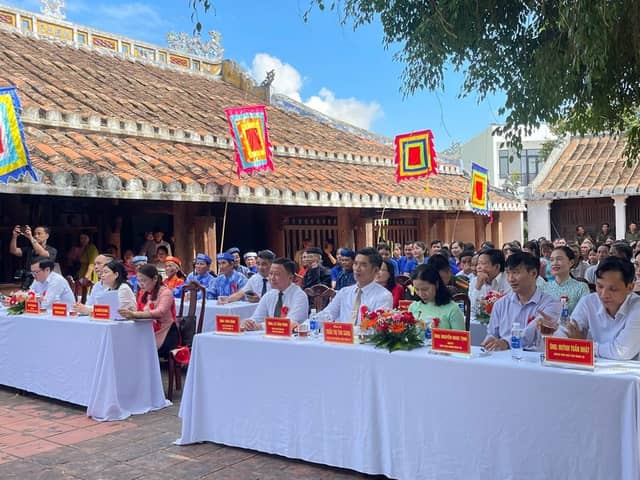
A tiled roof that has stood for more than 550 years opens its courtyard once a year, and the whole of Chiên Đàn, at the southern edge of Da Nang, comes home for it. You get folk singing on a mossy stone yard, incense drifting between jackfruit-wood columns, and a rite of thanks to the settlers who cleared this land, still performed almost exactly as it was five centuries ago.
Đình Chiên Đàn was raised around 1471–1473, right after King Le Thanh Tong (Lê Thánh Tông) established the Thừa tuyên Quảng Nam administrative region. It sits on roughly 1,500 sq m, built to the “chữ nhất” (single-bar) plan with five bays and two wings, massive jackfruit-wood columns, moss-covered yin-yang roof tiles and a “lưỡng long triều nguyệt” motif — two dragons facing the moon — on the ridge. The dragon, cloud and floral carvings were cut by craftsmen from the Văn Hà carpentry village. In 2002 the đình was listed as a National Architectural and Artistic Relic.
What to look out for
A procession of offerings and the incense ceremony led by commune officials and clan representatives
The Tiền Hiền rite honouring the founders who first settled the village
Hô hát bài chòi, the UNESCO-listed folk singing game of Central Vietnam, performed by villagers themselves
Music and martial arts displays in the đình courtyard
Scholarships handed to local pupils and students, 75 grants in 2025
This is a village day rather than a staged show: elders keep the ritual, children meet their communal house for the first time, and people who moved away time their trip home for it. If you care about old architecture or Central Vietnamese folk arts, it is a rare chance to see a national monument working as it was meant to, not sitting behind a rope.
The đình is more than a place of worship. In 1782, marching north, Quang Trung stopped here and formed the “Tiền Cơ Trung Nghĩa” militia. During the Cần Vương movement (1885–1887) it served as a recruiting and provisioning point. In the Duy Tân years (1904–1908) the reformists Phan Chau Trinh (Phan Châu Trinh) and Huynh Thuc Khang (Huỳnh Thúc Kháng) spoke here and at the nearby Văn Thánh Chiên Đàn. After the August Revolution of 1945 it housed the provisional People's Committee of Chiên Đàn commune.
An old Quảng Nam saying ranked the region's three great communal houses: “Nhất La Qua, nhì Thành Mỹ, ba Chiên Đàn”. The first two were destroyed in wartime, which leaves Chiên Đàn as the largest survivor, still holding its lacquered horizontal boards, parallel couplets and the village covenant stele.
The ceremonial part runs in the morning, so come early if you want the procession and the incense offering; the courtyard is open ground, so bring a hat and water. The đình stands in Đàn Trung hamlet, less than 1 km west of National Highway 1A along road ĐT615. Administratively this is Chiên Đàn commune, Da Nang — before the 2025 merger it was Tam Đàn commune, Phú Ninh district, Quảng Nam province, and mapping apps may still show the older name.
The festival is run by the Chiên Đàn Commune People's Committee together with the đình's management board.
A 550-year-old roof does not hold itself up; it holds because someone comes back every year to light incense. Come and see what that looks like.
Đình Chiên Đàn
Thôn Đàn Trung, ĐT615, xã Chiên Đàn, thành phố Đà Nẵng
Da Nang Exhibition Center (Trung tâm Hội chợ Triển lãm Đà Nẵng)
Contact organizers

Phường Sơn Trà
466,000 ₫ – 888,000 ₫

voco Ma Belle Danang
1,570,000 ₫ – 6,020,000 ₫

Đà Nẵng
Contact organizers

Koto Club
390,000 ₫

Dragon City Ink • Tattoo & Piercing Studio
Contact organizers

The Nalod Da Nang
Contact organizers

Ariyana Convention Centre
Free
Da Nang Exhibition Center (Trung tâm Hội chợ Triển lãm Đà Nẵng)
Contact organizers
Phường Sơn Trà
466,000 ₫ – 888,000 ₫
voco Ma Belle Danang
1,570,000 ₫ – 6,020,000 ₫