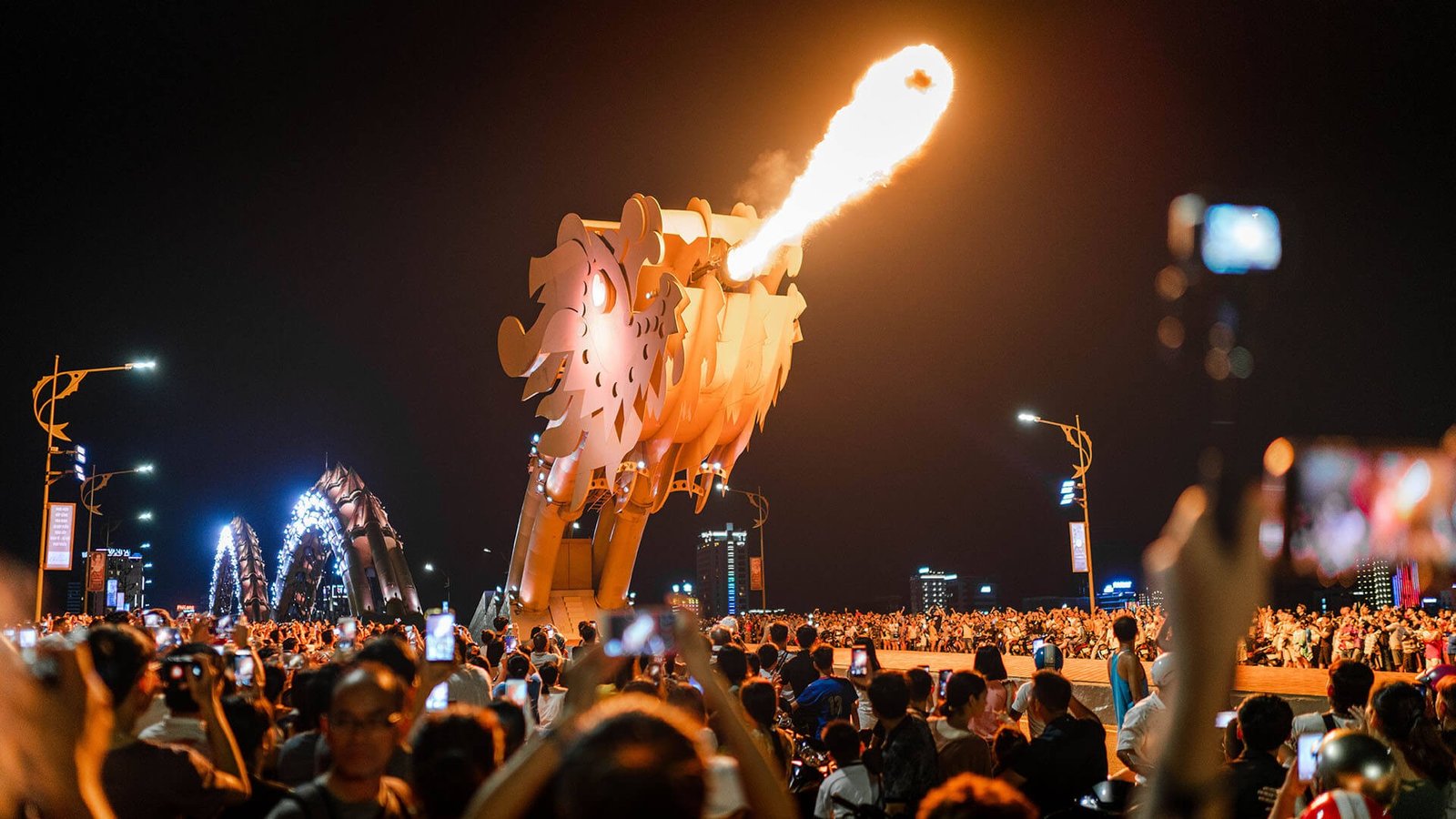
In 2012 there was a proposal to put a two-headed dragon over the Hàn River. The sculptor Phạm Văn Hạng wanted to give each end of the bridge a head of its own: one would face the airport and welcome visitors, the other would look out to sea. Nguyễn Bá Thanh, secretary of the city’s Party Committee, turned the idea down: dragons with their backs to each other, he argued, would have people saying that the city lacked unity. And so a single dragon rose over the river — a “purely Vietnamese” one, modeled on the dragons of the Lý dynasty, Vietnam’s medieval royal house, with heart-shaped eyes and a lotus for a tail. Its head was turned toward the sea, and its fire was made real, even though the American designers had proposed a laser.
The water was an afterthought, added at the last minute. With little more than a week to go before the opening, the job went to an engineer from Đà Nẵng — the inventor of a device that puts out fires with a mist of water. A tank for water and compressed air was buried beneath the bridge, the pipes were run to the dragon’s mouth around teeth that had already been finished, and the system was never once tested on the bridge itself. It was switched on for the first time at the opening ceremony — and the white jet, by the inventor’s account, shot out more than 250 meters (about 820 feet).
Since March 29, 2013, the bridge has been one of the symbols of the city, and Báo Đà Nẵng calls the fire and water show Đà Nẵng’s very own tourism brand. The bridge stands on the road from the airport to Mỹ Khê Beach, and, according to the same paper, many visitors get to know it the moment they arrive in the city.
At a glance
The dragon over the Hàn River
Cầu Rồng, the Dragon Bridge, is a road bridge across the Hàn River. It links the center of Đà Nẵng on the west bank with the former Sơn Trà district and the beaches on the east bank. The bridge’s steel arch is curved like the body of a dragon flying over the river toward the East Sea (Biển Đông): the head is at the eastern end, the tail at the western end. The bridge is about 666 meters long (666.565 m according to VnExpress) and 37.5 meters (about 123 feet) wide, with six traffic lanes, a median and two sidewalks of 2.5 meters (about 8 feet) each. On the day it opened, VnEconomy wrote that the bridge’s cross-section was considered the widest in Vietnam.
The steel part of the bridge is 568 meters (about 1,860 feet) long and weighs almost 9,000 metric tons (VnExpress and Báo Đầu tư, 2013). On opening day Báo Đầu tư, crediting VnExpress, and the next morning VnExpress itself ran the same paragraph, saying that Louis Berger had designed it as the “vòm thép đơn duy nhất tại khu vực Đông Nam Á tính đến thời điểm hiện tại” — “the only single steel arch in Southeast Asia to date.” The city tourism portal goes further: the combination of a steel girder, a steel arch and a concrete girder in the load-bearing system, it says, “được cho là thiết kế độc đáo chưa từng có trên thế giới” — “is considered a one-of-a-kind design never before seen anywhere in the world”; Tuổi Trẻ (2022) used the very same words to explain why the bridge had won so many awards. The bridge cost more than 1,500 billion ₫; the exact figures differ from source to source (details in “What we don’t know”).
The idea, the form and the engineering concept are American: the design competition was won by Louis Berger and Ammann & Whitney (USA). According to VnExpress (2013), the builders took pride in the fact that this was the “công trình đầu tiên ở Việt Nam lấy ý tưởng, hình khối, kỹ thuật của Mỹ, còn thiết kế chi tiết, thiết kế thi công là do nhà thầu Việt Nam thực hiện” — “the first structure in Vietnam to take its idea, form and engineering from America, while the detailed design and the construction design were done by Vietnamese contractors.” Vietnamese engineers built the bridge (VnExpress, 2024). The dragon’s head and tail were created by the sculptor Phạm Văn Hạng.
The main attraction is the fire and water show, held three evenings a week; on the other evenings the bridge is simply lit up. In 2014, as VnExpress retold a CNN report, the channel’s correspondent likened the bridge to a symbol of “một quốc gia đang trỗi dậy” — “a rising nation.” For the bridge’s tenth anniversary, Báo Đà Nẵng (2023) named it among the places that “thúc đẩy GDP của thành phố” — “drive the city’s GDP,” and as a place where the city’s own residents spend their evenings: it “tạo không gian văn hóa, giải trí hằng đêm cho người dân địa phương” — “creates a space for culture and entertainment for local people every night.”
Awards and a Guinness bid
The bridge has collected American engineering awards and prizes for its lighting:
- 2013 — the FX International Design Awards (UK), in the lighting design category. Here the sources disagree: according to Tuổi Trẻ News (2014), VnExpress (January 2014) and Viet Nam News (June 2014: “shortlisted”), the lighting project made it to the final, while according to Viet Nam News (2016), it won the award. VnExpress adds that six other international projects reached the final of the “Lighting Design” category alongside the bridge, among them the Edinburgh International Conference Centre and the University of the Arts London, and that the jury described the bridge’s lighting as “một giải pháp đầy tính cảm hứng cho một công trình độc đáo” — “a truly inspired solution for a one-of-a-kind structure.” According to the same paper, this was the first time Vietnamese artistic lighting had been recognized internationally alongside well-known European studios.
- 2014 — a finalist at the Lighting Design Awards (UK). In January 2014 the bridge’s lighting reached the final of the category “Công trình quốc tế có thiết kế chiếu sáng cảnh quan xuất sắc” (“International Project with Outstanding Landscape Lighting Design”), together with eight other projects — among them the Kipco Tower in Kuwait and the Gammel Hellerup sports complex in Denmark (VnExpress). The awards were to be announced in Britain in March 2014. In June, after that, Viet Nam News described the bridge’s lighting only as “shortlisted” in the international projects category of the 2014 Lighting Design Awards; the paper does not mention a win (Viet Nam News, June 23, 2014).
- 2014 — a Diamond Award (giải Kim cương) at the Engineering Excellence Awards of ACEC New York, the New York association of engineering firms. Gina R. Potfora, ACEC New York’s director of membership, praised the project for its quality and engineering expertise, according to Báo Đầu tư (2013); the paper announced the awards gala for March 29, 2014, in the ballroom of New York’s Waldorf Astoria hotel, and according to ExecutiveBiz (2016), the firms received the ACEC New York award in January 2014.
- 2014 — a Grand Award at the Engineering Excellence Awards. The sources disagree on who ran the competition: according to NJBIZ, it was the national competition of ACEC (the American Council of Engineering Companies); according to VOV (via DTiNews), it was ACEC New York, in the structural systems category. NJBIZ adds that eight projects received a Grand Award that year, that for Louis Berger it was the first such award in ACEC’s national competition since 2004, and that the prize is called the “Academy Award of the industry.” According to NJBIZ, Louis Berger’s president, Nick Masucci, was proud of the firms’ “inventive, yet culturally significant design.” At the ceremony in New York on April 30, 2014, Võ Duy Khương, vice chairman of the Đà Nẵng People’s Committee (the city government), called the bridge, as VOV reported, an envoy of peace and goodwill.
- 2014 — a Special Citation from the IALD, the International Association of Lighting Designers (USA). According to Tuổi Trẻ News, it was the first time a Vietnamese project had earned such a citation, and more than 200 entries competed — from ten countries, according to VietNamNet (2014). As the same paper paraphrased the organizers, the lighting was honored as a “whimsical, well-crafted multimedia experience.” The full wording in the list of winners is longer: “Special Citation for a Whimsical, Well-Crafted Multimedia Experience Communicating National and Religious Identity.” The awards were presented on June 4, 2014, in Las Vegas, during the Lightfair trade show, at an evening event at the Renaissance Las Vegas hotel; of more than 200 entries, 16 projects were honored (Architect Magazine, 2014).
- 2016 — the ASCE Outstanding Civil Engineering Achievement Award of the American Society of Civil Engineers: of the six finalists, the award went to the Dragon Bridge.
We found no confirmed Guinness World Record for the bridge — only a bid: in 2012 the city’s Department of Transport asked for permission to pursue the title “Con Rồng thép lớn nhất thế giới” — “the world’s largest steel dragon” (Tiền Phong). In November 2012, the department’s deputy director, Phan Văn Chương, told VnExpress that the department had just sent the People’s Committee a letter with this request; the argument was that the dragon’s “body” weighs more than 1,000 metric tons. On opening day, VnEconomy wrote that the city was preparing a Guinness application for two bridges at once — the Dragon Bridge and the Trần Thị Lý Bridge — and was seeking to protect their unusual silhouettes as industrial designs. We found no recognition of a record either in the press or on the Guinness World Records website; where the “world’s largest steel dragon” in newspaper headlines comes from is explained in “Myths and numbers.”
The bridge on the world map: CNN, APEC and lists of bridges
In July 2014, CNN Travel wrote about the bridge. According to VietNamNet (2014), CNN presented it as “Da Nang’s fiery new success symbol.” CNN’s Japanese edition (cnn.co.jp, July 7, 2014) described the bridge as “黄金の竜の形の” — “in the shape of a golden dragon” — and explained its imagery to readers with the Hanoi legend of 1010 (more on that in “Legends and lore”). CNN also noticed what had changed along the banks: shops selling dragon souvenirs had appeared by the river, along with hotels with “dragon” names and river cruises for viewing the bridge, and the local tourism authorities expected the bridge to help the city welcome 3 million visitors that year.
VnExpress, retelling CNN, added that the bridge had become a favorite symbol of the Vietnamese, “tượng trưng cho tương lai thịnh vượng của đất nước” — “standing for the country’s prosperous future,” and that from a distance it looks like a dragon “đang chuẩn bị vươn mình bay lên trời xanh” — “getting ready to rise up and fly into the blue sky” (VnExpress, July 7, 2014).
Four years later, as retold by VnExpress International (2019), CNN called the bridge “a symbol of the prosperity of Asia.” In the same article, VnExpress International put the Dragon Bridge among five Vietnamese bridges that have become global attractions — alongside Hanoi’s Nhật Tân and Long Biên bridges, the Golden Bridge at Bà Nà ( Sun World Ba Na Hills & Golden Bridge) and the Japanese Covered Bridge (Chùa Cầu, literally “pagoda bridge”) in Hội An.
A president of the United States mentioned the bridge, too. On November 10, 2017, when the leaders of APEC, the Asia-Pacific Economic Cooperation forum, gathered in Đà Nẵng, Donald Trump spoke at the forum’s meeting of business leaders, the APEC CEO Summit, and among the city’s landmarks he singled out the bridge:
“Today, we are no longer enemies; we are friends. And this port city is bustling with ships from around the world. Engineering marvels, like the Dragon Bridge, welcome the millions who come to visit Da Nang’s stunning beaches, shining lights, and ancient charms.”
— Donald Trump, APEC CEO Summit, Đà Nẵng, November 10, 2017 (White House transcript)
The same week left its mark by the dragon’s tail as well: on November 9, 2017, a few hundred meters from the bridge, a sculpture garden commemorating the APEC leaders’ meeting was opened — today’s APEC Park (more in our article on the park).
In 2013, the magazine of the American Society of Mechanical Engineers (ASME) introduced the bridge to its readers as what its designers call “a ‘unique’ interpretation of a single-arched bridge that doubles as performance art.” The designers themselves had not expected such success. According to Geo Week News (2017), they “never expected the bridge to become a destination structure.” The same publication writes that the city tourism board listed a visit to the bridge among its top 10 things to do in Đà Nẵng and that local tour companies run boat tours passing under it; Vietnamese media, according to the article, have called the bridge “a symbol of the city’s new development stage and growth.”
At home, the bridge made the “ten famous bridges of Vietnam” list announced in December 2014 by the Vietnam Records Center (VietKings) — alongside Hanoi’s Long Biên and Vĩnh Tuy, Bãi Cháy in Quảng Ninh, Mỹ Thuận and Cần Thơ in the Mekong Delta, and Đà Nẵng’s own Thuận Phước (VietNamNet, 2014). In July 2026, the 83 cyclo drivers of Đà Nẵng’s tourist service — the cyclo (xích lô) is a pedal-powered rickshaw with the passenger seat in front, and the city’s cyclo team has existed since 2003 — received new uniforms: the backs of their shirts show symbols of the city, and the first of them that Nhân Dân names is the Dragon Bridge, next to the sea and fireworks.
Plan your visit
Where it is and how to get there
The bridge is in the very center of the city. Its western approach is at the junction of Nguyễn Văn Linh and Bạch Đằng streets, next to the Museum of Cham Sculpture; its eastern approach is on Võ Văn Kiệt and Trần Hưng Đạo streets. The bridge is a continuation of Nguyễn Văn Linh Street, which runs from the airport. So if you are coming from the airport, you drive onto the bridge from the west, over the tail, while the head — and the crowd of spectators — is at the eastern end.
Administratively, the bridge links two wards (phường, the lowest tier of urban administration in Vietnam). The city tourism portal names them outright: the east bank by the bridge is in An Hải ward, and the west bank, across from the VTV8 television building, is in Hải Châu ward (Danang Fantasticity, December 30, 2025). There is no single official address with both street and ward: the bridge’s own page on the portal still gives its address under the old division — Nguyễn Văn Linh Street, Phước Ninh ward — and Phước Ninh became part of Hải Châu ward on July 1, 2025 (under Resolution No. 1659/NQ-UBTVQH15 of the National Assembly Standing Committee on merging Đà Nẵng’s wards).
From the tail to the head along the sidewalk it is about 0.5 km (about a third of a mile), some seven minutes on foot (our measurements, October 27, 2026).
| From — to the dragon’s head | By car | On foot |
|---|---|---|
| Airport, Terminal T1 (domestic flights) | ≈3.4 km, about 4 min | ≈3.8 km, about 50 min |
| Airport, Terminal T2 (international flights) | ≈3.6 km, about 5 min | ≈3.7 km, about 50 min |
| Đà Nẵng Railway Station | ≈3.3 km, about 4 min | ≈3.0 km, about 40 min |
These are our measurements along OpenStreetMap routes (OSRM), taken on October 27, 2026, from the “Dragon's Head” node in OpenStreetMap; driving times assume no traffic. By our calculation at 2026 rates, a taxi from Đà Nẵng Railway Station to the dragon’s head costs about 45,000–55,000 ₫ (Green SM: 30,500 ₫ for the first 2 km and 15,300 ₫ for each additional km up to the 12th; Grab: 27,000 ₫ for 2 km, 12,175 ₫ per km and 442 ₫ per minute, plus a platform fee of 3,000–9,000 ₫ depending on distance from November 10, 2026, to February 25, 2027, and 7% of the fare from February 26, 2027). Taxi fares are approximate and vary with the weather, holidays and rush hour. For a ride to the airport, the app shows the fare before you book. If you would rather start on the west bank, where the tail and the Museum of Cham Sculpture are, it is a little closer:
| From — to the dragon’s tail (western approach) | By car | On foot |
|---|---|---|
| Airport, Terminal T1 | ≈3.0 km, about 4 min | ≈3.3 km, about 44 min |
| Airport, Terminal T2 | ≈3.1 km, about 4 min | ≈3.2 km, about 43 min |
| Đà Nẵng Railway Station | ≈2.8 km, about 4 min | ≈2.5 km, about 33 min |
Our measurements along OpenStreetMap routes (OSRM), taken on November 17, 2026, from the “Dragon's Tail” node.
Parking. There is an underground parking garage beneath the APEC Park pavilion, by the western approach (Tuổi Trẻ, 2022). According to the commercial website Sun Paradise Land (2026), motorbikes park there for free and cars for a fee; we have found no official rate, so check on site.
By bus. We have not found an official list of routes “to the bridge.” According to the press, since July 18, 2025, routes 02 (to Hội An, ending at Cửa Đại) and 21 (to Tam Kỳ) have run past the western approach: outbound along Nguyễn Văn Linh Street and 2 Tháng 9 (September 2) Street, and inbound along 2 Tháng 9 Street and the Bạch Đằng riverfront (PLO and Báo Văn hóa, July 17, 2025). Neither paper names any stops near the bridge.
The fire and water show: when and in what order
When. In 2026 the show runs on Fridays, Saturdays and Sundays at 21:00. That is what Võ Thành Được, director of the operating company, told Tuổi Trẻ in August 2026. The operator is the Đà Nẵng Bridges and Roads Joint Stock Company (Công ty CP Cầu đường Đà Nẵng). The show is also staged on major holidays. For Tết, the Lunar New Year, and for Independence Day on September 2, the city People’s Committee approves series of several evenings in a row. For September 2, 2026, the city announced six evenings in a row — from Friday, August 28, through Wednesday, September 2. Tuổi Trẻ called such a long run a rare occasion. The series went ahead: in the round-up of the holiday, the show was once again named its highlight, one that drew crowds of residents and visitors (Luật sư Việt Nam, September 3, 2026).
In what order. First comes the fire — two series of nine “breaths” each, eighteen in all (Tuổi Trẻ, 2013) — and then the water, in three bursts, with sound and light effects. The whole performance lasts about 15 minutes. The sound carries over a radius of 300 meters (about 980 feet). Báo Đà Nẵng (2023) names the themes of the sound programs: “Huyền thoại Ngũ Hành Sơn” (“The Legend of the Marble Mountains”), “Huyền diệu sông Hàn” (“The Magic of the Hàn River”) and “Nơi rồng về khai hóa” (“Where the Dragon Came to Bring Civilization”).
Safety. Traffic on the bridge is stopped for the show: vehicles at both ends of the bridge wait for the full 15 minutes (VnExpress, 2026). Under the rules the city approved in 2013, the fire and water are launched only when no one is standing in the danger zone.
Who comes. For the bridge’s tenth anniversary, Báo Đà Nẵng described Saturday and Sunday evenings like this: thousands of visitors stroll on the bridge, take in the views and wait, unhurried, for the dragon to breathe fire (2023). Võ Thành Được in 2026: “Đây không phải hoạt động mới…, tuy nhiên thời gian gần đây lại thu hút rất đông du khách quốc tế” — “This is not a new activity…, but lately it has been drawing a great many international visitors.” On many international travel forums, he said, people have grown very fond of the show, and it has become famous.
What may change. In November 2026 the city is considering a proposal to stage the show on Tuesdays and Wednesdays as well — from December 1, 2026, as a one-year pilot (details in “Plans”). As of November 22, 2026, no decision has been reported in the press: if you are planning a weekday visit, check before you go.
Where to stand — and how not to get soaked
Báo Đà Nẵng writes that you can watch from many directions, but “đẹp nhất có lẽ từ hướng đường Trần Hưng Đạo, hoặc ngay dưới du thuyền sông Hàn” — “the most beautiful view is perhaps from Trần Hưng Đạo Street, or right from a cruise boat on the Hàn River.” Trần Hưng Đạo Street is the east-bank embankment, on the side where the head is. People also watch from the bridge itself, from both banks of the Hàn and from the high-rises nearby (VnExpress, 2026). James Pham, a Lonely Planet editor, suggests quieter spots — near the base of the bridge or along Bạch Đằng Street on the west bank (as paraphrased by Vietnam News, 2025).
People claim their spots early. The city tourism portal advises arriving ahead of time to pick a good vantage point and following the instructions on how traffic is let through during those hours (Danang Fantasticity, 2026). In February 2022, at the first show after a long break, thousands of people had gathered at the bridge and in the park beneath it by 20:00 — an hour before the start (Tuổi Trẻ).
Right by the head, you get wet. From the same Tuổi Trẻ report: when the water began, “không ít người đứng gần đầu rồng có trải nghiệm thú vị khi nước phun ướt áo như mưa” — “quite a few people standing near the dragon’s head had a fun experience as the spraying water soaked their clothes like rain.” The tourism portal also warns that you may get wet near the head. Tip: VnExpress suggests choosing which side to stand on — or bringing a raincoat or an umbrella.
From the water. Watching from the river is a long-standing habit: as early as 2014, CNN wrote about river cruises for viewing the bridge, and according to Geo Week News (2017), local tour companies run boat tours passing under it. The show matters to the boat operators: in November 2026 it was they who proposed staging it more often (see “Plans”). The boats leave from piers on the Hàn — see Hàn River cruises.
There is no need to worry about murky river water: the engineer who built the water system said he deliberately connected it to the city water supply rather than to the river — since the water flies over the heads of thousands of spectators, it has to be clean (VietNamNet, 2026; details in “A week to make water”).
Festivals at the bridge in 2025–2026
The dragon is not the only reason people come to the bridge in the evening. The park on the east bank by the head (công viên bờ Đông cầu Rồng, “the Dragon Bridge East Bank park” — the stretch between Trần Hưng Đạo and Lý Nam Đế streets) and Bạch Đằng Walking Street by the tail have become venues for city festivals in recent years. At the end of 2025, the city People’s Committee approved a list of cultural and festive events to be held regularly on the east and west banks of the Hàn in 2026. They are coordinated by the city’s Department of Culture, Sports and Tourism, which is also to publish the list for residents and visitors. The wards of Hải Châu, Hòa Cường, Sơn Trà and An Hải are responsible for order, cleanliness, electricity and public restrooms, and Hải Châu and Hòa Cường also make sure Bạch Đằng Walking Street does not get overcrowded (Báo Văn hóa, December 30, 2025).
New Year 2026. On December 30, 2025, the city festival “Lễ hội Chào năm mới Đà Nẵng 2026” (“Đà Nẵng 2026 Festival to Welcome the New Year”) opened in the park on the east bank. According to the program published by the city tourism portal, from December 20 to January 3 a 20-meter (about 66-foot) Christmas tree with color-changing LEDs stood on the northern viewing platform of the east bank, while across the river, on the west bank by the VTV8 building, stood the installation “Giai điệu Chào năm mới” (“New Year Melody”), made of stylized loudspeaker horns. From December 30 to January 3, a food area, Cheer Fest — “Kết nối niềm vui” (“Connecting Joy”) — was open in the park by the head from 17:00 to 22:00, and from December 31, bands and DJs played there in the evenings from 19:00 to 22:00. On Bạch Đằng Walking Street, from December 30 to January 1, an “avenue” called “Đà Nẵng – Chào năm mới 2026” (“Đà Nẵng Welcomes 2026”) was set up, with three zones — music, creativity and dance.
A New Year’s Eve run across the bridge. According to the same program, a run called “Thắp sáng sông Hàn – Chạy đến tương lai” (“Light Up the Hàn River — Run to the Future”), about 5 km (about 3 miles) long, was scheduled for December 31, 2025, from 22:00 to 24:00: it started on Bạch Đằng Walking Street, continued across the Dragon Bridge, along the Trần Hưng Đạo embankment and over the Nguyễn Văn Trỗi Bridge, and finished at the moment the year turned (Danang Fantasticity, December 30, 2025).
Tết 2026. From January 30 to February 8, 2026, the same east-bank park was the scheduled venue of the “Lễ hội Tết dân gian An Hải 2026” (“An Hải Folk Tết Festival 2026”). According to Báo Văn hóa’s preview, the program opened on the evening of January 30 with “Hồn Tết Việt bên sông Hàn – Bánh chưng xanh nghĩa tình An Hải” (“The Soul of Vietnamese Tết by the Hàn River — Green Bánh Chưng of An Hải Friendship”; bánh chưng is a square rice cake wrapped in banana leaves, the essential Tết dish). January 31 brought the opening with a concert and low-altitude fireworks; February 1, the concert “Hương xuân – Sắc Việt” (“Scent of Spring — Colors of Vietnam”); and February 7, an evening of folk games: tug-of-war, a game of pebbles and pits (ô quan), jump rope and the bamboo-pole dance (nhảy sạp), the lion and dragon dance, calligraphy and figurines of colored rice dough (tò he). From February 6 to 8, a “wishing tree” called “An Lành – An Hải” stood there (an lành means “peace and well-being,” and it echoes the ward’s name). And for February 13–22, after the festival in the park was over, the city scheduled the dragon’s own show — every evening (see “Frequently asked questions”).
The fireworks festival. During the DIFF international fireworks festival, the bridge itself turns into a grandstand: the festival’s official website lists it as a free spot from which to watch the fireworks (diff.vn, 2026). The dragon’s show was not held on those evenings in 2018 and 2023 (see “Frequently asked questions”); the festival itself is covered in our article APEC Park and the Đà Nẵng International Fireworks Festival (DIFF) on the Hàn River.
The marathon. The VnExpress Marathon Đà Nẵng 2025 was scheduled for July 20, 2025. Under the organizers’ plan, the 10 km (about 6.2-mile) race started at 05:30, ran across the Dragon Bridge and the Trần Thị Lý Bridge, looped around the center and finished at the Tiên Sơn Sports Palace. The organizers explained the course like this: “lộ trình khai thác tối đa lợi thế của thành phố biển bao gồm cầu sông Hàn, cầu Rồng, trục ven biển Nguyễn Tất Thành và khung cảnh bình minh trên vịnh Đà Nẵng” — “a route that makes the most of the seaside city’s assets, including the Sông Hàn Bridge, the Dragon Bridge, the Nguyễn Tất Thành coastal avenue and the sunrise over Đà Nẵng Bay” (VnExpress, June 26, 2025).
Festival dates are announced anew every year; look for the 2027 program closer to the dates, from the city authorities and on the tourism portal.
Practical information
| Fire and water show | Fridays, Saturdays and Sundays, 21:00, about 15 minutes; on major holidays — as announced by the city |
| Lighting | every evening; the colors change for holidays and events |
| During the show | traffic on the bridge is stopped for 15 minutes |
| On foot | sidewalks 2.5 m (about 8 feet) wide on both sides |
| Parking | underground, beneath the APEC Park pavilion by the western approach |
| Fee | free (according to VnExpress International, 2025) |
| Who announces the dates | the city authorities: the People’s Committee and the Department of Construction |
Prices and hours change — check before you go.
When to go. The show is on Friday, Saturday and Sunday at 21:00; in 2022, at the first show after the break, the crowd had gathered by 20:00. Holiday series run for Tết and for September 2, and the city announces the dates a few days in advance. On the evenings of the DIFF fireworks festival in 2018 and 2023, the show was not held. The lighting is on every evening; on the other days of the week there is no fire — the bridge simply glows.
Keep in mind. On show nights the area around the bridge is crowded, and traffic jams happen. In 2022 the city’s Department of Transport was studying a ban on trucks on Ngô Quyền Street and on parking motorbikes on the bridge during the show; we do not know whether it was adopted. Our sources contain no special rules for spectators (age limits, what you may bring).
What to see nearby
Distances are our measurements along OpenStreetMap routes (OSRM), taken on October 27, 2026, from the dragon’s head (the eastern end of the bridge); driving times assume no traffic.
- Sơn Trà Night Market at the Dragon Bridge (≈0.4 km on foot / 6 min) — by the eastern approach; Tuổi Trẻ calls it exactly that: “chợ đêm gần cầu Rồng” — “the night market by the Dragon Bridge.”
- Love Bridge and the Carp-Turning-into-Dragon Statue (≈0.5 km on foot / 7 min to the statue) — on the same east bank, to the north.
- Bạch Đằng Walking Street (starts at the dragon’s tail, ≈0.5 km from the head) — ≈1.2 km (about three-quarters of a mile) along the river, from the foot of the Dragon Bridge south to the Trần Thị Lý Bridge. It opened on June 7, 2024, and the city approved the pilot through the end of 2028 (Báo Văn hóa, June 13, 2024). As of 2024, it was open daily from 15:00 to 24:00, and on Fridays, Saturdays and Sundays the stretch from APEC Park to Bình Minh 10 Street was closed to traffic. There are kiosks and carts for drinks, food and shopping, plus restrooms, Wi-Fi and parking (Nhân Dân, June 10, 2024 — its first days of operation; we have found no hours for 2026, so check before you go). The street is part of the city’s 2026 program of events on both banks of the Hàn (Báo Văn hóa, December 30, 2025).
- Museum of Cham Sculpture (≈0.8 km on foot / 11 min across the bridge; ≈0.3 km / 4 min from the tail) — it is for the museum’s sake that the bridge’s western abutment was set so low that it stands in the water.
- APEC Park and the Hàn River bank (≈1.0 km on foot / 14 min) — a sculpture garden on the west bank, across from the Museum of Cham Sculpture; the same card in our database covers the DIFF international fireworks festival on the Hàn River.
- Hàn and Cồn Markets (≈1.5 km on foot / 20 min to Hàn Market) — in the center, on the west bank.
- Đà Nẵng Cathedral (the “Rooster Church”) (≈1.6 km on foot / 21 min) — also on the west bank.
- Mỹ Khê Beach (≈1.9 km on foot / 25 min along Võ Văn Kiệt Street) — the bridge was built as part of the road from the airport to this beach.
- Hàn River Swing Bridge (≈2.1 km on foot / 28 min) — according to 2024–2025 data, it swings open on Saturdays and Sundays at about 23:00 and swings back by midnight (Dân trí, 2024; city tourism portal, 2025 — although the text on the same portal page says “daily”), so after the dragon’s fire you still have time to get here; for Tết 2026, the city scheduled it to swing open on February 14, 15, 17, 18, 21 and 22 (Báo Văn hóa).
- Đà Nẵng Museum (≈2.3 km on foot / 31 min; our measurements, November 17, 2026) — in the former city hall on the Bạch Đằng riverfront; in 2019, when the museum was still housed in the Điện Hải Citadel, a large corner of its exhibition was given over to “ký ức nhà chồ” — “memories of the stilt houses” of the east bank as it was before the bridges (Tuổi Trẻ, 2019).
- Hàn River cruises (no measurements: our sources disagree on the address of the pier) — sightseeing boats and night cruises; from a boat, according to Báo Đà Nẵng, the show perhaps looks its most beautiful.
- Thuận Phước Suspension Bridge (no measurements) — another landmark bridge, at the mouth of the Hàn River.
- Marble Mountains (Ngũ Hành Sơn) (≈10.6 km, about 6.6 miles, by car / 12 min) — one of the show’s sound programs is devoted to their legend.
The Dragon Bridge is part of our guide to Đà Nẵng.
What to see
A walk from tail to head
The bridge is easy to cross on foot from tail to head — in the same direction the dragon is “flying.” It is about half a kilometer (about a third of a mile) along the sidewalk (for the time it takes, see “Where it is and how to get there”), and on the way you can see almost everything described in the sections below.
The tail and two dragons. The western end begins at the square in front of the Museum of Cham Sculpture. Before you climb onto the bridge, it is worth stepping into the museum: in the Tháp Mẫm gallery stands a 12th–13th-century Cham stone dragon found during the 1934 excavations, and since December 31, 2024, it has been a national treasure of Vietnam (Decision No. 1712/QĐ-TTg of the Prime Minister; Báo Văn hóa, 2025, and our article on the museum). So two dragons meet at the western approach: a stone one, some eight centuries old, and a steel one, just over ten years old. The tail itself is a stylized bouquet of lotuses; Bạch Đằng Walking Street begins at its foot, and the sculpture garden of APEC Park is nearby.
Along the sidewalk above the river. Sidewalks 2.5 meters (about 8 feet) wide run along both sides of the bridge. According to Geo Week News (2017), the outer edge of the sidewalk overlooking the river follows the undulating curves of the dragon’s body, so the “dragon” theme carries over to the pedestrian walkways too. As the tourism portal describes it, the arch rises above the road and then dips beneath it, while the deck hangs from cables, and that is why the road and the sidewalks seem to float above the water. Overhead is a bundle of five steel tubes held together by “spider” frames, and vertical suspender cables; the dragon’s scales are represented by decorative steel plates on the arch (ASME, 2013; details in “How the dragon’s body is built”).
The main span. The highest and longest stretch is the 200-meter (about 656-foot) main span; it was closed on October 26, 2012. The shipping channel runs beneath it: according to ASME, the channel had to be moved to the eastern side of the crossing, because on the west bank the bridge sits low, almost level with the street.
The head. At the eastern end, the dragon raises its head above the Trần Hưng Đạo embankment. This is where the main crowd gathers in the evening, where you are closest to the fire — and where you get wettest (see “Where to stand — and how not to get soaked”).
The east bank. Below the head lies the east-bank park, where the New Year and Tết festivals were held in 2025–2026 (see “Festivals at the bridge”). To the north along the embankment is the Carp-Turning-into-Dragon statue by the Love Bridge, and by the eastern approach, the Sơn Trà Night Market. You can return to the west bank over the same bridge or walk south along the embankment to the Trần Thị Lý Bridge — the “phoenix” that opened on the same day as the dragon.
Head, tail and steel spine
The head, according to Tiền Phong, is modeled on the stone dragons of the Lý dynasty. It is 10 meters (about 33 feet) high and 15 meters (about 49 feet) long (VnExpress); Hạng made it twice as large as in the American design (VnExpress, 2024). The eyes are heart-shaped: according to Phạm Văn Hạng, this is a nod to the hospitality of the people of Đà Nẵng. According to VnExpress (2014), lighting is built into the eyes.
The tail, at the western end by the museum, is a stylized lotus flower; VnExpress describes it as “bó hoa sen đang nở” — “a bouquet of blooming lotuses.”
The spine. The dragon’s body is a continuous arch; in cross-section, its steel part consists of five tubes 1.2 meters (about 4 feet) in diameter, bundled within a 4.5 × 4.5-meter (about 15 × 15-foot) envelope. Including the concrete sections, the “body” is more than 500 meters (about 1,640 feet) long, and the steel arch weighs more than 1,000 metric tons (Tiền Phong). The arch rises above the roadway and then dips below it, and the deck hangs from it on cables. As the tourism portal describes it, this is why the road and the sidewalks seem to float above the river, and why the structure blocks the view of neither drivers nor pedestrians.
The western end was made low on purpose. The abutment on the west bank stands in the water: it was lowered so that the bridge would not hide the Museum of Cham Sculpture (VnExpress, 2024). The approaches begin right at the water’s edge, so the view of the museum and of An Long Pagoda (chùa An Long, a Buddhist pagoda) stays open. The road off the bridge leads straight to the square in front of the museum, and from the embankment you can walk straight up onto the bridge (tourism portal).
How the dragon’s body is built
On the outside the bridge is a dragon; in essence it is an arch. The city tourism portal describes the idea like this: at its core is one of the most classic forms for spanning a river, but the arch is continuous, running both above the road and below it — “một xương sống liên tục gợi cho chúng ta liên tưởng đến hình ảnh một con Rồng trên sông” — “a continuous spine that calls to mind the image of a dragon over the river.” The deck is held by cables set in a staggered pattern.
Five tubes, not interlocked. According to VnExpress (2012), the wall of each of the five tubes is about 20 mm (under an inch) thick; the tubes are hollow along almost their entire length, except for five meters at the base, which are filled with concrete, and they are tied to the steel box girders of the deck by vertical hangers. The designers’ key innovation, according to ASME (2013), is that the tubes are not connected to one another: they are held in place by horseshoe-shaped steel “spider” frames. “There are no interlocking members,” Radu Dragan, a senior associate at Ammann & Whitney, pointed out. “It is certainly unusual and an innovative approach, especially having to connect the spider frame and the steel [tubes].” Between each tube and its frame lies a layer of neoprene — a material usually associated with expansion joints and bearings: it allows the tubes to move, and, Dragan said, it can easily be replaced over the bridge’s 100-year design life.
Hangers and deck. Suspender cables connect the arch with the deck every 8 meters (about 26 feet); below the deck, the arch turns into reinforced concrete and is integrated into the piers (ASME). The three central spans are hybrid steel box girders hung from the arch: the suspended sections are a triple-cell steel box, and the sections over the piers are prestressed twin-cell boxes. Cantilevers 10.5 meters (about 34 feet) long reach out to either side of the boxes, widening the superstructure to 35 meters (about 115 feet); the walkways add another meter to a meter and a half. The westernmost span is a cast-in-place prestressed concrete structure of variable depth, integral with the first pier. Usually, notes Chris Gagnon, senior vice president of Ammann & Whitney, a deck this wide is carried by two arches, one on each side; here there is a single arch, along the bridge’s centerline.
Spans. The main span is 200 meters long; according to the tourism portal (2015), it is flanked on either side by side spans of 128 meters (about 420 feet), and beyond them come the head and the tail. In all, the bridge has five main spans and three approach spans (Báo Đà Nẵng, 2023).
Piers. Solid rock for the piers was found about 43 meters (about 141 feet) below the waterline; the piers sit inside cofferdams that were partly left in the river for good, to keep the current from scouring the drilled shafts (ASME).
Under the bridge. The river does not need a high bridge: according to ASME, the Hàn is used mostly by local sampans and other low vessels, and this observation, made while surveying the site, steered the designers toward an arch. Above the main shipping channel, according to ASME, the clearance is 12 meters (about 39 feet); the Vietnamese press gives the navigational clearance for vessels (tĩnh không thông thuyền) as 7 meters (about 23 feet) (VnExpress, 2012). The figures probably refer to different things — the standard clearance and the headroom at the highest point of the channel — but no one explains this directly.
Scales and paint. The “dragon” on the arch, according to ASME, is formed by decorative steel plates — the scales — and by the head at the eastern end. Báo Đà Nẵng (2023) gives the weight of the parts: the “head section,” 194.1 metric tons; the 530-meter body, 8,405.1 tons; the 19.37-meter tail, 183.9 tons; the scales, 118.9 tons. Together that makes 8,902 tons (our calculation) — the very “almost 9,000 tons” of steel that newspapers wrote about in 2013. The entire bridge is covered with five coats of paint to protect it from the weather (Báo Đà Nẵng).
Where the steel was made. According to ASME, the bridge was built by two Vietnamese contractors — one for the substructure with the piers, the other for the superstructure; the steel “spider” frames and the tubes were fabricated in China and erected by crane on temporary supports. The designers modeled the bridge with the MicroStation and Adina software (Geo Week News, 2017).
Fire, water and light
The fire is real — Nguyễn Bá Thanh insisted on that. On opening day in 2013, Đặng Việt Dũng told Tuổi Trẻ that it was safe for the environment: the fuel and additives burn up completely right in the dragon’s mouth.
The water. As the city tourism portal describes it, the dragon releases not a jet but a powerful cloud of water spray. For this, the bridge has a tank for 20 cubic meters (about 5,300 gallons) of water and 325 cubic meters of compressed air. A single three-minute burst uses about 20 cubic meters of water and 40 kWh of electricity and, according to the portal, turns them into tens of thousands of cubic meters of spray at a flow rate of 1,944 liters per second. As designed, the same portal writes, the fire lasts two minutes, followed by three minutes of water; the whole performance, according to the newspapers, takes about 15 minutes. The system was built in the last days before the opening by the engineer Phan Đình Phương (see “A week to make water”).
The light. The lighting, made up of thousands of multicolored LEDs, was devised by the lighting designer Trần Văn Thành (Tran Van Thanh in the English-language press) and the Ho Chi Minh City studio ASA Lighting Design Studios — and it was the lighting that earned the bridge its IALD citation in 2014. The colors, according to Tuổi Trẻ News, change automatically for holidays and events. In 2022 Võ Thành Được said that the city’s Department of Construction was preparing lighting that would work together with the fire and water, “để đưa đến cho người xem trải nghiệm mới sinh động hơn” — “to give viewers a new, livelier experience.” Our sources do not say whether this has been done.
Light: a golden dragon, stars and clouds
As the lighting designers conceived it, a “Rồng Vàng rực rỡ” — a dazzling Golden Dragon — flies over the Hàn toward the East Sea. The main color is gold; besides it, the bridge is lit in silver, green, blue and “vàng dương,” another shade of yellow: these, in the designers’ words, are “những màu sắc quen thuộc của con rồng dân gian Việt Nam” — “the colors familiar from the Vietnamese folk dragon.” That is how the project was explained in January 2014 by ASA’s design director, Trần Văn Thành, who holds a doctorate and is an architect (TS.KTS — tiến sĩ, kiến trúc sư, “Doctor, Architect”) (VnExpress). The dragon’s movement is conveyed by lights on the suspension cables and clouds beneath the deck:
“Sự chuyển động của rồng được minh họa bằng hiệu ứng sao trên dây văng, cùng hình ảnh mây lam dưới dạ cầu phản chiếu trên mặt nước. Cả sao và mây được lập trình chuyển động nhẹ như có gió thổi, tạo nên khung cảnh rồng xuất hiện trên nền mây lung linh huyền ảo, và cùng tạo sự gắn kết theo như truyền thuyết rồng luôn xuất hiện cùng mây và gió” — “The dragon’s movement is illustrated by a star effect on the cables, together with blue clouds under the deck reflected on the surface of the water. Both the stars and the clouds are programmed to move gently, as if a breeze were blowing, creating a scene in which the dragon appears against shimmering, magical clouds — tying it all together, just as in legend the dragon always appears with clouds and wind.”
— Trần Văn Thành, VnExpress, January 23, 2014
The designers deliberately rejected a red dragon — more on that in “How the lighting was conceived.”
Legends and lore
Children of the Dragon, a dragon’s egg and a mate for the phoenix
A name drawn from two legends. According to VnExpress (2024), the name “cầu Rồng” — “Dragon Bridge” — was officially proposed only on October 18, 2012, at a meeting of the city’s council on naming streets and public works. The name was based on the legend “Con Rồng, cháu Tiên” — “Children of the Dragon, Grandchildren of the Fairy,” and linked with it was the tale “Trứng Rồng — Rùa thần” (“The Dragon’s Egg and the Sacred Turtle”), the legend of the Marble Mountains (since 2018, a special national monument). In brief, the tale goes like this: an old fisherman cast up on the shore saw a huge serpent-dragon lay an egg; the golden turtle Kim Quy appeared, buried the egg in the sand and told the old man to guard it; when a girl came out of the egg, the shell broke into five pieces — and so the five mountains came to be (a version recorded in 1995). Both known versions of the legend, and how they differ, are in our article Marble Mountains (Ngũ Hành Sơn).
Pride and feng shui. The project description on the city tourism portal explains the choice of a dragon this way. Local people value “phong thủy” (feng shui) and are proud to be “con Rồng, cháu Tiên” — “children of the Dragon, grandchildren of the Fairy” — so a bridge in the shape of a dragon will give them confidence.
The dragon and the phoenix. The same description says that Long and Phụng — the dragon and the phoenix — are two sacred creatures of East Asia. The neighboring Trần Thị Lý Bridge, which opened on the same day as the Dragon Bridge, resembles a phoenix, with two wings and a body soaring upward.
What the dragon stands for. VTC News (2026) points out that in the Vietnamese imagination the dragon is not a destroyer, as it is in Western culture, but a sacred creature that brings “mưa thuận gió hòa” — “timely rains and gentle winds,” and with them good harvests and prosperity. Fire in Vietnamese legends, according to VTC News, stands for strength and power, while water recalls the dragon that brings the rain and gives life to the fields. And the bridge’s length, 666 meters, is, according to the publication, a symbolic number in East Asian culture.
The ancestral myth. Where the formula “children of the Dragon, grandchildren of the Fairy” itself comes from is recalled in a special feature by Nhân Dân (2024): “từ hình ảnh xa xăm của tổ tiên trong huyền thoại Lạc Long Quân-Âu Cơ, mỗi người Việt ai cũng tự hào nhận mình là con rồng-cháu tiên” — “from the distant image of the ancestors in the myth of Lạc Long Quân and Âu Cơ, every Vietnamese person proudly claims to be a child of the dragon, a grandchild of the fairy.” The mother from this myth is present in Đà Nẵng too: the statue “Mẹ Âu Cơ” (“Mother Âu Cơ”) stands in a park on the seafront — Biển Đông Park (East Sea Park); whether its makers connected it with the bridge, the sources do not say.
Nearby, on the east bank, stands a statue with another dragon story — the carp turning into a dragon (cá chép hóa rồng): Love Bridge and the Carp-Turning-into-Dragon Statue.
A golden dragon over Đại La: the legend of 1010
The Lý-dynasty dragon points back to the most famous dragon story in Vietnamese history — the birth of the capital. The country’s principal chronicle, the “Đại Việt sử ký toàn thư” (“Complete Annals of Đại Việt”), recorded, as quoted by Nhân Dân (2024):
“Mùa thu, tháng bảy (năm Canh Tuất, 1010) vua dời đô từ thành Hoa Lư sang kinh đô lớn là Đại La của kinh phủ. Thuyền tạm đỗ ở dưới thành, có rồng vàng hiện ra ở thuyền ngự, vì thế đổi gọi là thành Thăng Long…” — “In autumn, in the seventh month (of the year Canh Tuất, 1010), the king moved the capital from the citadel of Hoa Lư to the great capital of Đại La in the capital prefecture. When the boats moored for a time beneath the citadel, a golden dragon appeared by the royal boat, and so the name was changed to the citadel of Thăng Long…”
Thăng Long means “soaring dragon”: according to legend, that is how today’s Hanoi got its name under the first king of the Lý dynasty, Lý Công Uẩn. The Imperial Citadel of Thăng Long, which grew up on the site of that capital, is covered in our guide to Hanoi. Nhân Dân takes the thought further: “Các vua Lý không độc chiếm biểu tượng rồng cho riêng mình như các bậc đế vương Trung Hoa mà khéo léo biến con rồng trở thành biểu tượng của quốc gia Đại Việt non trẻ…” — “The Lý kings did not keep the dragon symbol for themselves alone, as the Chinese emperors did, but skillfully made the dragon a symbol of the young nation of Đại Việt…”
It was CNN that tied the bridge directly to this legend. In 2014, CNN’s Japanese edition explained the bridge’s imagery this way: “竜のイメージは、1010年にハノイ入りした皇帝、李太祖が空に昇る金色の竜を見たという伝説にちなむ” — “The dragon imagery comes from a legend in which the emperor Lý Thái Tổ, who entered Hanoi in 1010, saw a golden dragon rising into the sky” (cnn.co.jp; Lý Thái Tổ is the name under which Lý Công Uẩn is known to history). Vietnamese sources on the bridge do not draw this connection directly: Phạm Văn Hạng chose the Lý-dynasty dragon from museum examples, and the head, according to Tiền Phong (2012), was modeled on a stone dragon of that era. It was the lighting designers who made the dragon golden: gold is the main color of the lighting (see “Light”).
What a Lý-dynasty dragon looks like
Nguyễn Bá Thanh demanded a “purely Vietnamese” dragon, and Phạm Văn Hạng, after going through dragons of different eras in museums, settled on the Lý dynasty (VnExpress, 2024). What such a dragon looks like is explained in Nhân Dân’s special feature “Rồng Việt: linh thiêng huyền ảo và lung linh gần gũi” (“The Vietnamese Dragon: Sacred and Mysterious, Shimmering and Familiar,” 2024):
“Hình Rồng thời Lý có mình trơn, thân uốn cong nhiều vòng uyển chuyển, mềm mại và nhỏ dần về phía đuôi” — “The Lý-dynasty dragon has a smooth body, curved in many graceful, supple coils and tapering toward the tail.”
On its head, according to the same feature, such a dragon has a flame-shaped crest and horns like a deer’s or like a branch of coral; its body is round and slender, like a snake’s, bent in soft waves “theo kiểu thắt miệng túi” — “like the drawn-tight neck of a pouch”; its claws are long and sharp, three to five of them. Under the next dynasty, the Trần (13th–14th centuries), the dragon grows stockier and more powerful and has fewer coils. From the Lý to the end of the Nguyễn dynasty, the dragon was a symbol of supreme power, associated with the king and the court; images of a five-clawed dragon were later, under the Early Lê dynasty (Lê sơ), reserved for the king alone.
The most accomplished Lý-dynasty dragons, in the view of an author writing for Báo Đại biểu Nhân dân (the newspaper of the National Assembly, 2024), are the carvings of Phật Tích Pagoda (chùa Phật Tích, a Buddhist pagoda) in Bắc Ninh province, from the time of King Lý Thánh Tông (1054–1072). His view is an author’s interpretation: he traces the Lý dragon back to the “crocodile-dragons” (giao long) of the Đông Sơn culture (in his dating, the 7th century BCE to the 1st century CE) and points to the pearl: “rồng thời Lý có miệng ngậm ngọc khác với rồng phương Bắc thường dùng vuốt giữ ngọc hay vờn ngọc” — “the Lý-dynasty dragon holds a pearl in its mouth, unlike the northern dragons, which usually hold the pearl in their claws or play with it.” Its main feature, in his words: “có thân tròn, thon, dài, uốn lượn nhiều khúc như hình sóng nước và hình thân rắn vận động” — “a round, slender, long body that winds in many bends like waves on the water and the body of a moving snake.”
The same author notes that the eyes of Lý-dynasty dragons are usually large, round and slightly bulging — like those of the frogs on Đông Sơn bronze drums, in his opinion. The steel dragon’s eyes are different: hearts, devised by Phạm Văn Hạng as a sign of hospitality.
Nhân Dân also recalls the general “formula” of the dragon: “Linh vật rồng tiêu chuẩn phải là sự hội tụ đầy đủ các đặc điểm được cho là tốt đẹp nhất của 9 con vật có thật” — “the standard dragon must bring together in full the features considered finest in nine real animals”: the body of a snake, the scales of a carp, the head of a camel, the antlers of a deer, the legs of a tiger, the talons of an eagle, the ears of an ox, the nose and mane of a lion and the tail of a rooster. A dragon symbolizing the emperor, according to the same feature, must have 81 yang scales and 36 yin scales and bend in nine coils. The steel dragon has scales too — decorative plates on the arch weighing almost 119 metric tons (see “How the dragon’s body is built”) — but the sources do not count them.
Comparing the bridge with these descriptions is up to the reader: the sources on the bridge itself speak only of the choice of era and of the stone model for the head. There is no pearl in the steel dragon’s mouth, although, according to Nhân Dân, Vietnamese dragons of every era “miệng thường ngậm châu ngọc” — “usually hold a pearl in the mouth.”
“This bank, that bank”: the Hàn River in folk song
Long before the bridges, people sang about the two banks of the Hàn. In the first installment of its series on Đà Nẵng’s bridges, Tuổi Trẻ (2019) quotes a “hò” — a long, drawn-out work song of the kind sung by boatmen and ferry rowers. It opened a documentary by the director Trí Trung, a Meritorious Artist (NSƯT — nghệ sĩ ưu tú, a Vietnamese state honorary title), which won a gold medal at the national radio and television festival; on screen, a ferrywoman of the Hàn sang:
“Ở bên ni Hàn ngó qua bên tê Hàn nước xanh như tàu lá / Ở bên tê Hàn ngó qua bên ni Hàn thấy phố xá nghênh ngang / Từ ngày Tây lại cửa Hàn / Đào sông Câu Nhí, bòn vàng Bồng Miêu / Dặn lòng ai dỗ đừng xiêu / Ở nuôi phụ mẫu sớm chiều có nhau” — “From this bank of the Hàn, look across to that bank: the water is green as a banana leaf; from that bank of the Hàn, look across to this one: streets and houses stand proud. Since the Westerners came to the mouth of the Hàn, they dig the Câu Nhí river and pan for gold at Bồng Miêu. I tell my heart: whoever tries to sway you, do not give in; stay to care for father and mother, together morning and night.”
“Bên ni” and “bên tê” mean “this” and “that” bank in the dialect of central Vietnam. “Tây” — “Westerners” — is what folk speech called the French, and the word is the song’s own. Câu Nhí and Bồng Miêu are the places the song sings about: where the river is dug and the gold is panned.
Tuổi Trẻ picks up the song’s images: in residents’ memory, the two banks of the Hàn changed little from the time when “Tây lại cửa Hàn” (“the Westerners came to the mouth of the Hàn”) until the end of the 20th century — on one side, still the “phố xá nghênh ngang” (“proud streets”), on the other, the “xanh như tàu lá” (“green as a banana leaf”) of the fishing villages. The writer Hồ Trung Tú recalled how people talked in those years: “Sự thua thiệt, cách trở đến mức người quận ba khi ấy nếu sang quận một đều nói ‘qua Đà Nẵng’” — “The disadvantage and the isolation were such that people from District 3, whenever they crossed to District 1, would say they were ‘going over to Đà Nẵng.’” District 3 (quận ba) was the name then given to the east bank — the territory of the later Sơn Trà and Ngũ Hành Sơn districts — and District 1 (quận một) to the center, the later Hải Châu district (Tuổi Trẻ, 2019).
Myths and numbers: what holds up
“A Guinness record.” Báo Đầu tư headlined its report on the opening “Khánh thành ‘rồng thép lớn nhất thế giới’” — “‘World’s largest steel dragon’ opens,” with the phrase in quotation marks; VietNamNet (2014) called the bridge “the world’s largest dragon-shaped steel bridge.” Behind this lies the 2012 bid, not recognition: we found no confirmed record (see “Awards and a Guinness bid”).
“One of the thirty most beautiful bridges in the world.” Báo Đà Nẵng (2023) writes that the bridge belongs to the “nhóm 30 cây cầu đẹp nhất hành tinh” — “group of the 30 most beautiful bridges on the planet,” without naming who compiled the list. The city tourism portal (2015) names it: it is the “30 gorgeous bridges” roundup on the Viralnova website — which the portal calls a well-known travel website and VnExpress International (2019) calls an Italian travel and entertainment site — and dates the roundup to 2015. It is a website editors’ pick, not a professional competition.
“15,000 LEDs.” The sources give different numbers of LEDs — from “more than 2,500” to 15,000 (see “What we don’t know”). The figure of 15,000 first appears in the proposal that Philips Electronics Vietnam submitted to the city in March 2012 (LEDinside, 2012) — yet the lighting was ultimately created by a different studio, ASA. The same number was later repeated by NJBIZ (2014) and VnExpress International (2019). Perhaps it migrated from the proposal that was not adopted, but no one says so directly.
“The sixth bridge over the Hàn” — or the fifth, or the seventh. ASME (2013) calls it the fifth, VnExpress (2012–2013) the sixth, and VOV (2014) and the city tourism portal the seventh. The city itself, in 2013, spoke of a plan for nine bridges (see “Two banks and one crossing”). The count apparently depends on whether the old and new Trần Thị Lý bridges are counted as one and whether bridges farther upstream are included; no source explains it.
Who came up with the two-headed dragon. According to VnExpress (2024), Phạm Văn Hạng proposed the two-headed version in March 2012, and Nguyễn Bá Thanh rejected it. Chris Gagnon of Ammann & Whitney told ASME a different story in 2013: “the original design called for a two-headed dragon but the owner opted for one head, facing east.” Perhaps each side is talking about a different stage; there is no official version.
Phoenix or sail. The tourism portal sees a phoenix — a mate for the dragon — in the neighboring Trần Thị Lý Bridge. On opening day, Báo Đầu tư described it differently: a bridge “mô phỏng cánh buồm căng gió” — “modeled on a sail filled with wind.”
“The bridge was designed by the British.” That is what the industry website LEDinside wrote in 2012, calling Louis Berger Group and Ammann & Whitney British architectural firms. Both are American: Ammann & Whitney is a New York firm, Louis Berger’s long-span bridge division (ASME, 2013; Geo Week News, 2017).
“An American bridge.” The concept and the engineering are American, but the head and tail were designed by a Vietnamese sculptor, the detailed design and construction drawings were done by Vietnamese contractors, Vietnamese engineers built it, a Ho Chi Minh City studio did the lighting, an inventor from Đà Nẵng did the water — and the tubes and frames of the arch, according to ASME, were fabricated in China.
“By day the dragon breathes water.” That is what VnExpress (2014) and VNS — the news service of the newspaper Viet Nam News (VietNamNet, 2023) — wrote: fire at night, water by day. All the other sources, from the 2013 rules to the 2026 announcements, describe a single evening show in which the water follows straight after the fire.
“Best Citation.” That is what Viet Nam News called the IALD honor as early as June 2014, and VNS again in 2023; in the list of winners (Architect Magazine, 2014) and in Tuổi Trẻ News (2014) it is a Special Citation. VTC News (2026) writes about an ASCE award in 2014, although the bridge received the ASCE award in 2016 (ExecutiveBiz; Viet Nam News).
“There was no fire on opening day.” Half true: the evening show for the public on March 29, 2013, was postponed, but in the morning, at the ceremony, there were fire and water (see “March 29, 2013”).
History
A rocky knoll and a stone dragon: the west bank before the bridge
The bridge itself was built in 2009–2013 and has no history before 1945. But the spot where the dragon rests its tail does.
The western approach leads out to the square of the Museum of Cham Sculpture, and the museum stands, in the words of the French archaeologist Henri Parmentier, “sur une petite butte rocheuse qui semble correspondre géologiquement aux Montagnes de marbre” — “on a small rocky knoll that seems to correspond geologically to the Marble Mountains.” These lines come from his catalogue of the museum, printed in 1919 in the Bulletin of the French School of the Far East (BEFEO). The knoll was the center of Tourane’s old sculpture garden — Tourane being what the French called Đà Nẵng: the main Cham statues stood on it even before the museum was built (according to our article on the museum).
In 1934, during excavations of the Cham temple complex of Tháp Mẫm in the former Bình Định province, led by Jean-Yves Claeys, a sandstone dragon of the 12th–13th centuries was found; it has been in the museum since 1935, and since December 31, 2024, it has been a national treasure of Vietnam (Decision No. 1712/QĐ-TTg of the Prime Minister). The Cham dragon, as described by Báo Văn hóa and retold in our article on the museum, has the head of the sea monster makara, the body and paws of a lion and the tail of a crocodile or of the naga serpent — an entirely different beast from the smooth, snakelike Lý-dynasty dragon over the river.
When, in the 2000s, the city was deciding where the new bridge would go, it was this knoll with its museum that became the main condition of the problem: the first design for a bridge over the embankment would have left the museum “under the bridge” (see “How an American dragon became a Lý-dynasty dragon”).
Modern history
Two banks and one crossing
“Hiếm có nơi nào mà sự hiện diện của những cây cầu ngoài ý nghĩa về giao thông lại mang những ý nghĩa biểu tượng đặc biệt như tại Đà Nẵng” — “There are few places where bridges, beyond their meaning for transportation, carry such special symbolic significance as in Đà Nẵng”: that is how Tuổi Trẻ (2019) opened its series on the city’s bridges. The explanation is simple: for almost the entire 20th century, the Hàn split the city in two. The documentary director Trí Trung recalled in 2019: “Chỉ có một điểm cầu chỗ Trần Thị Lý, còn bờ đông khi đó như một hòn đảo dài dằng dặc bị cách ly bởi sông Hàn và sông Cổ Cò kéo hơn 30km từ bán đảo Sơn Trà tới tít tận Hội An” — “There was only one bridge crossing, at Trần Thị Lý, and the east bank back then was like an endlessly long island, cut off by the Hàn and Cổ Cò rivers and stretching more than 30 km from the Sơn Trà peninsula all the way to Hội An.” He lived at the foot of Sơn Trà mountain and, to get to his job at the television station, either took the Hà Thân ferry or made a U-shaped detour by motorbike (Tuổi Trẻ, 2019). The bridges built by the French and the Americans alike stood far upstream because of the port within the city limits, and most of the Sơn Trà district remained cut off from city life (same source).
The Trần Thị Lý Bridge, according to the city tourism portal, “vốn là cầu đường sắt, thời Pháp thuộc cầu được gọi là De Lattre de Tassigny, sau năm 1975 cầu chính thức tên là Trần Thị Lý” — “was originally a railway bridge; in the French colonial period it was called De Lattre de Tassigny, and after 1975 it was officially named Trần Thị Lý.” Construction of today’s cable-stayed Trần Thị Lý Bridge, with its inclined pylon, began in April 2010, and it opened on the same day as the Dragon Bridge (Báo Đầu tư, 2013).
New bridges arrived at the end of the century (on the 1993 master plan, see the next section). The first in the center was the Hàn River Swing Bridge: according to the tourism portal, it opened on March 29, 2000, and it is the “cây cầu quay đầu tiên do kỹ sư, công nhân Việt Nam tự thiết kế và thi công” — “the first swing bridge designed and built by Vietnamese engineers and workers themselves.” It was paid for, according to VnExpress (2024), from the city budget and with contributions from residents. On February 19, 2004, the Tiên Sơn Bridge opened: it was built by the Ministry of Transport with a Japanese concessional loan (ODA, official development assistance) as part of the expansion of Tiên Sa port, and, according to Tuổi Trẻ (2019), it is the only bridge across the Hàn that container trucks are allowed to use.
Meanwhile, until 2013, the central Sông Hàn swing bridge was overloaded: at rush hour, traffic barely squeezed across, and in the mornings and evenings cars were banned from it altogether. On the day the Dragon Bridge opened, a resident of An Hải Tây on the east bank said that because of the morning ban, taking a child to school and getting to work in the center had been “hết sức trở ngại” — “extremely difficult”: “Nếu muốn qua được cầu phải đi thật sớm hoặc thật muộn. Còn bây giờ chúng tôi có thể qua sông bất cứ giờ nào” — “If you wanted to get across the bridge, you had to set out very early or very late. Now we can cross the river at any hour” (Tuổi Trẻ, March 29, 2013).
The new bridges changed more than the commute. On the day the Dragon Bridge opened, Văn Hữu Chiến, chairman of the city People’s Committee, said that the two bridges were opening a new era for residential neighborhoods, and that in the Ngũ Hành Sơn district, all the way to Hội An, a chain of new urban areas would take shape — a satellite city that would take some of the pressure off the crowded center (Tuổi Trẻ, March 29, 2013); the paper titled its report accordingly: “Hai cầu qua sông Hàn đánh thức chuỗi đô thị ven biển” — “Two bridges across the Hàn awaken a chain of coastal towns.” Six years later, the same paper captioned a photo of the embankment: “Chưa đầy 20 năm từ ngày nối đôi bờ, hai bên sông Hàn phố xá đã phát triển đồng đều” — “Less than 20 years after the two banks were joined, the streets on both sides of the Hàn have grown up evenly” (Tuổi Trẻ, 2019).
The Dragon Bridge and the new Trần Thị Lý Bridge were part of a larger plan. According to VnEconomy (March 29, 2013), together with the Nguyễn Tri Phương Bridge, which was due to open next, they formed part of a “chuỗi 9 cây cầu bắc qua sông Hàn” — “chain of nine bridges across the Hàn.” By 2019 there were six bridges on the Hàn, and Tuổi Trẻ wrote that each had a look of its own: “mỗi cầu một vẻ.” In March 2023, VNS wrote that Đà Nẵng is known as a “city of bridges” (VietNamNet, 2023), and on March 29, 2025, at a celebration of the 95th anniversary of the city’s Party organization and the 50th anniversary of the liberation of Đà Nẵng (March 29, 1975), Lê Trung Chinh, chairman of the city People’s Committee, listed what friends call Đà Nẵng: “thành phố sông Hàn, thành phố của những cây cầu, thành phố pháo hoa” — “the city of the Hàn River, the city of bridges, the city of fireworks.” The gala performance that evening was called “Những nhịp cầu vươn tới tương lai” — “Bridges Reaching Toward the Future” (Báo Đầu tư, 2025).
How an American dragon became a Lý-dynasty dragon
Đà Nẵng’s master plan provided for bridges across the Hàn as early as 1993, but building them began only after 1997, when Đà Nẵng was separated from Quảng Nam province and became a municipality directly under the central government. In 2003 it was decided to build a bridge at the end of Nguyễn Văn Linh Street as well, to link the airport with the sea. The first design — a bridge passing over the Bạch Đằng embankment — would have left the Museum of Cham Sculpture “under the bridge.” Đặng Văn Bài, then head of the Department of Cultural Heritage (Cục Di sản văn hóa), asked the city to find a solution that would not change the space around the museum (VnExpress, 2024).
At the end of 2005, Nguyễn Bá Thanh instructed the Department of Transport to hold an architectural competition: every bridge across the Hàn, as the department’s director Đặng Việt Dũng recalled, was to be not just a structure but a new symbol of the city. Louis Berger’s design beat 15 proposals from Vietnamese, Japanese and German firms. It solved the museum problem like this: the bridge does not pass over the museum, and a pedestrian tunnel under Bạch Đằng Street was planned — the design came “có hầm bộ hành trên đường Bạch Đằng để khách đi qua, đảm bảo không có gầm cầu chạy phía trên Bảo tàng Điêu khắc Chăm” — “with a pedestrian tunnel on Bạch Đằng Street for people to walk through, so that no part of the bridge’s underside runs above the Museum of Cham Sculpture” (VnExpress, 2024). Whether the tunnel was built, and where its entrance is, we have not been able to establish. The project itself, according to VnExpress (2013), was conceived in 2005–2006, and the city sought the views of residents and intellectuals several times. On December 17, 2008, the city approved the project, and on July 19, 2009, construction began — on a bridge that still had no name: the sign at the site read “Cầu mới bắc qua sông Hàn” (“New Bridge across the Hàn River”).
Head and tail. The American sketch of the head and tail, Dũng said, was done in a Western style. After winning the competition, the firm sent in a new version — a six-legged dragon and a bridge on two piers. The city rejected it, went back to the earlier version and announced a separate competition for the dragon’s head.
In March 2012 the sculptor Phạm Văn Hạng came to Đà Nẵng — according to VnExpress (2024), the creator of the monument to Mother Nhu (tượng đài Mẹ Nhu), made from the casings of bombs and shells; he had returned to his native Đà Nẵng to work on the new bridge. He proposed a dragon that soars upward rather than creeping across the river, and two heads: one facing the airport, to welcome visitors, and one facing the sea, to “vươn ra bốn bể năm châu” — “reach out to the four seas and five continents.” Nguyễn Bá Thanh said no. Hạng recounts his reasoning this way: “rồng bay mà xoay lưng lại với nhau thì không khéo người ta lại nói chưa chi đã mất đoàn kết, anh lên núi, anh xuống biển” — “if the dragons fly with their backs turned to each other, people may well say that unity was lost before anything had even started: one goes up to the mountains, the other down to the sea.” Thanh entrusted the head and tail to Hạng, but demanded a “rồng thuần Việt” — “a purely Vietnamese dragon.” Hạng toured museums, went through dragons from different eras and chose the dragon of the Lý dynasty.
Which way the dragon flies. On March 15, 2012, at a meeting of the city’s Architecture and Planning Council, Nguyễn Bá Thanh insisted that the head should face the shore, with the dragon “bay từ biển vào, uốn lượn trên sông Hàn” — “flying in from the sea and winding over the Hàn River.” Đặng Việt Dũng objected: the body of the bridge was almost finished, the western end by the museum had already been lowered, and a dragon flying inland would look as if it were nosediving. Thanh drew a line under the debate — people could argue as much as they liked, but once an option was agreed on, it had to be built without any more second-guessing — and sided with the department director. And so the dragon flew toward the sea.
Fire and water. Louis Berger proposed simulating the fire with a laser, but Nguyễn Bá Thanh cut it short: “rồng phải phun lửa thật” — “the dragon must breathe real fire.” When people started saying the fire would be very hot, a resident of Thanh Khê district suggested adding water. Thanh immediately phoned the inventor Phan Đình Phương, who built a hydraulic system for it (VnExpress, 2024).
The design through American eyes: an arch instead of cables
The American side tells the story of the competition in its own way. According to Geo Week News (2017), the Đà Nẵng People’s Committee wanted to connect the city with its developing eastern districts, with the region’s world-renowned beaches and with the UNESCO-listed ancient town of Hội An — and held an international design competition; the “dragon” concept came from Louis Berger’s long-span bridge division, Ammann & Whitney. The city required the bridge to be a landmark without overpowering the neighboring monuments — above all the Museum of Cham Sculpture — and to have as little impact as possible on the waterfront and the public squares along the river.
At the competition, according to ASME (2013), the designers offered two options — a cable-stayed bridge and a single-arch bridge — and the city chose the dragon. Chris Gagnon (Ammann & Whitney) explained the choice this way: a cable-stayed bridge, which many cities around the world build as a signature structure, requires abutments and elevated ramps, whereas an arch allows the bridge to come down to street level right in the center, at the Museum of Cham Sculpture square. His colleague Radu Dragan: “The arch was really different from everything else. And we were able to land the bridge directly at street level. That was very important to them.”
Geo Week News describes this solution as a “parkway-style” bridge with an at-grade approach at the western end: the low deck lets traffic from the bridge flow straight into city streets without the raised approaches that would block the view. Gagnon also recalled the cultural side: “We definitely understood the impact the bridge would have on people living in Da Nang during our site visits and meetings with Da Nang owners and representatives. In addition, we also started gaining a better understanding of Vietnam culture and the local community. We provided a solution that was both functional and culturally appropriate.” The dragon, according to the publication, is a tribute to one of the most revered symbols of Vietnamese culture, a sign of power and nobility.
Gagnon saw the Dragon Bridge as an example of a broader shift: “People today want an iconic structure that can become a symbol of the city. Cities are moving towards architecturally driven structures. It might raise the cost, but the client sometimes is willing to make that call” (Geo Week News, 2017). He gave ASME the final cost — 86 million dollars: “It’s a low cost compared to its complexity.”
Construction, 2009–2013: piles, an arch and Tết on the site
Construction took almost four years (tourism portal). Đặng Việt Dũng recalled that the structure at the time was “rất đặc biệt và duy nhất” — “very special and one of a kind”: a steel arch, a bridge hung from the arch, steel girders, and a steel-and-concrete span by the Museum of Cham Sculpture. Two more details in his words: “Cọc khoan nhồi 2 m lần đầu được thi công ở Đà Nẵng” — “Bored piles 2 m (about 6.6 feet) in diameter were built in Đà Nẵng for the first time”; “Thường cầu phải có hai trụ, nhưng cầu Rồng chỉ có một trụ ở giữa” — “Normally a bridge has to have two supports, but the Dragon Bridge has only one, in the middle.” The six-lane deck, he said, was very large for a structure of this kind, so the calculations were done with great care and argued over many times (VnExpress, 2024).
In September 2012 the Department of Transport asked the city People’s Council and People’s Committee for permission to register the Dragon Bridge and the Trần Thị Lý Bridge as industrial designs (kiểu dáng công nghiệp) in order to protect their appearance. The argument: “hình dáng kiến trúc, giải pháp kết cấu của hai cây cầu này vừa có tính mới trên thế giới, vừa có tính độc đáo, sáng tạo, có giá trị thẩm mỹ cao” — “the architectural form and the structural solution of these two bridges are both new to the world and distinctive, creative and of high aesthetic value” (Tiền Phong, 2012).
Closing the arch. On October 26, 2012, the bridge’s highest and longest span was closed. VnExpress reported: “Ngày 26/10, nhịp chính cao và dài nhất của cầu Rồng bắc qua sông Hàn (Đà Nẵng) đã được hợp long” — “On October 26, the highest and longest main span of the Dragon Bridge across the Hàn River (Đà Nẵng) was closed.” The steel tube arch of the P2–P3 span, 166 meters (about 545 feet) long and weighing almost 1,100 metric tons, was assembled by Tổng công ty Xây dựng công trình giao thông 1 (Transport Works Construction Corporation No. 1) on scaffolding and shoring weighing more than 540 tons. The paper called the bridge “cầu vòm ống thép độc đáo nhất Việt Nam” — “the most distinctive steel-tube arch bridge in Vietnam” (VnExpress, October 27, 2012).
Tết on the building site. At Tết 2013, more than 1,000 engineers and workers stayed on the job through the holiday to finish the bridge by March 29. Phạm Trường Sơn, director of the project management board, told VnExpress: “trên thế giới rất nhiều cây cầu đặc biệt nhưng kết cấu như cầu Rồng là độc nhất vô nhị, không giống bất cứ cây cầu nào” — “there are a great many special bridges in the world, but a structure like the Dragon Bridge’s is one of a kind, unlike any other bridge.” The city’s leadership, he said, kept telling the builders: “cầu Rồng là một công trình khó, đạt tiến độ nhưng dứt khoát phải đảm bảo chất lượng” — “the Dragon Bridge is a difficult project: keep to the schedule, but quality must be guaranteed, no matter what.” For Nguyễn Bá Thanh, according to the same paper, this was a bridge “làm cho người dân chứ không thiên về nghệ thuật” — “built for the people, not for art’s sake.” Nguyễn Tiến Oanh, who holds a master’s degree and formerly taught at the Hanoi University of Civil Engineering, told the paper about the steel structure: “kết cấu thép giúp phát huy hết khả năng chịu lực của vật liệu” — “a steel structure lets you make full use of the material’s load-bearing capacity” (VnExpress, February 16, 2013).
The whole city followed the construction. VnExpress told the story of a 74-year-old resident of Hải Châu district who cycled more than three kilometers every day to see how the work was going: “Tôi đã xem thiết kế, phối cảnh và thấy đây là một cây cầu đẹp. Tuy nhiên phải chờ đến khi cầu hoàn thành để xem ra sao?” — “I’ve seen the design and the renderings, and I think it’s a beautiful bridge. But we’ll have to wait until it’s finished to see how it turns out, won’t we?” (VnExpress, February 16, 2013).
March 29, 2013: the opening and the postponed fire
On the morning of March 29, 2013, for the 38th anniversary of the liberation of Đà Nẵng, the city opened two bridges across the Hàn at once — the Dragon Bridge and the Trần Thị Lý Bridge. The ribbon on the Dragon Bridge, according to Báo Đầu tư, was cut by Deputy Prime Minister Nguyễn Xuân Phúc, the minister of transport, Nguyễn Bá Thanh — by then head of the Central Internal Affairs Commission (Ban Nội chính Trung ương) — and the city’s leaders. The deputy prime minister said that anyone who comes to Đà Nẵng can see how powerfully the city has risen in transportation in the 38 years since liberation: “Có được điều này, ngoài sự quyết tâm của lãnh đạo thành phố còn có sự đồng lòng của người dân Đà Nẵng” — “This was achieved not only through the determination of the city’s leadership but also through the unity of purpose of the people of Đà Nẵng” (Báo Đầu tư, March 29, 2013).
Nguyễn Ngọc Tuấn, vice chairman of the city People’s Committee, spoke of what mattered most to residents: no more waiting and squeezing with difficulty across the Sông Hàn Bridge at rush hour, and no more ban, as before, on cars crossing it every morning and evening (Tuổi Trẻ). Văn Hữu Chiến, chairman of the People’s Committee, recalled that the two bridges together had cost 3,500 billion ₫ and had been built “trong thời buổi kinh tế khó khăn” — “in hard economic times,” and said: “Bây giờ người dân, du khách từ trung tâm TP có thể đi một con đường ngắn nhất qua sông Hàn đến các khu du lịch” — “Now residents and visitors from the city center can take the shortest route across the Hàn to the tourist areas.” Trần Đình Thiên, director of the Vietnam Institute of Economics, added that the bridges were opening the way for development to the east, toward the chain of coastal resorts, and that an easy route for visitors from the airport in the middle of the city to the hotels by the sea “có ý nghĩa cực kỳ quan trọng” — “is extremely important” (Tuổi Trẻ, March 29, 2013). On the same day, the Bà Nà Hills resort ( Sun World Ba Na Hills & Golden Bridge) opened the third line of its cable car.
Fire at the ceremony. In the morning, there was fire. Báo Đầu tư published its report on the morning ceremony at 15:26 — before the evening — with a photo by Nguyễn Đông captioned “Cầu Rồng phun lửa trong lễ khánh thành” — “The Dragon Bridge breathes fire at the opening ceremony.” In 2015, VnExpress ran a picture by the same photographer captioned “Cầu Rồng phun lửa biểu diễn trong lễ khánh thành” — “The Dragon Bridge puts on a fire display at the opening ceremony.” There was water, too: the engineer Phan Đình Phương recalls that he switched on his system for the first time on “the inauguration day,” and the jet shot out more than 250 meters (VietNamNet, 2026).
The evening. In the evening, nothing went according to plan. From 19:00, thousands of people streamed toward the bridge; the bridge was jammed for about three hours, and traffic toward the Sơn Trà and Ngũ Hành Sơn districts came to a standstill. People parked their motorbikes right on the roadway and stood directly beneath the dragon’s head. Phạm Trường Sơn, director of the project management board, explained to VnExpress that because of the crowd the road could not be closed, safety could not be guaranteed, and so the show was postponed. Many parents who had brought their children waited until 23:00 and went home without ever seeing the fire.
A week to make water: engineer Phan Đình Phương
The short version of this story is in the section on the design. The full version was told by the inventor himself in 2026 (VietNamNet English, November 3, 2026; we have not found a Vietnamese original).
A one-week deadline. In late February 2013, the city’s leaders required the dragon to breathe both fire and water at the opening. According to Phan Đình Phương, a foreign contractor already had a solution for the fire, but not for the water. At the time, he headed a science and technology company, An Sinh Xanh, and when the builders came to him, little more than a week remained before the opening.
The mist man. Water mist is his specialty. Back in 2006, VnExpress reported (drawing on a Tuổi Trẻ story) that he and his son had invented the “An Sinh” automatic fire-extinguishing unit: driven by carbon dioxide pressure, it releases water as a fine mist within one to three seconds and puts out a fire by depriving it of oxygen; it received a Vietnamese patent in 2002 and an American one in 2005, and it was approved for protecting 220–500 kV transformers (VnExpress, 2006). The story of that unit, according to VnExpress, began in 1999 at the Mỹ Khê fuel depot, where his son was looking after another of his father’s inventions and feared a fire among the gasoline tanks. At first the unit produced a jet rather than a mist; a fine mist over a large area, Phương explained, puts out a fire faster because it cuts off its oxygen — and father and son worked on this for almost five years, until early 2005. For the dragon, he used his patented “hydropneumatic” water mist technology: one cubic meter of water, he says, yields around 1,300 cubic meters of mist. The goal was not simply to make the dragon spit water but to produce a powerful jet that would spread into a huge white cloud in the air.
A tank under the bridge. The first problem was how to bring in the water without touching the finished structure: “I asked myself a big question: How could we make the dragon spray water? Surely we couldn’t tear open the structure just to install the system.” He calculated that he needed a steel tank more than 3 meters (about 10 feet) in diameter and more than 10 meters (about 33 feet) long, able to hold water and compressed air under high pressure. No factory in the city would take on the job; a lecturer at the University of Science and Technology of the University of Đà Nẵng (Đại học Bách khoa, Đại học Đà Nẵng) helped, and within a few days the tank was ready. It was buried in the ground and coated with hot bitumen against corrosion; it was hauled in at midnight and lowered into place beneath the bridge by two cranes.
Clean water. The water came not from the river but from the city’s water supply: “If water is going to spray over the heads of thousands of visitors, it has to be clean water from the city. River water can be murky one moment and clear the next, and rubbish could clog the system.” To bring it to the tank, Trần Hưng Đạo Street was dug up overnight, and traffic was back to normal by morning. The pipes ran hundreds of meters from the tank to the dragon’s mouth, through narrow gaps around the base of the bridge. The pressure came from a three-piston compressor ordered from Hanoi. The head had already been finished by then, so the pipes had to be routed around the teeth, and the roughly 45° angle the engineer had wanted could not be achieved.
Switching it on. He could not say how many meters the water would travel: the system had never been tested on the bridge. “Honestly, the inauguration day was also the first time I tested the dragon’s water-spraying system.” When the switch was flipped, a white jet shot out more than 250 meters, and the crowd burst into applause.
Two versions of one tank. The tourism portal’s figures take a different form: a tank for 20 cubic meters of water and 325 cubic meters of compressed air (see “Fire, water and light”). They do not directly contradict the engineer’s account, but they do not reconcile with it either — we give both, with attribution. The fire is also unclear: Phan Đình Phương speaks of a “foreign contractor,” whereas Radu Dragan of Ammann & Whitney told ASME in 2013 that the fire and water system “was developed and installed by local engineers.” No source names who built the fire system.
How the lighting was conceived
The first to offer the bridge its light was Philips. In March 2012, the company’s Vietnamese branch, Philips Electronics Vietnam, submitted a lighting proposal to the city worth about 30 billion ₫ ($1.4 million): around 15,000 LEDs would provide effects “on demand” for political and cultural events on the bridge. The same company proposed making the dragon “breathe fire” on liquefied gas or diesel fuel — at an estimated 5 to 7.7 million ₫ per evening, depending on the fuel; the fire was then planned for Saturdays and Sundays at 22:00 (LEDinside, 2012).
In the end, the lighting was created by ASA Lighting Design Studios of Ho Chi Minh City. Its director, Trần Văn Thành, told VNS in 2014 (the interview was reprinted by VietNamNet) that he had studied lighting design in Germany and the UK, earning a master’s degree and a PhD, that the bridge was the studio’s first lighting project, and that the work took two to three years. The main difficulty was respect for the image: “The dragon is a respected animal according to eastern belief, so we avoided caricaturing it. But if we made it too solemn, it would not be attractive.” And further: “At one point, we even thought of colouring it blue or red. But a red dragon would look extremely cruel. The animal should look friendly and peaceful.”
The name, he said, speaks for itself: “The name Cau Rong tells it all: a bridge and a dragon. It functions as both traffic infrastructure and an attractive sight.” He saw the change with his own eyes: in the past, on his way home from work, he found the area around the bridge dark and deserted, although it was barely 20:00; now it is packed with locals and visitors every evening, especially on weekends, and many residents have seen their incomes rise considerably from selling sugarcane juice and other services to visitors (VietNamNet, 2014). What came of all this on the bridge is described in “Light: a golden dragon, stars and clouds,” and which awards it brought, in “Awards.”
From the first schedule to three nights a week
On April 14, 2013, Tuổi Trẻ reported that the city had just approved a regular show, on Saturdays and Sundays at 22:00. On May 8, the same paper wrote that Văn Hữu Chiến, chairman of the city People’s Committee, had just issued a letter moving the show to 21:00 to make it more convenient for residents and visitors, with major holidays added to the weekends. The paper does not give the exact dates of the decisions themselves.
Nguyễn Bá Thanh died on February 13, 2015, and for Tết that year the city decided not to hold the show, in his memory. VnExpress described him as the man who “có công nối liền đôi bờ sông Hàn” — “did the great service of joining the two banks of the Hàn.”
Music for the dragon. In September 2015, the city began choosing a sound system for the show. The Department of Transport presented two options to Đặng Việt Dũng, vice chairman of the city People’s Committee. The first: 82 loudspeakers of 100/400 W — on the lampposts, facing the Trần Hưng Đạo sidewalk, on the sidewalk at the foot of the bridge, at the tail and on the pedestrian landing on the Bạch Đằng side — audible within a radius of 150 meters (about 490 feet), at a cost of 6.4 billion ₫. The second: six clusters of 4,800–7,200 W on new steel masts — on the Trần Hưng Đạo sidewalk, on the lawns on either side of the bridge approach and on the landing of the Bạch Đằng pedestrian street — with a radius of 300 meters and a cost of 9.35 billion ₫. Three sound scenarios would accompany three songs — “Hào khí Việt Nam” (“The Heroic Spirit of Vietnam”), “Huyền thoại Rồng – Tiên” (“The Legend of the Dragon and the Fairy”) and “Nhịp điệu thành phố” (“The Rhythm of the City”). Dũng instructed the Department of Culture, Sports and Tourism to work with a foreign design company on a script about the bridge and about the dragon in folk belief, to make it more interesting for visitors. The system was to be put into service for the 2016 tourist season (VnExpress, September 23, 2015). In 2023, Báo Đà Nẵng writes of sound over a radius of 300 meters — as in the second option — but names other themes for the programs (see “The fire and water show”).
Holiday series. For Tết 2017, on January 12 the People’s Committee approved four evenings of shows in a row — from January 26 to 29, that is, the last two evenings of the outgoing lunar year of Bính Thân (the Year of the Monkey) and the first two evenings of the year Đinh Dậu (the Year of the Rooster) (VnExpress, January 13, 2017). The city approved such series later as well — both for Tết and for September 2 (on 2026, see “The fire and water show” and “Frequently asked questions”).
Buses rerouted. From January 1, 2020, city bus routes 05, TMF, R15 and R16 were rerouted around the Dragon Bridge during the weekend shows — over the Trần Thị Lý Bridge (SGGP, January 3, 2020).
In March 2020, the show and the opening of the Sông Hàn swing bridge were suspended because of COVID-19 — until the epidemic was declared under control. While the dragon was silent, in 2021, the American action film “The Protégé,” directed by Martin Campbell and starring Michael Keaton, Maggie Q and Samuel L. Jackson, came out: several important scenes were filmed in Đà Nẵng, and, according to the city tourism portal, the Dragon Bridge appears on screen. The portal later added that the film’s heroine is a native of Đà Nẵng and that the bridge and the international airport appear in the film; and in 2023, the bridge, together with the buildings along the Hàn riverfront, appeared in the trailer for the series “Taxi Driver 2.” For filmmakers, the portal describes the bridge as “perfect for dynamic night scenes” (Danang Fantasticity, 2025).
The fire returned on February 12, 2022: according to Tuổi Trẻ, thousands of spectators came, most of them young people and couples from Ho Chi Minh City and other provinces. The paper described how “rất nhiều du khách trầm trồ, ồ lên thích thú khi chứng kiến cảnh con rồng thép khổng lồ phun ra từng ngọn lửa lớn sáng rực bầu trời đêm” — “a great many visitors gasped and cried out with delight as they watched the giant steel dragon breathe out great flames that lit up the night sky.” A young visitor from Ho Chi Minh City, who had flown in with his girlfriend for Valentine’s Day and learned by chance that the show had resumed, told the paper: “Tối nay không khí tại đây đông đúc rất vui, có lẽ cuộc sống đã trở lại bình thường” — “Tonight it’s crowded here and great fun — it looks like life is back to normal” (Tuổi Trẻ, February 12, 2022). From July 29, 2022, Friday was added to Saturday and Sunday — and that is how the show runs to this day.
Plans
An interchange at the western approach. In September 2026, the chairman of the city People’s Committee ordered urgent preparations to begin on an interchange project at the western approach to the bridge (Tuổi Trẻ, September 8, 2026); the design is to be chosen through an architectural competition. Tuổi Trẻ captioned its photo of the junction with a note that traffic regularly jams here at rush hour. The same instruction calls for speeding up the art-lighting project “Dòng sông ánh sáng” (“River of Light”). The paper gives no timelines or cost estimates.
“River of Light.” The project the city ordered to be sped up is already several years old. In March 2023, Đà Nẵng announced a 400-billion-₫ ($16.9 million) plan: new lighting for the banks of the Hàn from the Thuận Phước Bridge to the Tiên Sơn Bridge, and for six bridges — Thuận Phước, the Sông Hàn swing bridge, the Dragon Bridge, Nguyễn Văn Trỗi, Trần Thị Lý and Tiên Sơn. The first phase was to be switched on by the end of 2023, in time for Christmas and Tết, and the second on the Sơn Trà peninsula (VietNamNet, 2023). Whether the first phase was carried out, we have not been able to establish.
A new bridge nearby. On October 9, 2026, the city People’s Council (the city’s elected council) announced that it had added funds to the 2026–2030 investment plan for a new bridge across the Hàn at the Đống Đa Street junction, between Hải Châu and Sơn Trà wards. The Department of Construction explains that of the five main traffic corridors across the Hàn, three — among them the Nguyễn Văn Linh — Dragon Bridge corridor — carry heavy traffic, and congestion at the junctions in front of the bridges and along these corridors is getting worse; it proposes starting construction before 2030.
Fire on Tuesdays and Wednesdays? In early November 2026, An ninh Thủ đô reported that the city was considering a proposal to add two more show nights — Tuesday and Wednesday — to Friday, Saturday and Sunday. It was put forward by river cruise operators from the Đà Nẵng Tourism Association: at the start of the week, the boats carry far fewer passengers. Monday and Thursday would be kept free for rest and equipment maintenance. The same proposal calls for more powerful sound and light and for LEDs on the dragon’s “body” that change color in sync with the music according to separate scenarios, and, further ahead, for turning both approaches into a venue for a nighttime street festival with stories about the bridge’s culture, legends and architecture. River cruise passengers already pay a fee in support of the show; the operators propose doubling it and putting the money toward fuel, sound and light, maintenance, staff, fire safety and traffic control. Under their plan, in November 2026 the agencies gather opinions and submit the matter to the People’s Committee, and if the city approves, the pilot will run for a year from December 1, 2026. The paper stresses that the option has yet to be considered; as of November 22, 2026, no decision has been reported in the press.
Reference
Who’s who
The people who appear in this story, in the roles in which the sources name them.
- Nguyễn Bá Thanh — secretary of the Đà Nẵng Party Committee during the project: he ordered the competition, rejected the two-headed dragon, insisted on real fire and, in the dispute over which way the dragon should fly, sided with the Department of Transport (VnExpress, 2024). At the 2013 opening he was already head of the Central Internal Affairs Commission (Báo Đầu tư). He died on February 13, 2015.
- Đặng Việt Dũng — in 2013, director of the city Department of Transport: he ran the competition and won the argument for the dragon flying toward the sea; in 2015, as vice chairman of the People’s Committee, he chose the sound system for the show (VnExpress, 2015); later, standing vice chairman, and by 2024 president of the Vietnam Federation of Civil Engineering Associations (Tổng hội Xây dựng Việt Nam). Ten years after the opening, he called the bridge the pride of Vietnamese engineers who had coped with challenges where “nhiều cái chưa có trong sách vở” — “much of it wasn’t in any textbook” (VnExpress, 2024).
- Phạm Văn Hạng — sculptor, creator of the head and tail; according to VnExpress (2024), known for his monument to Mother Nhu made from the casings of bombs and shells.
- Phạm Trường Sơn — director of the Dragon Bridge project management board (Ban quản lý dự án cầu Rồng).
- Phan Văn Chương — deputy director of the Department of Transport; announced the Guinness bid (2012).
- Văn Hữu Chiến — chairman of the city People’s Committee in 2013; Nguyễn Ngọc Tuấn and Võ Duy Khương — his deputies.
- Nguyễn Xuân Phúc — deputy prime minister; cut the ribbon at the opening on March 29, 2013.
- Phan Đình Phương — engineer and inventor, in 2013 director of the An Sinh Xanh company: the water system.
- Trần Văn Thành — director of ASA Lighting Design Studios: the lighting.
- Chris Gagnon and Radu Dragan (Ammann & Whitney), Nick Masucci (Louis Berger) — the American designers.
- Nguyễn Tiến Oanh — holder of a master’s degree, former lecturer at the Hanoi University of Civil Engineering: spoke to the press about the bridge’s steel structure.
- Gina R. Potfora — ACEC New York’s director of membership: offered congratulations on the Diamond Award and praised the project (Báo Đầu tư, 2013).
- James Pham — Lonely Planet editor: advised watching the show from quiet spots near the base of the bridge or from Bạch Đằng Street.
- Võ Thành Được — director of the Đà Nẵng Bridges and Roads Joint Stock Company (Công ty CP Cầu đường Đà Nẵng), the show’s operator: announced the return of the show in 2022 and the series for September 2, 2026.
Timeline
| When | What |
|---|---|
| 1919 | Henri Parmentier describes the “rocky knoll” of the Museum of Cham Sculpture, where the western approach is today (BEFEO) |
| 1934 | The stone Cham dragon is found at the Tháp Mẫm excavations — since 2024 a national treasure in the museum by the bridge’s tail |
| 20th century | The only bridges across the Hàn in the center are at Trần Thị Lý, where there was also a former railway bridge; a ferry, the Hà Thân, runs to the east bank |
| March 29, 1975 | Liberation of Đà Nẵng; the Dragon Bridge will open on its 38th anniversary |
| 1993 | Đà Nẵng’s master plan provides for bridges across the Hàn |
| 1997 | Đà Nẵng becomes a municipality directly under the central government; in 1998 construction of the Sông Hàn swing bridge begins |
| March 29, 2000 | The Sông Hàn swing bridge opens |
| February 19, 2004 | The Tiên Sơn Bridge opens |
| 2005–2006 | The bridge is conceived; the city seeks the views of residents and intellectuals several times |
| late 2005 | Nguyễn Bá Thanh instructs the Department of Transport to hold an architectural competition |
| December 17, 2008 | The city approves the Louis Berger / Ammann & Whitney design |
| July 19, 2009 | Groundbreaking; the site sign reads “New Bridge across the Hàn River” |
| March 2012 | Philips Electronics Vietnam proposes its lighting; Phạm Văn Hạng arrives in the city |
| March 15, 2012 | The architecture council decides: the dragon flies toward the sea |
| September 2012 | The Department of Transport asks to register the two bridges as industrial designs |
| October 18, 2012 | The city naming council proposes the name “cầu Rồng” (“Dragon Bridge”) |
| October 26, 2012 | The main span is closed |
| November 2012 | The Department of Transport asks for permission to file a Guinness bid |
| February–March 2013 | More than 1,000 builders work through Tết; the water system is built in the last days before the opening |
| March 29, 2013 | Opening; fire and water at the morning ceremony, the evening show postponed |
| April 14, 2013 | Tuổi Trẻ: shows on Saturdays and Sundays at 22:00 |
| May 8, 2013 | Tuổi Trẻ: the show moves to 21:00 |
| 2013 | ASA Lighting Design Studios’ lighting at the FX International Design Awards in London (finalist or winner — the sources disagree) |
| January 2014 | The lighting reaches the final of the UK’s Lighting Design Awards (shortlisted; the sources do not mention a win) |
| 2014 | ACEC New York Diamond Award, Grand Award, IALD Special Citation (June 4, 2014, Las Vegas); CNN calls the bridge a “fiery new success symbol” |
| February 13, 2015 | Nguyễn Bá Thanh dies; no show at Tết 2015 |
| September 2015 | The city chooses a sound system for the show |
| 2016 | ASCE OCEA award |
| January 26–29, 2017 | Four nights of shows in a row for Tết |
| November 9–10, 2017 | APEC leaders’ week: the APEC sculpture garden opens by the bridge; Donald Trump mentions the bridge at the APEC CEO Summit |
| 2018 | No show on the five nights of the DIFF fireworks festival |
| 2019 | VnExpress International names the bridge among five Vietnamese bridges that have become global attractions |
| January 1, 2020 | Buses rerouted over the Trần Thị Lý Bridge during the show |
| March 2020 | The show suspended because of COVID-19 |
| 2021 | The bridge appears in the film “The Protégé” |
| February 12, 2022 | The fire returns |
| July 29, 2022 | Shows three nights a week: Friday, Saturday, Sunday |
| March 2023 | The “Dòng sông ánh sáng” (“River of Light”) lighting project announced |
| 2023 | The bridge turns ten; no show on DIFF fireworks festival nights; the bridge appears in the “Taxi Driver 2” trailer |
| June 7, 2024 | Bạch Đằng Walking Street opens by the tail |
| July 1, 2025 | New wards: the banks by the bridge become Hải Châu and An Hải wards |
| July 20, 2025 | The 10 km race of the VnExpress Marathon is planned to cross the bridge |
| December 30, 2025 | The 2026 New Year festival opens in the park by the head; the city approves the 2026 program of events on the banks of the Hàn |
| February 13–22, 2026 | Shows every evening for Tết |
| July 2026 | The bridge appears on the backs of the new uniforms of Đà Nẵng’s cyclo drivers |
| August 28 – September 2, 2026 | Six nights of shows for Independence Day |
| September 8, 2026 | Instruction to prepare the western interchange and speed up the “River of Light” |
| October 9, 2026 | Funds for a new bridge at Đống Đa in the 2026–2030 plan |
| November 2026 | The city considers shows on Tuesdays and Wednesdays |
What we don’t know
- How much the head weighs and how long the tail is. The head weighs 37 metric tons (VnExpress, 2013) or 40 tons (VnExpress, 2014 and 2024); Báo Đà Nẵng (2023) gives 194.1 tons for the “head section.” By Báo Đà Nẵng’s figures, all the parts add up to 8,902 tons (our calculation), that is, the “almost 9,000 tons” of the entire steel part, so 194.1 tons is probably the head together with its supporting structure, but no one says so directly. The tail is 9.5 meters long (VnExpress, 2013), about 15 meters (Tiền Phong, 2012) or 19.37 meters (Báo Đà Nẵng, 2023).
- How many LEDs there are. “More than 2,500” (Tuổi Trẻ News, 2014), 5,000 (Viet Nam News, 2016) or 15,000 (NJBIZ, 2014). The figure of 15,000 matches Philips’s 2012 proposal, which the city did not adopt (see “Myths and numbers”).
- How much the bridge cost. “Almost 1,500 billion ₫” (VnExpress, 2012–2013), “more than 1,500 billion” (Báo Đà Nẵng, 2023), “more than 1,700 billion” (VnExpress, 2013–2024; Báo Đầu tư, 2013), 1,739 billion (the bridge’s page on the tourism portal, which in the same breath also says “almost 1.5 thousand billion,” $88 million). Chris Gagnon gave ASME a “final cost” of $86 million. Why the figures differ — the cost of the bridge itself or of the whole project — no source explains.
- Who built the fire system. Phan Đình Phương speaks of a “foreign contractor,” and Radu Dragan (ASME, 2013) says the fire and water system was developed by local engineers; no source names who built the fire part.
- The pedestrian tunnel under Bạch Đằng Street. Louis Berger’s design included it (VnExpress, 2024); whether it was built, and where its entrance is, we do not know.
- Whether the show is called off in bad weather. Neither the press nor any official page says so; only an unofficial travel website with an outdated schedule writes about cancellations in heavy rain and wind.
- Where the bus stops near the bridge are. There is no official list of routes to the bridge; the press, naming routes 02 and 21 along the streets at the western approach, gives no stops.
- Whether the first phase of the “River of Light” — the lighting of the riverbanks and six bridges promised by the end of 2023 — has been completed.
- Whether there will be shows on Tuesdays and Wednesdays. As of November 22, 2026, there is only the boat operators’ proposal; no decision has been reported in the press.