
Running race «VnExpress Marathon Hai Phong 2026»
Thành phố Hải Phòng
400,000 ₫ – 880,000 ₫



 Culture and Arts
Some mornings the whole coast is awake before dawn: drums, five-coloured banners along the roads, and processions setting out from the village communal houses towards the central stadium in Đồ Sơn. If you want to see an old rite of the Hải Phòng seaboard in the place it actually belongs to — not a version staged for visitors — this is the one date in the year that offers it.
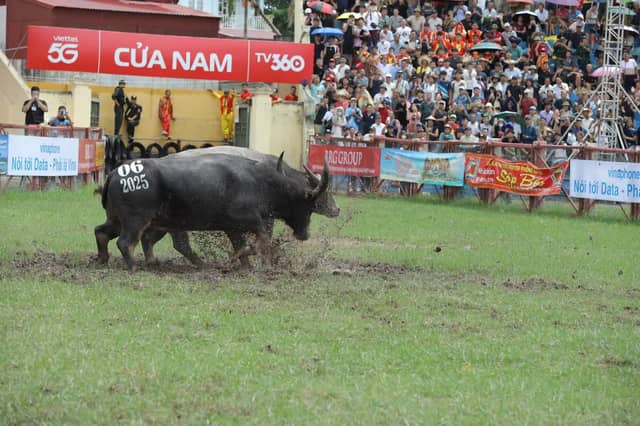
This season differs from the past decade: the festival returns to the full two-round format, a qualifier and a final, as set out in the heritage dossier approved by the Ministry of Culture, Sports and Tourism. The qualifier on the morning of 21 July brought 32 fighting buffalo (“ông trâu”, “mister buffalo”) into 16 bouts and drew more than 10,000 spectators; the opening bout — buffalo No. 16, owned by Đinh Đình Phú, the 91-year-old whose animal took the 2025 title, against No. 24 of Phí Văn Hiền — ran for over twenty minutes.
At a glance:
The festival grew out of the cult of Điểm Tước Đại Vương, the tutelary deity worshipped at đền Nghè, whom Đồ Sơn fishermen credit with protecting them at sea. The imperial gazetteer Đại Nam nhất thống chí records a shrine to the water deity at the foot of the Đồ Sơn hills and a traveller who saw two buffalo fighting below it — after which, the entry says, the villagers held a buffalo contest as an offering every ninth day of the eighth lunar month. A rhyme still repeated locally translates roughly as: “wherever you trade, wherever you sell, come home for the buffalo fight on the ninth of the eighth”. The festival was revived in 1990; this is the 37th year since.
Getting one animal to the arena takes close to a year. After Tết, owners travel to Thanh Hóa, Nghệ An, Nam Định, Thái Bình, sometimes as far as Tuyên Quang and Bắc Kạn, to find a bull that matches the traditional criteria: broad chest, thick flat back, jet-black horns curving up like two bows, dark eyes with a red iris. Champions usually weigh over a tonne. Before the season every animal passes repeated checks of condition and skill, and any showing unsafe behaviour is struck off. This year owners must cap the horn tips during handling and transport, train well away from residential areas and keep children and the elderly off the training ground; the stadium has been reinforced with concrete barriers, B40 mesh, buffalo exit gates and emergency exits.
One thing is worth knowing in advance, because photographs do not show it: this is a sacrificial rite, not a sport. A bout ends when one animal turns and runs. On the morning after the main day every buffalo that took part is slaughtered and offered at the communal houses; a dish of blood and hair is poured into the sea and the rest is shared among the community as a blessing. Meat is also sold on site — recent seasons have been reported at 3–5 million VND per kilo. Knowing that beforehand is the fairest way for you to decide whether this is an event you want to attend.
It rewards anyone interested in the religious life of Vietnam's fishing communities, and the families of Đồ Sơn treat it as a matter of village honour rather than entertainment. If the ceremony interests you more than the bouts, come early: the procession that escorts the buffalo to the arena — banners, drums, gongs, palanquins — and the opening flag dance are the oldest parts of the whole event.
Stadium capacity is limited, so this year the organisers are installing large LED screens outside to ease the crush; in 2025 they issued invitations rather than selling tickets, so check the current arrangements with the Đồ Sơn ward authorities before you travel. Around the festival there are OCOP craft and produce stalls, a food fair, folk games and local tourism displays.
Đồ Sơn is roughly twenty kilometres from central Hải Phòng — close enough to make a morning of it and still be back by lunch.
Sân vận động Đồ Sơn
Sân vận động Trung tâm phường Đồ Sơn, TP. Hải Phòng
Thành phố Hải Phòng
400,000 ₫ – 880,000 ₫

Hai Phong City
400,000 ₫ – 950,000 ₫
Quảng trường Trung tâm văn hóa Xứ Đông
Contact organizers
